
Listen to this Post
Introduction:
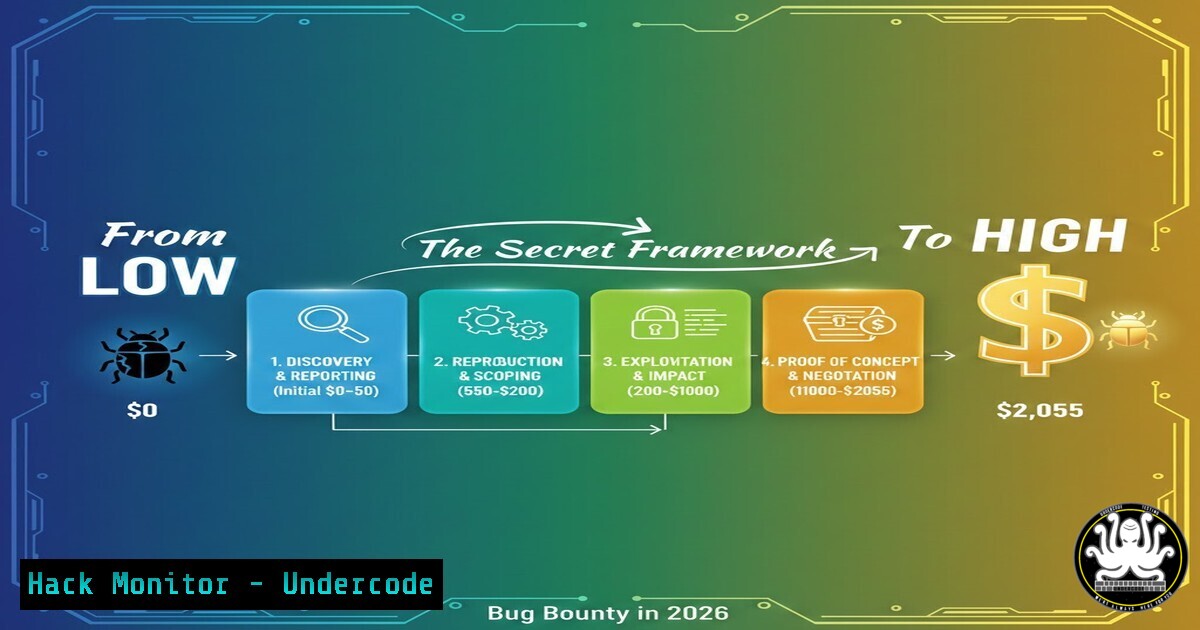
In the competitive realm of bug bounty hunting, initial vulnerability severity ratings are often subjective and contested. This article deconstructs a real-world case where a researcher transformed a “LOW” severity finding into a high-impact, financially rewarded vulnerability through meticulous evidence-based escalation. By leveraging structured security engineering principles over emotional appeals, hunters can systematically influence triage outcomes and maximize their rewards.
Learning Objectives:
- Master the process of escalating bug severity with logical argumentation and technical evidence.
- Learn to calculate and justify CVSS v3.1 scores that accurately reflect business impact.
- Develop skills to craft compelling bug reports that educate triage teams and demonstrate real-world abuse scenarios.
You Should Know:
1. Initial Assessment: Recon and Vulnerability Discovery
Before escalation, you must have a rock-solid, reproducible proof of concept (PoC). The initial finding often stems from thorough reconnaissance and automated testing validated manually.
Step-by-step guide explaining what this does and how to use it:
1. Reconnaissance: Use subdomain enumeration tools. On Linux, run `amass enum -d target.com -o subs.txt` followed by `httpx -l subs.txt -o live_urls.txt` to identify live endpoints.
2. Vulnerability Scanning: Employ targeted scanners. For a web app, use `nikto -h https://target.com` to identify common misconfigurations. Always validate scanner output manually to avoid false positives.
3. Proof of Concept (PoC) Development: Capture the issue with tools like Burp Suite or write a custom script. For instance, if you find an insecure direct object reference (IDOR), document it with curl commands: `curl -H “Authorization: Bearer
- Evidence Collection: Building Your Case with Impact Analysis
Severity escalation hinges on demonstrating tangible impact, such as data exposure, financial loss, or reputational damage.
Step-by-step guide explaining what this does and how to use it: - Map the Attack Surface: Determine what adjacent systems or data are affected. Use `nmap -sV -p-
` to scan for open ports and services that could be chained with the vulnerability. - Document Abuse Scenarios: Create a scenario tree. For example, a low-severity information leak might lead to credential stuffing. Show how with a Python script that tests leaked endpoints:
import requests; for endpoint in leaked_list: r = requests.get(endpoint); if sensitive_data in r.text: print("Vulnerable:", endpoint). - Quantify Implications: Estimate potential financial impact (e.g., cost of a data breach per record) or regulatory fines (e.g., GDPR). Reference industry standards like OWASP’s Risk Rating Methodology.
3. Mastering CVSS v3.1: Scoring Beyond “Vibes”
The Common Vulnerability Scoring System (CVSS) provides an objective metric. Learn to calculate it precisely.
Step-by-step guide explaining what this does and how to use it:
1. Access Vector (AV): Determine if exploitation requires Network (N), Adjacent (A), or Local (L) access. For a web app, it’s typically Network.
2. Attack Complexity (AC): Is exploitation trivial? If it requires special conditions, set it to High (H). Use the CVSS calculator from NVD.
3. User Interaction (UI): Does a user need to take action? For a reflected XSS, it’s Required (R).
4. Scope (S): Does the vulnerability affect components beyond its security scope? If it breaches tenant isolation in a cloud app, set it to Changed (C).
5. Impact Metrics: Assess Confidentiality (C), Integrity (I), and Availability (A) impact. For a bug allowing access to another user’s data, set Confidentiality to High (H). Justify each choice with your PoC.
4. Crafting the Escalation Report: Structured Persuasion
Your report must be a technical document that educates the triage team.
Step-by-step guide explaining what this does and how to use it:
1. Executive Summary: Briefly state the original rating, why it’s incorrect, and the proposed severity.
2. Technical Details: Include the HTTP request/response pairs from your PoC. Use Burp Suite’s “Copy as curl command” feature to provide reproducible steps.
3. CVSS Breakdown: Present your calculated score with justification for each metric. For example: “CVSS:3.1/AV:N/AC:L/PR:N/UI:N/S:C/C:H/I:N/A:N – Score 8.6 (High).”
4. Business Impact: Link the technical flaw to business risks like customer churn or brand degradation. Reference similar cases from HackerOne or Bugcrowd disclosures.
5. Tool Configuration for Effective Bug Hunting
Optimize your toolkit to gather evidence efficiently.
Step-by-step guide explaining what this does and how to use it:
1. Burp Suite Project Settings: Configure project-level settings to log all traffic. Go to Project options > Miscellaneous and enable “Save tool options” and “Log all requests and responses.”
2. Custom Wordlists for Fuzzing: Use `ffuf` for directory fuzzing. Generate targeted wordlists: `cewl https://target.com -w custom_words.txt` then ffuf -w custom_words.txt -u https://target.com/FUZZ -fc 403.
3. Automated Proof-of-Capture: Write a Bash script to document findings. Example:
!/bin/bash
URL=$1
echo "Testing $URL for IDOR..."
for i in {1000..1005}; do
curl -s -H "Cookie: session=valid_session" "$URL/user/$i" | grep -q "SSN" && echo "Vulnerable: $URL/user/$i" >> poc.log
done
6. Cloud Hardening and Misconfiguration Identification
Many bugs stem from cloud service misconfigurations. Learn to identify them.
Step-by-step guide explaining what this does and how to use it:
1. AWS S3 Bucket Checks: Use `aws s3 ls s3://bucket-name –no-sign-request` to test for public list permissions. If successful, the bucket is misconfigured.
2. Azure Storage Recon: Check for public blobs with `az storage blob list –account-name
3. Kubernetes API Security: If you discover a Kubernetes API endpoint, test for unauthenticated access: kubectl --server=https://<ip>:6443 get pods --insecure-skip-tls-verify. Never exploit; report immediately.
7. Post-Escalation: Maintaining Professional Engagement
After submission, engage constructively to ensure resolution.
Step-by-step guide explaining what this does and how to use it:
1. Monitor Communications: Respond promptly to triage queries. Use email filters to prioritize messages from bounty platforms.
2. Provide Additional Context: If asked, supply more details like Wireshark captures (tcpdump -i eth0 -w capture.pcap) or log analysis snippets (grep "ERROR" app.log | head -20).
3. Verify the Fix: Once the vendor patches the issue, retest with your PoC to confirm remediation. Document this for your records and potential bonus rewards.
What Undercode Say:
- Key Takeaway 1: Severity is a negotiable metric grounded in evidence, not a fixed label. Success requires translating technical flaws into business risk language that resonates with both security engineers and executives.
- Key Takeaway 2: Bug bounty hunting is a discipline of security engineering and structured communication. The highest rewards go to those who can articulate the “why” behind the exploit, educating triage teams through detailed scenarios and standardized scoring systems.
The case study underscores a shift in the bug bounty ecosystem: platforms and companies are increasingly responsive to well-reasoned arguments, but the burden of proof rests entirely on the researcher. This elevates the role from mere vulnerability finder to security consultant, where analytical depth and persuasive documentation are as critical as the initial discovery. The researcher’s avoidance of emotional reaction and focus on factual escalation exemplifies the professional mindset required to thrive in 2026’s competitive landscape.
Prediction:
This incident foreshadows a future where bug bounty programs will increasingly integrate AI-assisted triage systems that initially assess severity based on historical data. However, as demonstrated, human-driven contextual analysis and impact reasoning will remain irreplaceable for complex escalations. We predict a rise in platforms offering “escalation arbitration” features and standardized impact simulation tools to bridge the gap between automated scoring and real-world business consequences. Consequently, researchers who master this evidence-based persuasion framework will see higher success rates and bounties, while programs that fail to adapt may face researcher attrition and missed critical vulnerabilities.
▶️ Related Video (72% Match):
🎯Let’s Practice For Free:
IT/Security Reporter URL:
Reported By: Og Vedant – Hackers Feeds
Extra Hub: Undercode MoN
Basic Verification: Pass ✅


