
Listen to this Post
Introduction:
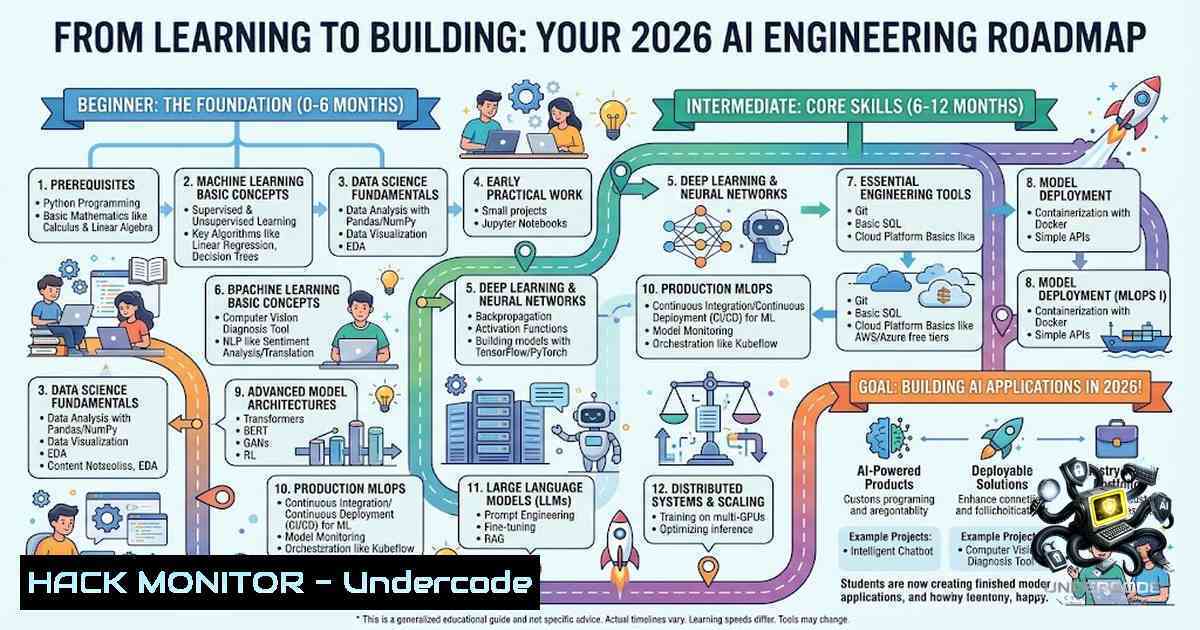
The artificial intelligence landscape has fundamentally shifted from an era of theoretical knowledge to one of practical, deployable engineering. The industry’s demand has moved past the ability to explain transformer architecture; the new premium is on the capacity to build, deploy, and scale autonomous systems that solve tangible business problems. This transition—from student to industry professional—is no longer defined by coursework but by the ability to bridge the gap between learning and doing, a gap that is now being closed by hands-on innovation cells and intensive prototyping.
Learning Objectives & Secrets:
- Objective 1: Master Agentic AI Workflows – Go beyond simple prediction models and learn to build autonomous agents capable of executing multi-step tasks, using frameworks like LangChain and AutoGen to orchestrate complex decision-making processes without human intervention.
- Objective 2 Secret Tips: Optimize AI-Assisted Coding – Leverage LLMs not as simple autocomplete tools, but as architectural partners. Secret: Use “Chain of Thought” prompting to break down complex software requirements into modular components before writing a single line of code, effectively using the LLM as a system architect to generate boilerplate and business logic at 10x speed.
- Objective 3 Secret Tips: Secure Generative AI Products – Moving from prompting to engineering AI products requires a shift in security mindset. Secret: Implement “Prompt Injection” testing as a standard part of your CI/CD pipeline, treating your AI model’s input layer as a primary attack vector, and utilize output sanitization to prevent data leakage.
You Should Know:
- Building Your First Agentic AI System with LangChain
The core of modern AI engineering is the ability to create agents that can reason and act. A standard agent uses a large language model as its “brain” and tools (like web search, calculators, or APIs) as its “hands.” To set up a basic agentic loop in Python, you will need to install the necessary libraries and connect to an LLM provider. Start by creating a virtual environment and installing LangChain and its community integrations. The following commands establish the foundation for a ReAct (Reason + Act) agent, which can dynamically decide which tools to use based on user input.Linux/macOS python3 -m venv ai_agent_env source ai_agent_env/bin/activate pip install langchain langchain-openai python-dotenv
For Windows, the activation command differs, but the core logic remains the same. Create a `.env` file with your
OPENAI_API_KEY. The agent’s code involves defining a prompt template and binding the tools to the model. This setup allows the agent to perform a chain of thought, iteratively deciding if it has enough information to answer or if it needs to execute another function call. This architecture is the bedrock of modern AI applications, from personal assistants to automated research analysts. -
Leveraging AI for Rapid Code Generation and Refactoring
AI-assisted coding is not just about writing new code; it is a powerful tool for refactoring legacy systems and unit testing. Using an LLM to generate unit tests for a complex function ensures that you catch regressions before they hit production. The secret to effective AI code generation lies in providing the model with rich context, such as the function’s intended behavior and potential edge cases. For instance, to generate Python unit tests usingpytest, you can prompt the model with the function signature and a description of its purpose. The generated tests can be executed directly. This process not only speeds up development but also enforces a discipline of test-driven development, where the AI helps write the tests first.Example of AI-generated test structure import pytest from my_app import complex_function</p></li> </ol> <p>def test_complex_function_normal_case(): assert complex_function(5) == 25 def test_complex_function_edge_case(): with pytest.raises(ValueError): complex_function(-1)
This workflow transforms the developer’s role from a writer of code to an orchestrator of AI-driven development, ensuring higher code quality and consistency.
3. Hardening API Security in AI-Driven Cloud Deployments
When you deploy an AI model as a service via an API, the security perimeter expands significantly. The primary threat is data exfiltration via prompt injection, where an attacker manipulates the input to leak sensitive system prompts or training data. To mitigate this, implement a strict input validation layer that sanitizes and parses user inputs before they reach the model. Additionally, use rate limiting to prevent denial-of-service attacks and implement robust authentication using API keys or OAuth. The following Linux command can be used to set up a basic rate-limiting rule using `iptables` or to configure an Nginx reverse proxy to limit requests per minute, protecting your AI endpoint from brute-force abuse.
 Linux - Nginx rate limiting configuration for AI endpoint
sudo nano /etc/nginx/nginx.conf
 Add to http block:
limit_req_zone $binary_remote_addr zone=ai_api:10m rate=5r/m;
 Add to location block for your API:
limit_req zone=ai_api burst=10 nodelay;
This proactive approach secures your AI product from the outset, ensuring that the “build” phase includes resilient security practices.
4. Continuous Experimentation and High-Intensity Hackathons
The transition from learning to building is accelerated through high-pressure environments like hackathons. These events force teams to apply theoretical knowledge to create a functional prototype within a constrained timeframe. The step-by-step guide for a successful hackathon involves: (1) Rapid ideation focusing on a specific, solvable problem; (2) Building a Minimum Viable Product (MVP) using pre-trained models and existing APIs; (3) Continuous integration of feedback through iterative testing; and (4) Showcasing the product with a focus on its business value and technical novelty. The goal is to transform a raw concept into a demonstrable prototype, which serves as a portfolio piece and a bridge to industry readiness.
- The Art of AI Product Development and Showcasing
Mastering AI product development is about understanding the entire lifecycle, from data ingestion and model training to deployment and monitoring. This involves setting up robust MLOps pipelines. For example, using Docker to containerize your AI application ensures consistency across development and production environments. The following Docker commands illustrate how to build and run a containerized AI application, making it portable and scalable.Create a Dockerfile for your AI application FROM python:3.9-slim WORKDIR /app COPY requirements.txt . RUN pip install --1o-cache-dir -r requirements.txt COPY . . CMD ["uvicorn", "main:app", "--host", "0.0.0.0", "--port", "8000"]
By containerizing the application, you enable seamless deployment on any cloud provider, ensuring that your prototype can be showcased as a reliable, industry-standard solution.
-
Advanced Vulnerability Exploitation and Mitigation in AI Systems
Beyond prompt injection, AI systems face threats like model inversion and adversarial attacks. To mitigate these, implement differential privacy during training and apply adversarial training techniques. For active monitoring, use logging and observability tools to detect unusual patterns. The Linux command `tail -f` can be used to watch logs in real-time for anomalies, while more sophisticated solutions involve integrating with SIEM (Security Information and Event Management) tools. Recognizing and defending against these exploits is what differentiates a security-conscious AI engineer from a casual learner.
What Undercode Say:
- Key Takeaway 1: The core value proposition for emerging AI professionals is shifting from consumption to creation. The “Learn → Build → Experiment” roadmap is not just a sequence but a cyclical process that ingrains practical problem-solving skills necessary for the industry.
- Key Takeaway 2: Hands-on, applied learning through building real products and participating in hackathons is the most effective way to secure an internship and transition into a professional role. This ecosystem fosters not just technical expertise but also a “build and ship” mentality that companies are actively seeking.
- Analysis: The creation of innovation cells and dedicated AI labs within academic institutions is a direct response to the skills gap in the AI industry. These entities function as incubators, compressing years of on-the-job experience into a few months of intense, project-based learning. By focusing on output—prototypes, demos, and hackathon projects—students build a tangible portfolio that speaks louder than transcripts. The emphasis on agentic AI and AI-assisted coding further aligns students with the current direction of enterprise technology, where efficiency and autonomous systems are paramount. Ultimately, this model ensures that graduates are not just job-seekers but job-creators, capable of identifying problems and building solutions from scratch, thereby reducing the onboarding time for employers and accelerating the integration of AI into mainstream business functions.
Prediction:
- +1 The democratization of AI tools will lead to a surge in niche, highly specialized AI agents that can outperform generalist models in specific business domains.
- +1 High-intensity hackathons will evolve into standard recruitment pipelines, with companies sponsoring events to directly scout and vet talent based on real-world performance rather than traditional credentials.
- -1 The rapid transition to AI-assisted coding may reduce the foundational knowledge of basic algorithms among new graduates, creating a reliance on LLMs that could be catastrophic in systems requiring low-level optimization.
- -1 The threat landscape will become more asymmetrical, as the barrier to entry for creating sophisticated deepfakes and automated disinformation campaigns lowers, demanding even more robust defensive AI frameworks.
- -P The implementation of secure MLOps pipelines will become a mandatory specialization, leading to a new cybersecurity role focused exclusively on AI/ML systems security.
▶️ Related Video (90% Match):
https://www.youtube.com/watch?v=1Eq4El-XpTg
🎯Let’s Practice For Free:
🎓 Live Courses & Certifications:
Join Undercode Academy for Verified Certifications
🚀 Request a Custom Project:
Secure, high-velocity infrastructure and disruptive technological engineering. Contact our engineering team for high-tier development and proprietary systems:
[email protected]
💎 Smart Architecture | 🛡️ Secure by Design | ⭐ Trusted by ThousandsIT/Security Reporter URL:
Reported By: https://lnkd.in/p/eCD8nY-6 – Hackers Feeds
Extra Hub: Undercode MoN
Basic Verification: Pass ✅🔐JOIN OUR CYBER WORLD [ CVE News • HackMonitor • UndercodeNews ]
📢 Follow UndercodeTesting & Stay Tuned:
- The Art of AI Product Development and Showcasing


