
Listen to this Post
Introduction:
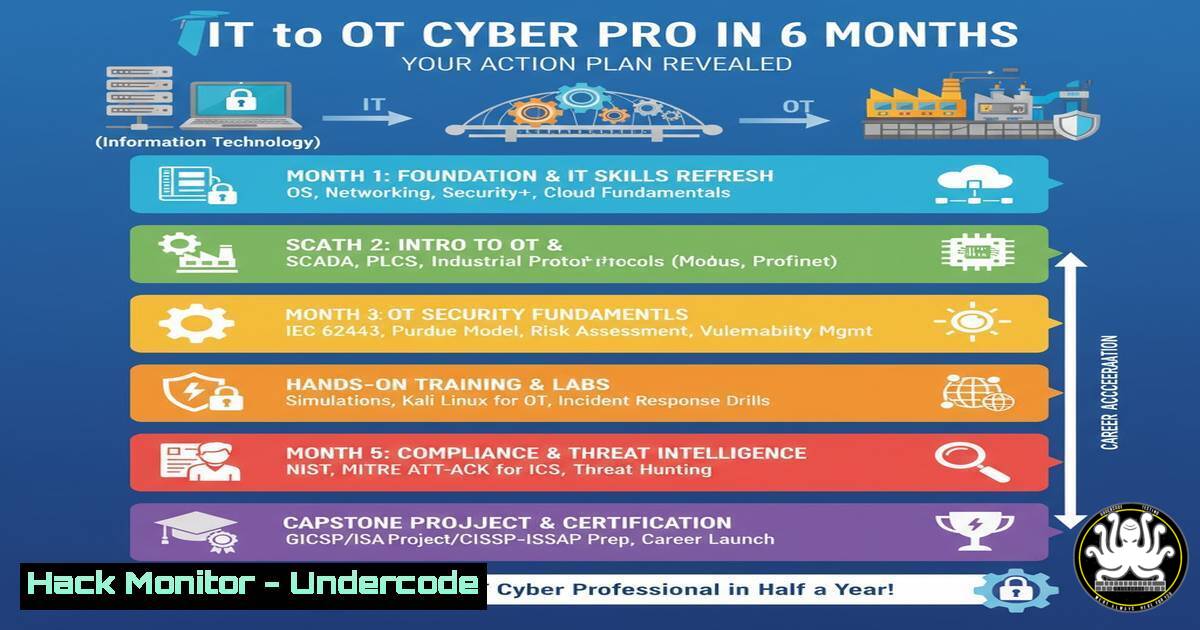
The convergence of Information Technology (IT) and Operational Technology (OT) is reshaping the cybersecurity landscape, creating a high-demand niche for professionals who can bridge the divide. OT environments, which control physical processes in industries like energy, manufacturing, and water, have unique priorities where safety and reliability trump confidentiality. This guide provides a structured, six-month plan for IT security experts to pivot their careers and master the fundamentals of securing critical infrastructure.
Learning Objectives:
- Differentiate core OT concepts, architectures, and protocols from traditional IT systems.
- Develop hands-on skills for OT network monitoring, risk assessment, and secure architecture design.
- Understand OT-specific penetration testing methodologies and red team tactics to enhance defensive postures.
You Should Know:
1. Building Your Home OT/ICS Lab
A virtual lab is crucial for safe, hands-on learning. Using simulated PLCs and HMIs, you can practice without risking real industrial equipment.
Verified Command/Tutorial:
 Using Docker to run a simulated Modbus PLC for testing
docker pull pymodbus:latest
docker run -d -p 5020:5020 --name modbus-plc pymodbus:latest

Using Python to read from a Modbus holding register
from pymodbus.client import ModbusTcpClient
client = ModbusTcpClient('192.168.1.100', port=5020)
result = client.read_holding_registers(address=0, count=10, slave=1)
print(result.registers)
client.close()
Step-by-step guide:
This setup allows you to run a soft PLC on your local machine. The Docker command pulls and runs a Modbus TCP server. The Python script acts as a client to connect to this server and read holding registers, which is a fundamental operation for interacting with PLCs. This is the first step in understanding how industrial devices communicate.
2. Analyzing OT Protocols with Wireshark
Passive network analysis is a cornerstone of OT security. Wireshark, with the right dissectors, can decode proprietary industrial protocols.
Verified Command/Tutorial:
1. Download and install Wireshark.
- Obtain OT protocol dissectors (e.g., for S7comm, DNP3, Modbus).
- Capture traffic on the network interface connected to your lab.
- Apply a Wireshark display filter for a specific protocol:
modbus || s7comm || dnp3
Step-by-step guide:
This filter isolates industrial protocol traffic from general network noise. By analyzing these packets, you can observe read/write commands, device queries, and data exchanges between HMIs and PLCs. Understanding normal traffic is essential for identifying malicious or anomalous activity in a live OT environment.
- Leveraging MITRE ATT&CK for ICS for Threat Modeling
MITRE ATT&CK for ICS is a curated knowledge base of adversary tactics and techniques specific to industrial control systems. It is invaluable for understanding the attack lifecycle in an OT context.
Verified Command/Tutorial:
While not a command, a critical practice is to map findings from your lab or assessments to the MITRE ATT&CK for ICS matrix. For example, if you perform a PLC stop command, you would map it to:
– Tactic: Inhibit Control Function
– Technique: T0805: Denial of Control
Step-by-step guide:
Use the MITRE website to search for techniques. For each technique, study the procedure examples and mitigation recommendations. This process helps transition from seeing an isolated action to understanding its role in a broader attack campaign, thereby improving your threat detection and hunting strategies.
4. Conducting Passive Network Monitoring with Zeek
Zeek (formerly Bro) is a powerful network security monitoring tool that can be configured for passive OT traffic analysis, generating logs for protocol usage and network conversations.
Verified Command/Tutorial:
 Install Zeek on a Linux sensor
sudo apt-get update && sudo apt-get install zeek

Create a basic Zeek script to monitor for Modbus (port 502)
echo '@load policy/protocols/modbus' >> local.zeek

Start Zeek on a network interface
sudo zeek -i eth0 local.zeek
Step-by-step guide:
This setup instructs Zeek to monitor network interface `eth0` and apply the Modbus protocol analyzer. Zeek will generate `modbus.log` files detailing every Modbus transaction. This passive approach is critical in OT environments where active scanning can disrupt operations, providing visibility into network traffic without introducing risk.
5. Active Reconnaissance with Nmap (Where Permitted)
In OT penetration testing, active scanning is highly restricted and often prohibited. However, in a dedicated lab environment, it can be used to learn asset discovery techniques.
Verified Command/Tutorial:
 A simple TCP SYN scan on common IT/OT ports
nmap -sS -p 21,22,80,443,502,102,20000-20100 192.168.1.0/24

A more OT-focused version using service detection
nmap -sS -sC -sV -p 502,102,20000-20100 --script modbus-discover 192.168.1.100
Step-by-step guide:
The first command performs a stealth scan on a range of IPs for common OT and IT ports (e.g., 502 for Modbus, 102 for S7comm). The second command uses Nmap’s scripting engine with the `modbus-discover` script to gently probe a specific target and gather more detailed information. Always ensure you have explicit, written permission before running any active scans.
6. Programming a Simple PLC Attack with Python
Understanding how attackers manipulate PLC logic is key to defending against it. This script demonstrates a simple, malicious write command.
Verified Command/Tutorial:
from pymodbus.client import ModbusTcpClient

client = ModbusTcpClient('192.168.1.50')  Target PLC IP
 Maliciously write a value to a coil to turn off a process
client.write_coil(address=0, value=False, slave=1)
print("Coil at address 0 written to FALSE.")
client.close()
Step-by-step guide:
This Python code connects to a Modbus PLC and writes a `False` (0) value to a coil, which could represent a motor starter or valve actuator. In a real-world scenario (like the TriSIS attack), this could stop a physical process. This demonstrates the direct impact a cyber attack can have on an operational process and underscores the need for output control validation.
7. Cloud Hardening for OT Data Historians
As OT data is increasingly sent to the cloud for analytics, securing these data pipelines is paramount. This involves strict network access controls.
Verified Command/Tutorial (AWS CLI example):
 Configure a security group to only allow inbound traffic from the on-premises OT data diode's IP on a specific port.
aws ec2 authorize-security-group-ingress \
--group-id sg-0a1b2c3d4e5f67890 \
--protocol tcp \
--port 443 \
--cidr 192.168.10.50/32
Step-by-step guide:
This AWS CLI command updates a security group (a virtual firewall) to only permit inbound HTTPS traffic from a single, specific IP address (192.168.10.50), which should be the egress point of your on-premises OT network (like a data diode). This practice of principle of least privilege is critical for reducing the attack surface of cloud-connected OT assets.
What Undercode Say:
- The transition from IT to OT is not just about learning new technology, but adopting a new mindset where availability is king.
- Hands-on lab work is non-negotiable; theoretical knowledge of OT protocols is insufficient without practical application.
The structured six-month plan effectively de-risks the career transition into OT cybersecurity. Its phased approach—moving from foundational concepts to active offensive techniques—mirrors a mature learning path. The critical differentiator for success will be the professional’s ability to internalize the safety-critical nature of OT. A defender in this space isn’t just protecting data; they are safeguarding public safety and environmental integrity. The tools and commands provided are the entry point, but the real skill is understanding the consequence of their use on a physical process.
Prediction:
The skills gap in OT cybersecurity will widen over the next 18-24 months, leading to a premium on professionals who can demonstrate practical, hands-on expertise. As nation-state actors and cybercriminal groups increasingly target critical infrastructure, the lessons from high-profile attacks like Colonial Pipeline will catalyze stricter regulations and larger security budgets. This will force a rapid modernization of OT security postures, creating a surge in demand for the very skills outlined in this plan, making this career pivot not just strategic, but critically necessary for global infrastructure resilience.
🎯Let’s Practice For Free:
IT/Security Reporter URL:
Reported By: Mikeholcomb Want – Hackers Feeds
Extra Hub: Undercode MoN
Basic Verification: Pass ✅


