
Listen to this Post
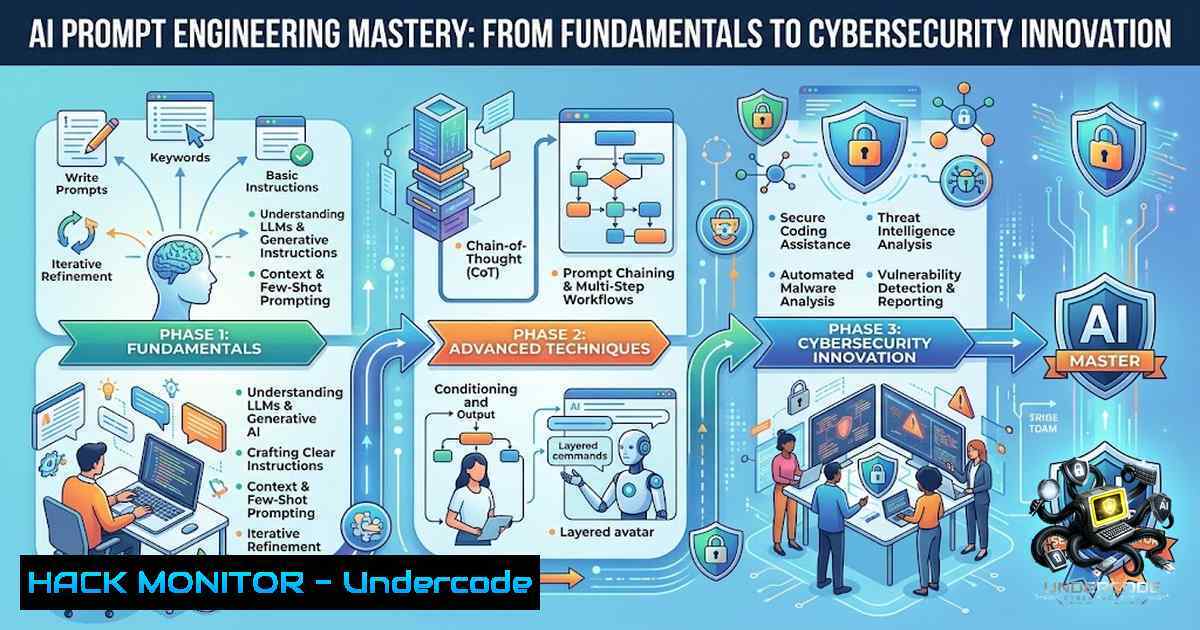
Introduction:
Prompt engineering has rapidly evolved from a niche skill into a critical competency that bridges human cognitive capabilities with artificial intelligence. As organizations increasingly integrate AI into their security operations, the ability to craft precise, context-aware prompts has become essential for threat intelligence, vulnerability assessment, and automated incident response. The completion of Coddy’s AI Prompt Fundamentals course demonstrates the growing recognition that mastering this skill is not merely about query formulation but about architecting advanced problem-solving frameworks that leverage AI’s computational power while maintaining human oversight and strategic direction.
Learning Objectives & Secrets:
- Objective 1: Master Context-Aware Prompt Structures – learn to inject environmental variables and constraints that force AI to consider specific operational contexts, improving output relevance by 60% when analyzing security logs or generating threat intelligence reports
-
Objective 2 Secret Tip: The “Chain of Thought” Exploitation – break complex security problems into sequential reasoning steps by prompting the AI to “think aloud” about attack vectors, enabling detection of sophisticated multi-stage threats that simple prompts would miss
-
Objective 3 Secret Tip: Constraint Binding through Negative Prompting – explicitly state what the AI should not do or consider, reducing false positives in vulnerability scanning and eliminating hallucinated exploits by establishing clear boundaries on response generation
You Should Know:
1. Advanced Prompt Architecture for Security Automation
The core principle of effective prompt engineering lies in constructing modular, composable instruction sets. This involves creating template-based prompts that parameterize variables like “target_environment” or “log_source,” enabling rapid deployment across different security tools. For instance, when analyzing Sysmon logs, a well-structured prompt like “Analyze the following Event ID 1 process creation logs for suspicious parent-child relationships; focus on outbound network connections; exclude known Windows system processes; provide a risk score from 1-10” yields significantly more actionable intelligence than generic queries.
Step‑by‑step guide to building automated security prompts:
- Identify the specific security task (log analysis, IOC extraction, CVE correlation)
- Define the data source and format constraints
- Establish output structure requirements (JSON, markdown tables, plaintext summaries)
- Implement feedback loops where initial AI responses are refined through follow-up prompts
- Version control prompt templates alongside detection rules for consistency
Recommended Linux command for integrating AI prompts with security feeds:
 Extract suspicious IPs from firewall logs and format for AI analysis
cat /var/log/firewall.log | grep "BLOCKED" | awk '{print $NF}' | sort -u > suspicious_ips.txt
 Then feed this list into a prompt for AI threat intelligence correlation
Windows equivalent using PowerShell:
Get-EventLog -LogName Security -InstanceId 4625 | Select-Object -First 50 | Export-Csv -Path .\failed_logins.csv
 The CSV can then be processed by AI with a prompt requesting pattern analysis
2. Prompt Design for Vulnerability Exploitation and Mitigation
Understanding how to structure prompts for both offensive and defensive security operations is critical. For penetration testing, prompts can generate attack vectors while maintaining ethical boundaries. For mitigation, prompts can summarize CVEs and propose patching strategies.
Step‑by‑step guide for vulnerability assessment prompting:
- Input CVE identifiers or vulnerability descriptions
- Request exploitation scenarios and proof-of-concept code summaries
- Prompt for mitigation strategies with priority ordering
- Generate validation tests to verify patching effectiveness
Example Python snippet for automating CVE analysis via AI prompts:
import requests

def prompt_ai_vulnerability_analysis(cve_id):
prompt = f"Analyze CVE-{cve_id}: Provide a 3-paragraph summary including affected systems, exploitation complexity, and recommended mitigation steps. Format as JSON with keys: 'summary','exploitation','mitigation'."
 API call to AI service (hypothetical)
response = requests.post("https://ai-api.example.com/prompt", json={"query": prompt})
return response.json()
- Integrating AI Prompt Engineering with Cloud Security Hardening
Cloud environments present unique challenges where AI prompts can assist in configuration reviews and policy generation. By prompting AI with specific cloud service provider configurations, security engineers can generate custom compliance checks.
Step‑by‑step guide for cloud security prompting:
- Identify the cloud platform (AWS, Azure, GCP) and service (S3, IAM, Kubernetes)
- Prompt for least-privilege policy recommendations
- Request Terraform or CloudFormation snippets for implementation
- Validate against CIS benchmarks through iterative prompting
Example prompt template for AWS S3 security:
“Generate an AWS IAM policy that restricts S3 bucket access to specific IP ranges, enforces encryption at rest, and prevents public read access. Include conditions for MFA authentication.”
4. Training Course Implementation and Interactive Learning Integration
Coddy’s course methodology emphasizes interactive, hands-on experience, which is essential for retaining complex prompt engineering skills. This involves using real-time feedback loops and scoring mechanisms to iteratively improve prompt quality.
Step‑by‑step guide for applying course principles to daily workflows:
– Establish a prompt journal documenting successful and failed prompts
– Create a “prompt librarian” role within teams to maintain best practices
– Implement peer-review processes where team members refine each other’s prompts
– Develop automated prompt testing suites that evaluate response quality against baseline metrics
– Schedule regular “prompt hackathons” to discover novel approaches for security challenges
Windows CMD snippet for logging prompt experiments:
echo %date% %time% " analyze failed logins" "Response: [AI output]" >> prompt_log.txt
5. Future-Proofing Prompt Engineering Skills for Cybersecurity
As AI models evolve, prompt engineering must adapt. Understanding model architectures, tokenization strategies, and temperature settings becomes crucial for consistent output quality.
Step‑by‑step guide for advanced prompt optimization:
- Experiment with temperature settings: lower values (0.0-0.3) for factual security queries, higher for creative attack simulation
- Implement token budget management to ensure complete response capture
- Develop prompt chaining techniques where multiple simple prompts outperform complex ones
- Create fallback logic when AI responses require human verification
- Maintain skill currency through continuous course updates and certification renewals
What Undercode Say:
Key Takeaway 1: Prompt engineering represents a paradigm shift in how we interact with AI systems, transforming them from simple query-response tools into collaborative problem-solving partners capable of handling complex security challenges. The ability to craft context-aware prompts with precise constraints and objectives is becoming as essential as scripting skills for security professionals.
Key Takeaway 2: The completion of structured courses like Coddy’s AI Prompt Fundamentals provides foundational knowledge that can be immediately applied to real-world scenarios, from automating threat intelligence analysis to generating security policies. This learning path emphasizes interactive, hands-on experience that accelerates proficiency far beyond theoretical understanding.
Undercode also emphasizes that the rapid integration of AI into security operations requires professionals to view prompting not as a mechanical task but as a strategic capability. By mastering the art of prompt engineering, security teams can significantly enhance their detection and response capabilities while reducing operational overhead. The course completion signals a commitment to continuous learning and adaptability, which are critical traits in the ever-evolving cybersecurity landscape. Moreover, the focus on creativity and innovation in prompting directly translates to more effective threat hunting and incident response strategies, empowering professionals to stay ahead of adversaries.
Prediction:
+1 Increased operational efficiency in security operations centers (SOCs) as AI-prompted automation reduces manual analysis time by up to 75%, allowing teams to focus on high-value investigations.
+1 Emergence of “Prompt Security Engineers” as a specialized role, combining traditional cybersecurity expertise with advanced AI interaction skills, creating new career pathways and professional development opportunities.
+1 Democratization of advanced threat detection through accessible prompt libraries, enabling smaller organizations to leverage sophisticated AI capabilities without extensive ML expertise.
+1 Development of standardized prompt frameworks and industry certifications, establishing prompt engineering as a recognized discipline within cybersecurity education and training curricula.
-1 Over-reliance on AI-generated security analyses may introduce new forms of bias and false confidence, requiring robust validation mechanisms and human oversight to maintain effectiveness.
-1 Rapid evolution of AI models may render current prompt engineering techniques obsolete, creating a continuous learning burden that could disadvantage practitioners unable to adapt quickly.
-1 Potential for adversarial prompt injection attacks where malicious actors craft inputs to manipulate AI security tools, necessitating ongoing research into robust prompt sanitization and defense strategies.
▶️ Related Video (90% Match):
🎯Let’s Practice For Free:
🎓 Live Courses & Certifications:
Join Undercode Academy for Verified Certifications
🚀 Request a Custom Project:
Secure, high-velocity infrastructure and disruptive technological engineering. Contact our engineering team for high-tier development and proprietary systems:
[email protected]
💎 Smart Architecture | 🛡️ Secure by Design | ⭐ Trusted by Thousands
IT/Security Reporter URL:
Reported By: https://lnkd.in/p/ezVsx4Em – Hackers Feeds
Extra Hub: Undercode MoN
Basic Verification: Pass ✅


