
Listen to this Post
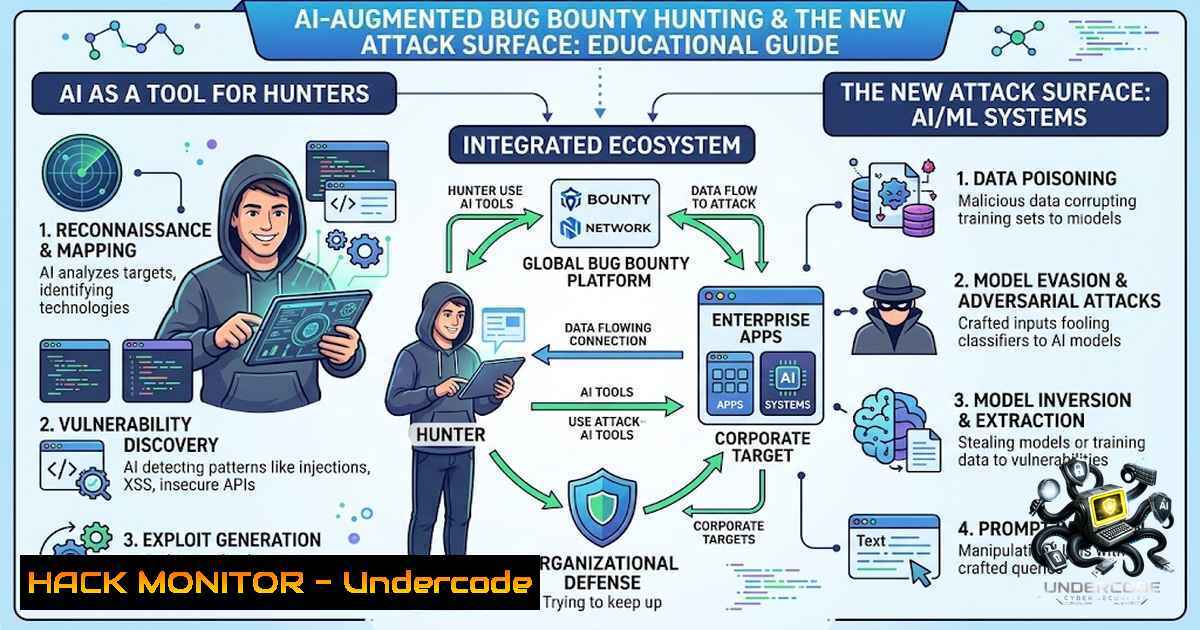
Introduction:
The integration of artificial intelligence into cybersecurity is revolutionizing vulnerability discovery, shifting the paradigm from purely manual code review to AI-assisted reconnaissance and exploitation. While AI tools can rapidly parse source code, automate endpoint fuzzing, and correlate vast datasets of known exploits, the fundamental gap remains in contextual judgment, business logic abuse, and zero-day creativity. This article explores how modern bug bounty hunters are evolving into “AI co-pilots,” leveraging machine learning for repetitive tasks while retaining the human intuition necessary to chain vulnerabilities into critical impact chains.
Learning Objectives & Secrets:
- Objective 1: Mastering AI-Assisted Code Analysis – Learn to configure static application security testing (SAST) tools like Semgrep or CodeQL augmented with large language models (LLMs) to reduce false positives and highlight tainted data flows across microservices.
-
Objective 2 Secret Tips: Prompt Engineering for Parameter Fuzzing – Craft specific prompts to generate targeted fuzzing dictionaries based on API documentation, reducing payload generation time by over 60% while increasing coverage of edge-case inputs that traditional fuzzers miss.
-
Objective 3 Secret Tips: Hybrid Reconnaissance Workflows – Combine AI-driven subdomain enumeration (e.g., using `chaos` or
shuffledns) with AI anomaly detection to identify deviation in HTTP response headers, quickly pinpointing outdated frameworks or misconfigured cloud storage buckets.
You Should Know:
- AI-Assisted Static Code Review with Semgrep and LLMs
Modern bug bounty programs often provide source code access. Running a standard SAST tool generates hundreds of warnings, most being noise. By integrating an AI model via API, you can filter findings based on business logic context.
Step‑by‑step guide:
- Linux/Mac: Install Semgrep via `python3 -m pip install semgrep` and run a baseline scan:
semgrep --config=p/owasp-top-ten ./src --json > raw_findings.json. - Windows (WSL): Use `wsl –install` then follow the Linux steps inside the Ubuntu terminal.
- Use a Python script to parse `raw_findings.json` and send each finding to an LLM with a prompt: “Is this SQL injection valid given that user input is sanitized by an ORM?”
- Save the LLM’s reasoning alongside the finding to create a prioritized report (
report_prioritized.md). - Command: `cat raw_findings.json | jq ‘.results[] | .check_id’` to quickly list all alert types before filtering.
2. Automated API Endpoint Fuzzing with AI-Generated Payloads
APIs are the largest attack surface in modern web applications. Traditional wordlists (SecLists) are static; AI can generate dynamic payloads based on parameter names and data types.
Step‑by‑step guide:
- Extract API endpoints using `katana` or
gospider:gospider -s https://target.com -o output.txt. - Analyze `output.txt` to identify parameters (e.g.,
user_id,file_name). - Feed these parameter names to an AI with the prompt: “Generate 50 edge-case payloads for a `file_name` parameter including path traversal, null bytes, and long strings.”
- Load the generated list into `ffuf` for fuzzing:
ffuf -u https://target.com/api/upload -w generated_payloads.txt -H "Content-Type: multipart/form-data" -X POST -d "file_name=FUZZ". - Windows PowerShell: Use `Invoke-WebRequest` with a loop to test each payload, monitoring response times for potential injection points.
3. Cloud Infrastructure Hardening & Misconfiguration Detection
AI tools excel at reading complex Infrastructure-as-Code (IaC) files like Terraform or CloudFormation. Detecting publicly exposed S3 buckets or overly permissive IAM roles can be automated.
Step‑by‑step guide:
- Use `checkov` to scan Terraform directories:
checkov -d ./terraform/. - Pipe the results to an AI for remediation: “Given this S3 bucket policy, rewrite it to adhere to the principle of least privilege while allowing CloudFront access.”
- For live cloud environments, use `aws s3api list-buckets` to enumerate buckets, then `aws s3api get-bucket-acl –bucket
` to check public access. - Pro Tip: Configure `aws configure` with your credentials and use `prowler` for a comprehensive cloud security audit:
prowler aws -M html.
- Exploiting Business Logic Flaws via AI Workflow Modeling
AI can map out user workflows (e.g., signup → purchase → refund) and generate state-transition diagrams. This helps identify race conditions and price manipulation vulnerabilities that static scanners miss.
Step‑by‑step guide:
- Record HTTP traffic using Burp Suite and export the history as XML.
- Write a script that extracts the sequence of requests and sends it to an AI to model the state machine.
- Ask the AI: “Identify which transitions lack idempotency keys or atomic checks.”
- Manually craft a concurrent request script using `parallel` in Bash: `parallel -j 50 ‘curl -X POST https://target.com/checkout -d “item=1&qty={}”‘ ::: {1..100}` to test race conditions.
- Windows: Use `start-job` in PowerShell to execute multiple concurrent `Invoke-RestMethod` calls.
- Mitigation: WAF Evasion and Bypass Techniques with AI
When a vulnerability is found, the next hurdle is often the Web Application Firewall (WAF). AI can analyze blocked payloads and suggest variants.
Step‑by‑step guide:
- Collect blocked responses (status code 403) from your fuzzing output.
- Feed the original payload and the server response to an AI with the prompt: “Suggest 10 SQLi variants that avoid keyword detection using commenting or case-swapping.”
- Test the variants manually using
curl -v -H "User-Agent: Mozilla" -X GET "https://target.com/search?q=PAYLOAD". - Command: `for payload in $(cat ai_bypass_list.txt); do curl -s -o /dev/null -w “%{http_code}” “https://target.com/search?q=$payload”; done` to quickly identify which variant returns a 200 OK.
6. API Security: JWT and OAuth 2.0 Weaknesses
AI can decode and analyze JSON Web Tokens (JWTs) to check for `alg:none` or weak secrets.
Step‑by‑step guide:
- Use `jwt_tool` to analyze the token:
python3 jwt_tool.py <JWT> -t. - If weak secret suspected, use `hashcat` to crack:
hashcat -a 0 -m 16500 jwt.txt rockyou.txt. - Configure AI to generate custom wordlists based on the application metadata (e.g., company name, founder names).
- Windows: Use `john` or `hashcat` via WSL; ensure `–force` is used if no OpenCL drivers are present.
7. Vulnerability Exploitation & Chaining for Maximum Impact
Single low-severity issues (e.g., reflected XSS, information disclosure) become critical when chained. AI can suggest chains based on available assets.
Step‑by‑step guide:
- Compile a list of all discovered vulnerabilities with their parameters.
- Input the list into an AI with the prompt: “How can an open redirect and a subdomain takeover be combined to achieve account takeover?”
- Follow the AI’s suggested chain: register a taken-over subdomain, host a malicious script, and use the open redirect to point users to the attacker-controlled domain.
- Mitigation: Always implement strict CSP headers and validate redirect URLs against a whitelist.
What Undercode Say:
- Key Takeaway 1: AI is a force multiplier, not a replacement. The most successful bug bounty hunters will be those who can efficiently query AI for pattern recognition while applying heuristic reasoning to dismiss false positives that AI inherently trusts.
- Key Takeaway 2: The democratization of AI coding assistants means that the “barrier to entry” is lowering, but the “barrier to mastery” is rising. Competition will shift from who can write scripts to who can craft the most sophisticated prompt chains to uncover atomic vulnerabilities.
- Analysis: The cybersecurity community is witnessing a bifurcation: script-kiddies with AI will flood triage queues with low-quality reports, while elite researchers will use the same AI to synthesize exploit chains that bypass modern defenses. The critical success factor will be the ability to instrument AI outputs—running shell commands, interpreting stack traces, and validating logic flows manually. Automation will excel at volume, but human cognition remains the only reliable filter for contextual business logic flaws.
Prediction:
- +1: The rise of AI will lead to “AI Bug Bounty Programs” where organizations pay for autonomous agents that run 24/7, increasing the overall security posture of the internet by reducing the time-to-discovery for critical CVEs.
- +1: Bug bounty platforms will introduce specialized leaderboards for “AI-Assisted” hunters, encouraging the development of open-source frameworks that standardize AI integration, making security testing more accessible to developers.
- -1: Entry-level bug bounty hunting will become a commodity; traditional “low-hanging fruit” like reflected XSS and missing security headers will be fully automated, pushing beginners out of the field unless they specialize in niche areas like smart contract auditing or hardware security.
- -1: The reliance on AI for code generation will inadvertently introduce new classes of vulnerabilities—specifically, AI hallucinations that generate syntaxically correct but logically flawed authentication logic, creating a new attack vector where attackers specifically target AI-generated code fragments.
- Overall, the next 24 months will define a new OWASP Top 10 for AI-powered applications, forcing the security industry to adapt its training curricula, penetration testing methodologies, and incident response playbooks.
▶️ Related Video (92% Match):
🎯Let’s Practice For Free:
🎓 Live Courses & Certifications:
Join Undercode Academy for Verified Certifications
🚀 Request a Custom Project:
Secure, high-velocity infrastructure and disruptive technological engineering. Contact our engineering team for high-tier development and proprietary systems:
[email protected]
💎 Smart Architecture | 🛡️ Secure by Design | ⭐ Trusted by Thousands
IT/Security Reporter URL:
Reported By: https://lnkd.in/p/eJjPaS6E – Hackers Feeds
Extra Hub: Undercode MoN
Basic Verification: Pass ✅


