Listen to this Post
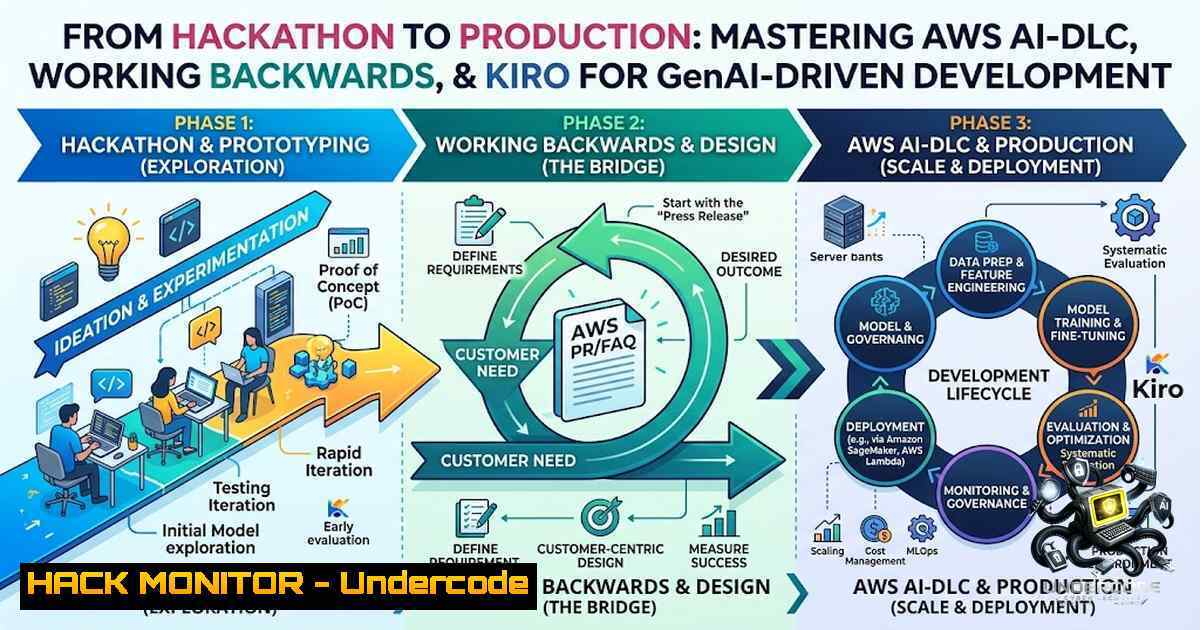
Introduction:
The fusion of Amazon’s Working Backwards methodology with the AI-Driven Development Lifecycle (AI-DLC) and agentic IDEs like Kiro represents a paradigm shift in how software is conceived and built. This approach prioritizes customer problems first, then leverages AI agents to collaboratively plan, implement, and review code through a structured, three-phase workflow. This article distills the core concepts from real-world hackathon experiences at AWS, providing a technical roadmap for integrating these powerful frameworks into your own development practice.
Learning Objectives:
- Understand the principles of Amazon’s Working Backwards methodology and its application in AI-driven hackathons.
- Master the AI-Driven Development Lifecycle (AI-DLC) and its three core phases: Inception, Construction, and Review.
- Gain hands-on proficiency with Kiro, an agentic IDE, for spec-driven development and automated code generation.
- Learn to configure and deploy AI-DLC workflows using AWS services like Amazon Q Developer, Bedrock AgentCore, and the AWS CLI.
You Should Know:
1. The Working Backwards Methodology: Customer-Obsessed Innovation
The Working Backwards process is Amazon’s systematic approach to product development. Its core tenet is to start by defining the customer experience and then iteratively work backwards from that point until the team is clear on what to build. This is primarily executed through the PR/FAQ (Press Release / Frequently Asked Questions) document. The goal is to achieve clarity of thought and ensure a product has a clear reason to exist before any engineering resources are committed.
Step-by-Step Guide to Implementing Working Backwards:
- Start with the Customer: Begin by deeply understanding and concisely defining a significant customer problem or need.
- Write the Press Release: Draft a press release announcing the product as if it were launching today. This forces you to articulate the customer benefit, solution, and key features in a compelling narrative.
- Develop the FAQ: Create a list of frequently asked questions (and their answers) that anticipate customer and internal stakeholder concerns about the product.
- Iterate and Refine: Teams should iterate on the problem statement and proposed solution multiple times, expanding the circle of stakeholders to recognize flaws and opportunities.
- Achieve Clarity: Continue refining until the team achieves clarity on what to build and the value it will add to the customer’s experience.
In the context of the hackathon, participants used this methodology to generate AI use cases before any code was written. This ensures that the development effort, even when accelerated by AI, is always anchored to a real customer need.
- The AI-Driven Development Lifecycle (AI-DLC): A Collaborative Human-AI Workflow
AI-DLC is a platform and methodology where humans and AI agents collaborate on software development through a shared, structured workflow. AWS has open-sourced this workflow, enabling developers to create software using this methodology. It is a significant change from traditional development, strategically assigning routine tasks to AI while maintaining human oversight for critical decisions.
Step-by-Step Guide to the AI-DLC Three-Phase Lifecycle:
The AI-DLC workflow is composed of three distinct phases:
- Phase 1: Inception (What and Why)
- Objective: Define requirements, user stories, and architectural design.
- Process: The AI agent analyzes the request and generates a structured plan. It asks clarifying questions and waits for human approval before proceeding.
- Output: A detailed requirements document, technical design, and a breakdown of tasks.
-
Phase 2: Construction (How)
- Objective: Implement the code based on the approved design.
- Process: An orchestrator dispatches independent tasks to parallel AI agents, each working on its own branch. Tasks with dependencies wait until their prerequisites are complete. All code, requirements, and decisions are linked in a graph database for full traceability.
-
Output: A pull request (PR) from the sprint branch to the main branch with the implemented code.
-
Phase 3: Review (Did it work)
- Objective: Evaluate the code against the original requirements.
- Process: A review agent assesses the code not just for quality, but to ensure it fulfills the requirements defined in the Inception phase. Human approval is required for phase transitions.
Deploying AI-DLC:
AWS provides a managed installer for deploying the AI-DLC platform. The following commands demonstrate the installation process:
 Download and inspect the installer script
curl -fsSLo /tmp/aidlc-install.sh \
https://raw.githubusercontent.com/aws-samples/sample-collaborative-ai-dlc/main/scripts/install.sh
less /tmp/aidlc-install.sh

Run the installer
bash /tmp/aidlc-install.sh install \
--profile <aws-profile> \
--region <aws-region> \
--environment dev \
--admin <administrator-email>
After installation, check the status and retrieve the deployment URL:
bash /tmp/aidlc-install.sh status
Prerequisites:
- Node.js 22+
- Terraform 1.4+
- AWS CLI v2
- Docker (recent stable)
3. Kiro: The Agentic IDE for Spec-Driven Development
Kiro is an agentic IDE and CLI that helps you go from idea to production with spec-driven development. It turns natural language prompts into detailed specifications, which are then transformed into working code, documentation, and tests. Kiro is built on Amazon Bedrock and leverages foundation models from Amazon and third-party AI companies.
Step-by-Step Guide to Using Kiro:
- Installation and Setup: Kiro can be used as an IDE or CLI. It integrates with AWS services and supports the Model Context Protocol (MCP) to connect to documentation, databases, and APIs.
2. Spec-Driven Development:
- Define the Requirement: Use natural language to describe what you want to build. For example: “Build a delivery-focused AI Agent platform that produces images, videos, documents, and web pages from user conversations.”
- Generate Specifications: Kiro automatically generates a structured three-tier specification:
- Requirements Document: Contains user stories, acceptance criteria, and technical constraints.
- Technical Design: Includes database schema, API interface definitions, component architecture, and sequence diagrams.
- Task Breakdown: A list of executable tasks for the AI agents.
- Implementation: Once the specifications are approved, Kiro’s agents handle the coding. The platform uses a three-tier runtime architecture: Strands Agents (Agent framework) + Amazon Bedrock AgentCore (Runtime, memory, and sandbox) + AWS CDK (Infrastructure as Code).
- Deployment: Kiro can deploy the generated application directly to AWS, leveraging services like Amplify for frontend and backend scaffolding.
Kiro Configuration for AI-DLC:
Kiro uses “Steering Files” to guide the AI-DLC workflow within a project. These are typically located in .kiro/steering/aidlc.md. For a project using AI-DLC, you can install the necessary rules:
 Example of extracting AI-DLC rules for Kiro
unzip ~/Downloads/aidlc-rules.zip -d .kiro/steering/
This ensures that the AI-DLC workflow guides the development process in Kiro.
4. AWS GenAI Ecosystem: Services and Security
The hackathon leveraged the broader AWS GenAI ecosystem. Key components include:
- Amazon Bedrock: The core managed service providing access to a wide range of high-performing foundation models (FMs) from leading AI companies through a single, consistent API.
- Amazon Q Developer: A generative AI coding assistant that supports the entire software development lifecycle and integrates with the AI-DLC workflow.
- Amazon SageMaker AI: A managed infrastructure service for building, training, and deploying AI models.
- AWS GovCloud (US): For regulated workloads, Kiro is available in these environments, with private endpoints over VPN or Direct Connect for network isolation.
Security and Compliance Commands:
When working with AWS services, especially in regulated environments, security is paramount. Here are some essential AWS CLI commands for identity and access management:
 Verify your current identity
aws sts get-caller-identity

Configure AWS SSO for secure access
aws configure sso

List S3 buckets to verify permissions
aws s3 ls
For invoking a foundation model via the AWS CLI, the `bedrock-runtime` service is used:
 Invoke Claude model for text generation
aws bedrock-runtime invoke-model \
--model-id anthropic.claude-3-sonnet-20240229-v1:0 \
--body '{"prompt":"Human: Explain the Working Backwards methodology. Assistant:","max_tokens_to_sample":300}' \
--cli-binary-format raw-in-base64-out \
output.json
This command demonstrates how to programmatically interact with GenAI models, which is a foundational skill for building AI-driven applications.
- From Hackathon to Production: Best Practices and Lessons Learned
The two-day hackathon format, which compressed learning, ideation, development, and presentation into a single event, highlights the power of these tools. The key takeaway is the ability to move from a customer problem defined via Working Backwards to a working prototype built with Kiro and AI-DLC in a matter of days.
Step-by-Step Guide to a Hackathon-to-Production Workflow:
- Day 1 – Morning: Customer Discovery & Working Backwards: Define the customer problem and draft the PR/FAQ.
- Day 1 – Afternoon: Inception with AI-DLC: Use Amazon Q Developer or Kiro to create the requirements, design, and task breakdown. Get human approval at each stage.
- Day 2 – Morning: Construction with Kiro: Let the AI agents implement the code in parallel, following the spec-driven development process.
- Day 2 – Afternoon: Review & Demo: Have the review agent check the code against requirements. Prepare a live demo of the working prototype.
- Post-Hackathon: Iterate and Deploy: Use the generated code and infrastructure as a starting point for a production-ready application. Leverage AWS services for scaling, monitoring, and security.
What Undercode Say:
- Key Takeaway 1: The integration of Working Backwards with AI-DLC ensures that AI-driven development is not just about speed, but about building the right thing. Starting with the customer problem prevents the common pitfall of building a technically impressive but commercially irrelevant solution.
-
Key Takeaway 2: Tools like Kiro are democratizing software development. The ability to go from a natural language prompt to a working application with minimal manual coding is transformative. However, human oversight remains critical. The “human-in-the-loop” approvals in AI-DLC are not a bottleneck but a quality gate, ensuring that AI agents stay aligned with the project’s strategic goals.
Prediction:
-
+1 The AI-DLC methodology and tools like Kiro will become standard in enterprise development within the next 2-3 years. The ability to reduce development cycles from months to days will be a significant competitive advantage.
-
+1 The open-sourcing of AI-DLC workflows will foster a vibrant ecosystem of community-driven improvements, making the methodology more robust and applicable to a wider range of use cases.
-
-1 The rapid acceleration of development enabled by these tools will increase the demand for professionals who can effectively manage and oversee AI agents. Skills in prompt engineering, specification writing, and AI governance will become as critical as traditional coding skills.
-
-1 Security and compliance will become even more complex. As seen with Kiro’s expansion to GovCloud, ensuring that AI agents operate within secure and compliant environments will be a major challenge. Organizations must invest in robust security frameworks and monitoring to prevent vulnerabilities introduced by AI-generated code.
-
+1 Hackathons like the one described will evolve from coding competitions into “innovation accelerators,” where cross-functional teams use these AI-driven tools to rapidly prototype and validate new business ideas, fundamentally changing how companies approach R&D.
▶️ Related Video (80% Match):
https://www.youtube.com/watch?v=-KDsJxHTPxg
🎯Let’s Practice For Free:
🎓 Live Courses & Certifications:
Join Undercode Academy for Verified Certifications
🚀 Request a Custom Project:
Secure, high-velocity infrastructure and disruptive technological engineering. Contact our engineering team for high-tier development and proprietary systems:
[email protected]
💎 Smart Architecture | 🛡️ Secure by Design | ⭐ Trusted by Thousands
IT/Security Reporter URL:
Reported By: Balavanitha R – Hackers Feeds
Extra Hub: Undercode MoN
Basic Verification: Pass ✅


