Listen to this Post
Introduction:
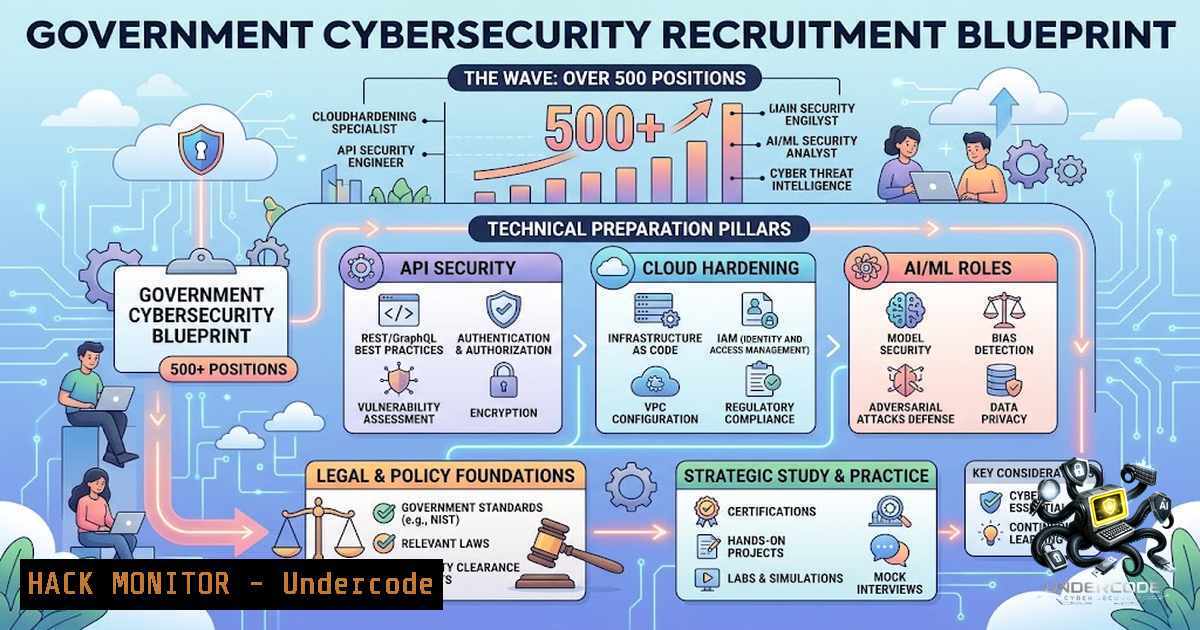
The Indian public sector is undergoing a massive digital transformation, reflected in this week’s surge of over 500 CSE/IT openings across PSUs, government bodies, and defence organizations. Positions span from Junior Programmers at HARTRON to Specialist Officers in API Management, Cloud Administration, DevSecOps, and Cyber Security at Union Bank of India, alongside AI/ML and Data Science roles at CSIR-1AL and defence internships at the Indian Army. This article provides a technical deep-dive into the skills, tools, and preparation strategies required to secure these roles, moving beyond eligibility criteria to the practical, hands-on knowledge demanded by modern government IT infrastructures.
Learning Objectives:
- Master the core technical domains tested in government IT recruitment: C/C++, Java, .NET, Oracle, and Web Technologies.
- Understand the security and cloud administration concepts required for Specialist Officer roles, including API Security, DevSecOps, and Cyber Forensics.
- Acquire practical Linux and Windows command-line skills for system administration, network troubleshooting, and security hardening.
- Develop a step-by-step approach to preparing for CBTs, skill tests, and interviews, including GATE-based exemptions.
You Should Know:
- Linux System Administration & Security Hardening for PSU IT Roles
Many government and defence IT roles, particularly those at HAL, ADA, and DRDO, require familiarity with secure, Unix-like environments. The ability to harden a Linux server, manage users, and monitor logs is crucial.
Step‑by‑step guide: Basic Linux Security Hardening
This guide covers essential commands to secure a fresh Linux installation, a common task for IT executives and system administrators.
- Update the System: Always start with patched software.
sudo apt update && sudo apt upgrade -y  Debian/Ubuntu
sudo yum update -y  RHEL/CentOS
2. Configure a Firewall (UFW): Restrict incoming traffic.
sudo ufw default deny incoming
sudo ufw default allow outgoing
sudo ufw allow ssh
sudo ufw enable
sudo ufw status verbose
- Secure SSH Configuration: Disable root login and password authentication (use keys).
sudo nano /etc/ssh/sshd_config
Set: PermitRootLogin no
Set: PasswordAuthentication no
sudo systemctl restart sshd
-
Audit Open Ports & Services: Identify and disable unnecessary services.
sudo ss -tulpn | grep LISTEN
sudo systemctl list-units --type=service --state=running
5. Implement Fail2ban: Protect against brute-force attacks.
sudo apt install fail2ban -y
sudo systemctl enable fail2ban
sudo systemctl start fail2ban
2. Windows Server & Active Directory Administration
HARTRON’s syllabus explicitly includes Windows Server and ASP .Net. Many PSUs operate hybrid environments, requiring proficiency in Windows Server administration, Group Policy, and PowerShell scripting.
Step‑by‑step guide: Essential Windows Server Commands (PowerShell)
1. Get System Information:
Get-ComputerInfo
Get-WmiObject -Class Win32_OperatingSystem
2. Manage Active Directory Users:
 Create a new user
New-ADUser -1ame "John Doe" -SamAccountName "jdoe" -UserPrincipalName "[email protected]" -Enabled $true
 Unlock a user account
Unlock-ADAccount -Identity "jdoe"
3. Configure Windows Firewall Rules:
 Allow port 8080
New-1etFirewallRule -DisplayName "Allow Port 8080" -Direction Inbound -LocalPort 8080 -Protocol TCP -Action Allow
4. Manage Services Remotely:
Get-Service -ComputerName "Server01" -1ame "Spooler"
- API Security & Cloud Administration (Union Bank of India SO)
Union Bank of India is hiring for Specialist Officers in API Management, Cloud Administration, and DevSecOps. This requires understanding how to secure RESTful APIs and manage cloud resources securely.
Step‑by‑step guide: Securing a REST API with OAuth 2.0 & JWT (Conceptual & Practical)
- Implement Rate Limiting: Prevent brute-force and DDoS attacks.
– Python (Flask): Use `Flask-Limiter` to restrict requests per IP.
from flask_limiter import Limiter
from flask_limiter.util import get_remote_address
limiter = Limiter(app, key_func=get_remote_address, default_limits=["200 per day", "50 per hour"])
- Validate Input: Prevent SQL Injection and XSS. Use parameterized queries.
– Bad: `query = “SELECT FROM users WHERE id = ” + user_id`
– Good: `cursor.execute(“SELECT FROM users WHERE id = %s”, (user_id,))`
3. Use HTTPS (TLS): Encrypt data in transit. Configure a web server (e.g., Nginx) to enforce HTTPS.
server {
listen 443 ssl;
ssl_certificate /etc/ssl/certs/yourcert.crt;
ssl_certificate_key /etc/ssl/private/yourkey.key;
}
4. Implement JWT for Stateless Authentication:
- Generate a token upon login, include user claims, and verify the signature on each request.
- Set short expiration times (
expclaim) and implement refresh tokens.
- Vulnerability Exploitation & Mitigation (Cyber Security & Forensics)
The Cyber Security & Forensic Analysis roles require understanding of common vulnerabilities and mitigation strategies.
Step‑by‑step guide: Identifying and Mitigating Common Web Vulnerabilities
- Cross-Site Scripting (XSS): Test input fields with
<script>alert('XSS')</script>.
– Mitigation: Sanitize output. In Python (Django), use `escape()` or `mark_safe()` with caution. Implement a Content Security Policy (CSP).
- SQL Injection: Test input with
' OR '1'='1.
– Mitigation: Use ORM (Object-Relational Mapping) or parameterized queries.
3. Directory Traversal: Test URLs with `../../etc/passwd`.
- Mitigation: Sanitize file paths and use a whitelist of allowed files.
- Command Injection: Test inputs with
; ls -la.
– Mitigation: Avoid using `system()` or `exec()` with user input. Use language-specific APIs.
- AI/ML & Data Science for CSIR-1AL and Defence Internships
CSIR-1AL is recruiting for AI/ML/Data Science roles, and the Indian Army offers internships in AI, ML, and Data Analytics. These roles require practical data handling and model building skills.
Step‑by‑step guide: Setting up a Python Data Science Environment
1. Install Anaconda or Miniconda:
wget https://repo.anaconda.com/archive/Anaconda3-2024.10-1-Linux-x86_64.sh
bash Anaconda3-2024.10-1-Linux-x86_64.sh
2. Create a Virtual Environment:
conda create -1 ds_env python=3.9
conda activate ds_env
3. Install Core Libraries:
pip install numpy pandas matplotlib seaborn scikit-learn tensorflow jupyter
4. Launch Jupyter Notebook:
jupyter notebook --ip=0.0.0.0 --port=8888 --1o-browser
5. Perform Basic Data Analysis:
import pandas as pd
df = pd.read_csv('data.csv')
print(df.describe())
print(df.isnull().sum())
6. Programming Fundamentals for Written Tests (CBT)
HARTRON and other PSUs test foundational programming skills in C/C++, Java, and .NET.
Step‑by‑step guide: Compiling and Running a Simple C Program in Linux
1. Write the Code:
nano hello.c
include <stdio.h>
int main() {
printf("Hello, PSU!\n");
return 0;
}
2. Compile with GCC:
gcc -o hello hello.c
3. Run the Executable:
./hello
4. Debug with GDB:
gcc -g -o hello_debug hello.c
gdb ./hello_debug
(gdb) break main
(gdb) run
(gdb) next
What Undercode Say:
- Key Takeaway 1: Hybrid Skill Sets are Non-1egotiable. The demand is no longer for pure programmers or pure network admins. Roles like DevSecOps, Cloud Administrator, and API Specialist require a T-shaped skill set combining deep programming knowledge with infrastructure and security expertise.
- Key Takeaway 2: Certification Matters, but Practical Proficiency Wins. While GATE scores can bypass written tests for ADA, the interview and skill test will focus on real-world problem-solving. Candidates must demonstrate hands-on experience with Linux hardening, API security, and cloud platforms, not just theoretical knowledge.
Analysis: This recruitment wave signals a strategic shift in India’s public sector towards modernizing IT infrastructure, particularly in banking (API/Cloud), defence (AI/Cyber), and aerospace (Data Science). The emphasis on cyber security, AI/ML, and cloud roles indicates that future government IT professionals will be expected to secure, scale, and innovate on critical national infrastructure. The sheer volume of vacancies (over 500) combined with the advanced technical requirements suggests a skills gap that the government is aggressively trying to fill, making this an opportune moment for technically proficient candidates to enter the PSU sector.
Prediction:
- +1 The integration of AI/ML and Cyber Security into government internships and entry-level roles will accelerate the modernization of India’s defence and public sector IT, potentially leading to indigenous, secure technology stacks.
- +1 The demand for DevSecOps and API Security professionals in PSU banks will drive a new wave of fintech innovation within the public sector, improving digital banking services for millions.
- -1 The rapid hiring in these advanced domains may outpace the current training infrastructure, leading to a period where new hires require significant on-the-job training, potentially slowing down critical projects initially.
- +1 GATE and other standardized test exemptions for interviews will streamline recruitment, allowing specialized talent to enter the system faster, particularly in research-oriented roles at ADA and DRDO.
- -1 The increasing reliance on cloud and API-based systems in government without a corresponding investment in legacy system modernization could create complex, hybrid environments that are difficult to secure and maintain.
- +1 This recruitment drive will likely spur a surge in specialized certifications (Cloud, Security, AI) among engineering graduates, creating a more competitive and skilled talent pool for the entire Indian IT sector.
▶️ Related Video (68% Match):
🎯Let’s Practice For Free:
🎓 Live Courses & Certifications:
Join Undercode Academy for Verified Certifications
🚀 Request a Custom Project:
Secure, high-velocity infrastructure and disruptive technological engineering. Contact our engineering team for high-tier development and proprietary systems:
[email protected]
💎 Smart Architecture | 🛡️ Secure by Design | ⭐ Trusted by Thousands
IT/Security Reporter URL:
Reported By: Bhawnachelani This – Hackers Feeds
Extra Hub: Undercode MoN
Basic Verification: Pass ✅


