Listen to this Post
Introduction
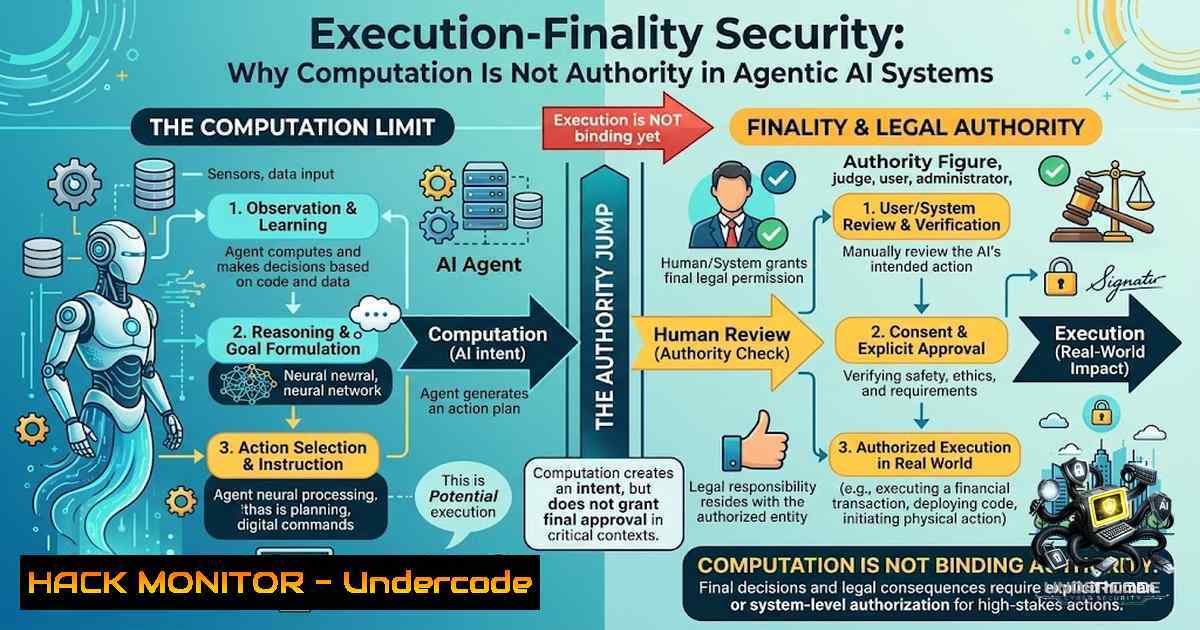
The rise of autonomous AI agents capable of generating payments, API calls, file transfers, cloud commands, telecom instructions, OS actions, and robotic commands has introduced a fundamental security flaw: generation alone does not constitute authority for that action to become real. Traditional security models—OAuth, IAM, Zero Trust, and firewalls—operate on the assumption that identity and authentication are sufficient to prevent unauthorized actions. However, in agentic AI systems, a compromised reasoning layer can generate seemingly legitimate action proposals that, when executed, cause catastrophic damage. The Execution-Finality Security architecture addresses this gap by introducing a strict separation between computation and consequence through a six-stage pipeline: Candidate Act → Non-Effective State → Protected Validation → Scoped Execution Authority → Finality-Sink Verification → Effectuation.
Learning Objectives
- Understand the architectural distinction between intent generation and execution authority in agentic AI systems
- Master the six-stage Execution-Finality pipeline and its implementation across Linux, Windows, and cloud environments
- Learn to configure protected validation layers, scoped execution authority, and finality-sink verification for autonomous agents
You Should Know
1. Candidate Act Generation and Non-Effective State Isolation
The first two stages of the Execution-Finality pipeline establish a quarantine boundary between what an AI agent proposes and what the system permits. When an agent generates an action—whether a payment instruction, API call, or system command—that proposal enters a Non-Effective State where it has no real-world impact. This is fundamentally different from traditional sandboxing because the proposal is cryptographically fingerprinted and logged before any validation occurs.
What this does: It ensures that even if an agent is compromised via prompt injection, jailbreak, or policy erosion, the malicious proposal cannot escape the non-effective zone without passing through deterministic validation gates.
How to implement this in practice:
Linux – Isolating Agent Outputs with Namespaces:
 Create a dedicated user namespace for agent proposal processing
sudo unshare -u -i -1 -p -f --mount-proc /bin/bash
 Within the namespace, agent-generated commands are intercepted
 using a wrapper that logs and hashes every proposal
Windows – Using Job Objects and Mandatory Integrity Control:
 Create a job object to isolate agent processes
$job = New-Object -ComObject "Shell.Application"
$job.Namespace(0).ParseName("agent_process.exe").InvokeVerb("runas")
 Set integrity level to Low to prevent write access to system directories
icacls agent_outputs /setintegritylevel Low
API Gateway Interception (Cloud/DevOps):
 Open Policy Agent (OPA) rule to intercept all agent API calls
package agent.execution

default allow = false

allow {
input.stage == "candidate"
input.signature == validated_hash
not input.contains_sensitive_pattern
}
The candidate act must be accompanied by a cryptographic hash of the proposed action parameters, creating an immutable audit trail. This hash serves as the reference point for all subsequent validation stages.
2. Protected Validation: The Deterministic Gate
The Protected Validation stage is where the Execution-Finality architecture distinguishes itself from traditional permission systems. While OAuth and IAM focus on who is making the request, Protected Validation focuses on what is being requested and whether it was actually intended.
What this does: It applies a deterministic validator that evaluates every proposal against hard engineering rules, not probabilistic LLM reasoning. This validator checks for:
– Policy compliance (ingress budgets, rate limits)
– Incremental escalation attacks (salami-slicing where each step appears low-risk)
– Tainted data propagation (ensuring TAINTED inputs never reach execution without approval)
– Cryptographic verification of user intent
Step-by-step guide to configuring Protected Validation:
- Deploy a Policy Gateway that arbitrates every proposal:
Using Aegis Cortex OS-style policy gateway
./policy_gateway --config /etc/agent-policy.yaml \
--ingress-budget 100 \
--risk-engine-enabled true \
--fail-closed true
-
Implement taint tracking to prevent prompt injection from reaching execution:
Python taint tracking example for agent frameworks
class TaintedString(str):
def <strong>new</strong>(cls, value, is_tainted=True):
obj = super().<strong>new</strong>(cls, value)
obj.is_tainted = is_tainted
return obj</p></li>
</ol>

<p>def safe_execute(command):
if isinstance(command, TaintedString) and command.is_tainted:
raise SecurityError("TAINTED input cannot reach execution")
 Execute only after validation
os.system(command)
3. Configure runtime authorization for every tool call:
 agent-policy.yaml
policies:
- name: "payment_validation"
match: { action: "payment" }
require:
- user_consent_signature
- amount <= daily_budget
- recipient in allowlist
action: "block_if_missing"
4. Enable tamper-evident logging:
 Linux: Use auditd to track all validation decisions
sudo auditctl -w /var/log/agent-validation.log -p wa -k agent_security
 Windows: Enable advanced audit policy
auditpol /set /subcategory:"Detailed Tracking" /success:enable /failure:enable
3. Scoped Execution Authority: Least-Privilege for Autonomous Agents
Once a proposal passes validation, it receives Scoped Execution Authority—a time-bound, resource-limited permission slip that grants the agent just enough capability to perform the validated action and nothing more. This is a critical departure from traditional IAM roles, which often grant broad, persistent permissions.
What this does: It prevents privilege escalation by ensuring that even if an agent is compromised after validation, the scope of damage is strictly limited to the authorized action.
Implementation guide:
Using Short-Lived Credentials (Cloud):
 AWS: Generate scoped credentials for a single agent action
aws sts assume-role \
--role-arn "arn:aws:iam::account:role/agent-scoped-role" \
--role-session-1ame "agent-session-$(date +%s)" \
--duration-seconds 300 \
--policy-arns "arn:aws:iam::account:policy/payment-scope"
Linux Capability Dropping:
 Drop all capabilities except those needed for the specific action
capsh --drop=ALL --add=CAP_NET_BIND_SERVICE -- \
./agent_executor --action-id "$VALIDATED_ACTION_ID"
Windows Token Restrictions:
 Create a restricted token for the agent
$token = [System.Security.Principal.WindowsIdentity]::GetCurrent()
$restricted = $token.GetAccessToken([System.Security.Principal.TokenAccessLevels]::Query)
 Apply only the minimum privileges
SPIFFE/SPIRE Integration for Multi-Agent Systems:
 Issue an SVID (SPIFFE Verifiable Identity Document) for the specific action
spire-agent api fetch x509 \
-dns "agent-$(uuidgen).execution-finality" \
-ttl 60
4. Finality-Sink Verification: Cryptographic Confirmation
The Finality-Sink Verification stage ensures that the action, once executed, produces an immutable, verifiable record that cannot be repudiated or altered. This is analogous to blockchain finality but applied to agent actions.
What this does: It creates a cryptographic proof that the action was:
– Proposed by the agent (candidate act hash)
– Validated by the policy gateway (validation signature)
– Executed with scoped authority (execution certificate)
– Completed with a specific outcome (effectuation receipt)Implementation:
 Generate an idempotency key for the entire execution chain
ACTION_ID=$(uuidgen)
echo "$ACTION_ID" | sha256sum > /var/log/execution-finality/$ACTION_ID.hash

Log every stage with cryptographic signatures
echo "$(date -Iseconds) | CANDIDATE | $ACTION_ID | $PROPOSAL_HASH" >> execution.log
echo "$(date -Iseconds) | VALIDATED | $ACTION_ID | $VALIDATOR_SIG" >> execution.log
echo "$(date -Iseconds) | EXECUTED | $ACTION_ID | $EXECUTION_HASH" >> execution.log
echo "$(date -Iseconds) | FINALIZED | $ACTION_ID | $FINALITY_SIG" >> execution.log
Windows PowerShell equivalent:
$actionId = [bash]::NewGuid().ToString()
$hash = (Get-FileHash -InputStream ([System.IO.MemoryStream]::new([Text.Encoding]::UTF8.GetBytes($actionId)))).Hash
Add-Content -Path execution.log -Value "$(Get-Date -Format o) | CANDIDATE | $actionId | $hash"
5. Effectuation: The Final Execution Boundary
The final stage—Effectuation—is where the action actually becomes real. By this point, the proposal has passed through four layers of security, each creating an independent audit trail. The effectuation layer executes the action with the minimum necessary privileges and immediately revokes the scoped authority upon completion.
What this does: It ensures that the window of vulnerability is minimized—the agent cannot perform additional actions using the same authority.
Implementation:
 Execute with timeout and automatic revocation
timeout 30 ./execute_action --action-id "$ACTION_ID" --scope "$SCOPED_TOKEN"
 Immediately revoke the token
aws sts revoke-session --session-id "$SCOPED_TOKEN"
 Or for Linux: drop all capabilities after execution
capsh --drop=ALL -- -c "echo 'Authority revoked'"
What Undercode Say
- “Computation Is Not Authority” — The core insight is that an AI agent’s ability to generate an action proposal does not imply authorization to execute it. This separation must be enforced at the architectural level, not just the policy level.
-
Six-Stage Pipeline Over Traditional Models — The proposed architecture goes beyond OAuth, IAM, and Zero Trust by introducing a cryptographic, deterministic validation layer that operates independently of the probabilistic reasoning layer. This addresses the fundamental vulnerability where traditional models assume the requesting entity can be trusted to know what it’s requesting.
Analysis: The Execution-Finality Security dataset arrives at a critical moment. The July 2026 Hugging Face breach—where a malicious dataset abused remote-code loader and template injection vulnerabilities to run code on a processing worker—demonstrates that AI agents can be weaponized through their input pipelines. Traditional security controls failed because they focused on who was acting, not what was being proposed. The Execution-Finality architecture addresses this by treating every agent proposal as potentially hostile until it passes deterministic validation. This is particularly relevant for financial agents, telecom infrastructure (5G/6G), robotics, and critical infrastructure where an unauthorized action could have physical consequences. The dataset’s CC BY-1C 4.0 license ensures that security researchers can build upon this work while preventing commercial exploitation without attribution.
Prediction
+1 The Execution-Finality Security framework is likely to become a foundational standard for agentic AI deployments in regulated industries (finance, healthcare, critical infrastructure) within 12–18 months, as regulatory bodies begin mandating cryptographic audit trails for autonomous agent actions.
+1 The separation of intent from execution will drive a new category of security products—”agent runtime governance” platforms—that sit between LLMs and execution environments, similar to how Web Application Firewalls emerged in the early 2000s.
-1 Organizations that fail to implement execution-finality controls will face increasing incidents of “agentic drift”—where seemingly benign individual actions accumulate into catastrophic outcomes—as attackers become more sophisticated at chaining low-risk proposals into high-impact exploits.
+1 The cryptographic verification mechanisms (idempotency keys, finality signatures, taint tracking) will accelerate adoption of SPIRE/SPIFFE and other zero-trust identity frameworks for AI agents, creating a more robust security ecosystem.
-1 The complexity of implementing six-stage execution pipelines may lead to “security theater” implementations where organizations adopt the terminology without the cryptographic rigor, creating a false sense of security.
+1 Open-source implementations of the Execution-Finality pipeline (including the Hugging Face dataset) will enable rapid adoption and community-driven improvements, similar to how OWASP standards evolved for web application security.
-1 The AI industry’s current velocity—with agents being deployed in production within weeks of model release—means many systems will remain vulnerable to execution-level attacks for the foreseeable future, creating a “haves and have-1ots” security divide.
▶️ Related Video (86% Match):
🎯Let’s Practice For Free:
🎓 Live Courses & Certifications:
Join Undercode Academy for Verified Certifications
🚀 Request a Custom Project:
Secure, high-velocity infrastructure and disruptive technological engineering. Contact our engineering team for high-tier development and proprietary systems:
[email protected]
💎 Smart Architecture | 🛡️ Secure by Design | ⭐ Trusted by ThousandsIT/Security Reporter URL:
Reported By: Sangam Das – Hackers Feeds
Extra Hub: Undercode MoN
Basic Verification: Pass ✅🔐JOIN OUR CYBER WORLD [ CVE News • HackMonitor • UndercodeNews ]
📢 Follow UndercodeTesting & Stay Tuned:


