Listen to this Post
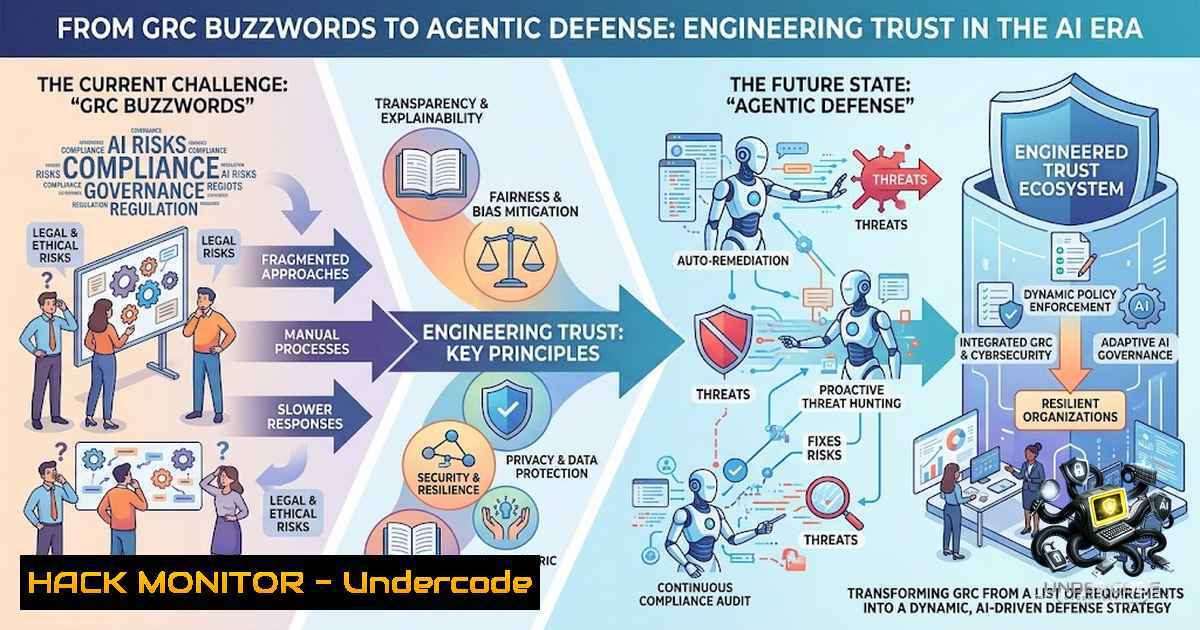
Introduction:
The governance, risk, and compliance (GRC) landscape is undergoing a fundamental transformation. As artificial intelligence permeates every layer of the software stack—from development pipelines to production workloads—traditional security models that treat protection as an afterthought are becoming dangerously obsolete. The recent GRC India AI Conclave 2026, organized by Ampcus Cyber in partnership with the ISACA New Delhi Chapter, brought this reality into sharp focus. Industry leaders convened to dissect how organizations can move beyond generic AI narratives toward actionable frameworks for securing digital identity at scale, embedding security into software architecture from the outset, and leveraging agentic AI to automate penetration testing. This article distills the technical essence of those conversations—extracting verified commands, configuration hardening techniques, and architectural patterns that security practitioners can implement immediately.
Learning Objectives:
- Objective 1: Understand the architectural pillars of Self-Sovereign Identity (SSI) and decentralized data storage, with practical applications in digital public infrastructure.
- Objective 2: Master Secure by Design principles in the AI era, including NIST SSDF integration, OS-level hardening (FreeBSD jails, OpenBSD pledge/unveil), and vulnerability mitigation for widely deployed open-source components like FFmpeg.
- Objective 3: Evaluate agentic AI penetration testing platforms—their architecture, operational workflows, and how they address the gaps in traditional VAPT (Vulnerability Assessment and Penetration Testing) programs.
You Should Know:
- Securing Digital Identity at Scale: The Digi Yatra Architecture
The Digi Yatra initiative represents a paradigm shift in how digital identity can be secured at national scale. Unlike centralized identity repositories that present massive attack surfaces, Digi Yatra is built on the concept of Self-Sovereign Identity (SSI) , where Personally Identifiable Information (PII) never resides in any central repository.
The Digi Yatra Central Ecosystem (DYCE) operates on a decentralized model: all passenger data—including facial biometrics and ID credentials—is encrypted and stored exclusively in the secure wallet of the user’s smartphone. The blockchain layer within DYCE serves a singular, specific purpose: it stores only hash/key values for data integrity verification, not the underlying PII. This design ensures that even if the blockchain were compromised, no sensitive personal information would be exposed.
Critically, the system implements automated data purging mechanisms. Data shared with airport verifiers is deleted from airport systems within 24 hours of flight departure. When a user uninstalls the Digi Yatra app, all credentials and travel history are deleted by default. The entire ecosystem is subject to mandatory CERT-In audits, with the most recent audit confirming that no PII is stored.
For security practitioners designing similar identity systems, this architecture offers several takeaways:
– Decentralized storage eliminates single points of failure for data breaches.
– Blockchain for integrity only (not data storage) provides tamper evidence without privacy risk.
– Time-bound data retention (24-hour purging) minimizes the window of exposure.
– Self-sovereign principles give users ultimate control over their own data.
- Secure by Design in the AI Era: Engineering Trust into Software
The transition from “bolt-on” security to “built-in” security is no longer optional—it is a regulatory and operational imperative. The CIS and SAFECode joint white paper, Secure by Design: A Guide to Assessing Software Security Practices, provides a practical, risk-based framework aligned with the NIST Secure Software Development Framework (SSDF) and CIS Controls.
The guide structures secure software development across six key areas: secure software design, secure development, secure default configuration, supply chain security, code integrity, and vulnerability remediation. For AI-enabled systems, the framework extends to cover emerging risks including prompt injection, model poisoning, and data leakage through inference.
Practical Implementation: OS-Level Hardening
Two operating systems featured prominently in the conclave’s Secure by Design discussions: FreeBSD and OpenBSD, each offering distinct security primitives.
FreeBSD Jails provide lightweight operating-system-level virtualization. A basic jail configuration (/etc/jail.conf):
exec.start = "/bin/sh /etc/rc";
exec.stop = "/bin/sh /etc/rc.shutdown";
exec.consolelog = "/var/log/jail_console_${name}.log";
path = "/usr/jails/${name}";
host.hostname = "${name}";
ip4.addr = 192.168.1.100;
securelevel = 2;
The `securelevel` parameter raises the kernel’s immutable flag and device protection within the jail. For production deployments, consider:
– Setting `allow.set_hostname = 0` to prevent jail escape via hostname manipulation
– Enforcing `enforce_statfs = 1` to restrict filesystem visibility
– Using ZFS datasets with `jail` mountpoints for additional isolation
OpenBSD pledge() and unveil() offer fine-grained process restriction. `pledge()` restricts the system calls a process can make; `unveil()` limits filesystem visibility.
Example for a web application process:
include <unistd.h>

// Allow only stdio, rpath (read), and inet (network)
if (pledge("stdio rpath inet", NULL) == -1) {
perror("pledge");
exit(1);
}

// Restrict filesystem access to /var/www only
if (unveil("/var/www", "r") == -1) {
perror("unveil");
exit(1);
}
// Lock the filesystem view
if (unveil(NULL, NULL) == -1) {
perror("unveil");
exit(1);
}
These primitives enforce least privilege at the syscall level, dramatically reducing the blast radius of any exploit. For containerized environments, Linux’s seccomp and Landlock provide analogous capabilities.
FFmpeg Vulnerability Mitigation
The conclave highlighted FFmpeg as a case study in securing widely deployed open-source components. Recent vulnerabilities—including CVE-2026-8461 (out-of-bounds write in MagicYUV decoder, enabling RCE), CVE-2026-66036 (heap buffer overflow in vf_hqdn3d filter), and CVE-2026-39215 (heap overflow in update_mb_info())—demonstrate the persistent risk posed by media processing libraries.
Practical mitigation strategies:
- Immediate patching: Upgrade to FFmpeg 8.1.2 or later.
2. Containerization with resource limits:
docker run --rm \
--memory="512m" \
--cpus="0.5" \
--security-opt=seccomp=seccomp.json \
--read-only \
--tmpfs /tmp:rw,noexec,nosuid,size=100m \
ffmpeg:hardened -i input.mp4 output.mp4
3. Process isolation: Run FFmpeg in a sandboxed environment with no network access.
4. Disable unnecessary decoders at compile time to reduce attack surface.
- Agentic Pentesting: Mirror and the Future of Continuous Security Testing
Perhaps the most significant technical revelation from the conclave was the launch of Mirror, an autonomous AI-powered penetration testing platform within Ampcus Cyber’s ComplyX portfolio. Mirror represents a fundamental shift from point-in-time, manual penetration testing to continuous, agentic security validation.
Architecture and Capabilities:
Mirror employs an agentic AI architecture—not merely following predefined scripts but actively analyzing environments, identifying attack paths, and adapting based on discoveries. It operates across six attack surfaces simultaneously: web applications, APIs, infrastructure, source code, Android, and iOS. Key capabilities include:
– Autonomous asset discovery across networks, cloud environments, and applications
– Real-time vulnerability identification with exploitability validation
– Attack path chaining—simulating lateral movement, privilege escalation, and data exposure
– Continuous testing triggered by each deployment event
How It Compares to Traditional Pentesting:
| Aspect | Traditional Pentesting | Mirror (Agentic AI) |
|–|-||
| Duration | 2-4 weeks per engagement | Hours per test cycle |
| Coverage | One attack surface at a time | Six surfaces simultaneously |
| Frequency | Annual or quarterly | Continuous, event-triggered |
| Findings | Theoretical vulnerabilities | Exploit-validated attack paths |
| Reporting | Static, point-in-time | Continuous, evidence-backed |
Operational Commands and Integration:
For organizations integrating AI-driven pentesting into their CI/CD pipeline, consider this automated workflow:
 GitHub Actions workflow for continuous pentesting
name: Continuous Security Validation
on:
push:
branches: [bash]
schedule:
- cron: '0 2   '  Daily at 2 AM

jobs:
pentest:
runs-on: ubuntu-latest
steps:
- name: Trigger Mirror Pentest
run: |
curl -X POST https://api.mirror.ampcus.com/v1/scans \
-H "Authorization: Bearer ${{ secrets.MIRROR_API_KEY }}" \
-H "Content-Type: application/json" \
-d '{
"targets": ["${{ env.APP_URL }}", "${{ env.API_ENDPOINT }}"],
"scope": ["web", "api", "infrastructure"],
"continuous": true
}'
- name: Wait for Completion
run: |
while [ "$(curl -s -H "Authorization: Bearer ${{ secrets.MIRROR_API_KEY }}" \
https://api.mirror.ampcus.com/v1/scans/${{ env.SCAN_ID }}/status | jq -r '.status')" != "complete" ]; do
sleep 60
done
- name: Download Report
run: |
curl -o pentest-report.json \
-H "Authorization: Bearer ${{ secrets.MIRROR_API_KEY }}" \
https://api.mirror.ampcus.com/v1/scans/${{ env.SCAN_ID }}/report
- name: Fail on Critical Findings
run: |
if jq -e '.findings | map(select(.severity == "critical")) | length > 0' pentest-report.json; then
echo "Critical vulnerabilities found! Failing build."
exit 1
fi
Compliance Alignment:
Mirror is designed to satisfy the specific penetration testing obligations of SOC 2, ISO 27001, PCI DSS v4.0, and NIS2. Modern compliance auditors no longer accept year-old pentest reports; they demand validated findings, documented attack paths, and remediation evidence. Mirror produces structured, evidence-backed reports that demonstrate not just what was tested, but what was proven about the security posture.
- GRC in the Agentic Era: Beyond Checkbox Compliance
The conclave reinforced that GRC is evolving from a reactive compliance function to a proactive, AI-enabled strategic discipline. The launch of Ampcus Cyber’s ComplyX portfolio—including GRACE (AI-driven GRC automation), Mirror (continuous pentesting), and WIZARD (AI-powered third-party risk management)—signals a broader industry trend toward autonomous governance.
Organizations should consider:
- Automating compliance evidence collection to reduce audit burden
- Continuous risk monitoring rather than periodic assessments
- Integrating security testing into CI/CD pipelines to catch vulnerabilities before production
- Adopting AI-specific security frameworks, including the NIST AI RMF, ISO/IEC 42001, and the CIS AI Security Companion Guides
What Undercode Say:
- Key Takeaway 1: The GRC India AI Conclave 2026 marked a critical inflection point—moving the conversation from generic AI hype to concrete, implementable security architectures. The emphasis on Self-Sovereign Identity, Secure by Design principles, and agentic pentesting reflects a maturation of the industry’s approach to AI governance.
-
Key Takeaway 2: Traditional, periodic security testing is no longer sufficient in an era of continuous deployment and evolving threat landscapes. Agentic AI platforms like Mirror represent not just an incremental improvement but a fundamental rethinking of how organizations validate security—shifting from “did we test?” to “what did testing prove?”
Analysis: The convergence of AI, GRC, and cybersecurity is creating both unprecedented opportunities and novel risks. Organizations that treat security as an architectural property—embedded from design through deployment—will be better positioned to adopt AI confidently. However, the rise of agentic AI in offensive security also raises important governance questions: How do we ensure these autonomous systems operate within ethical boundaries? What safeguards prevent unintended consequences? The industry must develop robust frameworks for AI agent governance, including clear accountability structures, audit trails, and containment mechanisms. The GRC India AI Conclave 2026 demonstrated that these conversations are no longer theoretical—they are the foundation of secure digital transformation.
Prediction:
- +1 Agentic AI penetration testing will become the industry standard within 24-36 months, reducing the average time to identify critical vulnerabilities from weeks to hours. Organizations that adopt continuous, AI-driven testing will experience significantly shorter breach containment times compared to those relying on periodic assessments.
-
+1 Self-Sovereign Identity architectures, inspired by models like Digi Yatra, will proliferate across government and enterprise sectors, dramatically reducing the attack surface associated with centralized identity repositories. This will shift the burden of data protection from centralized providers to individuals, requiring new user education and support models.
-
-1 The democratization of AI-powered offensive security tools will lower the barrier to entry for malicious actors. Just as defenders gain access to agentic pentesting, attackers will deploy similar AI agents to automate vulnerability discovery and exploitation at scale. This asymmetric capability will create a temporary window of heightened risk before defensive AI matures.
-
-1 Without robust governance frameworks for agentic AI systems, organizations risk deploying autonomous security tools that operate outside human oversight, potentially causing unintended damage or violating regulatory requirements. The industry must prioritize the development of standardized AI agent governance models to prevent governance failures that could undermine trust in AI-driven security.
▶️ Related Video (84% Match):
https://www.youtube.com/watch?v=-8eB6MZt_7M
🎯Let’s Practice For Free:
🎓 Live Courses & Certifications:
Join Undercode Academy for Verified Certifications
🚀 Request a Custom Project:
Secure, high-velocity infrastructure and disruptive technological engineering. Contact our engineering team for high-tier development and proprietary systems:
[email protected]
💎 Smart Architecture | 🛡️ Secure by Design | ⭐ Trusted by Thousands
IT/Security Reporter URL:
Reported By: Adityagaur008 Grc – Hackers Feeds
Extra Hub: Undercode MoN
Basic Verification: Pass ✅


