Listen to this Post
Introduction:
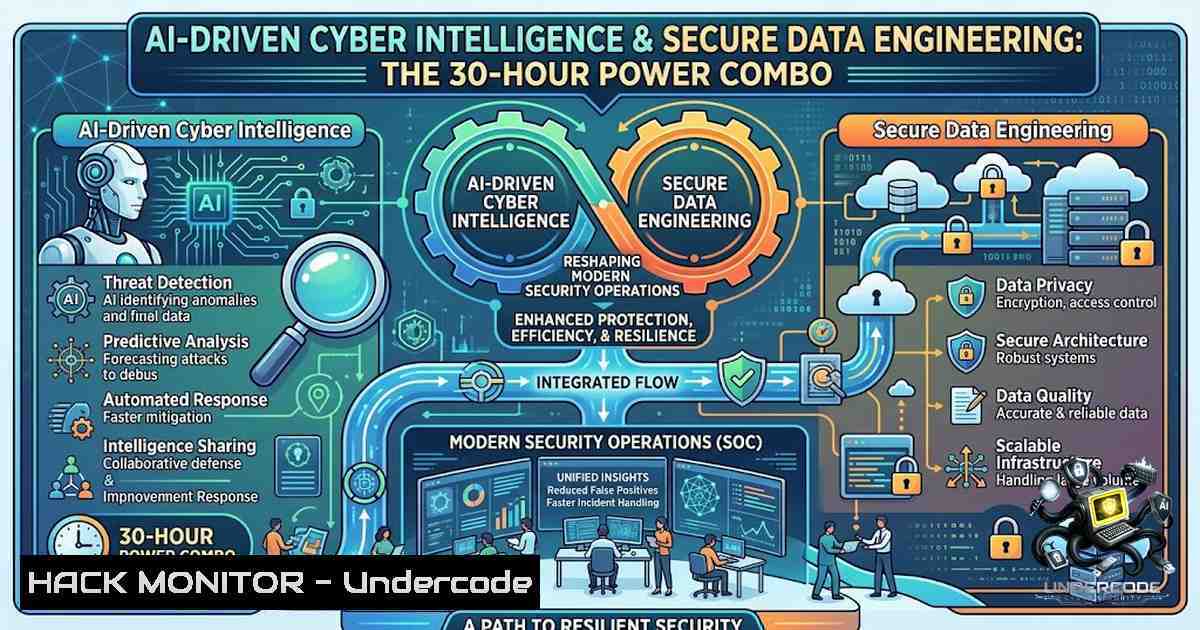
The convergence of artificial intelligence, cybersecurity, and data engineering has emerged as the most formidable defense paradigm against modern cyber threats. Traditional signature-based detection systems struggle with zero-day vulnerabilities and advanced persistent threats (APTs), often yielding high false positive rates and poor adaptability to evolving attack vectors. By integrating AI-driven threat detection with secure data engineering practices—protecting data at every stage from ingestion to serving—organizations can build proactive, resilient security architectures that not only detect but predict and neutralize threats before full-scale intrusions occur.
Learning Objectives:
- Objective 1: Understand how machine learning and deep learning architectures (autoencoders, LSTMs, Transformers) detect attack precursors and anomalies in real-time network traffic.
- Objective 2: Master secure data engineering principles—encryption at rest, in transit, and in use; tokenization; and least-privilege access controls across data pipelines.
- Objective 3: Build and deploy AI-powered SIEM integrations, threat hunting workflows, and automated incident response using open-source tools and industry frameworks.
You Should Know:
- AI-Powered Threat Detection: From Anomaly Scoring to Predictive Defense
Modern AI-driven cyber intelligence moves beyond rule-based detection to predictive, behavior-based security. Frameworks like CyberGuard-X integrate anomaly detection, time-series analysis, and multi-stage classification using deep learning techniques—autoencoders for dimensionality reduction, LSTM networks for sequence modeling, and Transformer layers for contextual understanding. Tested on benchmark datasets (CICIDS2017, CSE-CIC-IDS2018, UNSW-1B15), such systems achieve 96.1% accuracy, 94.7% precision, and an 84.5% zero-day detection rate with inference times as low as 12.8 ms.
Similarly, SentinelAI-IDS employs a hybrid ensemble of Random Forest and XGBoost classifiers optimized via Bayesian optimization, achieving 97.10% accuracy and 95.50% F1-score while significantly reducing false positives. The key insight: MI-based feature selection combined with PCA dimensionality reduction creates a robust learning pipeline capable of multi-dataset training for broad defense coverage.
Step-by-Step: Building a Python-Based Anomaly Detection Pipeline for Threat Hunting
import pandas as pd
from sklearn.feature_extraction.text import TfidfVectorizer
from sklearn.cluster import DBSCAN

Load process creation events (Sysmon Event ID 1 or Windows Event 4688)
df = pd.read_csv('process_events.csv')

Vectorize command lines using character n-gram TF-IDF
vec = TfidfVectorizer(
analyzer='char_wb',
ngram_range=(3, 5),
min_df=2
)
X = vec.fit_transform(df['command_line'].fillna(''))

Cluster to find outliers—rare command lines worth hunting
db = DBSCAN(eps=0.5, min_samples=5, metric='cosine').fit(X)
df['cluster'] = db.labels_

Extract anomalies (cluster == -1 = DBSCAN noise)
rare_commands = df[df['cluster'] == -1].sort_values('command_line')
print(f"Found {len(rare_commands)} anomalous command lines to investigate")
This approach, as documented in threat hunting best practices, doesn’t ask “is this malicious?” but rather “is this like everything else?”—a question ML answers reliably. Character n-gram TF-IDF handles obfuscation like base64 blobs and mixed casing, dropping encoded PowerShell payloads straight into the anomaly group.
- Secure Data Engineering: Protecting Data at Every Stage
Secure data engineering requires a zero-trust approach across the entire pipeline—ingestion, streaming, transformation, and serving layers. Core practices include:
- Encryption at rest, in transit, and in use using modern KMS/HSM workflows
- Least-privilege access with service identities and automated credential controls
- Tokenization and format-preserving encryption (FPE) to protect sensitive fields while preserving analytical utility
HashiCorp Vault provides a production-ready solution for securing external data through transit encryption, tokenization, and transforms. The transform plugin supports three modes: Format Preserving Encryption (maintains original format and length), data masking, and tokenization—each addressing different compliance and security requirements.
Step-by-Step: Encrypting Sensitive Data in a Pipeline with Vault Transit
 1. Enable the transit secrets engine
vault secrets enable transit

<ol>
<li>Create an encryption key
vault write -f transit/keys/pipeline-key</p></li>
<li><p>Encrypt sensitive data (e.g., PII field)
vault write transit/encrypt/pipeline-key plaintext=$(base64 <<< "SENSITIVE_DATA")</p></li>
<li><p>Store ciphertext in your database; application never handles raw key</p></li>
<li>Decrypt when needed for processing
vault write transit/decrypt/pipeline-key ciphertext=<ciphertext_from_step_3>
For field-level protection in Unix/Linux pipelines, command-line utilities can execute protection in-line without forcing teams to rebuild existing scripts or move data to external security services. Always store encryption keys in secure secret managers—never in flat files—and rotate keys on a regular schedule.
- AI-Powered SIEM Integration: Real-Time Threat Monitoring at Scale
Integrating AI with SIEM platforms transforms security operations from reactive alerting to proactive threat hunting. Modern AI-driven SIEM systems unify network-based intrusion detection, log-based anomaly detection, and real-time event streaming through tools like Apache Kafka, Elasticsearch, and Grafana.
The architecture typically follows this pattern: logs are tailed by Fluent Bit, published to Kafka, consumed by Logstash for MITRE ATT&CK tagging, and indexed in Elasticsearch—all while an AI model (e.g., hybrid attention LSTM autoencoder) runs unsupervised anomaly detection on the log stream.
Step-by-Step: Deploying an AI-Driven SIEM Lab with Docker
 1. Clone the AI-driven SIEM repository
git clone https://github.com/AK11105/AI-driven-SIEM-System.git
cd AI-driven-SIEM-System

<ol>
<li>Configure environment and start the stack
cp .env.example .env
docker compose up -d</p></li>
<li><p>Generate simulated security events for testing
Brute force attack (MITRE T1110 - Credential Access)
for i in {1..10}; do
logger -p auth.info "Failed password for invalid user admin from 10.0.0.$i port 22 ssh2"
done

Privilege escalation (MITRE T1078)
sudo ls /root

Persistence mechanism (MITRE T1053)
logger "CRON[bash]: (root) CMD (/bin/bash /tmp/backdoor.sh)"

Lateral movement (MITRE T1021)
logger -p auth.info "Accepted password for ubuntu from 192.168.1.100 port 54321 ssh2"
The ML model—a weighted ensemble of Bi-LSTM Autoencoders with Multi-Head Self-Attention—runs on raw log files and detects anomalous sequences with 94.2% precision and 91.8% recall on Linux logs. Each anomaly is tagged with severity (Low/Medium/High/Critical), confidence score, and the exact log lines that triggered it.
- Threat Hunting with Machine Learning: Shrinking the Candidate Set
The most practical application of ML in threat hunting isn’t finding threats—it’s reducing the volume of data analysts must review. Instead of scrolling through 40,000 outbound sessions, ML hands them 40 that don’t look like the rest.
Step-by-Step: Hunting Command-Line Anomalies with DBSCAN
 On Windows: Enable Sysmon to capture process creation (Event ID 1)
 On Linux: Use auditd or capture bash history

Export command-line data to CSV
 Then run the Python clustering script (see Section 1)

Investigate the outliers—these are your hunting leads
 Example: A PowerShell command with base64 encoding that doesn't cluster with legitimate scripts
The same pattern works on outbound HTTP sessions, DNS query strings, and user-agent values. For labeled problems (e.g., DGA domains, phishing URLs), supervised classification with gradient-boosted models works effectively; for most hunting scenarios where you don’t have labels, unsupervised clustering is the practical choice.
5. Hardening AI Systems: Industry Standards and Frameworks
As AI becomes integral to security operations, the AI systems themselves become attack targets. Organizations must adopt formal approaches using established frameworks:
- MITRE ATLAS: Maps AI-specific attack techniques—data poisoning, model evasion, model theft—similar to MITRE ATT&CK for traditional cybersecurity
- NIST AI Risk Management Framework: Provides structured methodology (Map, Measure, Manage, Govern) for managing AI risks across the lifecycle
- NIST Adversarial Machine Learning Taxonomy: Categorizes evasion attacks (inference), poisoning attacks (training), and extraction/inversion attacks (model confidentiality)
- OWASP AI Exchange: Addresses insecure model configuration, supply chain risks in AI pipelines, and AI-specific API vulnerabilities
Step-by-Step: Applying MITRE ATLAS to AI Security Assessments
- Map your AI/ML systems to ATLAS tactics and techniques
- Integrate AI threat modeling into existing red-team and penetration testing practices
- Implement layered sandboxing—no single sandbox technology covers the full threat surface of AI agents; combine network filtering with kernel isolation
- Continuously monitor for prompt injection, model exploitation, and data exfiltration
What Undercode Say:
- Key Takeaway 1: AI-driven threat detection is not a replacement for human judgment—it’s a force multiplier that shrinks the attack surface and candidate sets, enabling security teams to focus on high-value threats rather than drowning in alerts.
-
Key Takeaway 2: Secure data engineering is non-1egotiable. Protecting data at every stage—from ingestion through transformation to serving—requires encryption, tokenization, least-privilege access, and continuous auditing. The integration of AI with secure pipelines creates a defense-in-depth strategy that addresses both external threats and insider risks.
Analysis: The 30-hour course described represents a microcosm of the broader industry shift toward integrated security architectures. What’s notable is the emphasis on practical, hands-on learning—building actual pipelines, deploying AI models, and understanding real attack patterns rather than abstract theory. The collaboration with Redback IT Solutions highlights the growing demand for professionals who can bridge the gap between data engineering and cybersecurity. As cybercrime is projected to cost the global economy $10.5 trillion annually by 2025, the ability to build AI-driven, secure data systems is becoming not just a competitive advantage but a business imperative. The convergence of these three domains—AI, cybersecurity, and data engineering—represents the new frontier in digital defense, and professionals who master this combination will be at the forefront of the industry’s most critical battles.
Prediction:
- +1 The integration of AI with SIEM and data engineering will become standard practice within 3-5 years, with AI-powered detection engineering pipelines automating 60-70% of routine threat hunting tasks.
-
+1 Open-source tools (Elastic Stack, Kafka, Vault, scikit-learn) will continue to democratize AI-driven security, enabling smaller organizations to deploy enterprise-grade threat detection without massive budgets.
-
-1 The reliance on AI for security will create new attack surfaces—adversaries will increasingly target ML models through data poisoning and evasion techniques, requiring continuous model retraining and adversarial robustness testing.
-
+1 Certification and training programs like the one described will proliferate, creating a new category of “AI Security Engineer” roles that command premium salaries and become essential in every security operations center.
-
-1 Organizations that fail to adopt AI-driven security will face widening defense gaps, as attackers leverage AI to automate and scale their operations, making traditional rule-based detection obsolete within the next 24-36 months.
▶️ Related Video (78% Match):
https://www.youtube.com/watch?v=0tHb6U2604g
🎯Let’s Practice For Free:
🎓 Live Courses & Certifications:
Join Undercode Academy for Verified Certifications
🚀 Request a Custom Project:
Secure, high-velocity infrastructure and disruptive technological engineering. Contact our engineering team for high-tier development and proprietary systems:
[email protected]
💎 Smart Architecture | 🛡️ Secure by Design | ⭐ Trusted by Thousands
IT/Security Reporter URL:
Reported By: Fayeza Qareen – Hackers Feeds
Extra Hub: Undercode MoN
Basic Verification: Pass ✅


