
Listen to this Post
Introduction:
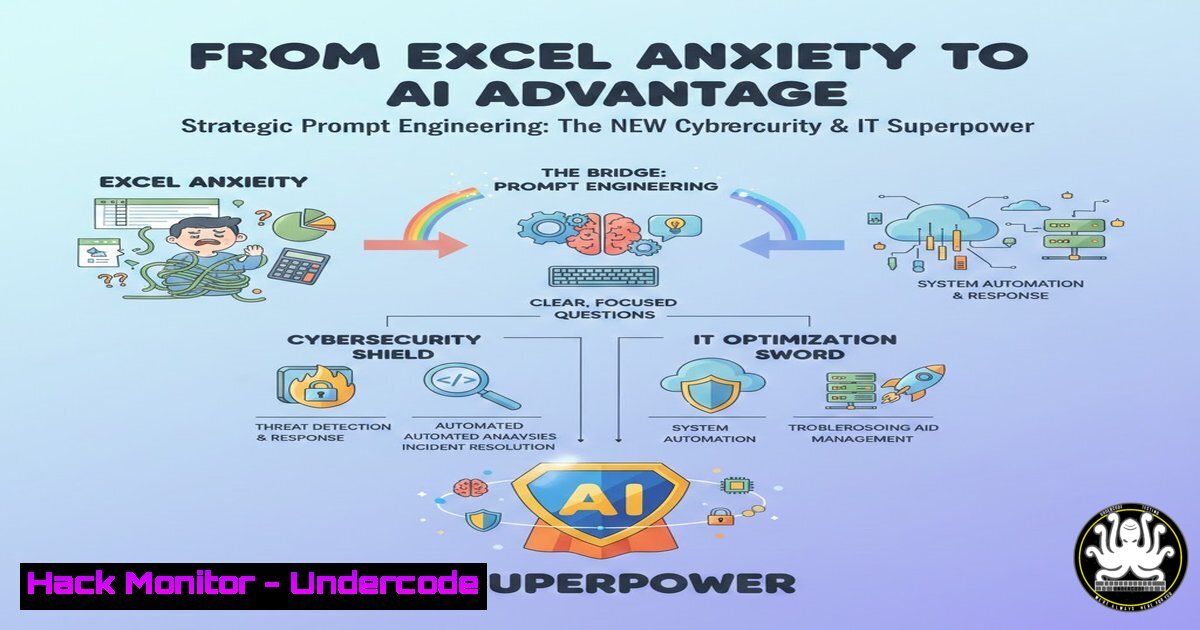
The pervasive fear that AI will automate away technical jobs mirrors historical anxieties around tools like Excel. However, the true transformative power of AI in cybersecurity, IT, and DevOps lies not in providing canned answers, but in augmenting human expertise. By leveraging AI as a dynamic reasoning partner, professionals can deconstruct complex systems, identify logical flaws, and harden environments against novel threats. This article explores the methodology of using AI for deep conceptual understanding and provides actionable technical guides for applying this approach to security hardening, threat analysis, and automated defense.
Learning Objectives:
- Transform AI from an answer engine into a critical-thinking partner for security analysis and system design.
- Apply a structured, five-phase methodology to deconstruct and rebuild IT processes and security postures.
- Implement specific command-line and scripting techniques, validated through AI-assisted reasoning, for proactive system defense.
You Should Know:
1. Deconstructing the Attack Surface: AI-Assisted Threat Modeling
The first step is moving beyond checklist security. Use AI to challenge your assumptions about system boundaries and trust zones.
Step‑by‑step guide:
- Prompt for Context, Not Lists: Instead of “list common web app vulnerabilities,” prompt: “Act as a senior security architect. I have a typical three-tier web app (NGINX, Python/Flask, PostgreSQL) on AWS. Critically analyze the implied trust model between tiers and hypothesize three non-obvious attack paths that could bypass standard OWASP Top 10 mitigations.”
- Map the Data Flow: Use AI to generate a potential data-flow diagram (DFD) in text or Mermaid.js syntax. Critique this diagram with follow-up prompts: “Where are the implicit trust boundaries in this DFD that are not enforced by technical controls?”
- Technical Validation: Test hypotheses. For an attack path involving server-side request forgery (SSRF) from the app tier to internal metadata endpoints, craft a detection rule. Use `tcpdump` on the app host to monitor outbound calls to the metadata IP (
169.254.169.254).Linux command to monitor for metadata service attempts sudo tcpdump -i any -n dst host 169.254.169.254 -A
Then, write a restrictive iptables/nftables rule on the application server to block direct metadata access, a common cloud hardening step.
Example nftables rule to drop traffic to AWS/GCP/Azure metadata IPs nft add rule ip filter OUTPUT ip daddr { 169.254.169.254, 169.254.170.2 } counter drop -
Removing the Fluff: Hardening Scripts & Minimal Configs
AI excels at refining verbose configurations into minimal, secure baselines. Use it to audit and generate hardened configurations.
Step‑by‑step guide:
- Input Your Config: Provide AI with your current
sshd_config,nginx.conf, or Windows GPO snippet. - Prompt for Reduction & Hardening: “Strip this SSH configuration of all non-essential directives and apply the principles of least privilege and cryptographic hardening. Explain the security rationale for each retained line.”
- Implement & Diff: Apply the AI-suggested config in a test environment. Use diff tools to understand changes.
Diff original vs. hardened config
diff -u /etc/ssh/sshd_config.original /etc/ssh/sshd_config.hardened
- Automate with Ansible: Prompt AI to convert the hardened config into an Ansible playbook task for consistent deployment.
</li> </ol> <p>- name: Harden SSH Daemon Configuration ansible.builtin.lineinfile: path: /etc/ssh/sshd_config regexp: "{{ item.regexp }}" line: "{{ item.line }}" loop: - { regexp: '^?PermitRootLogin', line: 'PermitRootLogin no' } - { regexp: '^?PasswordAuthentication', line: 'PasswordAuthentication no' } - { regexp: '^?KexAlgorithms', line: 'KexAlgorithms [email protected],diffie-hellman-group-exchange-sha256' } notify: restart ssh- Testing in the Real World: AI-Generated Security Incident Simulations
Use AI to design realistic tabletop exercises and breach simulations that move beyond canned vulnerability scans.
Step‑by‑step guide:
- Scenario Crafting: “Generate a step-by-step incident simulation for a compromised AWS IAM key leading to a Kubernetes privilege escalation. Include specific CLI commands an attacker would use, and corresponding CloudTrail/container log entries for detection.”
- Build Detections: Use the AI-generated attack narrative to write Sigma or YARA rules. For instance, for the IAM key compromise step, a Sigma rule for CloudTrail might look for `ConsoleLogin` without MFA.
- Containment Scripting: Ask AI to help craft an AWS Lambda function for automated incident response, such as revoking temporary credentials attached to a specific IAM user.
Python snippet for a Lambda response function (conceptual) import boto3 def lambda_handler(event, context): iam = boto3.client('iam') compromised_user = event['detail']['userIdentity']['userName'] Attach a deny-all policy as a containment step policy_arn = 'arn:aws:iam::aws:policy/AWSDenyAll' iam.attach_user_policy(UserName=compromised_user, PolicyArn=policy_arn) print(f"Containment policy attached to {compromised_user}") -
The Iterative Fortress: Continuous Feedback with Logging & SIEM
Security is iterative. Use AI to analyze your logs and suggest improvements to your detection logic.
Step‑by‑step guide:
- Feed Real Logs (Sanitized): Provide sanitized snippets of failed login logs, WAF blocks, or `sudo` logs.
- Prompt for Anomaly Detection: “Analyze this sudo log data. Based on normal user behavior patterns, suggest a heuristic for detecting anomalous privilege escalation attempts that would bypass static rules looking for
sudo su.” -
Implement Heuristics: Translate the suggestion into a SIEM query or a simple Python script for log analysis.
Example: Advanced grep to find sudo commands executed from unusual TTYs or times
grep "sudo:" /var/log/auth.log | awk '$3 !~ /^(pts\/0|tty1)$/ || $6 !~ /^(09|10|11|12|13|14|15|16|17):/' | head -20
-
Automating the Mundane: Secure Code & Configuration Generation
Offload repetitive, error-prone tasks to AI, but always review the output with a critical eye.
Step‑by‑step guide:
- Define the Task: “Write a Python script that uses the `boto3` library to inventory all S3 buckets in an AWS account, check for public read/write permissions, and report findings to a Slack webhook. Include error handling and pagination.”
- Security Review the Code: Use a follow-up prompt: “Perform a security audit on the provided Python script. Identify any potential issues with secret exposure, TLS verification, or injection in the Slack webhook URL.”
- Deploy Safely: Run the vetted script in a staging account first, using a read-only IAM role.
Example command to run the script with explicit AWS profile for safety
AWS_PROFILE=Staging-AuditRole python3 s3_auditor.py
What Undercode Say:
- AI as a Force Multiplier, Not a Replacement: The strategic value of AI in technical fields is its ability to accelerate the understanding of complex systems, not just to automate tasks. This leads to more resilient, thoughtfully architected defenses.
- The Human-in-the-Loop is Non-Negotiable: AI-generated code, configurations, and strategies must undergo rigorous human validation. The critical thinking to identify subtle flaws in AI logic is the irreplaceable human skill.
The shift mirrors the Excel revolution: it commoditized basic calculation but created higher-value roles in data analysis and financial modeling. Similarly, AI will commoditize the ability to generate boilerplate code or run simple scans, but it simultaneously elevates the value of professionals who can direct AI with expert prompts, critically validate its output, and integrate its insights into complex, real-world systems. The future belongs to the cyber-AI strategist.
Prediction:
Within two years, “Prompt Engineering for Security” will evolve into a formalized discipline within cybersecurity and IT operations. We will see the emergence of specialized AI reasoning models fine-tuned on threat intelligence, MITRE ATT&CK frameworks, and secure code patterns. These models will act as real-time adversarial simulators and defense coordinators. The most significant breaches will increasingly be attributed not to a lack of tools, but to a failure of human teams to effectively leverage AI-assisted reasoning to anticipate novel attack vectors, making AI-augmented critical thinking the most sought-after skill in the defense arsenal.
▶️ Related Video (74% Match):
🎯Let’s Practice For Free:
IT/Security Reporter URL:
Reported By: Tanushqgupta Converted – Hackers Feeds
Extra Hub: Undercode MoN
Basic Verification: Pass ✅🔐JOIN OUR CYBER WORLD [ CVE News • HackMonitor • UndercodeNews ]
📢 Follow UndercodeTesting & Stay Tuned:
- Testing in the Real World: AI-Generated Security Incident Simulations


