
Listen to this Post
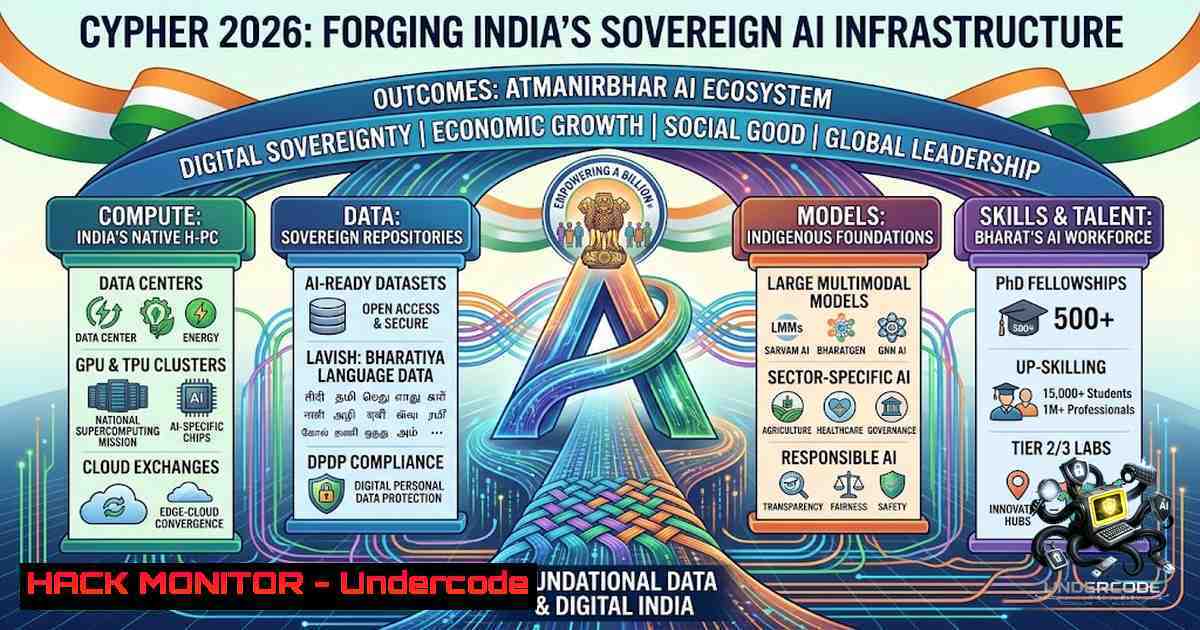
Introduction:
As India’s AI ecosystem matures, the focus shifts from generic large language models to culturally aware, multilingual, and sector-specific intelligence. The Cypher 2026 summit in Bengaluru brings together pioneers tackling the unique challenges of building AI that understands India’s linguistic diversity, quantum-ready hardware, and deep-tech applications in healthcare and agriculture. For security professionals, this evolution introduces critical vectors: securing heterogeneous AI pipelines, protecting indigenous datasets, and hardening quantum-adjacent infrastructure against emerging threats.
Learning Objectives & Secrets:
- Objective 1: Implement secure data ingestion pipelines for multilingual datasets, including dialect-specific normalization and adversarial input filtering.
- Objective 2 (Secret Tip): Leverage hardware security modules (HSMs) and Trusted Execution Environments (TEEs) to protect model weights during fine-tuning on sensitive Indian healthcare and agricultural data.
- Objective 3 (Secret Tip): Deploy zero-trust API gateways with dynamic rate limiting and payload validation to defend against prompt injection and data exfiltration attacks targeting vernacular AI models.
You Should Know:
1. Secure Dataset Curation for Low-Resource Languages
Building AI for India’s 22 scheduled languages and thousands of dialects requires ingesting data from diverse sources—government portals, news archives, and user-generated content. This process mirrors threat intelligence aggregation but with added complexity: data poisoning, bias injection, and PII leakage. To mitigate these, implement content-addressable storage (CAS) for dataset versioning and cryptographic hashing (SHA-3) to verify corpus integrity before each training epoch.
Step‑by‑step guide:
- Linux: `sha3sum -a 256 /data/corpus/.txt > corpus.checksums` – generate hashes for validation.
- Windows: `Get-FileHash -Algorithm SHA256 -Path D:\corpus\.txt > corpus_checksums.txt` – PowerShell equivalent.
- Tutorial: Use `git-lfs` with GPG-signed commits to track dataset changes; enforce pre-commit hooks that scan for PII using `pii-detector` (custom regex for Aadhaar, PAN, and phone numbers).
2. Quantum-Resistant Cryptography for AI Model Distribution
With Prof. Arindam Ghosh’s work on quantum materials and nanotechnology, Cypher 2026 underscores the impending shift to quantum computing. While Q-day may be years away, AI models trained today will be exfiltrated and stored for future decryption. Hence, implement post-quantum cryptographic (PQC) algorithms—specifically CRYSTALS-Kyber for key encapsulation and Dilithium for digital signatures—when packaging and distributing model artifacts.
Step‑by‑step guide:
- Linux: Install `liboqs` and use `oqs-kem` to encrypt model.tar.gz with Kyber-1024:
oqs-kem -e kyber1024 -i model.tar.gz -o model.encrypted. - Windows: Use the Open Quantum Safe (OQS) Python binding:
from oqs import KeyEncapsulation; kem = KeyEncapsulation('Kyber1024'); ct, ss = kem.encap(public_key). - Configuration: For cloud deployments, enable PQC in NGINX for TLS 1.3 using `ssl_kyber` directives (available in OpenSSL 3.4+).
3. Hardening AI Inference APIs Against Adversarial Attacks
Vernacular AI models deployed in production—such as Josh Talks’ benchmarks or Coremantle’s data intelligence infrastructure—are prime targets for prompt injection and model inversion. To secure inference endpoints, deploy a multi-layered defense: input sanitization, output filtering, and anomaly detection using a secondary guardrail model (e.g., a distilled BERT for toxicity and jailbreak detection).
Step‑by‑step guide:
- Linux: Use `modsecurity` with OWASP CRS rules tailored for JSON payloads: enable rule `941100` (SQL injection) and add custom rule `950001` for Unicode homoglyph detection.
- Windows: In IIS, install URL Rewrite Module and add a rule to block requests containing `(?i)(ignore|forget|system|cmd)` in the `text` parameter.
- API Security: Implement mutual TLS (mTLS) using Istio in Kubernetes: define `PeerAuthentication` with `mtls: STRICT` and `AuthorizationPolicy` to allow only service accounts with verified SPIFEE identities.
4. Cloud Hardening for AI Training Clusters
Training massive models on cloud infrastructure (AWS, GCP, Azure) used by ARTPARK and Shodh AI demands robust IAM and network segmentation. The principle of least privilege must extend to storage buckets (S3/GCS) and GPU instances. Additionally, implement VPC Service Controls to prevent data exfiltration via malicious model checkpoints and enforce egress filtering for unexpected API calls.
Step‑by‑step guide:
- Linux (AWS CLI): `aws s3api put-bucket-policy –bucket ai-training-data –policy file://deny_public.json` – block public access.
- Windows (Azure CLI): `az storage account update –1ame aistorage –set networkAcls.defaultAction=Deny` – restrict to virtual network.
- Tutorial: Use `kubescape` to scan Kubernetes manifests for privilege escalation risks; configure PodSecurityPolicy to disallow `hostNetwork` and `privileged` containers.
5. Vulnerability Exploitation & Mitigation in ML Pipelines
Common attack surfaces include pickle deserialization (unsafe load()), exposed Jupyter notebooks, and unsecured MLflow tracking servers. At Cypher 2026, expect discussions on securing the entire MLOps lifecycle. To mitigate pickle bombs, switch to `safetensors` for model serialization. For Jupyter, enforce password authentication, disable token-based access, and use `jupyter nbconvert` to strip outputs before sharing.
Step‑by‑step guide:
- Linux: `jupyter notebook password` – set strong passphrase; `pip install safetensors` and convert `.bin` to `.safetensors` using
from safetensors.torch import save_file. - Windows: Use `Process Monitor` to detect unauthorized `python.exe` spawns; implement AppLocker to restrict execution to signed binaries only.
- Code: Example of safe loading:
from safetensors.torch import load_file; model.load_state_dict(load_file("model.safetensors")).
6. Compliance and Data Sovereignty in Multilingual AI
With India’s Digital Personal Data Protection (DPDP) Act, any AI solution processing citizen data must ensure data localization and consent management. Raghu Dharmaraju’s work in public health and climate resilience highlights the need for audit trails. Implement comprehensive logging using a SIEM (e.g., Wazuh) and integrate with a data lineage tool (e.g., Amundsen) to track data flow from ingestion to inference.
Step‑by‑step guide:
- Linux: Install Wazuh agent:
wget https://packages.wazuh.com/4.x/apt/pool/main/w/wazuh-agent/wazuh-agent_4.5.0-1_amd64.deb && dpkg -i wazuh-agent.deb. - Windows: Deploy Sysmon with a configuration file to log process creation and network connections:
Sysmon64.exe -accepteula -i sysmon_config.xml. - Tutorial: Set up ELK stack to visualize logs; create a dashboard for DPDP compliance reporting (data access, consent revocation, and deletion requests).
What Undercode Say:
- Key Takeaway 1: India’s AI future hinges on securing indigenous data pipelines—every dataset must be treated as critical infrastructure, with cryptographic integrity checks and PII redaction built into the curation workflow.
- Key Takeaway 2: Quantum readiness is not optional; start integrating post-quantum algorithms today, especially for model distribution, because today’s encrypted model is tomorrow’s decrypted asset.
Analysis: The Cypher 2026 agenda implicitly calls for a shift from academic AI to operational AI. This transition exposes vulnerabilities common in DevOps but amplified by the unique attack surface of ML: data poisoning, model theft, and adversarial inputs. The speakers represent both the public and private sectors, indicating a national interest in self-reliant AI. For cybersecurity teams, this means adopting DevSecOps principles tailored for ML—automated checks for data drift, model fairness, and security patches for dependencies like PyTorch and TensorFlow. The emphasis on vernacular AI introduces linguistic adversarial examples; hence, security must be multilingual too. Finally, the convergence of quantum and AI suggests a timeline of 5-10 years before NIST-post-quantum standards become mandatory—start planning hybrid encryption strategies now.
Prediction:
- +1 By 2028, Indian enterprises will mandate FIPS 140-3 validated cryptographic modules for all AI training clusters, driving demand for local HSM vendors.
- +1 The adoption of vernacular AI will create a new sub-field: “adversarial linguistics,” leading to specialized red-team tools for detecting biases and jailbreaks in low-resource languages.
- -1 Unsecured AI pipelines in healthcare and agriculture may lead to catastrophic model failures, potentially harming patient outcomes or crop yields before regulations catch up.
- +1 Cypher 2026 will catalyze the formation of an India-specific AI security consortium, producing open-source benchmarks and threat intelligence feeds for the community.
- -1 The shortage of cybersecurity professionals skilled in both AI and quantum cryptography will become a critical bottleneck by 2027.
- +1 Quantum-safe TLS will become a standard offering from major cloud providers for Indian government projects by Q4 2026.
▶️ Related Video (94% Match):
🎯Let’s Practice For Free:
🎓 Live Courses & Certifications:
Join Undercode Academy for Verified Certifications
🚀 Request a Custom Project:
Secure, high-velocity infrastructure and disruptive technological engineering. Contact our engineering team for high-tier development and proprietary systems:
[email protected]
💎 Smart Architecture | 🛡️ Secure by Design | ⭐ Trusted by Thousands
IT/Security Reporter URL:
Reported By: https://lnkd.in/p/expnibyJ – Hackers Feeds
Extra Hub: Undercode MoN
Basic Verification: Pass ✅


