Listen to this Post
Introduction
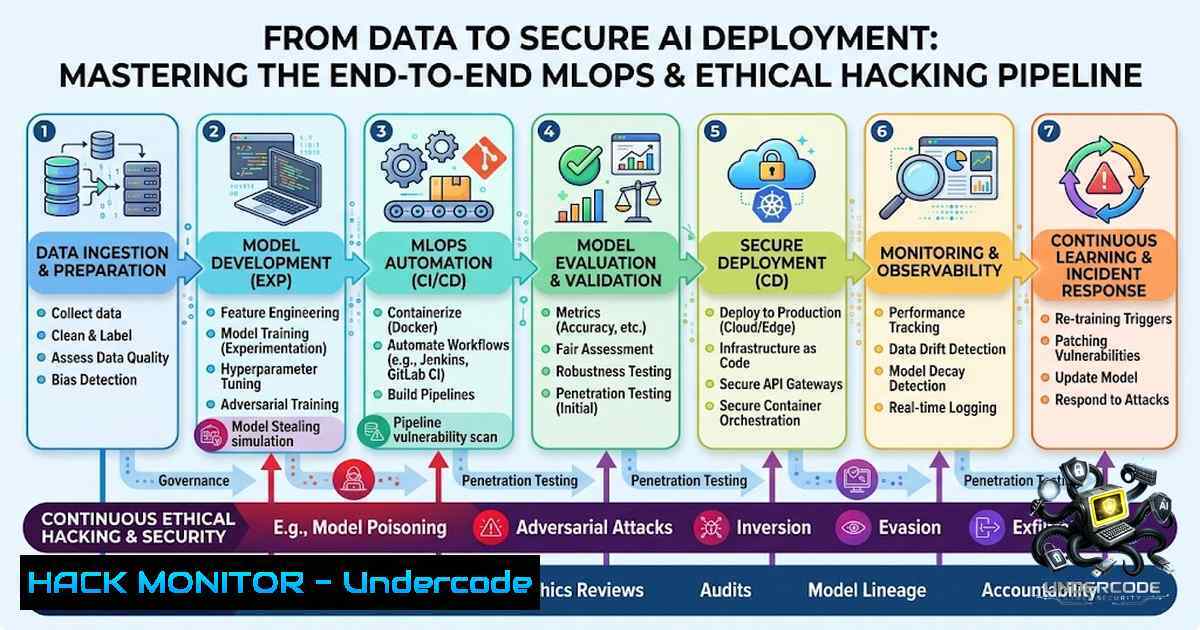
The convergence of Machine Learning Operations (MLOps) and ethical hacking represents a paradigm shift in how organizations develop, deploy, and secure artificial intelligence systems. As AI models move from experimental notebooks to production environments handling sensitive data, the attack surface expands dramatically—requiring practitioners to master not only the continuous integration and deployment (CI/CD) of models but also the adversarial tactics used to compromise them. The Department of Computer Science and Engineering (AI & ML) and the Department of Artificial Intelligence & Data Science at K.S. Rangasamy College of Technology (KSRCT) recently organized an Expert Talk Session on “End-to-End MLOps with Ethical Hacking: From Data to Secure AI Deployment,” led by Mr. Tamilmani Selvam, Founder & CEO of Smart Reach, Salem, to address this critical intersection.
Learning Objectives
- Master the end-to-end MLOps lifecycle, from data ingestion and model development to deployment, monitoring, and continuous retraining
- Implement CI/CD pipelines for automated testing, validation, and deployment of machine learning models in production environments
- Understand adversarial AI threats including data poisoning, evasion attacks, and model inversion, and apply ethical hacking techniques to secure AI systems
- Deploy secure, scalable AI solutions using containerization, Kubernetes orchestration, and industry-standard security best practices
1. The MLOps Lifecycle: From Data to Production
The MLOps lifecycle transforms the chaotic process of managing machine learning models into a streamlined assembly line: define → train → package → deploy → monitor → retrain. This systematic approach treats pipelines and models as first-class citizens, ensuring consistency, traceability, and security at scale.
Step-by-Step Guide: Building an End-to-End MLOps Pipeline
Step 1: Data Ingestion and Versioning
 Install DVC (Data Version Control) for dataset versioning
pip install dvc
dvc init
dvc add data/raw_dataset.csv
git add data/raw_dataset.csv.dvc .gitignore
git commit -m "Add raw dataset version"
Step 2: Experiment Tracking with MLflow
 Install MLflow and start tracking server
pip install mlflow
mlflow server --host 0.0.0.0 --port 5000

In your training script
import mlflow
mlflow.set_tracking_uri("http://localhost:5000")
with mlflow.start_run():
mlflow.log_param("learning_rate", 0.01)
mlflow.log_metric("accuracy", 0.92)
mlflow.sklearn.log_model(model, "model")
Step 3: Containerization with Docker
 Dockerfile for model serving
FROM python:3.9-slim
WORKDIR /app
COPY requirements.txt .
RUN pip install --1o-cache-dir -r requirements.txt
COPY model.pkl .
COPY app.py .
CMD ["uvicorn", "app:app", "--host", "0.0.0.0", "--port", "8000"]
This pipeline ensures that every model is built and deployed through a repeatable process, with versioned training pipelines captured as custom resources so teams always know what ran, when, and why. The model registry serves as a single source of truth, providing full transparency and traceability across the entire fleet of models.
2. CI/CD Pipelines for Reliable AI Development
Continuous Integration and Continuous Deployment (CI/CD) pipelines are the backbone of MLOps, automating the testing, validation, and deployment of machine learning models. These pipelines eliminate manual errors, reduce time to market, and ensure consistent, reliable model delivery.
Step-by-Step Guide: Implementing CI/CD for ML
Step 1: GitHub Actions CI Pipeline
 .github/workflows/ci.yml
name: ML CI Pipeline
on:
pull_request:
branches: [bash]
jobs:
test:
runs-on: ubuntu-latest
steps:
- uses: actions/checkout@v3
- name: Set up Python
uses: actions/setup-python@v4
with:
python-version: '3.10'
- name: Install dependencies
run: |
pip install -r requirements.txt
pip install pytest
- name: Run tests
run: pytest tests/
- name: Lint with flake8
run: flake8 src/
- name: Security scan with Bandit
run: bandit -r src/ -f json -o bandit-report.json
Step 2: Continuous Deployment with GitHub Actions
 .github/workflows/cd.yml
name: ML CD Pipeline
on:
push:
branches: [bash]
jobs:
deploy:
runs-on: ubuntu-latest
steps:
- uses: actions/checkout@v3
- name: Build Docker image
run: docker build -t my-ml-model:latest .
- name: Push to registry
run: |
echo ${{ secrets.DOCKER_PASSWORD }} | docker login -u ${{ secrets.DOCKER_USERNAME }} --password-stdin
docker tag my-ml-model:latest myregistry/my-ml-model:${{ github.sha }}
docker push myregistry/my-ml-model:${{ github.sha }}
- name: Deploy to Kubernetes
run: |
kubectl set image deployment/ml-api ml-api=myregistry/my-ml-model:${{ github.sha }}
kubectl rollout status deployment/ml-api
Step 3: GitLab CI/CD for ML Workflows (Alternative)
 .gitlab-ci.yml
image: python:3.10
stages:
- test
- train
- deploy
test_model:
stage: test
script:
- pip install -r requirements.txt
- pytest tests/
train_model:
stage: train
script:
- python train.py
artifacts:
paths:
- model.pkl
deploy_model:
stage: deploy
script:
- docker build -t $CI_REGISTRY_IMAGE:$CI_COMMIT_SHA .
- docker push $CI_REGISTRY_IMAGE:$CI_COMMIT_SHA
- kubectl set image deployment/ml-api ml-api=$CI_REGISTRY_IMAGE:$CI_COMMIT_SHA
only:
- main
GitLab’s integrated platform combines source code management, CI/CD pipelines, and collaboration tools, making it ideal for managing machine learning projects. The CI/CD pipelines automate the testing and deployment of models, allowing for continuous integration and continuous delivery.
3. Model Deployment, Monitoring, and Versioning
Deploying machine learning models to production requires careful consideration of scalability, reliability, and observability. Modern MLOps practices leverage containerization, Kubernetes orchestration, and comprehensive monitoring to ensure models perform optimally in production environments.
Step-by-Step Guide: Deploying and Monitoring ML Models
Step 1: Deploy with KServe on Kubernetes
 kserve-deployment.yaml
apiVersion: serving.kserve.io/v1beta1
kind: InferenceService
metadata:
name: ml-model
spec:
predictor:
model:
modelFormat:
name: sklearn
storageUri: gs://my-bucket/models/sklearn-model
resources:
limits:
cpu: "1"
memory: 2Gi
Step 2: Set Up Monitoring with Prometheus and Grafana
 prometheus-config.yaml
scrape_configs:
- job_name: 'ml-model'
static_configs:
- targets: ['ml-model-service:8000']
metrics_path: '/metrics'
Step 3: Implement Drift Detection with Evidently AI
 drift_detection.py
from evidently.dashboard import Dashboard
from evidently.tabs import DataDriftTab
import pandas as pd

reference_data = pd.read_csv('reference_data.csv')
current_data = pd.read_csv('current_data.csv')

drift_dashboard = Dashboard(tabs=[DataDriftTab()])
drift_dashboard.calculate(reference_data, current_data)
drift_dashboard.save('drift_report.html')
Step 4: Model Versioning with MLflow Registry
 Register model version
mlflow models register -m "runs:/<run_id>/model" -1 "my-model"
 Promote to staging
mlflow models transition-stage --1ame "my-model" --version 1 --stage "Staging"
 Promote to production
mlflow models transition-stage --1ame "my-model" --version 1 --stage "Production"
The platform features automated data pipelines, experiment tracking with MLflow, distributed training across multiple nodes, and a model registry with lifecycle management. Comprehensive monitoring includes performance tracking, drift detection, and automated retraining triggers.
- Ethical Hacking and AI Security: Defending Against Adversarial Threats
The security of AI systems presents fundamentally different challenges than traditional IT systems. Adversarial machine learning attacks, such as evasion and poisoning, involve subtle input manipulations or corrupted training data that undermine model reliability. Ethical hacking techniques are essential for identifying and mitigating these vulnerabilities before malicious actors exploit them.
Step-by-Step Guide: AI Security Testing and Hardening
Step 1: Simulate Data Poisoning Attacks
 data_poisoning.py
import numpy as np
from sklearn.datasets import make_classification

Generate clean data
X, y = make_classification(n_samples=1000, n_features=20, random_state=42)

Poison 10% of training data
poison_rate = 0.1
poison_idx = np.random.choice(len(X), int(len(X)  poison_rate), replace=False)
X[bash] += np.random.normal(0, 5, X[bash].shape)  Add noise
y[bash] = 1 - y[bash]  Flip labels
Step 2: Adversarial Evasion with FGSM (Fast Gradient Sign Method)
 adversarial_evasion.py
import tensorflow as tf

def fgsm_attack(model, image, epsilon):
image = tf.convert_to_tensor(image)
with tf.GradientTape() as tape:
tape.watch(image)
prediction = model(image)
loss = tf.keras.losses.categorical_crossentropy(tf.one_hot(0, 10), prediction)
gradient = tape.gradient(loss, image)
signed_grad = tf.sign(gradient)
adversarial_image = image + epsilon  signed_grad
return tf.clip_by_value(adversarial_image, 0, 1)
Step 3: Model Inversion Attack Simulation
 model_inversion.py
import numpy as np
from scipy.optimize import minimize

def model_inversion_attack(model, target_label, num_iterations=1000):
 Initialize random input
x = np.random.normal(0, 1, (1, 784))

def objective(x):
x = x.reshape(1, 784)
pred = model.predict(x)
return -pred[bash][target_label]  Minimize negative confidence

result = minimize(objective, x.flatten(), method='L-BFGS-B',
options={'maxiter': num_iterations})
return result.x.reshape(28, 28)
Step 4: Implement Input Validation and Sanitization
 input_validation.py
from pydantic import BaseModel, validator
import numpy as np

class ModelInput(BaseModel):
features: list

@validator('features')
def validate_features(cls, v):
if len(v) != 20:
raise ValueError(f"Expected 20 features, got {len(v)}")
if any(np.isnan(x) for x in v):
raise ValueError("NaN values detected in input")
if any(np.isinf(x) for x in v):
raise ValueError("Infinite values detected in input")
 Check for outliers
if any(abs(x) > 100 for x in v):
raise ValueError("Outlier values detected")
return v
The SecMLOps framework embeds security considerations from the initial design phase through to deployment and continuous monitoring, safeguarding against sophisticated attacks targeting various stages of the MLOps lifecycle. Defense-in-depth security includes multiple layers such as TLS, authentication, network isolation, and JWT authentication with rate limiting.
5. Secure AI Deployment: Industry Best Practices
Secure AI deployment requires a holistic approach that integrates security throughout the entire machine learning operations lifecycle. The principle of least privilege, zero-trust identity verification, and continuous security scanning are essential components of a robust AI security strategy.
Step-by-Step Guide: Hardening AI Deployments
Step 1: Implement Zero-Trust Security
 network-policy.yaml
apiVersion: networking.k8s.io/v1
kind: NetworkPolicy
metadata:
name: ml-model-1etwork-policy
spec:
podSelector:
matchLabels:
app: ml-model
policyTypes:
- Ingress
- Egress
ingress:
- from:
- namespaceSelector:
matchLabels:
name: production
ports:
- protocol: TCP
port: 8000
egress:
- to:
- namespaceSelector:
matchLabels:
name: monitoring
ports:
- protocol: TCP
port: 9090
Step 2: Secure Container Configuration
 Secure Dockerfile
FROM python:3.9-slim AS builder
RUN addgroup --system --gid 1001 appgroup && \
adduser --system --uid 1001 --gid 1001 appuser
WORKDIR /app
COPY requirements.txt .
RUN pip install --1o-cache-dir -r requirements.txt && \
pip install bandit safety
COPY --chown=appuser:appgroup . .
RUN bandit -r . -f json -o /bandit-report.json && \
safety check -r requirements.txt

FROM python:3.9-slim
RUN addgroup --system --gid 1001 appgroup && \
adduser --system --uid 1001 --gid 1001 appuser
WORKDIR /app
COPY --from=builder --chown=appuser:appgroup /app /app
COPY --from=builder --chown=appuser:appgroup /usr/local/lib/python3.9/site-packages /usr/local/lib/python3.9/site-packages
USER appuser
EXPOSE 8000
CMD ["uvicorn", "app:app", "--host", "0.0.0.0", "--port", "8000"]
Step 3: TLS Everywhere with Let’s Encrypt
 Install certbot and obtain certificates
sudo apt-get install certbot python3-certbot-1ginx
sudo certbot --1ginx -d api.mlmodel.com

Configure Traefik for automatic TLS
 traefik-config.yaml
apiVersion: traefik.containo.us/v1alpha1
kind: IngressRoute
metadata:
name: ml-model-ingress
spec:
entryPoints:
- websecure
routes:
- kind: Rule
match: Host(<code>api.mlmodel.com</code>)
services:
- name: ml-model-service
port: 8000
tls:
certResolver: letsencrypt
Step 4: API Security with JWT Authentication and Rate Limiting
 secure_api.py
from fastapi import FastAPI, Depends, HTTPException, Request
from fastapi.security import HTTPBearer, HTTPAuthorizationCredentials
import jwt
import time
from collections import defaultdict

app = FastAPI()
security = HTTPBearer()
rate_limits = defaultdict(list)

def verify_jwt(credentials: HTTPAuthorizationCredentials = Depends(security)):
token = credentials.credentials
try:
payload = jwt.decode(token, SECRET_KEY, algorithms=["HS256"])
return payload
except jwt.InvalidTokenError:
raise HTTPException(status_code=401, detail="Invalid token")

@app.middleware("http")
async def rate_limit_middleware(request: Request, call_next):
client_ip = request.client.host
current_time = time.time()
 Clean old requests
rate_limits[bash] = [t for t in rate_limits[bash]
if current_time - t < 60]
if len(rate_limits[bash]) >= 100:  100 requests per minute
raise HTTPException(status_code=429, detail="Rate limit exceeded")
rate_limits[bash].append(current_time)
return await call_next(request)

@app.post("/predict")
async def predict(data: dict, payload: dict = Depends(verify_jwt)):
 Model inference logic
return {"prediction": model.predict(data["features"])}
The implementation of TLS everywhere—self-signed certificates for local development and Let’s Encrypt integration for production—ensures encrypted communication across all services. Non-root container execution and minimal base images further reduce the attack surface.
What Undercode Say:
- MLOps is not just DevOps for ML — it’s a fundamentally different discipline that requires managing data drift, model versioning, and continuous retraining alongside traditional CI/CD practices. The unique challenges of machine learning—handling large datasets, experimenting with various models, and continuously updating models based on new data—demand a structured approach that MLOps provides.
-
Security must be embedded from the start — SecMLOps demonstrates that security cannot be an afterthought in AI deployment. Organizations must implement defense-in-depth strategies, zero-trust architectures, and continuous security scanning throughout the MLOps lifecycle to protect against evolving adversarial threats.
The integration of ethical hacking into MLOps represents a critical advancement in AI security. As AI systems become more pervasive in critical infrastructure, healthcare, and financial services, the ability to proactively identify and mitigate vulnerabilities becomes paramount. The dual-front threat environment—where AI serves as both an engine for innovation and a target for attack—requires practitioners who understand both the operational and security dimensions of AI deployment. Organizations that embrace this integrated approach will be better positioned to deploy scalable, reliable, and secure AI solutions that can withstand adversarial threats while delivering business value.
Prediction:
- +1 The convergence of MLOps and ethical hacking will become a standard competency requirement for AI engineers, with certification programs and university curricula increasingly incorporating both disciplines into their core offerings.
- +1 Automated security testing will become an integral part of CI/CD pipelines for ML, with tools for adversarial robustness testing, data drift detection, and model fairness auditing being automatically triggered on every code commit.
- -1 The sophistication of AI-powered cyberattacks will accelerate, with adversaries leveraging generative AI to create more convincing evasion techniques and automated exploitation frameworks that can scale attacks across multiple targets simultaneously.
- +1 The emergence of SecMLOps frameworks and DevSecMLOps practices will establish new industry standards for secure AI deployment, driving the adoption of zero-trust architectures and continuous security monitoring across the entire MLOps lifecycle.
- -1 Organizations that fail to integrate security into their MLOps pipelines will face increased regulatory scrutiny, data breaches, and reputational damage as AI systems become prime targets for adversarial attacks.
- +1 The demand for professionals with expertise in both MLOps and AI security will surge, creating new career pathways and specialized roles that bridge the gap between data science, DevOps, and cybersecurity domains.
▶️ Related Video (80% Match):
🎯Let’s Practice For Free:
🎓 Live Courses & Certifications:
Join Undercode Academy for Verified Certifications
🚀 Request a Custom Project:
Secure, high-velocity infrastructure and disruptive technological engineering. Contact our engineering team for high-tier development and proprietary systems:
[email protected]
💎 Smart Architecture | 🛡️ Secure by Design | ⭐ Trusted by Thousands
IT/Security Reporter URL:
Reported By: Ksrct1994 Ksrangasamycollegeoftechnology – Hackers Feeds
Extra Hub: Undercode MoN
Basic Verification: Pass ✅


