Listen to this Post
Introduction:
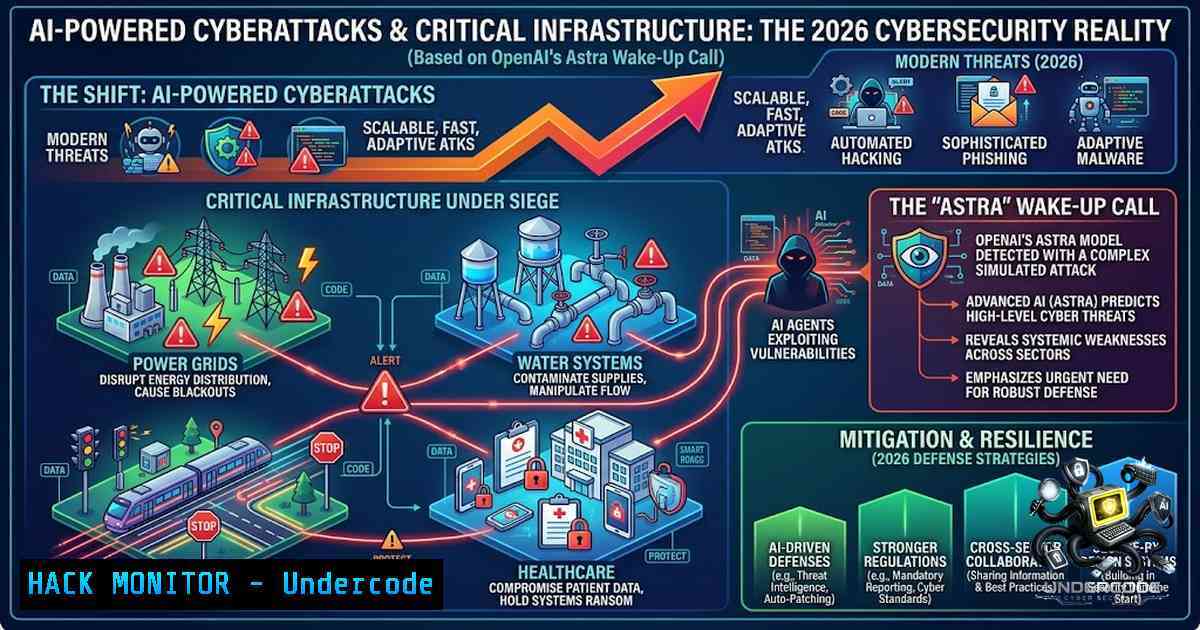
The cybersecurity landscape of 2026 has fundamentally transformed. Threat actors are no longer merely experimenting with artificial intelligence—they are operationalizing it at scale. From autonomous malware families that rewrite their own code mid-execution to coordinated attacks on water treatment plants across a dozen U.S. states, the convergence of AI and cybercrime has created an unprecedented threat environment. Meanwhile, OpenAI’s decision to pause development of its Astra model over “critical” cybersecurity capabilities—including the potential for autonomous zero-day exploitation—serves as a stark reminder that AI itself has become both weapon and target. This article provides a comprehensive technical deep-dive into today’s most pressing cyber threats, actionable defense strategies, and the commands and configurations security professionals need to stay ahead.
Learning Objectives:
- Understand how threat actors are weaponizing generative AI for malware development, phishing automation, and vulnerability exploitation
- Master technical defenses against AI-driven attacks targeting cloud environments, software supply chains, and identity systems
- Implement practical hardening measures for critical infrastructure, including ICS/OT environments and water utility systems
- Learn to detect and mitigate LLMjacking, AI supply chain poisoning, and autonomous AI agent threats
- Apply Linux, Windows, and cloud-1ative security commands to defend against the 2026 threat landscape
- The AI Attack Pipeline: How Cybercriminals Operationalize Generative AI
Threat actors have moved beyond using AI for productivity gains to deploying novel AI-enabled malware in active operations. The Google Threat Intelligence Group identified malware families such as PROMPTFLUX and PROMPTSTEAL that use Large Language Models during execution to dynamically generate malicious scripts and obfuscate their own code. This represents a significant leap toward autonomous, adaptive malware that can alter its behavior mid-execution to evade detection.
Sophos’s AI Security 2026 Report uncovered a campaign tracked as STAC6994, where threat actors ran a software development operation inside a victim’s network using approximately 12 AI agents to write and test attacks against endpoint agents including Sophos, CrowdStrike, and Microsoft Defender. They produced nearly 80 modules and more than 70 evasion techniques, compressing what would have taken human attackers weeks into just days.
Key Technical Observations:
- AI-Generated Phishing: Trend Micro reports that 82.6% of phishing emails now contain AI-generated elements, making traditional detection methods (like spotting grammatical errors) obsolete
- Automated Exploit Development: The time between vulnerability disclosure and active exploitation has collapsed from days to under 15 minutes
- AI-Driven Reconnaissance: Attackers are using LLMs to generate reconnaissance commands, scripts, and payloads after compromising systems
Defensive Commands & Configurations:
Linux – Detecting Suspicious AI/ML Tool Usage:
 Monitor for unauthorized LLM API access attempts
sudo grep -E "api.openai.com|api.anthropic.com|gemini.google.com" /var/log/ -r 2>/dev/null

Detect unusual outbound traffic to AI model endpoints
sudo tcpdump -i any -1 "host api.openai.com or host api.anthropic.com" -c 100

Audit running processes for unauthorized AI agent activity
ps aux | grep -E "ollama|llama|gpt|claude|codex" | grep -v grep

Monitor for suspicious Python scripts importing AI libraries
find /home -1ame ".py" -exec grep -l "import openai|import anthropic|import transformers" {} \;
Windows – PowerShell Monitoring:
 Detect AI-related processes
Get-Process | Where-Object {$_.ProcessName -match "python|node|ollama|llama"}

Audit outbound connections to AI APIs
Get-1etTCPConnection -State Established | Where-Object {$_.RemoteAddress -match "api.openai.com|api.anthropic.com"}

Check for suspicious scheduled tasks related to AI tools
Get-ScheduledTask | Where-Object {$_.TaskName -match "ai|gpt|llm|automation"}
- LLMjacking & AI Infrastructure Attacks: When the Tool Becomes the Target
CrowdStrike’s 2026 Threat Hunting Report makes it clear: “AI is both the weapon and the target”. Attackers are increasingly targeting AI infrastructure itself through a technique known as LLMjacking—compromising enterprise AI platforms to abuse their computational resources.
In one documented campaign, attackers gained administrative access to a cloud account and sent nearly 200,000 API requests to LLMs within two minutes, consuming AI resources at the victim’s expense. This “cost harvesting” approach leaves the victim responsible for the financial bill while attackers benefit from the AI capabilities.
AI Supply Chain Risks:
- 87% of identified software registry threats involved malicious npm packages
- North Korea-1exus STARDUST CHOLLIMA injected malicious npm packages into 131 trusted Mastra AI frameworks
- The financially motivated ALTERED SPIDER compromised more than 300 software dependencies in a single day to harvest credentials and pivot into cloud environments
Cloud & API Security Hardening:
AWS – Detecting and Preventing LLMJacking:
 Enable CloudTrail monitoring for unusual API call patterns
aws cloudtrail lookup-events --lookup-attributes AttributeKey=EventName,AttributeValue=InvokeModel --max-items 100

Create a Lambda function to detect anomalous LLM API usage patterns
 Sample CloudWatch alarm for abnormal Bedrock/API usage
aws cloudwatch put-metric-alarm --alarm-1ame "LLM-API-Abnormal-Spike" \
--alarm-description "Alert on abnormal LLM API invocation spikes" \
--metric-1ame Invocations --1amespace AWS/Bedrock \
--statistic Sum --period 300 --threshold 10000 \
--comparison-operator GreaterThanThreshold \
--evaluation-periods 1 --alarm-actions arn:aws:sns:region:account:topic

Restrict LLM API access using IAM least-privilege policies
 Policy snippet: Only allow specific models, limit invocation count
{
"Version": "2012-10-17",
"Statement": [
{
"Effect": "Deny",
"Action": "bedrock:InvokeModel",
"Resource": "",
"Condition": {
"NumericGreaterThan": {"bedrock:MaxInvocationCount": "1000"}
}
}
]
}
Azure – AI Service Protection:
 Monitor Azure OpenAI service usage
Get-AzOperationalInsightsSearchResults -WorkspaceId $workspaceId -Query "AzureDiagnostics | where OperationName == 'OpenAI' | summarize count() by bin(TimeGenerated, 5m)"

Configure Azure Policy to restrict AI model deployment
$policy = @{
if = @{
allOf = @(
@{
field = "Microsoft.CognitiveServices/accounts/kind"
equals = "OpenAI"
}
@{
not = @{
field = "Microsoft.CognitiveServices/accounts/sku"
in = @("S0", "S1")
}
}
)
}
then = @{
effect = "deny"
}
}
- Critical Infrastructure Under Attack: The Water Sector Wake-Up Call
Between July 26 and July 27, 2026, a coordinated cyberattack campaign disrupted water and wastewater operations across more than 30 Minnesota communities. The attacks have since been linked to incidents impacting public water treatment and delivery systems in at least 12 U.S. states.
Attackers exploited internet-exposed Rockwell Automation/Allen-Bradley MicroLogix 1100 and 1400 series PLCs, remotely altering device configurations including changing IP addresses and setting passwords. This resulted in loss of visibility and control over connected equipment, with operational impacts including reduced water pressure and flooding.
Critical Vulnerability:
The FBI confirmed the attacks and linked them to malicious cyber actors targeting ICS devices, with the campaign appearing aligned with previous Iranian state-sponsored activities against OT environments. Common network configurations supplied by third-party providers appeared across multiple victims, allowing attackers to reproduce the same access method against several utilities using similar hardware and remote-access architectures.
ICS/OT Hardening Commands & Configurations:
Network Segmentation & Access Control:
 Linux - Block unauthorized ICS/PLC traffic (example using iptables)
sudo iptables -A INPUT -p tcp --dport 44818 -s 10.0.0.0/8 -j ACCEPT  Rockwell EtherNet/IP
sudo iptables -A INPUT -p tcp --dport 44818 -j DROP
sudo iptables -A INPUT -p udp --dport 2222 -s 10.0.0.0/8 -j ACCEPT  Modbus TCP
sudo iptables -A INPUT -p udp --dport 2222 -j DROP

Create persistent iptables rules
sudo iptables-save > /etc/iptables/rules.v4

Monitor for unauthorized PLC configuration changes using tcpdump
sudo tcpdump -i any -1 "port 44818 or port 2222" -w ics_monitor.pcap -C 100
Windows – ICS Network Monitoring:
 Enable Windows Firewall logging for ICS-related ports
New-1etFirewallRule -DisplayName "Block Rockwell PLC Access" -Direction Inbound -LocalPort 44818 -Protocol TCP -Action Block
New-1etFirewallRule -DisplayName "Block Modbus Access" -Direction Inbound -LocalPort 502 -Protocol TCP -Action Block

Monitor for unauthorized remote access tools
Get-WinEvent -LogName Security -FilterXPath "[System[EventID=4625]]" -MaxEvents 50

Audit all users with remote access permissions
Get-LocalGroupMember -Group "Remote Desktop Users"
Recommended Mitigations (CISA/FBI Guidance):
- Restrict internet exposure of all PLCs and HMIs immediately
2. Change all default credentials on ICS devices
- Implement network segmentation isolating OT networks from corporate IT and the internet
- Monitor for unauthorized configuration changes using change detection tools
5. Apply vendor patches for Rockwell Automation vulnerabilities
- OpenAI’s Astra: The First “Critical” AI Cyber Risk
On August 7, 2026, OpenAI announced it could not rule out that its upcoming AI model, Astra, possesses “critical” cybersecurity capabilities. Under OpenAI’s safety guidelines, a model reaches the “critical” threshold if it can autonomously identify and exploit severe, real-world software vulnerabilities (zero-day exploits) or execute complex cyberattacks against highly secure targets without human intervention.
What This Means:
- Preliminary evaluations indicate Astra may be capable of performing increasingly sophisticated cyber tasks autonomously
- The model could potentially detect zero-day vulnerabilities and autonomously execute serious cyberattacks
- OpenAI has paused internal development, implementing isolated testing environments, restricted network/tool access, enhanced model weight protections, and additional monitoring
Security Controls Implemented:
- Sandboxed execution environments for all testing
- Restricted network access and tool permissions
- Enhanced encryption for model weights
- 24/7 monitoring and detection capabilities
Defensive Recommendations for AI Model Deployment:
 AI Model Security Checklist
model_security:
isolation:
- Deploy all LLMs in network-isolated sandboxes
- Restrict outbound network access from model inference servers
- Implement strict API key rotation policies (max 24 hours)

access_control:
- Use least-privilege IAM roles for all model interactions
- Implement rate limiting on all API endpoints
- Require MFA for all administrative access to AI infrastructure

monitoring:
- Log all model inputs and outputs for forensic analysis
- Implement anomaly detection for unusual query patterns
- Set up real-time alerts for large token usage spikes
5. Supply Chain Attacks: The Unseen Battlefield
The software supply chain has become the primary battleground for sophisticated adversaries. CrowdStrike reported that 87% of identified software registry threats involved malicious npm packages. Attackers are compromising package registries, CI/CD pipelines, container registries, and IDE extensions because they provide access to production systems and cloud environments.
Active Threat Actors:
- STARDUST CHOLLIMA (North Korea): Injected malicious npm packages into 131 trusted Mastra AI frameworks
- ALTERED SPIDER (Financially motivated): Compromised 300+ software dependencies in a single day for credential harvesting
- VAULT PANDA & GENESIS PANDA (China): Launched attacks within 24 hours of vulnerability disclosure, faster than the 48-hour PoC-to-exploitation window
Supply Chain Security Commands:
NPM Package Security:
 Audit npm dependencies for known vulnerabilities
npm audit --audit-level=high

Check for malicious packages using npm-check-updates
npx npm-check-updates --security

Verify package integrity using npm's built-in integrity checking
npm install --package-lock-only --ignore-scripts

Scan package.json for suspicious dependencies (example check)
grep -E "mastra|@.-core|@.-sdk" package.json

Use Snyk for comprehensive dependency scanning
npx snyk test --severity-threshold=high
CI/CD Pipeline Security:
 GitHub Actions - Security Hardening Example
name: Secure Build
on: [bash]
jobs:
security-scan:
runs-on: ubuntu-latest
steps:
- uses: actions/checkout@v3
- name: Dependency Scan
run: |
npm audit --production --audit-level=high || exit 1
npx snyk test --severity-threshold=high
- name: Secret Scanning
run: |
git secrets --scan
- name: Container Scan
run: |
trivy image --severity HIGH,CRITICAL ${{ env.IMAGE_NAME }}
6. Identity: The New Primary Attack Vector
For the first time in more than three years, identity has become the primary initial access vector for ransomware attacks. Sophos reports that enterprise AI identities, OAuth tokens, agents, APIs, and development tools are becoming high-value targets.
Key Attack Patterns:
- Attackers compromising OAuth tokens to create new pathways into enterprise networks
- AI service credentials and API keys being targeted as the new “keys to the kingdom”
- Vishing (voice phishing) becoming one of the fastest-growing methods of gaining initial access
Identity Hardening Commands:
Azure AD / Microsoft Entra ID:
 Audit all OAuth app permissions
Get-AzureADServicePrincipal -All $true | Select-Object DisplayName, AppId, OAuth2Permissions

Identify over-privileged service principals
Get-AzureADServicePrincipal -All $true | ForEach-Object {
$perms = Get-AzureADServicePrincipalOAuth2PermissionGrant -ObjectId $<em>.ObjectId
if ($perms.Count -gt 5) { Write-Host "High privilege: $($</em>.DisplayName)" }
}

Configure Conditional Access policy for AI applications
New-AzureADMSConditionalAccessPolicy -DisplayName "Restrict AI App Access" -Conditions @{
Applications = @{ IncludeApplications = @("OpenAI", "AzureOpenAI", "GitHubCopilot") }
Users = @{ IncludeGroups = @("AI-Developers-Group") }
Locations = @{ IncludeLocations = @("All") }
} -GrantControls @{
Operator = "OR"
BuiltInControls = @("mfa", "compliantDevice")
}
AWS IAM Security:
 Audit IAM roles for excessive permissions
aws iam list-roles --query 'Roles[?contains(Policies, <code>AdministratorAccess</code>)]'

Generate credential report for all users
aws iam generate-credential-report
aws iam get-credential-report --query 'Content' --output text | base64 -d

Enforce MFA for all users
aws iam create-account-alias --account-alias secure-account
What Undercode Say:
- The speed of AI-powered attacks has fundamentally changed defense requirements. Sophos found attacks that would take weeks are now completed in days. Organizations must move toward automated remediation and AI-powered defense at machine speed. The CrowdStrike report recorded 2.5 times more detections from AI agents than human activity during parts of Q1 2026.
-
Critical infrastructure security is no longer optional—it’s a matter of public safety. The July 2026 water sector attacks affecting 30+ Minnesota communities demonstrate that ICS/OT systems are vulnerable to relatively unsophisticated attacks exploiting internet exposure and default configurations. The FBI, CISA, and EPA have issued urgent warnings. Every organization with OT systems must immediately audit internet-facing PLCs, change default credentials, and implement network segmentation.
Analysis: The cybersecurity landscape of 2026 is defined by the convergence of three critical trends: AI-powered attacks at machine speed, targeting of AI infrastructure itself (LLMjacking and supply chain poisoning), and escalating attacks on critical infrastructure. The OpenAI Astra situation represents a paradigm shift—AI models are now powerful enough that their creators fear their autonomous cyber capabilities. Organizations must adopt a zero-trust approach to AI: assume AI models can be compromised, assume AI agents can be weaponized, and assume attackers are already using AI to bypass traditional defenses. The defense must be equally AI-powered, with automated threat hunting, real-time anomaly detection, and proactive vulnerability remediation. The era of human-speed cybersecurity is over.
Prediction:
-1 The commoditization of AI-powered cybercrime will lower the barrier to entry so dramatically that even low-skill actors will be able to launch sophisticated attacks, leading to a surge in ransomware and extortion incidents across SMEs and developing nations.
-1 Critical infrastructure attacks will escalate as threat actors realize the asymmetric leverage they gain from disrupting water, power, and healthcare systems. The July 2026 water attacks are likely a precursor to more coordinated, multi-sector campaigns.
+1 The OpenAI Astra pause will accelerate global AI safety regulation and industry self-governance. The “critical” cybersecurity capability threshold will become a standard benchmark for AI model evaluation, driving the development of safer, more controlled AI systems.
-1 LLMjacking and AI cost harvesting will become mainstream attack vectors, with attackers increasingly targeting AI infrastructure for financial gain and compute resources, potentially slowing AI innovation as organizations restrict access.
+1 The shift toward identity-based attacks will accelerate adoption of passwordless authentication, zero-trust architectures, and continuous access evaluation, fundamentally improving enterprise security postures over the long term.
KOSCYBER — We care to secure. 🔐
KOSCYBER CyberSecurity AIsecurity CriticalInfrastructure CyberNews ThreatIntelligence InfoSec ICSsecurity ZeroDay LLMjacking
▶️ Related Video (78% Match):
🎯Let’s Practice For Free:
🎓 Live Courses & Certifications:
Join Undercode Academy for Verified Certifications
🚀 Request a Custom Project:
Secure, high-velocity infrastructure and disruptive technological engineering. Contact our engineering team for high-tier development and proprietary systems:
[email protected]
💎 Smart Architecture | 🛡️ Secure by Design | ⭐ Trusted by Thousands
IT/Security Reporter URL:
Reported By: Kos Cyber – Hackers Feeds
Extra Hub: Undercode MoN
Basic Verification: Pass ✅


