Listen to this Post
Introduction:
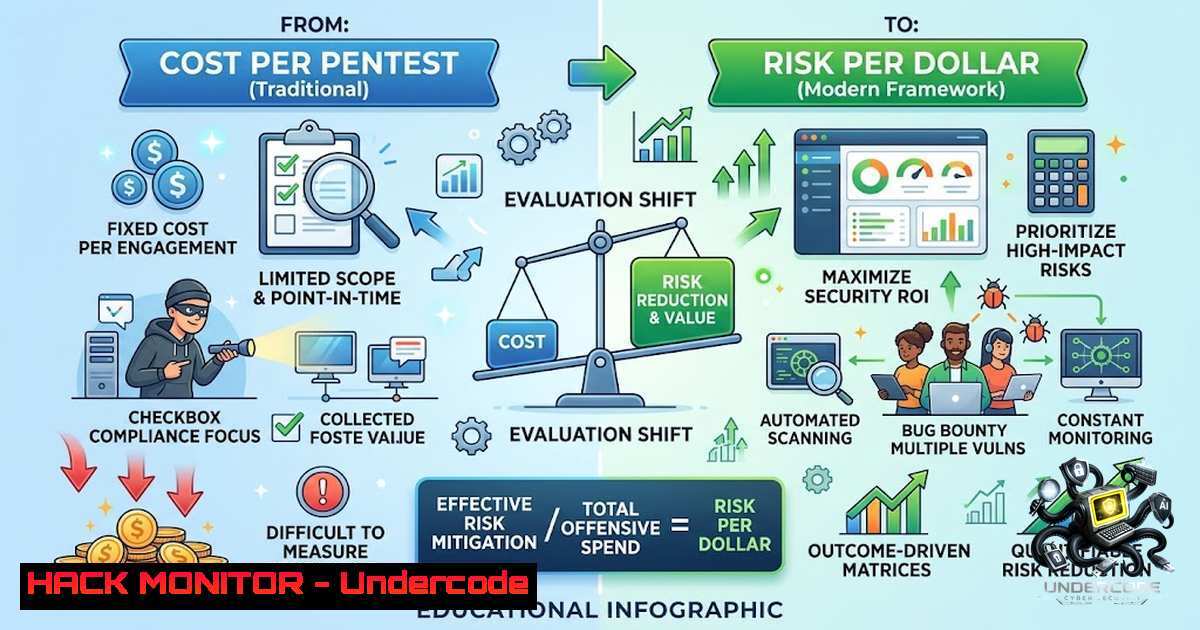
The penetration testing industry has exploded, with over 8,000 firms worldwide offering services that range from $2,000 to over $50,000 per application. For CISOs and security leaders, comparing these options has traditionally meant comparing price tags. However, a fundamental shift is underway: the most sophisticated buyers no longer evaluate a pentest by its cost, but by the risk it reduces per dollar spent. This framework—measuring “cost per vulnerability” and “risk reduced per dollar”—transforms security testing from a procurement exercise into a strategic risk mitigation function, and it’s a lens that is now being applied to the emerging field of AI security testing.
Learning Objectives & Secrets:
- Objective 1: Master the “Cost Per Vulnerability” Metric. Learn to evaluate penetration testing engagements not by the total cost, but by the number of high-impact, exploitable vulnerabilities identified. A lower-cost test that misses a critical bug, which later costs $20,000 in a bug bounty payout, was never truly cheap.
- Objective 2 Secret Tip: Quantify Risk Reduction. Go beyond vulnerability counts. Map each discovered flaw to a potential business impact—breach cost, regulatory fines, or reputational damage. This allows you to calculate the actual “risk reduced per dollar” and build a business case for investing in higher-quality testing.
- Objective 3 Secret Tip: Apply the Framework to AI Security. As AI adoption accelerates, the same principle applies. The question isn’t “how much does an AI pentest cost?” but “how much real risk does this AI security assessment actually reduce, and how fast?”. The market is shifting, and those who can measure risk reduction will lead.
You Should Know:
- The Economics of Offensive Security: Why Talent is the Real Cost Driver
The wide price disparity in penetration testing—from $5,000 to $400,000 for a red-team exercise—is not arbitrary. It is driven primarily by the caliber of the security researchers involved. The best researchers, who routinely earn top bounties on platforms like HackerOne and Bugcrowd, command premium rates. They possess the intuition and creativity to find complex, business-logic flaws that automated scanners and junior testers will miss. For a CISO, paying for top-tier talent is an investment in risk mitigation. A single missed critical vulnerability could result in a breach costing millions, dwarfing the initial savings of a cheaper test.
Step‑by‑Step Guide: Calculating the True Cost of a Pentest
- Define “Critical” Vulnerabilities: Work with your team to define what constitutes a critical or high-severity finding for your specific application (e.g., remote code execution, privilege escalation, data exposure).
- Track Post-Pentest Findings: After a pentest, track how many critical findings were identified. Compare this to findings from your bug bounty program or internal security team that occur after the test.
- Calculate Cost Per Critical Finding: Divide the total cost of the pentest by the number of critical vulnerabilities found. For example, a $50,000 test that finds 10 critical bugs costs $5,000 per critical finding.
- Factor in Bug Bounty Payouts: If a bug is missed by the pentest but later found and reported via your bug bounty program, add that bounty payout to the pentest’s “true cost.” A $20,000 bounty on a missed bug means your $50,000 test now costs $70,000 in real terms.
- Compare Vendors: Use this “cost per critical vulnerability” metric to compare different pentest vendors. The vendor with the higher upfront cost but significantly better find rates will often be the more cost-effective choice for risk reduction.
2. Linux Penetration Testing Command Toolkit
For hands-on security professionals, proficiency with Linux is non-1egotiable. The following commands form the bedrock of a thorough Linux assessment.
Step‑by‑Step Guide: Essential Linux Reconnaissance
- System and Network Enumeration: Begin by gathering intelligence on the target system.
OS and kernel information
uname -a
cat /etc/os-release

Network configuration and active connections
ip addr show
ss -tulpen  List all listening ports and services
sudo lsof -i -P -1  List open network files
-
User and Privilege Escalation Checks: Identify potential pathways for privilege escalation.
List users and their groups
cat /etc/passwd
cat /etc/group

Check for sudo permissions
sudo -l

Find SUID/SGID binaries (potential privilege escalation vectors)
find / -perm -4000 2>/dev/null
find / -perm -2000 2>/dev/null
-
Automated Enumeration with LinPEAS: For a comprehensive and fast assessment, use automated tools.
Download and run LinPEAS (Linux Privilege Escalation Awesome Script)
curl -L https://github.com/carlospolop/PEASS-1g/releases/latest/download/linpeas.sh | sh
LinPEAS will automatically enumerate the system, highlighting misconfigurations and potential vulnerabilities.
3. Windows Penetration Testing Command Toolkit
Windows environments require a different set of commands, often executed via PowerShell or the command prompt.
Step‑by‑Step Guide: Essential Windows Reconnaissance
- System and User Enumeration: Gather critical system information and user details.
System information
systeminfo
hostname

User and group enumeration
net user
net localgroup administrators
-
Network and Process Inspection: Understand the network layout and running processes.
Network connections and listening ports
netstat -ano

Running processes
tasklist /v
-
Automated Enumeration with WinPEAS: Similar to LinPEAS, WinPEAS automates the enumeration of Windows systems for privilege escalation vectors.
Download and run WinPEAS (from a PowerShell prompt)
.\winpeas.exe
WinPEAS will check for unquoted service paths, weak permissions, stored credentials, and other common misconfigurations.
-
Web Application and API Security Testing with OWASP Tools
Web applications and APIs are prime targets. The OWASP project provides excellent open-source tools for testing them.
Step‑by‑Step Guide: Web App and API Scanning
1. Initial Reconnaissance with Nmap and Gobuster:
 Scan for open ports and services
nmap -sV -sC -p- target.com

Enumerate directories and files
gobuster dir -u https://target.com -w /usr/share/wordlists/dirb/common.txt
- Web Vulnerability Scanning with Nikto and OWASP ZAP:
Scan a web server for common vulnerabilities
nikto -h https://target.com

Run OWASP ZAP in daemon mode for automated scanning
docker run -u zap -p 8080:8080 -i owasp/zap2docker-stable zap.sh -daemon -host 0.0.0.0 -port 8080
zap-cli quick-scan https://target.com
3. API Security Testing:
 Enumerate API endpoints from an OpenAPI spec
curl -s "https://api.target.com/swagger.json" | jq '.paths | keys[]'

Use a dedicated API scanner like 'offat'
offat -f https://api.target.com/swagger.json
5. Cloud and Infrastructure Hardening
Securing cloud infrastructure is a shared responsibility. Hardening both Linux and Windows servers is critical.
Step‑by‑Step Guide: Basic Server Hardening
1. Linux Hardening:
 Update all system packages
sudo apt update && sudo apt upgrade -y

Harden SSH configuration (disable root login, change default port)
sudo sed -i 's/PermitRootLogin prohibit-password/PermitRootLogin no/' /etc/ssh/sshd_config
sudo sed -i 's/Port 22/Port 2222/' /etc/ssh/sshd_config
sudo systemctl restart sshd

Set restrictive permissions on sensitive directories
sudo chmod 700 /root
2. Windows Hardening (PowerShell):
 Enable Windows Defender real-time protection
Set-MpPreference -DisableRealtimeMonitoring $false

Configure Windows Firewall
netsh advfirewall set allprofiles state on
6. The Rise of AI-Powered Penetration Testing
The industry is on the cusp of a major transformation. Many of the 8,000+ pentest firms are expected to become “AI pentest firms,” leveraging artificial intelligence to automate and enhance their services. This is a positive development, as it can democratize access to security testing and increase the speed and scale of assessments.
Step‑by‑Step Guide: Exploring AI Penetration Testing Tools
- Research Available Tools: Explore emerging open-source and commercial AI penetration testing frameworks. Projects like
offsec-ai,AIPTX, and `DarkMoon` are leading the charge. - Test with a Lab Environment: Before deploying any AI tool in a production environment, test it in a controlled lab setting, such as on a deliberately vulnerable application (e.g., DVWA, WebGoat).
- Integrate into CI/CD: Consider integrating AI-powered security agents like `strix-agent` into your CI/CD pipeline to automatically scan for vulnerabilities on every pull request.
- Evaluate Effectiveness: Just like with human testers, evaluate AI tools based on the “risk reduced per dollar” metric. Compare their findings against those from traditional tools and manual testing.
What Undercode Say:
- Key Takeaway 1: The real value of a penetration test is not its price tag, but its ability to reduce risk. CISOs are shifting from a cost-per-test mindset to a cost-per-vulnerability and risk-reduced-per-dollar framework. A more expensive test that finds critical flaws is a better investment than a cheaper test that misses them.
- Key Takeaway 2: The talent behind the test is the primary cost driver. The best security researchers are expensive because they find the bugs that matter. This principle will extend to the AI security space, where the quality of the AI model and its training data will determine its effectiveness.
- Analysis: The post highlights a critical maturity inflection point in the cybersecurity industry. As organizations become more sophisticated, they move beyond treating security as a compliance checkbox and begin to view it as a strategic risk management function. The introduction of AI into penetration testing is inevitable and beneficial, but it will not eliminate the need for human expertise. Instead, it will augment it, allowing skilled researchers to focus on the most complex and business-critical vulnerabilities. The ultimate differentiator for both human and AI-powered testing will be the ability to answer one question: how much real risk do you actually reduce, and how fast?
Prediction:
- +1: The adoption of AI in penetration testing will significantly lower the barrier to entry for security testing, enabling smaller companies to afford continuous, automated assessments.
- +1: The “cost per vulnerability” metric will become an industry standard, leading to greater transparency and accountability from penetration testing vendors.
- -1: The proliferation of AI pentest tools will lead to a flood of low-quality, automated reports, making it harder for organizations to distinguish between real threats and noise.
- -1: As AI tools become more common, attackers will also leverage them to discover vulnerabilities at scale, potentially increasing the speed and volume of attacks.
- +1: The human element will become more valuable, not less. The most sought-after security professionals will be those who can effectively direct, interpret, and act upon the findings of both human and AI-powered tests.
▶️ Related Video (78% Match):
🎯Let’s Practice For Free:
🎓 Live Courses & Certifications:
Join Undercode Academy for Verified Certifications
🚀 Request a Custom Project:
Secure, high-velocity infrastructure and disruptive technological engineering. Contact our engineering team for high-tier development and proprietary systems:
[email protected]
💎 Smart Architecture | 🛡️ Secure by Design | ⭐ Trusted by Thousands
IT/Security Reporter URL:
Reported By: https://lnkd.in/p/euqXj_WS – Hackers Feeds
Extra Hub: Undercode MoN
Basic Verification: Pass ✅


