Listen to this Post
Introduction:
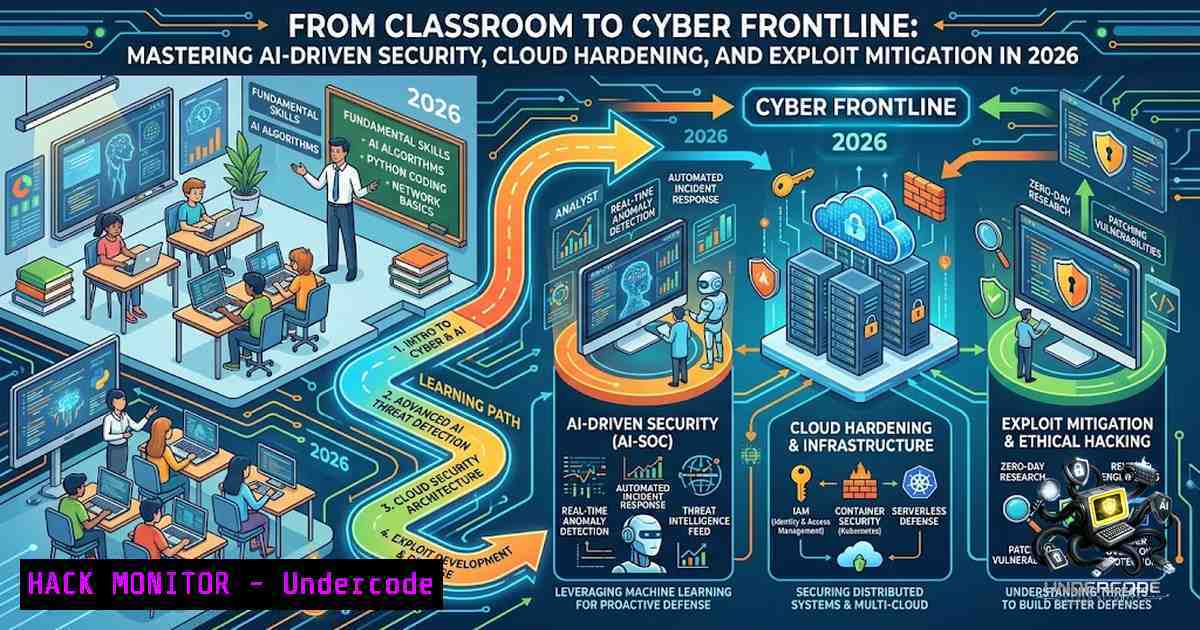
The digital battlefield is no longer confined to the realms of fiction; it is the reality of modern infrastructure, where every connected device and line of code represents a potential vulnerability. As BITT Polytechnic opens its doors to the next generation of engineers specializing in Cybersecurity, AI & ML, and Cloud Computing, the demand for professionals who can navigate this complex landscape has never been more critical. This article bridges the gap between academic theory and practical, battle-ready skills, providing a comprehensive guide to the core competencies required for a career in modern cybersecurity, from foundational command-line operations to advanced AI-driven threat hunting and cloud security hardening.
Learning Objectives:
- Master essential Linux and Windows command-line operations for security assessment and system administration.
- Understand and apply API security hardening principles and cloud infrastructure protection strategies.
- Learn to leverage AI tools for vulnerability discovery, penetration testing, and automated threat intelligence.
- Implement advanced vulnerability exploitation and mitigation techniques, including memory protection and input sanitization.
- Develop a holistic, multi-layered security mindset applicable to on-premise, cloud, and hybrid environments.
You Should Know:
- The Indispensable Command Line: Your First Line of Defense
Proficiency in the command line is the bedrock of cybersecurity. Whether you are managing a Linux server or a Windows domain, understanding how to navigate, audit, and secure systems from the terminal is non-1egotiable. For Linux, distributions like Kali or Ubuntu are standard in the industry. You must be comfortable with commands for process management, network analysis, and file permissions. For instance, to view active network connections and listening ports on a Linux system, you would use `ss -tulpn` or netstat -tulpn. On Windows, the equivalent is `netstat -an` or the more powerful `Get-1etTCPConnection` in PowerShell. Essential Windows security commands include `whoami /priv` to check user privileges and `auditpol /get /category:` to review audit policies.
- Linux Process Management: `ps aux | grep [bash]` to find a process ID, and `kill -9 [bash]` to terminate it forcefully.
- Windows System Audit: `systeminfo` to gather detailed system configuration, and `wmic qfe list brief /format:texttable` to list installed hotfixes.
- Network Diagnostics:
ping, `traceroute` (Linux) / `tracert` (Windows), and `nslookup` for DNS interrogation.
- API Security Hardening: Protecting the Digital Nervous System
APIs are the connective tissue of modern applications, and they are a prime target for attackers. Hardening your API gateways and endpoints is a critical task. A robust 2026 API security baseline must enforce TLS 1.2 or higher everywhere to encrypt data in transit. Furthermore, strict CORS (Cross-Origin Resource Sharing) policies should be configured to prevent unauthorized domains from interacting with your API.
- Step-by-Step Hardening:
- Enforce TLS: On an NGINX server, ensure your configuration includes `ssl_protocols TLSv1.2 TLSv1.3;` and uses strong ciphers.
- Configure Rate Limiting: Protect your endpoints from brute-force and DoS attacks. In an NGINX configuration, you can use `limit_req_zone $binary_remote_addr zone=mylimit:10m rate=5r/s;` to limit requests to 5 per second per IP.
- Implement Input Validation: Always validate and sanitize all inputs on the server-side using libraries like Pydantic for Python or Joi for Node.js. This prevents injection attacks.
- Principle of Least Privilege: Ensure that the service accounts used by your APIs have only the minimum necessary permissions within your cloud environment.
3. Cloud Hardening in Multi-Cloud Environments
With organizations rapidly adopting AWS, Azure, and GCP, securing cloud infrastructure is paramount. A key area of focus is identity and access management (IAM). For example, on Azure, you can audit service principals using the CLI: az ad sp list --all --query "[?contains(displayName, 'your-app-1ame')]". On AWS, a similar audit can be performed with `aws iam list-users` and aws iam list-attached-user-policies --user-1ame [bash].
- Hardening Commands:
- AWS: `aws guardduty create-detector –enable` to activate continuous security monitoring.
- Azure: `az security auto-provisioning-setting update –1ame default –auto-provision On` to ensure vulnerability assessments are automatically set up for VMs.
- Linux Hardening in Cloud: Use `systemctl` to disable unnecessary services. For example, `sudo systemctl disable –1ow vsftpd` disables the FTP service, reducing the attack surface.
4. Vulnerability Discovery and Exploitation Techniques
A defender must think like an attacker. Understanding exploitation techniques like code injection and Return-Oriented Programming (ROP) is crucial for building effective defenses. Tools like Metasploit and Nmap are industry standards for vulnerability scanning and penetration testing. For instance, using Nmap to scan for open ports on a target: nmap -sV -p- [bash]. This command performs a version detection scan on all ports, identifying running services and their versions, which can be cross-referenced with known vulnerability databases.
- Active Exploitation & Mitigation:
- Memory Protection: Modern operating systems employ techniques like Address Space Layout Randomization (ASLR) and Data Execution Prevention (DEP) to make exploitation harder.
- Input Sanitization: Always sanitize user inputs. For example, using parameterized queries in SQL prevents SQL injection attacks. A simple example in Python is using `cursor.execute(“SELECT FROM users WHERE id = %s”, (user_id,))` instead of string concatenation.
5. AI-Powered Cybersecurity: The Force Multiplier
AI is not just a topic in the curriculum; it is a powerful tool in the cybersecurity arsenal. AI can be used to analyze vast amounts of log data to identify anomalies, automate threat hunting, and even assist in exploit development. Tools like `aiscan` are emerging as AI-driven agents for penetration testing and red teaming.
- Practical AI Integration:
- Installation: On Linux, you can download and install a tool like `aiscan` using
curl -L -o aiscan https://github.com/chainreactors/aiscan/releases/latest/download/aiscan_linux_amd64 && chmod +x aiscan && sudo mv aiscan /usr/local/bin/. - Threat Hunting with AI: Platforms like `vigil` allow you to hunt threats from the terminal. For example, `vigil hunt –ioc “185.220.101.47”` can be used to investigate a specific indicator of compromise.
- Automated Security Scanning: Tools like the `Apiiro CLI` can be integrated into your CI/CD pipeline to scan for security issues automatically. A command like `apiiro scan –path ./my-app` can be run to identify vulnerabilities in your codebase.
- Zero-Day Vulnerability Mitigation: Closing the Window of Exposure
Zero-day vulnerabilities represent the most dangerous threats, as they are exploited before a patch is available. Modern defense strategies focus on reducing the “window of exposure.” This involves implementing Attack Surface Management (ASM) to continuously discover and assess risk and using runtime application self-protection (RASP) or similar technologies that can mitigate flaws in minutes rather than waiting for engineering cycles.
- Step-by-Step Mitigation Strategy:
- Maintain an Inventory: Use a Software Bill of Materials (SBOM) to know exactly what components are in your applications.
- Assume Breach: Implement a zero-trust architecture where every access request is verified, regardless of its origin.
- Behavioral Monitoring: Deploy endpoint detection and response (EDR) solutions that monitor for suspicious behavior rather than just known signatures.
- Rapid Response: When a new vulnerability is disclosed, use automated tools to identify exposure within minutes and apply virtual patches or configuration changes to mitigate the risk.
What Undercode Say:
- Key Takeaway 1: The foundation of a successful cybersecurity career is built on a deep understanding of operating systems and networking, which is precisely what programs like the one at BITT Polytechnic aim to provide.
- Key Takeaway 2: The future of security is proactive and AI-driven. Professionals must not only understand the threats but also how to leverage AI to defend against them at scale.
The analysis shows a clear industry shift from reactive security to proactive, intelligence-led defense. The integration of AI into security tools is not a novelty but a necessity to handle the volume and sophistication of modern cyberattacks. For aspiring students, this means that a curriculum combining foundational IT skills with advanced topics in AI and cloud security is the most direct path to a high-impact career.
Prediction:
- +1 The demand for cybersecurity professionals with AI and cloud expertise will continue to outpace supply, leading to higher salaries and more specialized roles in the next 3-5 years.
- -1 The increasing sophistication of AI-powered attacks will render many traditional, signature-based security tools obsolete, forcing organizations to rapidly adopt new defensive technologies and strategies.
- +1 Educational institutions like BITT Polytechnic that offer hands-on, industry-relevant training in these emerging fields will become critical talent pipelines for the global cybersecurity workforce.
- -1 The “patch gap”—the time between a vulnerability’s disclosure and its remediation—will remain a critical vulnerability for most organizations, with attackers increasingly exploiting this window.
- +1 The adoption of zero-trust architectures and AI-driven threat hunting will become standard practice, significantly improving the overall security posture of organizations that successfully implement them.
▶️ Related Video (78% Match):
🎯Let’s Practice For Free:
🎓 Live Courses & Certifications:
Join Undercode Academy for Verified Certifications
🚀 Request a Custom Project:
Secure, high-velocity infrastructure and disruptive technological engineering. Contact our engineering team for high-tier development and proprietary systems:
[email protected]
💎 Smart Architecture | 🛡️ Secure by Design | ⭐ Trusted by Thousands
IT/Security Reporter URL:
Reported By: Bittpolytechnic Bittpolytechnic – Hackers Feeds
Extra Hub: Undercode MoN
Basic Verification: Pass ✅


