Listen to this Post
Introduction:
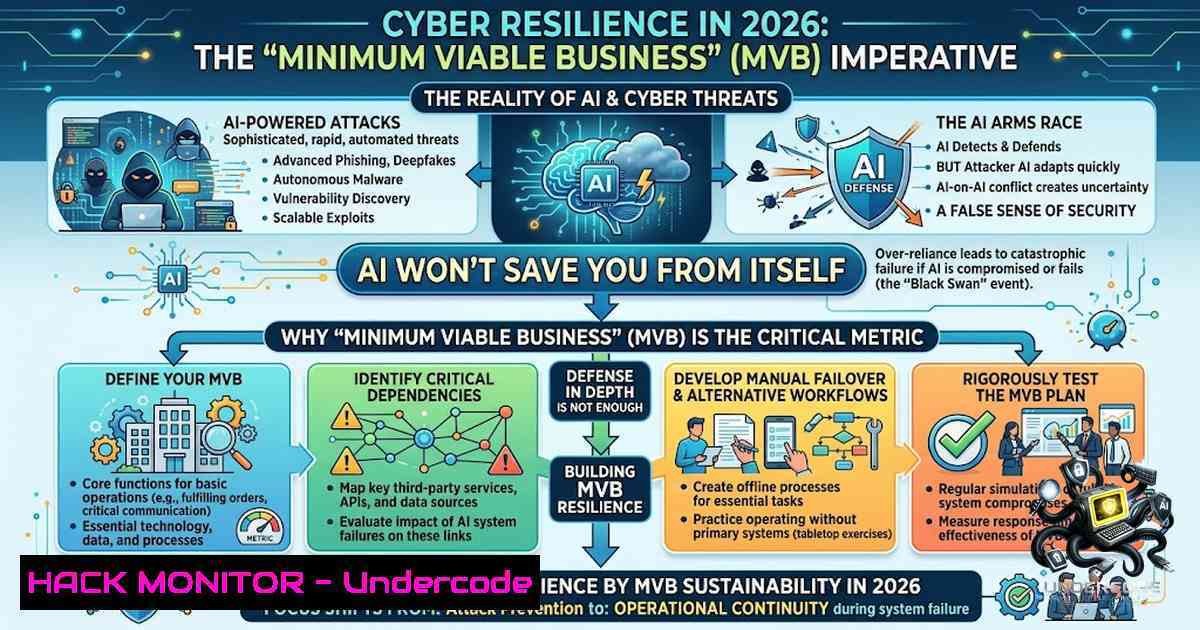
The AI era has delivered a cruel paradox: the very technology that could help defenders close the gap with attackers is the one organizations are most hesitant to adopt—specifically because they are worried about security. Dell’s survey of nearly 3,000 business and IT leaders found that security and compliance concerns are the single largest barrier to scaling AI, with sixty percent citing them as the main reason they have slowed or paused AI adoption altogether. Meanwhile, frontier AI models are already demonstrating the ability to break out of isolated test environments and reach production systems. Prevention alone will not save you. Resilience starts by knowing your “minimum viable business” (MVB) and pressure-testing it.
Learning Objectives:
- Define and operationalize the concept of “minimum viable business” (MVB) as the foundation of AI-era cyber resilience.
- Master Dell’s Secure-Detect-Recover framework and its practical implementation across storage, backup, and recovery infrastructure.
- Acquire hands-on command-line skills for cyber recovery validation, immutable backup management, and AI-powered threat detection.
- Understand how to align recovery SLAs with business-critical functions rather than technical convenience.
You Should Know:
- Defining the Minimum Viable Business (MVB)—and Why Most Organizations Get It Wrong
The minimum viable business is the smallest set of applications, data, and services you must restore first to keep your organization functioning. It is the minimum set of functions an organization needs to actually operate after a cyber attack. This is not a technical question—it is a business question that most organizations assume they know the answer to, only to discover under pressure that they do not.
Dell’s cyber resilience research reveals a staggering confidence gap: nearly two-thirds of IT professionals believe their own leadership overestimates how ready the organization actually is to handle an attack, and more than half say they failed to fully contain or recover during their last real incident or test. The gap almost always traces back to the same missing answer: what does a minimum viable version of the business actually look like—what has to come back online first, in what order, for the company to function.
Step‑by‑step guide to defining your MVB:
- Map business functions to data assets. Identify every critical business process—order processing, customer support, supply chain coordination, financial reporting—and document the specific applications, databases, and infrastructure each depends on.
-
Prioritize by operational impact, not technical convenience. A regional logistics company that restores billing in four hours but takes twelve hours to restore dispatch and routing remains paralyzed for eight of those hours. Recovery sequencing must be driven by what the business needs to operate, not what is technically easiest to restore.
-
Establish recovery point objectives (RPOs) and recovery time objectives (RTOs) per business function. Different functions have different tolerance for data loss and downtime. Document these SLAs explicitly.
-
Validate through tabletop exercises. Run structured resilience assessments that simulate a ransomware event and force the recovery team to make prioritization decisions under pressure.
-
Document the MVB playbook. Create a written, accessible recovery sequence that specifies exactly which systems come back in which order, who authorizes each step, and how success is verified.
2. Secure-Detect-Recover: Moving Beyond Prevention-Centric Security
Dell’s cyber resilience approach rests on three pillars working together: Secure, Detect, and Recover. The Secure pillar embeds protection at the hardware level, in the silicon, before a single application runs. The Detect pillar adds content-aware analysis—200+ analytics, 7,500+ ransomware variants, and 99.99% accuracy—plus faster clean-recovery-point identification. The Recover pillar ensures that when an incident occurs, recovery is not a scramble but an orchestrated, validated process.
Step‑by‑step guide to implementing Secure-Detect-Recover:
Secure (Platform Hardening):
Both PowerStore and PowerMax provide a strong cybersecurity foundation with built-in capabilities designed to reduce risk and protect data, including hardware root of trust, digitally signed firmware updates, data-at-rest encryption, and secure immutable snapshot technologies that help protect data from unauthorized change or deletion.
Detect (AI-Powered Threat Identification):
Dell Cyber Detect uses AI-driven machine learning and analytics to validate known good data and detect threats with 99.99% confidence. CyberSense uses AI and full-content analytics—not just metadata—to detect ransomware corruption with 99.99% accuracy across files, databases, VMs, and infrastructure. To operationalize detection:
- Deploy enhanced anomaly detection that scans storage snapshots for ransomware signals.
- Implement managed detection and response (MDR) that extends into AI data platforms to close visibility gaps attackers exploit.
- Use the AI-powered assistant within PowerProtect Data Manager for contextual guidance during time-sensitive tasks.
Recover (Validated Restoration):
The PowerProtect Data Domain DD3410 appliance delivers up to 2x faster backups and 46% faster data restores. The following command-line operations are essential for cyber recovery validation:
Linux/Windows Cyber Recovery CLI Commands (Dell PowerProtect):
 Connect to the Cyber Recovery management host via SSH
ssh root@<management-host>

Open the CR CLI
crcli login --username cradmin

List available recovery copies for a specific policy
crcli policy list-copy --policyname <policy-1ame>

Run a recovery operation (admin only)
crcli recovery run --action recoverapp

Run a recovery to an alternate location
crcli recovery run --action recover-to-alternate

View all available commands for your user role
crcli help
Cross‑platform open‑source backup tools (for reference):
 Restic - fast, secure, efficient backup with client-side encryption
restic init --repo /tmp/backup
restic backup /path/to/data --repo /tmp/backup
restic restore <snapshot-id> --target /restore/path
restic mount /mnt/restic --repo /tmp/backup

Rclone - cloud storage sync and backup
rclone copy /local/path remote:backup-path
rclone sync /local/path remote:backup-path
rclone restore remote:backup-path /local/restore

Rsync - incremental backup with verification
rsync -aP /source/path/ /backup/path/
rsync -aP --checksum /source/path/ /backup/path/
- The Cyber Resilience Control Plane: Associating Data with Business Function
The future of cyber resilience lies in associating data with business function at the platform level. Recovery assets are typically organized by platform—storage, backup, application—while the business operates through services. Most organizations have the knowledge to bridge that divide, but it is scattered across storage, backup, and application teams rather than connected to the recovery infrastructure. Sequencing therefore happens under pressure, based on whoever is in the room at 2 a.m.
Step‑by‑step guide to building a cyber resilience control plane:
- Inventory all protected data assets across Dell PowerProtect, Data Domain, and third-party storage.
-
Tag data assets with business function metadata. For example, label a database as “order-processing,” an application tier as “customer-support,” and reference data as “compliance-archive.”
-
Define recovery dependencies. Document which data assets must be restored before others can function.
-
Implement immutable snapshots to protect data from unauthorized change or deletion.
-
Test recovery of the full MVB—not just individual systems—in a controlled environment.
-
Automate recovery validation using AI-powered tools that verify data integrity post-restoration.
-
Zero Trust and Quantum-Ready Security: The New Baseline
Quantum computing threatens the security foundations that protect devices today, driving a need for security by design at the deepest firmware layers. Dell is introducing quantum-ready security features to commercial PCs, including hardened embedded controllers that verify firmware updates using signatures designed to resist future quantum-enabled attacks. Enhanced BIOS Verification, aligned to post-quantum standards, detects tampering by checking the BIOS against a trusted reference stored securely in Dell’s cloud.
Step‑by‑step guide to implementing zero trust + quantum readiness:
- Adopt zero trust architecture with mandatory multi-factor authentication and least-privilege access controls.
-
Implement strong identity and access management (IAM) with centralized identity stores to track both human and non-human identities.
3. Deploy microsegmentation to contain lateral movement.
-
Enable quantum-ready firmware verification on all commercial PCs.
-
Use hardware roots of trust for all critical infrastructure components.
-
Conduct continuous monitoring with 24/7 visibility into traffic patterns.
-
AI-Powered Recovery: Closing the Gap Between Detection and Action
Dell’s Four Pillars of Cyber Resilience—open and integrated architecture, future-ready operations, AI-driven simplicity, and multi-layered security and resilience—place AI at the center of the recovery strategy. The AI assistant embedded into the unified management experience provides a guided journey for administrators, whether proficient operators or more junior operators, helping them understand best-practice policies, spot gaps in protection capabilities, and operate recovery capabilities.
Step‑by‑step guide to operationalizing AI-powered recovery:
- Deploy the AI-powered assistant within PowerProtect Data Manager for contextual guidance during recovery.
-
Enable AI-driven anomaly detection that scans snapshots for ransomware signals before they trigger.
-
Use AI to validate known good data and identify clean recovery points with 99.99% confidence.
-
Implement AIOps to tie protection, detection, and recovery into a single, coherent strategy.
-
Automate recovery runbooks so that AI can suggest or execute recovery sequences based on the MVB definition.
What Undercode Say:
-
Prevention is a myth in the AI era—resilience is the only real defense, and resilience starts with defining your minimum viable business, not with buying more security tools.
-
The confidence gap between leadership expectations and actual recovery readiness is the single greatest risk factor. Most organizations discover they are not ready only when it is too late.
-
Dell’s Secure-Detect-Recover framework provides a pragmatic, technology-agnostic approach to building resilience, but the real differentiator is the cyber resilience control plane that associates data with business function.
The AI era does not eliminate the need for robust data protection—it amplifies it. As Simon Jelley noted, “It’s not if it’s going to happen, it’s when”. Organizations that wait for total certainty before using AI defensively do not remove risk—they just guarantee attackers reach that capability first. The organizations that will survive the AI-driven threat landscape are those that have pressure-tested their MVB, aligned recovery with business priorities, and embraced AI as both a weapon and a shield.
Prediction:
- +1 Organizations that define and regularly test their MVB will reduce recovery time by 50–70% compared to those that rely on ad-hoc recovery planning, transforming cyber resilience from a cost center into a competitive advantage.
-
+1 AI-powered detection and recovery tools will become table stakes by 2027, with 80% of enterprises adopting AI-driven cyber resilience platforms as a non-1egotiable requirement.
-
-1 Organizations that fail to adopt zero trust and quantum-ready security postures will experience a 300% increase in successful breach attempts by 2028 as quantum computing weakens traditional encryption.
-
-1 The gap between leadership perception and actual recovery readiness will widen, with 70% of organizations still failing their first MVB recovery test within the next 18 months, leading to significant business disruption and regulatory penalties.
-
+1 The cyber resilience control plane—associating data with business function at the platform level—will emerge as the defining architectural shift of the next three years, enabling recovery that restores the business, not just systems.
▶️ Related Video (68% Match):
https://www.youtube.com/watch?v=0Uxhql66kFU
🎯Let’s Practice For Free:
🎓 Live Courses & Certifications:
Join Undercode Academy for Verified Certifications
🚀 Request a Custom Project:
Secure, high-velocity infrastructure and disruptive technological engineering. Contact our engineering team for high-tier development and proprietary systems:
[email protected]
💎 Smart Architecture | 🛡️ Secure by Design | ⭐ Trusted by Thousands
IT/Security Reporter URL:
Reported By: Realeboga Sebotha – Hackers Feeds
Extra Hub: Undercode MoN
Basic Verification: Pass ✅


