Listen to this Post
Introduction:
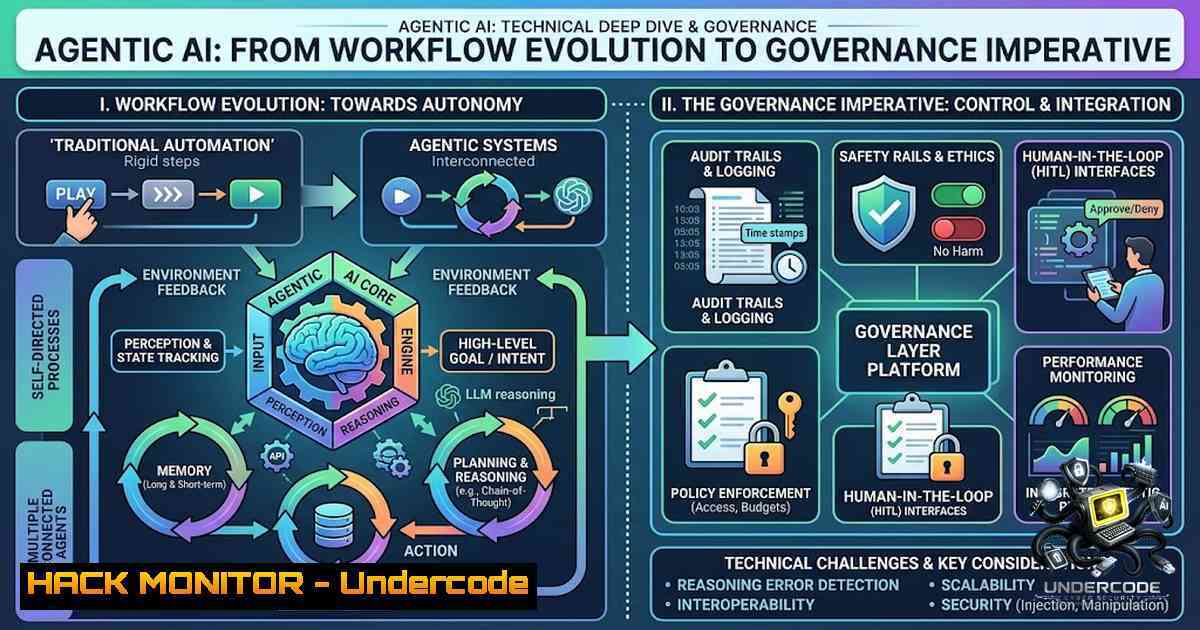
The modern enterprise is witnessing a paradigm shift where Agentic AI systems are transitioning from experimental proof-of-concepts to production-grade autonomous agents capable of reshaping entire IT and financial operations. This article dissects the core architecture, security frameworks, and governance models presented at the recent iThome Agentic Automation Day, translating these high-level discussions into actionable technical playbooks for system architects, security engineers, and AI implementation leads tasked with navigating this complex transformation.
Learning Objectives:
- Understand the foundational security requirements for integrating autonomous AI agents into existing enterprise IT infrastructure.
- Master the technical implementation of data repatriation strategies, including cloud-to-on-premise workload migration.
- Design and implement robust Agentic Governance models focusing on behavior, data lineage, and rule enforcement.
- Configure API gateways and granular access controls for secure Multi-AgentOps environments.
You Should Know:
1. Rethinking Cyber Defense for Autonomous Systems
Traditional security frameworks (CIA triad) are insufficient when dealing with autonomous agents that possess decision-making capabilities and environmental interaction vectors. Agentic systems introduce a “dynamic attack surface” where agents interact with APIs, internal databases, and external services based on real-time prompts and objectives. The key concern is the “Hallucination Exploit,” where an attacker manipulates input data to force an agent into executing unintended privileged commands or data exfiltration. This requires the implementation of “Constitutional AI” safety filters and strict context windows. In a technical sense, this translates to containerized runtime environments, the injection of canary tokens to detect data leaks, and the enforcement of “Principle of Least Privilege” (PoLP) across the agent’s entire toolchain.
Step‑by‑step guide implementing autonomous defense mitigation:
- Containerization: Isolate the agent’s runtime using Docker to prevent host system compromise.
docker run --rm -it --read-only --tmpfs /tmp:rw,noexec,nosuid \
-e "AGENT_API_KEY=$(vault read -field=key secret/agent)" \
my-agent-image:latest
- Command Sanitization: Validate shell commands generated by the agent.
if [[ $AGENT_CMD =~ ^(ls|pwd|cat|grep) ]]; then
eval "$AGENT_CMD"
else
echo "Blocked: $AGENT_CMD" >> /var/log/agent_security.log
fi
- Prompt Injection Testing: Regularly fuzz the agent’s input gateways using adversarial prompts to identify boundary violations. This ensures the agent ignores system prompt overrides from user inputs.
-
The Economics of Data Repatriation: AWS to On‑Premise
A significant trend discussed was the strategic movement of AI workloads from hyperscaler clouds (AWS) back to on-premise infrastructure. This is driven not just by cost optimization, as often speculated, but by “data gravity” and specific regulatory requirements regarding training data. While cloud environments offer elasticity, high-volume data transfer costs for large language model (LLM) fine-tuning and repetitive vector database queries can dwarf compute savings. The technical challenge lies in maintaining the scalability and redundancy of AWS while reducing egress fees and network latency. This requires deploying hyper-converged infrastructure (HCI) solutions capable of running GPU-accelerated workloads.
Step‑by‑step guide for hybrid repatriation:
- Audit Egress Costs: Utilize AWS Cost Explorer to identify the top data transfer contributors.
aws ce get-cost-and-usage --time-period Start=2026-07-01,End=2026-08-01 \ --granularity DAILY --filter '{"Dimensions": {"Key": "SERVICE", "Values": ["AWSDataTransfer"]}}' - Data Tiering: Use AWS Snowball or Storage Gateway to initially seed the on-premise storage.
- DNS Failover: Configure Route 53 to route active inference traffic to the on-premise cluster, maintaining the cloud as a fallback for capacity spikes.
{ "WeightedRoutingPolicy": { "Weight": 70, "SetIdentifier": "OnPrem" } } -
Network Optimization: Establish a dedicated AWS Direct Connect (or VPN) to ensure a secure, low-latency link for orchestration commands, keeping only the control plane in the cloud while the data plane resides locally.
-
Mastering the Agent Harness and Knowledge Base Evolution
Writing effective “Agent Harnesses” (or agent specifications) was a key technical theme. A harness defines the agent’s boundaries, tool access, and the context of the task. The shift is moving away from simple “Retrieval-Augmented Generation” (RAG) pipelines to “Agentic RAG,” where the agent dynamically decides how to query the knowledge base based on the user’s intent. This involves implementing semantic caching and query rewriting layers. The failure mode here is often “Context Retrieval Collapse,” where the agent continuously reads the same chunk of data, creating a feedback loop of irrelevant answers. To solve this, we implement “Vector Search Diversity” by adjusting `efSearch` parameters in vector databases like Milvus to increase variability in retrieved results.
Step‑by‑step guide for writing a robust Agent Harness:
Define the agent’s structure using YAML configurations, ensuring strict tool boundaries.
AgentHarness:
Name: "Financial-Analysis-Agent"
System "You are a strict financial analyst. Do not use web search. Only use internal tools."
Tools:
- Name: "SQL_DB_Query"
AccessLevel: "ReadOnly"
Connection: "SSH_Tunnel"
Command: "SELECT  FROM financials WHERE quarter = ?"
- Name: "Email_Send"
AccessLevel: "Write"
Parameters: [recipient, subject, body]
Important: The harness must include a “User Confirmation Gate” for any “Write” or “Delete” operations, forcing the agent to pause execution and request human authorization. Implement timeout logic to prevent agent loops.
 Example of a safety loop in Python
def execute_with_timeout(func, timeout=30):
with ThreadPoolExecutor(max_workers=1) as executor:
future = executor.submit(func)
try:
return future.result(timeout=timeout)
except TimeoutError:
print("Agent operation timed out.")
return None
4. Multi‑AgentOps and API Gateway Granular Access Control
When multiple agents interact, the complexity of access control expands exponentially. An agent might delegate tasks, such as a “Database Agent” requesting a “Reporting Agent” to summarize data. Security collapses if API gateways treat these machine-to-machine requests as trusted. The solution lies in implementing “mTLs” (mutual TLS) for agent-to-agent communication and “Distributed Policy Enforcement Points” (PEPs). We use Open Policy Agent (OPA) integrated with the API gateway to validate every request based on the agent’s identity (agent_id) and the specific scope of the request.
Step‑by‑step guide for implementing API Gateway Policies:
- Configure Client Certificates: Ensure each agent has a unique certificate to establish trust with the Istio/Envoy proxy.
- Define OPA Policy: Restrict the “Analytics-Agent” to only query the “Analytics-API.”
package envoy.authz</li>
</ol>

default allow = false

allow {
input.attributes.request.http.path == "/analytics/v1/data"
input.attributes.request.http.headers["x-agent-type"] == "Analytics-Agent"
}
3. Rate Limiting: Enforce rate limits on the API gateway based on the agent’s role to prevent a single misconfigured agent from causing a denial-of-service (DoS).
 Envoy configuration snippet for rate limits
rate_limits:
- stage: 0
actions:
- generic_key:
descriptor_value: "analytics-agent-limit"
- metadata:
metadata_key:
key: envoy.filters.http.rbac
path:
- agent_name
4. Audit Trails: Activate full request/response payload logging for debugging, ensuring sensitive data is masked via “Data Masking” filters to prevent token exposure in logs.
- The Three Pillars of AI Governance: Behavior, Data, and Rules
Governance is transitioning from a “check-box” compliance exercise to a technical reality embedded in the CI/CD pipeline. The three pillars form a technical triad: - Behavior: Monitoring drift (does the agent’s output conform to expected patterns?).
- Data: Tracking lineage (where did the agent retrieve this data, and was it properly sanitized?).
- Rules: Enforcing policies (does the action violate a company policy?).
Step‑by‑step guide for implementing technical governance:
- Data Lineage: Integrate “OpenLineage” to track every data query executed by the agent.
- Behavior Drift Detection: Collect embeddings of the agent’s responses and compare them to a baseline to monitor for output degradation or jailbreak attempts.
- Rule Enforcement: Use “Celery” and “Redis” to monitor the state of tasks. If an agent attempts to execute an unauthorized SQL query, automatically kill the worker thread and blacklist the agent ID.
from celery import Celery
app = Celery('tasks', broker='redis://localhost:6379/0')</li>
</ol>

@app.task(bind=True)
def secure_task(self, agent_prompt):
if "DROP TABLE" in agent_prompt:
self.retry(countdown=10, exc=Exception("SQL Injection attempt logged."))
4. Token Economy Monitoring: These governance layers must also track token consumption per agent to assist in cost allocation and identifying inefficient prompt usage.
What Undercode Say:
- Key Takeaway 1: Agentic AI is fundamentally a systems engineering challenge, not just a prompt engineering one. The security and architecture guardrails built around an agent determine its enterprise value far more than the underlying LLM model.
- Key Takeaway 2: The true differentiator moving forward will be “Agentic Governance.” Organizations must build observability and control planes as robust as their data planes to mitigate the risks of autonomous decision-making.
Analysis: While industry focus often drifts toward the “Next Gen AI” model, the conference highlighted that 80% of the current value lies in integration (APIs, cloud repatriation, and access control). The adoption of Agentic AI is currently hampered by the “legacy architecture tax,” where existing IT systems lack the APIs necessary for agents to interact. Companies are facing a “Data Tsunami,” where agents require structured, unambiguous data schemas to function effectively. The focus is now shifting from generic “pseudo-intelligence” to “functional intelligence,” where success is measured by the agent’s ability to execute specific tasks reliably. There is a clear consensus that the AI-1ative workflow will not replace human intelligence but will augment it by absorbing high-latency, repetitive data gathering and reporting tasks.
Prediction:
- +1 We predict a surge in demand for “Security Engineers” with expertise in prompt injection defense and agentic policy enforcement, outpacing the demand for pure AI researchers.
- -1 The reliance on API gateways creates a new, highly complex threat landscape. We predict a wave of “Agent-to-Agent” (A2A) poisoning attacks in the next 18 months, where malicious actors leverage compromised credentials to manipulate the entire agentic ecosystem.
- +1 Data repatriation will become a critical skill, with specialized “Cloud-to-OnPrem” migration frameworks emerging to balance AI inference speed and data sovereignty regulations.
- -1 Organizations that fail to implement “Token Economics” (cost tracking per query) will suffer from “Budget Shock,” unable to predict the resource consumption of their autonomous agent fleets, leading to project cancellations.
- +1 Agent Governance, specifically “Behavior,” will evolve into a formal certification standard, much like SOC2, requiring third-party audits of autonomous workflows. This will create a new niche market for AI audit firms.
- +1 We anticipate the standardization of “Agent Harnesses” through open-source frameworks, enabling easier interoperability between different agent vendors and preventing vendor lock-in.
- -1 The push towards on-premise data processing to cut costs may result in “Data Swamps” where legacy hardware cannot support the vector query demands of modern RAG systems, potentially negating the cost benefits.
- +1 The adoption of “mTLs” and “Distributed Policy Enforcement” will finally push Zero Trust Architecture (ZTA) principles into mainstream AI deployments, a move that will secure the foundational layer of future AI-1ative applications.
▶️ Related Video (74% Match):
🎯Let’s Practice For Free:
🎓 Live Courses & Certifications:
Join Undercode Academy for Verified Certifications
🚀 Request a Custom Project:
Secure, high-velocity infrastructure and disruptive technological engineering. Contact our engineering team for high-tier development and proprietary systems:
[email protected]
💎 Smart Architecture | 🛡️ Secure by Design | ⭐ Trusted by ThousandsIT/Security Reporter URL:
Reported By: Onlytest Attended – Hackers Feeds
Extra Hub: Undercode MoN
Basic Verification: Pass ✅🔐JOIN OUR CYBER WORLD [ CVE News • HackMonitor • UndercodeNews ]
📢 Follow UndercodeTesting & Stay Tuned:
- The Three Pillars of AI Governance: Behavior, Data, and Rules


