Listen to this Post
Introduction:
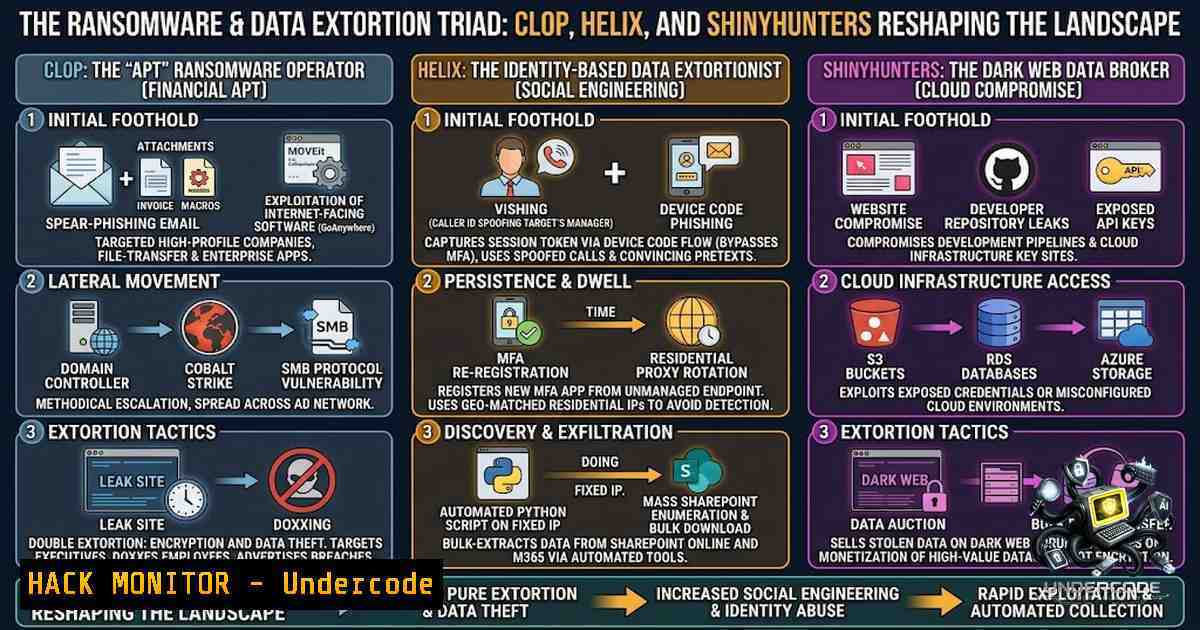
The modern cyber threat landscape is witnessing a dangerous evolution as ransomware groups diversify their attack vectors, moving beyond simple encryption to sophisticated data extortion campaigns. Recent attacks on Uber Freight, RingCentral, and major corporations like Shell and Philips demonstrate a concerning trend where threat actors combine social engineering, zero-day exploitation, and supply chain compromises to maximize impact. Organizations must now defend against a multi-layered threat matrix where data exfiltration has become the primary weapon, making traditional backup-and-recover strategies obsolete.
Learning Objectives:
- Understand the tactical evolution of modern ransomware groups and their shift toward data-centric extortion
- Implement detection and prevention mechanisms for social engineering attacks targeting enterprise AI platforms
- Configure vulnerability assessment tools to identify and remediate flaws in manufacturing management software like PTC Windchill and FlexPLM
- Develop incident response playbooks specific to data breach extortion scenarios
- Master the use of threat intelligence feeds to track emerging ransomware groups like Helix
- Exploiting Supply Chain Vulnerabilities: The PTC Windchill and FlexPLM Attack Surface
The Clop ransomware group’s recent targeting of over 40 victims, including Shell, Philips, and General Electric, highlights a critical weakness in industrial software supply chains. The attack likely exploited vulnerabilities in PTC Windchill and FlexPLM, platforms that manage product lifecycle and factory production lines. These systems often run on legacy architectures with exposed web interfaces, making them prime targets.
Step-by-step guide to identify and mitigate PTC/FlexPLM vulnerabilities:
1. Asset Discovery and Version Enumeration
 Linux: Scan network for Windchill instances
nmap -p 80,443,8080,8443 --open -sV --script=http-title 192.168.1.0/24 | grep -i "windchill|flexplm"
 Windows PowerShell: Check for installed versions via registry
Get-ChildItem -Path "HKLM:\SOFTWARE\Microsoft\Windows\CurrentVersion\Uninstall" | ForEach-Object { Get-ItemProperty $<em>.PsPath } | Where-Object { $</em>.DisplayName -like "Windchill" }
2. Vulnerability Assessment with Nuclei Template
 Install Nuclei and run specific templates for PTC vulnerabilities
nuclei -target https://your-windchill-server.com -t ~/nuclei-templates/http/vulnerabilities/ -tags ptc,windchill
3. Patch Management Workflow
- Download the latest security patches from PTC Support Portal (requires valid license)
- Implement a staged rollout: Test → Staging → Production
- Verify patch success:
Check services status after patching
systemctl status windchill-server
Critical Configuration Hardening:
 /etc/windchill/windchill.conf - Security hardening example
windchill.service.authentication=STRONG
windchill.session.timeout=15
windchill.audit.enabled=true
windchill.api.rate.limit=100/minute
windchill.external.connections.deny=true
Organizations should also implement network segmentation, ensuring that Windchill and FlexPLM servers are isolated from corporate networks and internet-facing systems use strict access control lists (ACLs).
- Social Engineering: The Human Firewall Vulnerability Exploited by ShinyHunters
The ShinyHunters group’s data breach at RingCentral, affecting 1.6 million customers, demonstrates that social engineering remains a highly effective attack vector. The attackers gained access to RingCentral’s AI-powered voice assistant infrastructure, exposing sensitive customer data. These attacks often rely on spear-phishing, pretexting, and credential theft.
Step-by-step guide to detect and prevent social engineering attacks:
1. Deploy Anti-Phishing Email Filters
 Linux: Configure SpamAssassin for enhanced filtering
 /etc/spamassassin/local.cf
score HEADER_FROM_DIFFERENT_DOMAINS 0.5
score SPF_FAIL 1.5
score DKIM_INVALID 1.0
 Add custom rules for executive impersonation
header EXEC_SPOOF From:name =~ /(CEO|CTO|CFO|President)/
describe EXEC_SPOOF Executive impersonation attempt
score EXEC_SPOOF 3.0
2. Implement User Behavior Analytics (UBA)
 Windows: Monitor for unusual login patterns using PowerShell
Get-WinEvent -FilterHashtable @{LogName='Security'; ID=4624; StartTime=(Get-Date).AddDays(-7)} |
Where-Object { $<em>.Properties[bash].Value -like "RingCentral" } |
Select-Object TimeCreated, @{Name='User';Expression={$</em>.Properties[bash].Value}}, @{Name='IP';Expression={$_.Properties[bash].Value}}
3. Configure MFA with Contextual Policies
 Example Azure AD Conditional Access Policy via MS Graph API
az rest --method POST --uri "https://graph.microsoft.com/v1.0/identity/conditionalAccess/policies" --body '{
"displayName": "Block unmanaged devices for RingCentral",
"conditions": {
"applications": {"includeApplications": ["ringcentral-app-id"]},
"signInRiskLevels": ["medium", "high"],
"clientAppTypes": ["all"],
"deviceStates": {"excludeDeviceStates": ["Compliant"]}
},
"grantControls": {"operator": "OR", "builtInControls": ["mfa", "block"]}
}'
Security Awareness Training Implementation:
- Schedule monthly phishing simulations using tools like KnowBe4
- Establish clear reporting channels for suspicious emails
- Conduct executive protection training targeting C-level personnel
- The Helix Group: Tracking and Analyzing Emerging Ransomware Actors
Helix, the new group that attacked Uber Freight, represents a worrying trend: rapid emergence and immediate monetization through data theft. These groups operate with agility, often bypassing traditional security controls and deploying sophisticated double-extortion tactics.
Step-by-step guide to threat intelligence collection on Helix:
- Set up OSINT Monitoring for Emerging Threat Groups
Linux: Use theHarvester and Recon-1g for dark web OSINT
Install dependencies
sudo apt install theharvester recon-1g

Example recon-1g command to search for Helix indicators
recon-1g
marketplace install search/leakix
workspace create helix_tracking
use search/leakix
set domain uber.com
run
2. Configure IDS/IPS Signatures for Known Exploits
 Suricata rule example to detect Helix group tactics
alert http $HOME_NET any -> $EXTERNAL_NET any (msg:"Helix Data Exfiltration Detected"; flow:to_server,established; content:"POST"; http_method; content:"/api/v1/data"; http_uri; pcre:"/(exfil|dump|export)/R"; sid:1000001; rev:1;)
3. Endpoint Detection and Response (EDR) Configuration
 Windows: Enable advanced logging for threat hunting
auditpol /set /subcategory:"Detailed File Share" /success:enable /failure:enable
auditpol /set /subcategory:"File System" /success:enable /failure:enable

Enable PowerShell script block logging
Set-ItemProperty -Path "HKLM:\SOFTWARE\Policies\Microsoft\Windows\PowerShell\ScriptBlockLogging" -1ame "EnableScriptBlockLogging" -Value 1
Analysis of Helix TTPs (Tactics, Techniques, and Procedures):
- Initial Access: Likely via exposed remote desktop protocols (RDP) or VPN vulnerabilities
- Defense Evasion: Uses living-off-the-land binaries (LOLBins) to avoid detection
- Exfiltration: Employs legitimate cloud storage services to avoid network monitoring
- Extortion: Targets C-level executives directly with personalized threats
4. Securing AI-Powered Voice Assistants: Lessons from RingCentral
The RingCentral breach highlights critical vulnerabilities in AI-powered communication platforms. Attackers can exploit these systems through credential harvesting, API abuse, and unsecured endpoints.
Step-by-step guide to secure AI voice assistant platforms:
1. API Security Hardening for AI Endpoints
 Linux: Configure Nginx reverse proxy with rate limiting and token validation
location /api/v1/voice {
limit_req zone=one burst=5 nodelay;
auth_request /auth/token;
proxy_set_header X-Real-IP $remote_addr;
proxy_set_header X-Forwarded-For $proxy_add_x_forwarded_for;
proxy_pass http://ai-voice-service:5000;
}
2. OAuth2/OpenID Connect Configuration
 Example OAuth2 configuration for AI platforms
oauth:
providers:
- name: ringcentral
client_id: RINGCENTRAL_CLIENT_ID
client_secret: RINGCENTRAL_CLIENT_SECRET
scopes: ["openid", "profile", "email"]
redirect_uri: https://your-app.com/oauth/callback
token_endpoint: https://platform.ringcentral.com/restapi/oauth/token
3. Data Encryption at Rest and in Transit
 Linux: Apply TLS 1.3 only and disable weak ciphers
 /etc/ssl/openssl.cnf
[bash]
MinProtocol = TLSv1.3
CipherString = DEFAULT@SECLEVEL=2
Security Checklist for AI Voice Platforms:
- Implement federated identity management with SAML or OIDC
- Conduct regular penetration testing of API endpoints
- Deploy Web Application Firewall (WAF) with OWASP Core Rule Set
- Enforce principle of least privilege for service accounts
- Implement real-time anomaly detection for unusual call patterns
- Ransomware Extortion Defenses: Building Resilience Against Data Leaks
With groups like Clop and Helix shifting focus to data theft, organizations must develop comprehensive data security strategies.
Step-by-step guide to data leakage prevention:
1. Data Loss Prevention (DLP) Policy Configuration
 Windows: Configure Windows Information Protection (WIP)
New-Item -Path "HKLM:\SOFTWARE\Policies\Microsoft\Windows\WIP" -Force
Set-ItemProperty -Path "HKLM:\SOFTWARE\Policies\Microsoft\Windows\WIP" -1ame "AllowUserDecryption" -Value 0
Set-ItemProperty -Path "HKLM:\SOFTWARE\Policies\Microsoft\Windows\WIP" -1ame "ProtectedDomainList" -Value ".acme.com;.acme.local"
2. Zero Trust Network Access (ZTNA) Implementation
 Linux: Configure WireGuard VPN with per-application routing
 /etc/wireguard/wg0.conf
[bash]
PrivateKey = [bash]
Address = 10.0.0.1/24
ListenPort = 51820

[bash]
PublicKey = [bash]
AllowedIPs = 10.0.0.2/32
 Restrict to specific application ports
Table = off
PostUp = ip rule add from 10.0.0.2/32 ipproto tcp dport 443 table 200
PostDown = ip rule delete from 10.0.0.2/32 ipproto tcp dport 443 table 200
3. Incident Response Playbook for Data Extortion
- Stage 1: Isolate affected systems immediately (notify incident response team)
- Stage 2: Preserve forensic evidence (memory dumps, network logs)
- Stage 3: Engage legal counsel and breach response providers
- Stage 4: Notify law enforcement and affected stakeholders
- Stage 5: Communicate transparently with customers and partners
Critical Backup Strategy:
 Linux: Implement immutable backup strategy with AWS S3 Object Lock
aws s3api put-object-lock-configuration --bucket critical-data-backups --object-lock-configuration '{
"ObjectLockEnabled": true,
"Rule": {
"DefaultRetention": {
"Mode": "GOVERNANCE",
"Days": 365
}
}
}'
6. Threat Hunting: Proactive Detection Against Emerging Ransomware
Organizations must adopt proactive threat hunting methodologies to detect ransomware groups before they execute their attacks.
Step-by-step guide to setting up threat hunting infrastructure:
1. SIEM Configuration with Custom Correlation Rules
 Elastic SIEM rule for suspicious process creation
rule:
name: Ransomware Process Chain Detection
type: correlation
condition: |
process.name in ["powershell.exe", "cmd.exe"] and
process.command_line contains " -enc " and
file.path contains "\temp\" and
network.direction == "outbound"
severity: high
2. Network Traffic Analysis for Data Exfiltration
 Linux: Use tcpdump and Wireshark to monitor unusual traffic patterns
tcpdump -i eth0 -1n -s 0 -G 300 -W 24 -z gzip -w /var/log/exfil_%Y%m%d_%H%M.pcap host ! 192.168.1.0/24 and port not 22 and port not 443
3. Endpoint Log Aggregation and Analysis
 Windows: Deploy Sysmon and collect logs
 Install Sysmon with custom configuration
Sysmon64.exe -accepteula -i sysmon-config.xml

Forward logs to centralized collector
wevtutil query-events Security /format:rss /rd:true /c:100
What Undercode Say:
- Key Takeaway 1: The convergence of ransomware and data extortion represents a paradigm shift in cyber threats, requiring organizations to prioritize data loss prevention and incident response over traditional backup strategies.
- Key Takeaway 2: Supply chain vulnerabilities in industrial software like PTC Windchill are becoming primary attack vectors, demanding immediate patching and network segmentation.
- Key Takeaway 3: AI-powered platforms, as demonstrated by the RingCentral breach, introduce new attack surfaces that require rigorous API security and identity management.
- Key Takeaway 4: The rapid emergence of new groups like Helix underscores the need for continuous threat intelligence and automated detection capabilities.
Analysis: The current ransomware landscape is characterized by four critical trends: (1) Increased specialization among threat actors, with groups targeting specific verticals; (2) The normalization of data extortion as the primary monetization strategy; (3) The exploitation of AI and cloud infrastructure as entry points; and (4) The sophistication of social engineering techniques that bypass traditional security controls. Organizations must adopt a zero-trust architecture, invest in proactive threat hunting, and implement comprehensive employee security awareness programs. The integration of AI-driven security analytics and automated incident response will be crucial in combating these evolving threats.
Prediction:
- -1: The number of ransomware groups will increase by 40% in the next 12 months, leading to a fragmented threat landscape that overwhelms security teams.
- +1: Increased public awareness and regulatory pressure will drive significant investment in cyber resilience, particularly in critical infrastructure sectors.
- -1: The cost of ransomware extortion will exceed $500 billion globally by 2027 as attacks become more frequent and severe.
- +1: The adoption of AI-powered threat detection and automated response systems will reduce mean time to respond (MTTR) from weeks to hours.
- -1: Supply chain attacks will become the dominant vector, with 60% of breaches originating from third-party vendors.
- +1: Open-source threat intelligence sharing platforms will evolve to provide real-time, actionable intelligence to SMBs.
- -1: Insurance premiums will increase by 200% for companies without robust cybersecurity frameworks.
- +1: The next generation of cybersecurity professionals will focus on adversarial AI and defensive data science, creating new career opportunities.
▶️ Related Video (78% Match):
🎯Let’s Practice For Free:
🎓 Live Courses & Certifications:
Join Undercode Academy for Verified Certifications
🚀 Request a Custom Project:
Secure, high-velocity infrastructure and disruptive technological engineering. Contact our engineering team for high-tier development and proprietary systems:
[email protected]
💎 Smart Architecture | 🛡️ Secure by Design | ⭐ Trusted by Thousands
IT/Security Reporter URL:
Reported By: https://lnkd.in/p/eaRv4G2P – Hackers Feeds
Extra Hub: Undercode MoN
Basic Verification: Pass ✅


