Listen to this Post
Introduction:
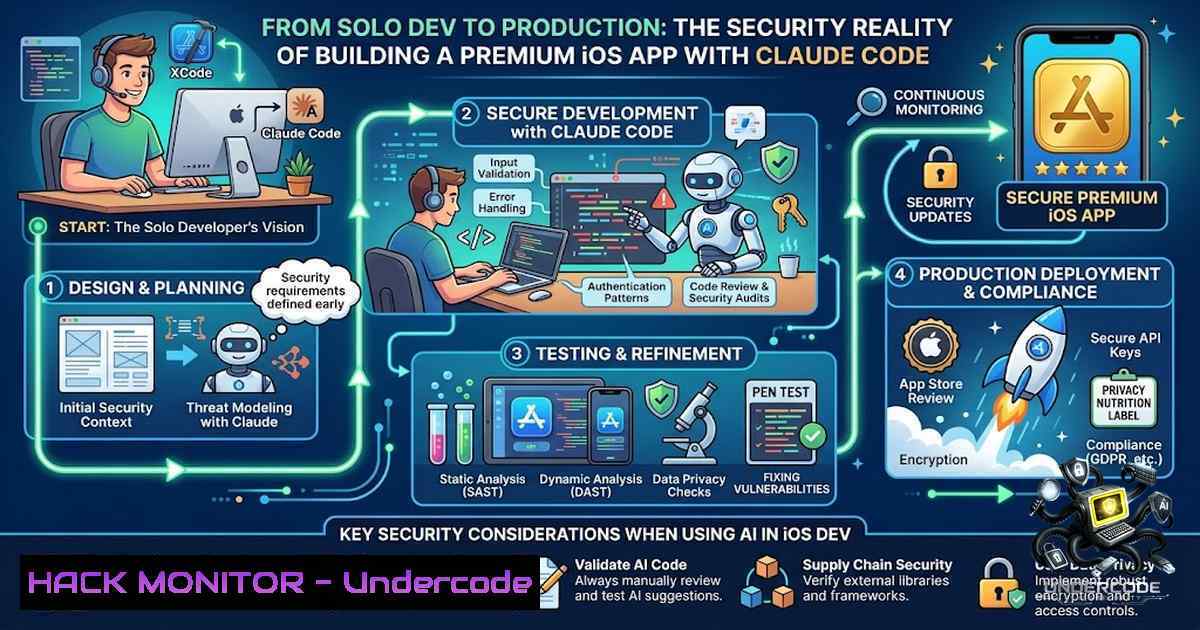
The intersection of AI-assisted development and production-grade security presents a paradox that few solo developers fully appreciate. When Darius Mora leveraged Claude Code to build Ābsorbed—a premium iOS app with a 4.8 App Store rating and $99/year subscription—he discovered that while AI can generate 95% of functional code, the remaining 5% requires specialized security engineering that no current AI model can reliably deliver. The Model Context Protocol (MCP) that enabled Claude to connect with XCode introduced capabilities that, without proper guardrails, could expose API keys, compromise user data, and create attack vectors that traditional development workflows would catch automatically. This article examines the security architecture required to safely deploy AI-generated iOS applications, the vulnerabilities that emerge when developers bypass traditional security reviews, and the practical hardening measures that transformed an AI-built MVP into a production-ready subscription product.
Learning Objectives:
- Understand the security risks inherent in MCP-based AI coding workflows, including credential exposure, prompt injection, and sandbox escape vulnerabilities
- Implement RevenueCat integration securely with proper API key management, Trusted Entitlements, and server-side verification
- Apply iOS production security controls including Keychain storage, App Transport Security, and dependency pinning
- Deploy Claude Code with enterprise-grade security controls including sandboxing, permission policies, and MCP allowlisting
- Establish a security review checklist for AI-generated code that covers injection flaws, insecure defaults, and hallucinated dependencies
You Should Know:
- The MCP Attack Surface: What Claude Code Can Actually Access
The Model Context Protocol (MCP), introduced by Anthropic in late 2024, provides Claude with a standardized way to connect to external tools and context sources. When integrated with XCode through an MCP server, Claude can interact with your iOS project, read files, execute build commands, and—crucially—modify code. This capability transforms the attack surface dramatically. Security researchers have demonstrated that over 85% of identified MCP attacks successfully compromise at least one platform, with core vulnerabilities universally affecting Claude, OpenAI, and Cursor.
The risk multiplies because MCP roughly doubles the security problem: you must decide not only what Claude can do in your shell, but also what it can do with every external system you connect. Third-party MCP servers should be treated like GitHub Apps with repo read scopes, CI plugins, or endpoint agents—requiring endpoint controls, egress controls, and audit trails.
Step-by-Step MCP Hardening for iOS Development:
 1. Audit active MCP servers and their permissions
claude mcp list

<ol>
<li>Restrict MCP server access using allowlist approach
Create .claude/settings.json with explicit tool permissions
{
"permissions": {
"allow": [
"mcp__xcode__read_file",
"mcp__xcode__build_project"
],
"deny": [
"mcp__xcode__modify_scheme",
"mcp__xcode__delete_files"
]
}
}</p></li>
<li><p>Enable sandboxing for all MCP operations
Set workspace boundaries - Claude can only write to its working directory
/sandbox --allow-read=/path/to/project --allow-write=/path/to/project/src</p></li>
<li><p>Verify MCP server integrity before approving
Check version pinning and source authenticity
claude mcp verify --server xcode-mcp --version 1.2.3
- The RevenueCat Integration: Where AI Almost Exposed Your Users
Mora’s engineer added RevenueCat integration and ensured API keys weren’t exposed—a task that took “a few hours of work for a decent engineer.” This understates the security complexity. RevenueCat SDK configuration requires using the public SDK key exclusively; secret keys must never ship in a mobile app. The `appUserID` must not be guessable, shared, or derived from email or device IDs.
Critical RevenueCat Security Implementation:
// ✅ CORRECT: Initialize with public key only
import RevenueCat

func configureRevenueCat() {
Purchases.configure(
with: Configuration.Builder(withAPIKey: "appl_public_key_here")
.with(usesStoreKit2IfAvailable: true)
.with(entitlementVerificationMode: .informational)
.build()
)
}

// ❌ NEVER: Embed secret keys in client code
// Purchases.configure(withAPIKey: "sk_live_secret_key_here") // DANGER

// ✅ Enable Trusted Entitlements to prevent MiTM attacks
// Trusted Entitlements requires SDK version 4.25.0+
// The SDK provides verification data, but YOU must check the result
func checkEntitlements() {
Purchases.shared.getCustomerInfo { customerInfo, error in
guard let info = customerInfo else { return }
if info.entitlements["premium"]?.isActive == true {
// Verification result must be checked - not automatic!
grantAccess()
}
}
}
RevenueCat’s Trusted Entitlements feature uses strong SSL to secure communications against interception, preventing MiTM attacks between the SDK and RevenueCat servers. However, enabling Trusted Entitlements does not automatically protect your app—it’s your responsibility to check the verification result in your code and decide whether to grant access based on unverified entitlements.
3. iOS Production Security: The Non-1egotiable Baseline
Mora’s engineer performed a security audit that caught exposed API keys and “something silly like that.” For production iOS apps with subscription revenue, this audit must be systematic. iOS apps should store credentials, tokens, and encryption keys exclusively in Keychain Services, never in NSUserDefaults, plist files, or Core Data without additional encryption.
Production iOS Security Checklist:
 1. Scan for hardcoded secrets using ios-security-scanner
npx ios-security-scanner scan --path ./ios

<ol>
<li>Verify Info.plist doesn't contain API keys
grep -r "api[_-]key" ./ios//Info.plist</p></li>
<li><p>Check App Transport Security configuration
NSAllowsArbitraryLoads must be false in production
plutil -p ./ios/App/Info.plist | grep NSAppTransportSecurity</p></li>
<li><p>Audit Swift Package Manager dependencies
Pin to exact versions, not floating ranges
swift package show-dependencies --format json | jq '.dependencies[].url'</p></li>
<li><p>Verify Keychain storage implementation
kSecAttrAccessibleWhenUnlockedThisDeviceOnly is minimum
security add-generic-password -a "user" -s "service" -w "secret" -T /usr/bin/security
The OWASP MASVS framework provides the definitive specification for mobile app security controls. Critical controls include: applying `.complete` Data Protection to sensitive files (encrypts contents when device is locked), enabling App Attest and DeviceCheck for server trust validation, and implementing App Tracking Transparency (ATT) for iOS 14.5+.
- Claude Code Vulnerabilities: What Your AI Assistant Won’t Tell You
In 2026, security researchers identified multiple critical vulnerabilities in Claude Code that directly impact production deployments. CVE-2026-46406 affects versions 2.1.59 through 2.1.128, where the `/copy` command wrote responses to a hardcoded, predictable path (/tmp/claude/response.md) without UID isolation, randomness, or symlink protection. This allowed any local user to read a privileged user’s Claude response—potentially containing secrets or credentials—and enabled local attackers to pre-create directories and plant symlinks to overwrite attacker-chosen files.
CVE-2026-40068 affects versions 2.1.63 through 2.1.83, where folder trust determination logic used the git worktree `commondir` file without validating its contents, allowing attackers to craft malicious repositories that execute hooks defined in .claude/settings.json. China’s National Vulnerability Database (NVDB) flagged versions 2.1.91 through 2.1.196 for built-in monitoring mechanisms that could transmit sensitive information—including location data and identity-related identifiers—to remote servers without user authorization.
Vulnerability Mitigation Commands:
 1. Check current Claude Code version
claude --version

<ol>
<li>Update to patched version (2.1.197+)
npm update -g @anthropic-ai/claude-code</p></li>
<li><p>Scan for vulnerable /copy command usage
find . -1ame ".md" -path "/tmp/claude/" -ls</p></li>
<li><p>Verify workspace trust settings
Never auto-trust repositories from unknown sources
cat .claude/settings.json | jq '.trust'</p></li>
<li><p>Implement pre-commit hooks for secrets scanning
Use trufflehog or git-secrets
trufflehog git file://. --since-commit HEAD~10
5. AI-Generated Code Security Review: The Human Firewall
Mora’s experience—building 95% of the app with AI and hiring an engineer for the final 5%—validates a critical security principle: AI-generated code requires human security review. Research shows AI code exhibits the same CWE-89, CWE-79, and CWE-798 patterns that static analysis has cataloged for two decades, but produced at a pace no human review queue was sized for.
AI Code Security Review Checklist:
 1. Run SAST on all AI-generated code
 Use Semgrep with AI-specific rules
semgrep --config p/ai-security --config p/owasp-top-ten ./src

<ol>
<li>Verify dependencies - AI hallucinates package names
Check every import exists on registries
npm audit --production
pip-audit --requirement requirements.txt</p></li>
<li><p>Scan for secrets in AI-generated code
gitleaks detect --source . --verbose</p></li>
<li><p>Check for insecure defaults
Disabled TLS verification, permissive CORS, weak parameterization
grep -r "verify=false|allowAnyOrigin|NO_CHECK" ./src</p></li>
<li><p>Manual review for injection flaws
SQL injection, command injection, path traversal
AI commonly generates vulnerable parameterized queries
The most common failure modes in AI-generated code are injection flaws, insecure defaults, and hallucinated dependencies. Teams should flag AI-generated code in pull requests, apply security-focused review specifically checking for injection vulnerabilities in code that processes external input, and verify authentication and authorization checks are present and correct.
What Undercode Say:
- AI accelerates development but cannot replace security engineering—Mora’s 95% AI-built app required human intervention for RevenueCat integration, API key management, and production hardening. The security-critical 5% represents the difference between a functional MVP and a production-ready subscription product.
-
MCP expands the attack surface exponentially—connecting Claude to XCode through MCP transforms a code assistant into a system that can read, write, and execute across your development environment. Without explicit permissions, sandboxing, and allowlisting, every MCP server becomes a potential supply chain attack vector.
-
Production iOS security requires systematic controls—Keychain storage, ATS enforcement, dependency pinning, and Trusted Entitlements verification are not optional. Mora’s engineer spent hours implementing these controls because AI models cannot reliably generate secure payment integration code.
-
Claude Code has known vulnerabilities that demand version management—CVE-2026-46406, CVE-2026-40068, and the NVDB backdoor warning demonstrate that AI coding tools themselves require patch management. Production deployments must run patched versions (2.1.197+) with strict workspace trust policies.
-
AI-generated code needs security review before merge—the same vulnerabilities that plague human-written code appear in AI output, but at higher velocity. SAST, secrets scanning, and manual injection checks must be non-1egotiable gates for AI-generated pull requests.
Prediction:
-
+1 Solo developers and small teams will increasingly adopt AI-first development workflows, but the “last mile” security engineering gap will create a new class of security consultants specializing in AI-generated code review and production hardening.
-
+1 MCP security tooling will mature rapidly, with enterprise-grade proxy layers, runtime guardrails (like Stallion), and automated allowlist management becoming standard components of AI development stacks.
-
-1 The frequency of AI-generated code vulnerabilities will increase as adoption scales, with attackers targeting MCP servers, prompt injection vectors, and hallucinated dependencies as primary entry points.
-
+1 Regulatory bodies will establish security certification requirements for AI-generated production code, similar to PCI DSS for payment processing, creating compliance-driven demand for security review automation.
-
-1 Organizations that treat AI-generated code as “reviewed” without systematic SAST, secrets scanning, and manual injection testing will experience security incidents within 6-12 months of production deployment.
-
+1 The integration of Claude Code Security capabilities—scanning codebases for vulnerabilities and suggesting targeted patches—will evolve into automated remediation workflows, reducing the human effort required for security review.
▶️ Related Video (74% Match):
https://www.youtube.com/watch?v=-ldzZ6D5cwY
🎯Let’s Practice For Free:
🎓 Live Courses & Certifications:
Join Undercode Academy for Verified Certifications
🚀 Request a Custom Project:
Secure, high-velocity infrastructure and disruptive technological engineering. Contact our engineering team for high-tier development and proprietary systems:
[email protected]
💎 Smart Architecture | 🛡️ Secure by Design | ⭐ Trusted by Thousands
IT/Security Reporter URL:
Reported By: Moravcik Im – Hackers Feeds
Extra Hub: Undercode MoN
Basic Verification: Pass ✅


