
Listen to this Post
Introduction:
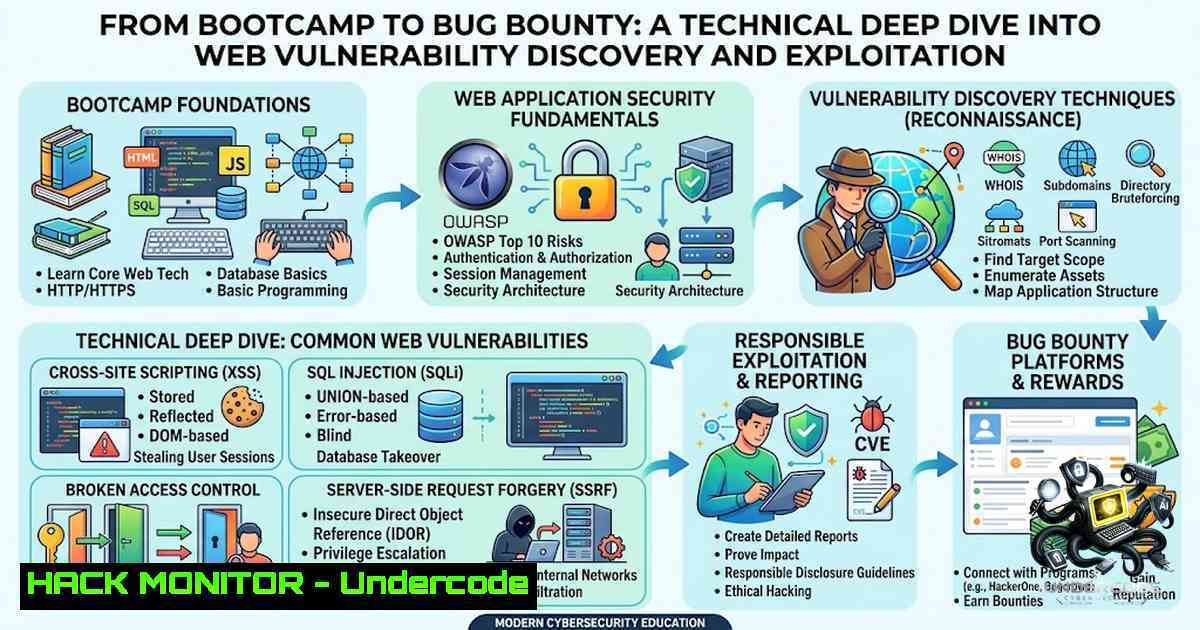
The ethical hacking and bug bounty landscape continues to evolve rapidly, with 2026 marking a pivotal year for offensive security professionals. A recent FREE Ethical Hacking & Bug Bounty Bootcamp, co-hosted by the Center For Cyber Security & Digital Forensics (CCSDF), Nexus Defenders, and Axeronix Technologies, brought together over 70 aspiring security researchers to explore the fundamental pillars of vulnerability discovery. Led by security researcher Muhammad Saqib Arif, the session covered reconnaissance, IDOR, XSS, authentication flaws, API security, and the art of writing effective bug reports—skills that are increasingly critical as API attacks surge by 681% and organizations scramble to secure their digital perimeters.
Learning Objectives & Secrets:
- Objective 1: Master the Hacker Mindset and Reconnaissance Methodology – Understand that reconnaissance is not merely running a few tools; it is a structured intelligence operation that transforms a single domain into a complete attack surface map. Start with business logic analysis, then progress through passive OSINT, subdomain enumeration, and active scanning.
-
Objective 2 Secret Tip: IDOR Beyond Basic Parameter Tampering – Most beginners stop at incrementing numeric IDs. Elite hunters test UUID predictability, manipulate indirect references in cookies and local storage, and leverage Burp Suite’s Autorize extension for automated cross-account testing. The secret is treating every user-supplied identifier as untrusted and testing authorization at every object access point.
-
Objective 3 Secret Tip: XSS Chaining for Maximum Impact – Reflected and stored XSS vulnerabilities remain prevalent, present in 68% of tested applications. The secret lies in chaining XSS with other flaws—using a stored XSS payload to steal session tokens, then leveraging those tokens to exploit IDOR or privilege escalation vulnerabilities for maximum severity and payout.
You Should Know:
1. Reconnaissance & Attack Surface Mapping
Reconnaissance is the foundation of every successful bug bounty engagement. The 2026 recon workflow follows a phased approach: passive intelligence gathering before any active scanning touches the target.
Step-by-step guide:
Phase 1 – Target Intake & Validation: Normalize the target, resolve the host, run reverse-DNS and geo-IP lookups, and define scope boundaries.
Phase 2 – Passive OSINT: Gather WHOIS, DNS records, ASN ownership, and email security posture without directly touching the target.
Phase 3 – Subdomain Enumeration:
 Linux – Passive subdomain discovery
subfinder -d target.com -all -recursive -o subs_subfinder.txt

Combine with assetfinder for broader coverage
assetfinder --subs-only target.com >> subs_assetfinder.txt

Use certificate transparency logs
curl -s "https://crt.sh/?q=%.target.com&output=json" | jq -r '.[].name_value' | sort -u
Phase 4 – Content Discovery:
 Wayback Machine URL harvesting
waybackurls target.com | sort -u > wayback.txt

Directory brute-forcing with ffuf
ffuf -u https://target.com/FUZZ -w /usr/share/wordlists/dirb/common.txt -e .php,.txt,.html -t 50

API endpoint discovery with Kiterunner
kr scan https://target.com -w routes-large.kite -x 20 --ignore-length=34
Kiterunner specializes in discovering undocumented API routes by sending properly-formatted requests with various HTTP methods, bypassing common security measures that block malformed requests.
2. Exploiting IDOR (Insecure Direct Object References)
IDOR vulnerabilities occur when applications use user-supplied input to access objects directly without proper authorization checks. The root cause is not just that an identifier is exposed, but that access control decisions are made—or skipped—based solely on user input.
Step-by-step IDOR testing methodology:
Step 1: Parameter Discovery – Identify all object references in URLs, API endpoints, POST bodies, cookies, and headers. Look for patterns like /user/123, ?file_id=456, or {"order_id":789}.
Step 2: Initial Testing with Burp Repeater – Send the request to Repeater, modify the identifier value, and observe the response. Test both horizontal (same privilege level, different user) and vertical (different privilege level) privilege escalation.
Step 3: Automated Testing with Burp Intruder:
1. Send the target request to Intruder (Ctrl+I)
2. Select “Sniper” attack type
- Highlight the identifier value and click “Add §” to set payload position
- Use a payload list of sequential numbers, UUIDs, or common patterns
Step 4: Advanced Bypass Techniques:
- Encode the identifier (Base64, URL-encode)
- Use alternative identifiers (email, username instead of ID)
- Manipulate indirect references in cookies or local storage
Prevention:
- Implement server-side authorization on every object access
- Use indirect reference maps (e.g., mapping table instead of exposing database IDs)
- Never trust client-side restrictions
3. Cross-Site Scripting (XSS) – Attack and Defense
XSS remains one of the most reported vulnerabilities, with OWASP reporting its presence in 68% of tested applications. The attack occurs when untrusted data is executed in a user’s browser context.
XSS Variants:
- Reflected XSS: Payload is reflected off a web server in an error message or search result
- Stored XSS: Payload is permanently stored on the server and executed when users access the compromised page
- DOM-based XSS: Payload executes through client-side JavaScript without touching the server
Testing for XSS:
 Simple reflected XSS test – inject into URL parameter
curl "https://target.com/search?q=<script>alert('XSS')</script>"

Using Burp Suite – intercept request and modify parameters
 Test common injection points: search fields, comment boxes, profile fields
Prevention Playbook:
- Rule 0: Never insert untrusted data except in allowed locations—avoid script blocks, HTML comments, attribute names, and tag names
- Rule 1: HTML-encode before inserting into element content
- Rule 2: Use Content Security Policy (CSP) with nonces as a second layer of defense
- Rule 3: Set HttpOnly and Secure flags on all authentication cookies; use SameSite=Strict or Lax
- Rule 4: For React applications, avoid
dangerouslySetInnerHTML; use DOMPurify for sanitization
4. API Security – The New Frontline
APIs now account for 71% of internet traffic, making them prime attack targets. The OWASP API Security Top 10 (2023 Edition) remains the industry standard, with Broken Object Level Authorization (BOLA)—formerly known as IDOR—topping the list.
Critical API Security Controls:
Authentication & Authorization:
- Use OAuth 2.0 with OpenID Connect for identity federation
- Validate tokens on every request: check signature, issuer, audience, expiration, and required claims
- Use short-lived access tokens (15-60 minutes) with rotating refresh tokens
- Never use basic authentication or static API keys for public APIs
Input Validation & Rate Limiting:
- Validate all input for type, length, and format
- Implement rate limiting to prevent brute force and resource exhaustion
- Enforce TLS 1.2 or 1.3 only
Testing API Security:
 Test API endpoint with different HTTP methods
curl -X GET https://api.target.com/v1/users/123
curl -X PUT https://api.target.com/v1/users/123 -d '{"email":"[email protected]"}'
curl -X DELETE https://api.target.com/v1/users/123

Check for BOLA – test accessing another user's resource
curl -H "Authorization: Bearer $TOKEN" https://api.target.com/v1/users/456
Prevention:
- Always perform authorization checks at the server level—never trust the client to enforce restrictions
- Replace sequential IDs with non-predictable identifiers
- Store secrets in secure vaults rather than hardcoding them
5. Writing Effective Bug Reports
A bug report survives triage when a stranger on the security team can reproduce the vulnerability. Poorly written reports waste triage time and damage your reputation.
Essential Report Structure:
- Clear vulnerability class and affected component (e.g., “IDOR in User Profile Endpoint Allows Access to Any User’s Personal Data”)
-
Description: Brief explanation of the vulnerability and its business impact
-
Preconditions: Account type, authentication state, specific endpoint or parameter
-
Reproduction Steps: Numbered steps using exact requests or a short proof-of-concept script
-
Proof of Concept: Include request/response pairs, screenshots, or a video demonstration
-
Impact: Plainly stated business impact—what an attacker can actually do
-
Suggested Fix: Optional but appreciated—shows you understand the remediation
Critical Rule: No PoC = No report. If you cannot reproduce it step by step, do not submit it.
6. Vulnerability Severity & Payout Expectations
Understanding how bug bounty programs classify severity is essential for maximizing earnings.
Severity Classification:
- Critical: Remote code execution, full account takeover, database compromise—payouts $5,000+
- High: IDOR exposing sensitive user data, authentication bypass—payouts $1,000-$5,000
- Medium: Reflected XSS, CSRF, information disclosure—payouts $250-$1,000
- Low: Self-XSS, missing security headers, clickjacking—payouts $50-$250
Impact Multipliers:
- Chaining vulnerabilities increases severity (e.g., XSS + CSRF = account takeover)
- Impact on high-value targets (financial, healthcare, government) commands higher bounties
- Demonstrating automated exploitation increases perceived severity
What Undercode Say:
- Key Takeaway 1: Reconnaissance is not a checkbox—it is an intelligence operation where 80% of success is determined. Professional hunters spend 60-70% of their time on recon, not exploitation. The 2026 recon workflow is phased, disciplined, and repeatable, turning a single domain into a complete attack surface map. The difference between a junior and elite hunter is not tool knowledge—it is methodology.
-
Key Takeaway 2: IDOR and API vulnerabilities are the highest-value targets in 2026. With 99% of organizations experiencing API security issues and API calls comprising 71% of internet traffic, mastering BOLA/IDOR testing is non-1egotiable. The OWASP API Top 10 places Broken Object Level Authorization at 1 for good reason. Every API endpoint with an object reference is a potential payday.
-
Key Takeaway 3: Writing effective bug reports is a skill separate from finding bugs. Reports that survive triage have clear titles, precise preconditions, numbered reproduction steps, and undeniable proof-of-concept. A vulnerability that cannot be communicated effectively is a vulnerability that does not get paid. Triage teams are busy—make their job easy, and they will reward you accordingly.
Prediction:
-
+1 The bug bounty industry will continue its exponential growth through 2026-2027, with programs expanding beyond traditional tech companies into healthcare, finance, and government sectors. The demand for skilled ethical hackers will outpace supply, driving bounty payouts higher.
-
+1 AI-powered reconnaissance and vulnerability discovery tools like Repeater Strike and ParamSpecter will become standard in every hunter’s toolkit, enabling faster, more comprehensive testing. However, human reasoning and business logic understanding will remain irreplaceable.
-
-1 The rise of AI-assisted hacking will lead to a surge in automated vulnerability scanning, forcing bug bounty programs to implement stricter scope controls and rate limiting. This may reduce the effectiveness of traditional brute-force and fuzzing techniques.
-
-1 As API security breaches continue to make headlines—with 99% of organizations already affected—regulatory pressure will increase. Organizations may respond by reducing bug bounty scopes or implementing more restrictive testing policies, potentially limiting hunter access to high-value targets.
-
+1 The democratization of cybersecurity education through free bootcamps and internships—like the CCSDF program in Pakistan—will create a new generation of skilled security researchers from diverse backgrounds, strengthening the global security community.
-
+1 The OWASP API Top 10 2026 draft introduces new categories addressing AI/LLM consumption risks, signaling that the next frontier in API security will involve securing AI-powered applications. Hunters who develop skills in AI/ML security testing will be uniquely positioned for high-value bounties in 2027 and beyond.
▶️ Related Video (78% Match):
https://www.youtube.com/watch?v=-Y0A-5RKFhA
🎯Let’s Practice For Free:
🎓 Live Courses & Certifications:
Join Undercode Academy for Verified Certifications
🚀 Request a Custom Project:
Secure, high-velocity infrastructure and disruptive technological engineering. Contact our engineering team for high-tier development and proprietary systems:
[email protected]
💎 Smart Architecture | 🛡️ Secure by Design | ⭐ Trusted by Thousands
IT/Security Reporter URL:
Reported By: https://lnkd.in/p/eHQdxY-X – Hackers Feeds
Extra Hub: Undercode MoN
Basic Verification: Pass ✅


