
Listen to this Post
Introduction:
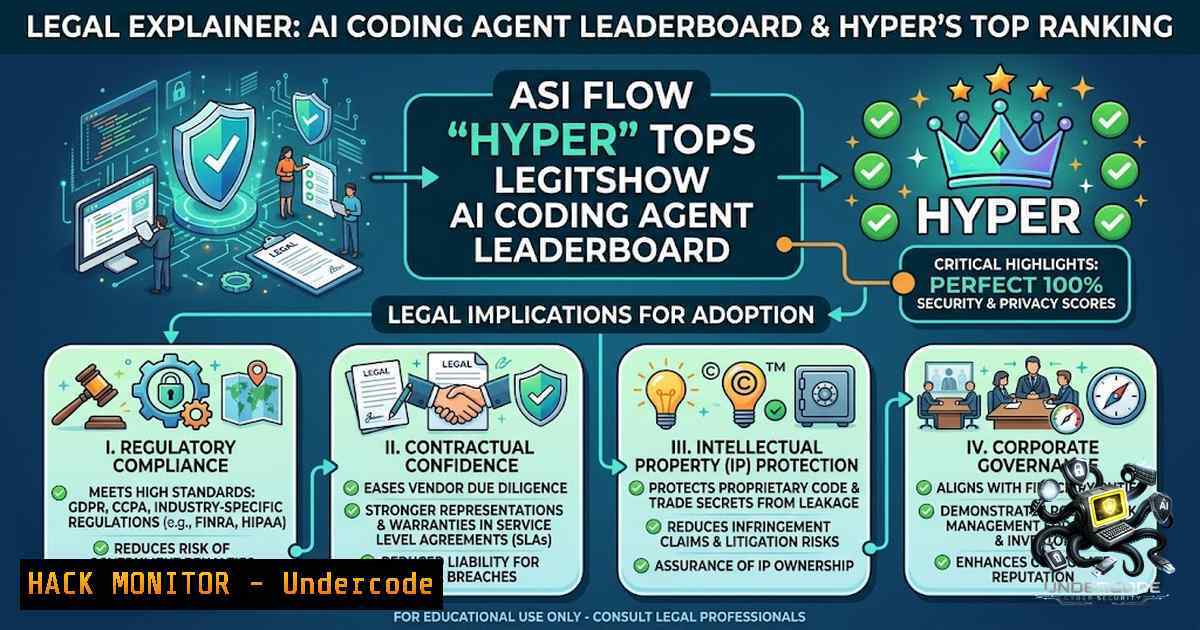
The AI-assisted software development space has become a crowded battlefield, with dozens of “coding agents” vying for developer mindshare. However, a recent shift in the ranking paradigm has exposed the difference between feature-rich prototypes and production-ready engineering tools. Legit.Show, a benchmark platform that utilizes a deterministic 7-frame production-readiness test, has just crowned Hyper by ASI Flow as the 1 AI Coding Agent, scoring a perfect 100/100 across multiple critical security and operational dimensions. This achievement signals a significant maturation in the AI development lifecycle, moving the conversation from simple code generation to robust, verifiable, and secure autonomous systems.
Learning Objectives & Secrets:
- Objective 1: Understand Production-Readiness Metrics. Learn how to evaluate AI coding tools beyond LLM performance, focusing on observability, reliability, and compliance.
- Objective 2 Secret Tip: Leverage Deterministic Scoring for Procurement. Use public benchmark results to compare tools based on objectively verifiable security headers and API behavior.
- Objective 3 Secret Tip: Security as a Code-Agent Feature. Treat AI agents like infrastructure; implement CI/CD pipeline scanning rules (e.g., using `gitleaks` or
trivy) to mirror the “security first” approach of top-tier agents.
You Should Know:
1. Decoding the Legit.Show 7-Frame Benchmark
Legit.Show distinguishes itself by avoiding subjective criteria like user votes or feature count. Instead, it conducts a deterministic analysis of a product’s public surface. This likely involves comprehensive HTTP header analysis, SSL/TLS configuration validation, API endpoint security posture, and standardized JSON schema responses for LLM interactions. The benchmark specifically measures Security (100/100), Privacy (100/100), and Reliability (100/100), which suggests a rigorous testing of authentication mechanisms, data handling policies, and uptime consistency.
How to Replicate This Assessment on Your Own Infrastructure:
If you are integrating an AI agent into your enterprise, you can perform similar basic validation using open-source tools.
– Step 1: Validate TLS/SSL security to prevent man-in-the-middle attacks: `nmap –script ssl-enum-ciphers -p 443 api.youragency.com`
– Step 2: Check for secure HTTP headers that prevent XSS and clickjacking: curl -I https://your-agent-endpoint.com` (Look forStrict-Transport-Security,X-Frame-Options,X-Content-Type-Options).Get-ChildItem Env: | Where-Object {$_.Name -like “API”}`.
- Step 3: Test API authentication flows using JWT validation. If the agent uses an API key, ensure it’s not exposed: `env | grep -i api_key` (on Linux) or using Windows PowerShell:
2. Implementing “Secure by Default” Agent Workflows
Hyper’s perfect scores in Security and Privacy highlight a critical trend: AI agents must enforce Zero-Trust principles. If an AI agent can generate code, it can inadvertently generate vulnerable code or expose proprietary logic. To secure your own AI workflows, administrators must enforce strict permission boundaries.
Step‑by‑Step Guide for Securing Agent Execution:
- Step 1: Run agents in isolated containers (Docker/Kubernetes) to prevent host system access. Use Docker:
docker run --rm --read-only --tmpfs /tmp:rw -e "API_KEY=$KEY" your-agent-image. - Step 2: Implement a “Secrets Scanner” in the pre-commit hook to stop the agent from committing API keys into code. Linux/Windows command line: `git secrets –install` and
git secrets --register-aws. - Step 3: For cloud hardening, ensure your agent’s IAM role has the least privilege principle. Instead of full
S3:, use a policy that only allows `s3:PutObject` into a specific bucket. This is security standard 100/100 behavior.
3. Observability and Reliability Engineering
Hyper scored 100/100 in Reliability and 95/100 in Discoverability, indicating that the system is not just functional but traceable. In complex AI environments, “black box” failures are the enemy. Reliability in this context implies handling API rate limits, LLM timeouts, and network failures gracefully.
Implementation Guide for Enhanced Observability:
To ensure your AI production system is verifiable, implement structured logging and telemetry.
– Step 1: Configure logging to JSON format for easy ingestion by tools like ELK Stack or Datadog. Example for Python (usually used in AI backends): logging.basicConfig(stream=sys.stdout, level=logging.INFO, format='{"message": %(message)s}').
– Step 2: Set up retry mechanisms with exponential backoff (e.g., using `tenacity` or `backoff` libraries) to handle API unavailability.
– Step 3: For Windows servers, use `Get-WinEvent` to filter security logs and correlate them with AI agent requests to ensure no suspicious activity is bypassing security: Get-WinEvent -LogName Security | Where-Object { $_.Id -eq 4624 }.
4. Performance Optimization vs. Security Trade-offs
The only blemish on Hyper’s scorecard was Performance at 83/100. This is a common trade-off; heavy validation (Security 100) often consumes time (CPU cycles for TLS handshakes, complex regex for input sanitization). For developers optimizing their own agents, performance can be tweaked without sacrificing security.
Step‑by‑Step Guide for Optimization:
- Step 1: Profile the agent’s startup time. In Linux, use
time ./your-agent-binary. - Step 2: Cache frequent API calls to reduce latency. Implement a Redis cache. In Linux: `redis-cli set key “value”` to store results of heavy SQL queries.
- Step 3: For Windows, use Performance Monitor (PerfMon) to analyze CPU/Memory usage during heavy inference loads.
5. The Shift to Autonomous Software Engineering
The post mentions building toward “autonomous software engineering capable of turning intent into production-grade software.” This moves beyond “code copilot” into “systems engineer.” This requires integrating CI/CD pipelines, IaC (Infrastructure as Code), and automated testing frameworks (e.g., Jest, PyTest). To replicate this, developers must treat AI-generated code like human-generated code.
Configuration for Production-Grade Verification:
- Step 1: Use Trivy or Snyk to scan the generated code for vulnerabilities before merge. Command:
trivy fs --severity HIGH,CRITICAL ./generated_src. - Step 2: Automatically run linters on the agent’s output. For JavaScript:
npx eslint ./generated --fix. For Python:black ./generated && flake8 ./generated. - Step 3: Enforce Software Bill of Materials (SBOM) generation to track dependencies. Linux/Windows:
cyclonedx-bom -o bom.json.
What Undercode Say:
- Key Takeaway 1: The 1 ranking is less about the “code” quality and more about the “operational hygiene” of the platform. 100/100 in Security and Privacy means the product handles data exfiltration risks and user confidentiality better than 44 competitors.
- Key Takeaway 2: Legit.Show’s methodology (deterministic, public-surface testing) sets a new standard. It forces AI vendors to compete on verifiable metrics (SSL, CORS, Logging) rather than just marketing fluff.
The analysis of this ranking reveals that the AI market is entering an “enterprise readiness” phase. In 2025, we are seeing that AI agents can write code, but the true differentiator is whether they can do so without exposing your infrastructure to risk. Hyper’s almost perfect score suggests they have prioritized vulnerability mitigation (input sanitization, output validation, secure API key rotation) which is often neglected in rapid AI development. This reflects a broader industry shift where “DevSecOps” principles are retrofitted into “MLSecOps.” The 83/100 Performance score indicates that security checks add overhead—a reminder that building robust AI requires careful resource provisioning (e.g., GPU/CPU scaling). Ultimately, this milestone validates the thesis that the future of AI engineering lies not in generating more code, but in generating safer, more observable, and reliable software.
Prediction:
- +1 This benchmark win will accelerate enterprise adoption, as organizations now have a verifiable standard to justify AI procurement to security boards.
- +1 We will see a surge in “deterministic benchmarking” tools for AI, leading to healthier competition focused on security hardening.
- +1 Hyper’s success will pressure Google, Amazon, and Microsoft to enhance the security posture of their own AI Code Agents.
- +1 The concept of “Turn Intent into Software” will be integrated into low-code platforms, reducing human error.
- -1 The 83/100 Performance score suggests increased latency, which may bottleneck real-time coding during high-demand hours.
- -1 Smaller AI startups may struggle to compete because implementing 100/100 security standards requires significant infrastructure investment.
- -1 If the benchmark’s methodology becomes public, vendors might “game” the 7-frame test by over-optimizing the public surface while neglecting internal system logic.
- +1 We will see “Privacy” scores (100/100) becoming a key differentiator in Europe, leading to GDPR-compliant AI development becoming the norm.
- +1 The industry standard for AI safety will evolve from “secure code” to “secure system,” integrating hardware-level security modules (TPMs) directly into AI workflows.
- -1 The lack of focus on “Discoverability” (95/100) suggests that while the system is secure, it may still be difficult to integrate into legacy monolithic applications, potentially causing friction for older enterprises.
▶️ Related Video (76% Match):
🎯Let’s Practice For Free:
🎓 Live Courses & Certifications:
Join Undercode Academy for Verified Certifications
🚀 Request a Custom Project:
Secure, high-velocity infrastructure and disruptive technological engineering. Contact our engineering team for high-tier development and proprietary systems:
[email protected]
💎 Smart Architecture | 🛡️ Secure by Design | ⭐ Trusted by Thousands
IT/Security Reporter URL:
Reported By: https://lnkd.in/p/exGembrp – Hackers Feeds
Extra Hub: Undercode MoN
Basic Verification: Pass ✅


