Listen to this Post
Introduction:
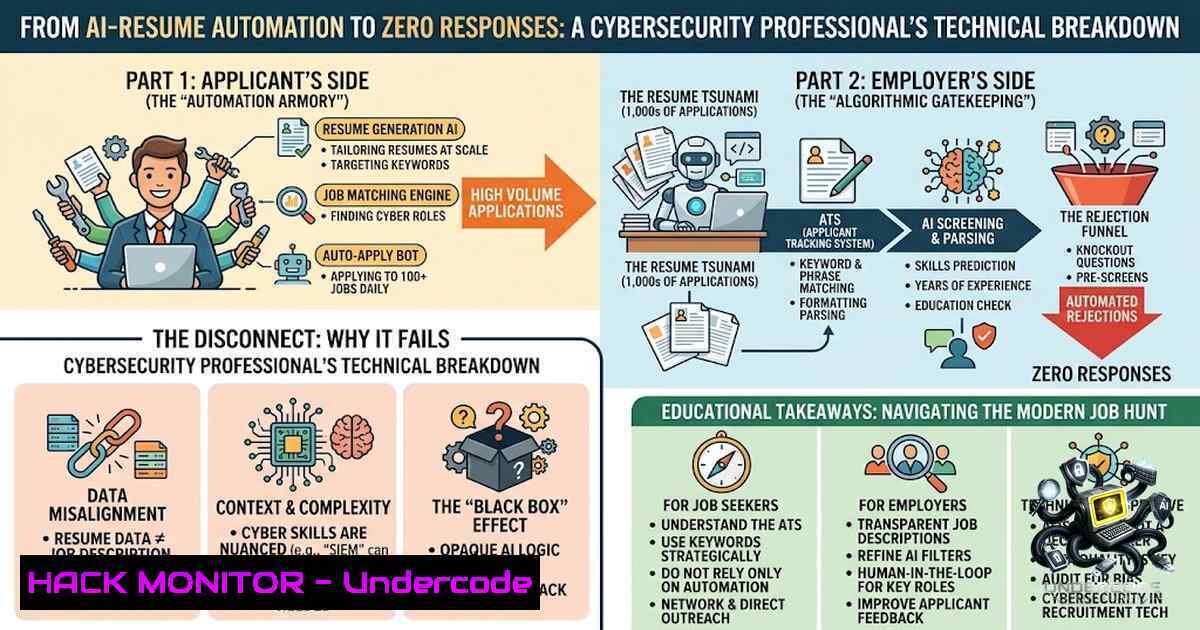
The modern job market has become an algorithmic battlefield where candidates increasingly deploy AI-powered automation to mass-produce applications, yet find themselves met with silence rather than interviews. JP Bouliane-Agnew, a cybersecurity specialist with enterprise healthcare experience, recently detailed his journey building a fully automated application pipeline—complete with web crawlers, AI resume generators, and ATS-optimized cover letters—only to receive zero responses after two months of intensive applications. This paradox highlights a critical gap between technical automation and human-centric hiring, raising questions about whether AI-assisted applications are genuinely effective or simply contributing to the noise they aim to overcome.
Learning Objectives & Secrets:
- Objective 1: Build an Automated Job Application Pipeline – Learn how to integrate web crawlers, AI resume generators, and email automation to streamline the application process, reducing manual effort while maintaining ATS compliance.
- Objective 2: Optimize Resume Content for ATS While Preserving Human Readability – Secret tip: Use AI to generate tailored resumes and cover letters, but always inject personal anecdotes and unique phrasing to avoid detection as purely machine-generated content.
- Objective 3: Leverage Portfolio Projects as Differentiators – Secret tip: Instead of relying solely on resumes, build a public portfolio (e.g., GitHub, personal website) that demonstrates problem-solving capabilities, allowing employers to evaluate your thinking process rather than just your job history.
You Should Know:
- Building an Automated Job Scraping & Application System
The core of Bouliane-Agnew’s system involved web crawlers that automatically discovered job postings, fed them into an AI backend, and generated customized application packages. This approach mirrors common automation techniques used in cybersecurity for threat intelligence gathering and can be repurposed for job hunting.
Step‑by‑step guide for setting up a basic job scraping and application automation pipeline:
Step 1: Set Up a Web Scraper for Job Boards
Use Python with `requests` and `BeautifulSoup` to scrape job listings from platforms like LinkedIn, Indeed, or company career pages. For LinkedIn, consider using the `linkedin-api` library (unofficial) or Selenium for dynamic content.
import requests
from bs4 import BeautifulSoup

def scrape_jobs(keyword, location):
url = f"https://www.indeed.com/jobs?q={keyword}&l={location}"
headers = {"User-Agent": "Mozilla/5.0"}
response = requests.get(url, headers=headers)
soup = BeautifulSoup(response.text, "html.parser")
 Extract job titles, companies, and descriptions
jobs = []
for result in soup.select(".jobsearch-SerpJobCard"):
title = result.select_one(".title").text.strip()
company = result.select_one(".company").text.strip()
summary = result.select_one(".summary").text.strip()
jobs.append({"title": title, "company": company, "summary": summary})
return jobs
Step 2: Parse Job Descriptions for Key Requirements
Use Natural Language Processing (NLP) libraries like `spaCy` or `nltk` to extract skills, certifications, and experience requirements from job descriptions. This allows your system to compare your profile against each posting.
import spacy
nlp = spacy.load("en_core_web_sm")

def extract_skills(text):
doc = nlp(text)
skills = [ent.text for ent in doc.ents if ent.label_ in ["SKILL", "ORG"]]
return skills
Step 3: Generate Tailored Resumes and Cover Letters
Leverage OpenAI’s GPT API or a local LLM like Llama to generate customized application materials. Provide the model with your base resume, the job description, and a prompt instructing it to highlight relevant experience and address missing qualifications.
import openai
openai.api_key = "your-api-key"

def generate_cover_letter(job_description, base_resume):
prompt = f"Based on the following job description: {job_description}\n\nAnd my resume: {base_resume}\n\nGenerate a professional cover letter that highlights my relevant experience and addresses any gaps."
response = openai.ChatCompletion.create(
model="gpt-4",
messages=[{"role": "user", "content": prompt}]
)
return response.choices[bash].message.content
Step 4: Automate Email Submission
Use `smtplib` or integration with email APIs (e.g., Gmail API) to send applications directly to hiring managers or through application portals. For portals without APIs, consider using Selenium for browser automation.
import smtplib
from email.mime.text import MIMEText

def send_email(recipient, subject, body):
msg = MIMEText(body)
msg["Subject"] = subject
msg["From"] = "[email protected]"
msg["To"] = recipient
with smtplib.SMTP("smtp.gmail.com", 587) as server:
server.starttls()
server.login("[email protected]", "your-password")
server.sendmail("[email protected]", recipient, msg.as_string())
Step 5: Implement Rate Limiting and Anti-Detection Measures
To avoid being blocked by job boards, implement random delays between requests, rotate user agents, and use proxy rotation. This is similar to evasion techniques used in penetration testing.
import time
import random
time.sleep(random.uniform(1, 5))  Random delay between 1-5 seconds
2. ATS Optimization: Balancing Keywords and Human Readability
Applicant Tracking Systems (ATS) parse resumes for specific keywords, often discarding those that don’t match. However, over-optimization can result in resumes that read as robotic or generic, potentially contributing to the “silence” Bouliane-Agnew experienced.
Step‑by‑step guide for ATS-optimized resume creation:
Step 1: Extract Keywords from Job Descriptions
Use TF-IDF or simple frequency analysis to identify the most important keywords in a job description. Prioritize terms that appear multiple times or are listed as required skills.
from sklearn.feature_extraction.text import TfidfVectorizer

def extract_keywords(text, n=10):
vectorizer = TfidfVectorizer(stop_words="english")
tfidf = vectorizer.fit_transform([bash])
scores = zip(vectorizer.get_feature_names_out(), tfidf.toarray()[bash])
sorted_scores = sorted(scores, key=lambda x: x[bash], reverse=True)
return [word for word, score in sorted_scores[:n]]
Step 2: Map Keywords to Your Experience
For each keyword, identify a corresponding achievement or responsibility from your work history. This ensures that your resume doesn’t just list keywords but demonstrates them in context.
Step 3: Structure Your Resume for ATS Parsing
Use a clean, single-column layout with standard section headings (e.g., “Experience,” “Education,” “Skills”). Avoid tables, images, or complex formatting that can confuse ATS parsers. Bouliane-Agnew’s portfolio highlights skills like Active Directory, PowerShell, ServiceNow, and vulnerability assessment—all of which should be prominently featured in an ATS-optimized resume.
Step 4: Inject Personalization
After generating an AI-assisted resume, manually edit it to include personal anecdotes, unique phrasing, and specific project outcomes. This helps the resume read as human-written and may improve engagement from human recruiters who review it.
3. Building a Technical Portfolio as a Differentiator
Bouliane-Agnew emphasizes that his portfolio—not his resume—best demonstrates his capabilities. His projects include healthcare infrastructure security assessments, Active Directory automation with PowerShell, and ServiceNow incident management. A well-maintained portfolio can serve as tangible proof of skills, especially in cybersecurity and IT.
Step‑by‑step guide for creating a cybersecurity portfolio:
Step 1: Select Representative Projects
Choose projects that demonstrate a range of skills: vulnerability assessment, automation, incident response, and system administration. Bouliane-Agnew’s portfolio includes a healthcare security assessment project that involved TLS remediation and Arctic Wolf monitoring.
Step 2: Document Your Process
For each project, write a detailed case study covering the problem, your approach, tools used, and outcomes. Include metrics where possible (e.g., “reduced manual reporting time by 70%”).
Step 3: Host Your Portfolio Publicly
Use platforms like GitHub Pages, Netlify, or a personal domain to host your portfolio. Bouliane-Agnew hosts his at `jpbouliane-agnew.manus.space` and his studio site at DefiningChaosLabs.ca. Ensure your site is optimized for Chrome, Edge, and Safari.
Step 4: Integrate AI Features
Consider adding an AI backend that can analyze job postings and rate your fit, similar to Bouliane-Agnew’s approach. This demonstrates both technical skill and practical problem-solving.
4. Automation Ethics and Anti-Detection in Cybersecurity
Automating job applications raises ethical and practical concerns, including spamming employers and violating platform terms of service. In cybersecurity, similar principles apply to penetration testing and vulnerability scanning—automation must be used responsibly.
Step‑by‑step guide for ethical automation:
Step 1: Respect Robots.txt and Terms of Service
Before scraping any website, check its `robots.txt` file and terms of service to ensure compliance. Many job boards explicitly prohibit automated scraping.
Step 2: Implement Rate Limiting and Throttling
Avoid overwhelming target servers by implementing delays and limiting request rates. This is a best practice in both web scraping and penetration testing.
Step 3: Use Proxies and Rotate User Agents
To distribute requests and avoid IP bans, use proxy rotation and regularly change user-agent strings. This mimics legitimate user behavior and reduces the risk of detection.
import requests
from fake_useragent import UserAgent

ua = UserAgent()
headers = {"User-Agent": ua.random}
proxies = {"http": "http://proxy:port", "https": "https://proxy:port"}
response = requests.get(url, headers=headers, proxies=proxies)
Step 4: Monitor and Adjust
Regularly review your automation’s impact and adjust parameters to avoid disruptions. In a job search context, this might mean limiting applications to a reasonable number per day to avoid being flagged as spam.
- Leveraging AI for Continuous Learning and Skill Development
Bouliane-Agnew’s journey underscores the importance of continuous learning, especially in cybersecurity. His education includes Windows Administration, Linux, Python, Digital Forensics, and Risk Management. AI can accelerate this learning by providing personalized study plans and practice environments.
Step‑by‑step guide for AI-assisted learning:
Step 1: Identify Skill Gaps
Use AI to analyze job descriptions in your target field and identify recurring skills you lack. Bouliane-Agnew’s system did this automatically, highlighting areas where he needed to bridge gaps.
Step 2: Generate Custom Study Plans
Use LLMs to create tailored learning paths, including recommended courses, books, and hands-on labs. For cybersecurity, platforms like TryHackMe, Hack The Box, and Cybrary offer structured learning.
Step 3: Practice with Simulated Environments
Set up virtual labs using tools like VMware, VirtualBox, or cloud-based sandboxes to practice skills in a safe environment. This is particularly important for cybersecurity, where hands-on experience is critical.
Step 4: Document and Share Your Learning
Maintain a blog or GitHub repository documenting your learning journey. This not only reinforces your knowledge but also serves as additional portfolio material.
What Undercode Say:
- Key Takeaway 1: AI-powered automation can dramatically streamline the job application process, but it does not guarantee responses. The “silence” experienced by Bouliane-Agnew highlights that technical efficiency does not always translate to hiring success, and that human factors—such as networking, personal branding, and portfolio presentation—remain critical.
- Key Takeaway 2: A well-documented technical portfolio is often more persuasive than a resume. By showcasing projects, case studies, and problem-solving approaches, candidates can demonstrate their value in a way that resumes alone cannot. Bouliane-Agnew’s portfolio, which includes healthcare security assessments and Active Directory automation, serves as a powerful testament to his capabilities.
The broader lesson from Bouliane-Agnew’s experience is that while AI can augment the job search, it cannot replace the human elements of storytelling, relationship-building, and authentic self-presentation. His decision to pivot toward building public-facing projects and a personal brand reflects a strategic shift from volume-based applications to value-based differentiation. In an era where AI-generated resumes are becoming the norm, standing out requires not just technical prowess but also the ability to communicate one’s unique perspective and contributions effectively.
Prediction:
- -1 The increasing use of AI in job applications will likely lead to hiring platforms implementing more sophisticated detection mechanisms, potentially penalizing or filtering out AI-generated content. This could create an arms race between automation tools and ATS filters, further complicating the job search for candidates who rely heavily on AI.
- -1 As AI-generated applications become more prevalent, human recruiters may become desensitized to polished, keyword-optimized resumes, placing greater emphasis on portfolios, GitHub repositories, and other tangible evidence of skills. Candidates who fail to build a public technical presence may find themselves at a disadvantage.
- +1 The automation tools developed by candidates like Bouliane-Agnew could evolve into legitimate career management platforms, offering personalized job matching, skill gap analysis, and continuous learning recommendations. This could democratize access to career development resources, particularly for those in technical fields.
- +1 The emphasis on portfolios and project-based evaluation may encourage a shift in hiring practices toward more skills-based assessments, reducing reliance on traditional resumes and potentially mitigating biases inherent in conventional screening processes.
- -1 The emotional toll of automated rejection and silence, as described by Bouliane-Agnew, may exacerbate mental health challenges for job seekers, particularly those facing financial pressure. The lack of human feedback in an increasingly automated process can lead to feelings of isolation and self-doubt.
▶️ Related Video (76% Match):
🎯Let’s Practice For Free:
🎓 Live Courses & Certifications:
Join Undercode Academy for Verified Certifications
🚀 Request a Custom Project:
Secure, high-velocity infrastructure and disruptive technological engineering. Contact our engineering team for high-tier development and proprietary systems:
[email protected]
💎 Smart Architecture | 🛡️ Secure by Design | ⭐ Trusted by Thousands
IT/Security Reporter URL:
Reported By: https://lnkd.in/p/eeMEWGHG – Hackers Feeds
Extra Hub: Undercode MoN
Basic Verification: Pass ✅


