Listen to this Post
Introduction:
DEF CON, the world’s largest and most iconic hacker convention, serves as a critical barometer for the state of cybersecurity, artificial intelligence, and information technology. For professionals and enthusiasts alike, it is a chaotic yet structured environment where theoretical vulnerabilities meet practical exploitation, and where the convergence of AI and security is not just discussed but actively dissected through hands-on challenges. This article distills the core technical and cultural lessons from a first-time attendee’s experience, transforming anecdotal observations into actionable intelligence for security engineers, IT administrators, and AI practitioners, covering everything from hardware reverse engineering to cloud hardening and API security.
Learning Objectives & Secrets:
- Objective 1: Mastering the AI Security Landscape. Understand the practical challenges of AI deepfakes and adversarial machine learning through direct engagement with live detection games, highlighting the gap between theoretical model security and real-world application security.
- Objective 2: Unlocking Hardware and Embedded Systems. Gain secret tips on approaching hardware reverse engineering, including how to identify debug interfaces (JTAG/SWD) and extract firmware using low-cost tools, moving beyond software-only pentesting.
- Objective 3: Leveraging Community Intelligence for Cloud Hardening. Discover how networking with security engineers reveals undocumented cloud misconfigurations and API rate-limiting bypasses, offering a raw, unfiltered view of attack surfaces often missed by automated scanners.
You Should Know:
- DEF CON Villages: A Technical Deep Dive into Specialized Security Domains
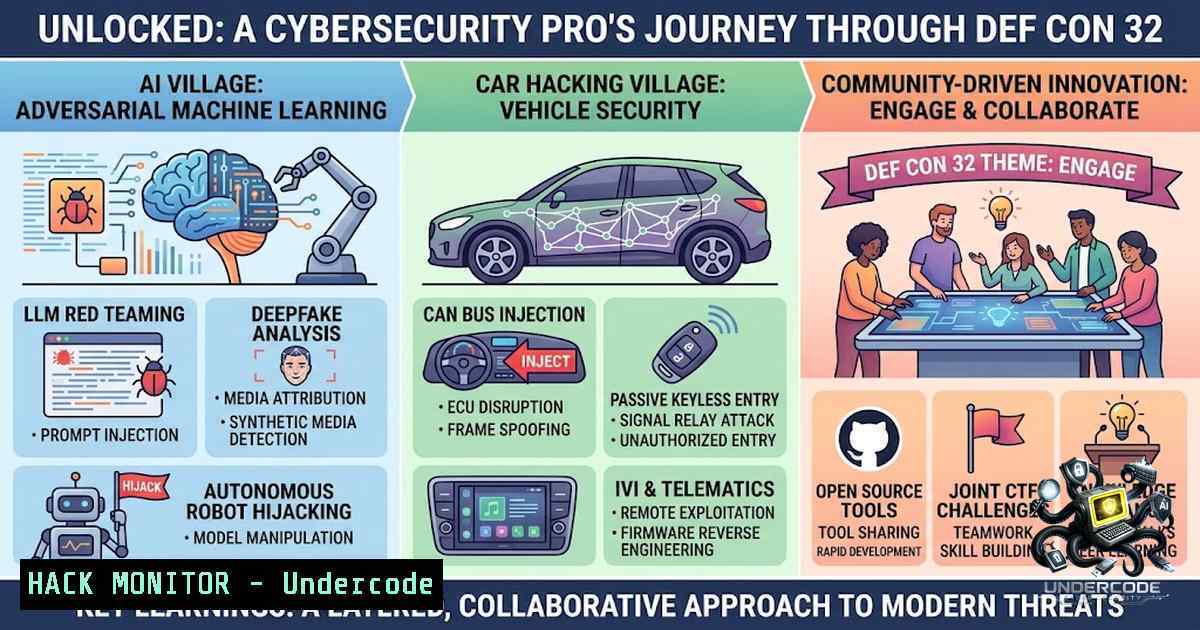
The “Villages” at DEF CON are not merely exhibition booths; they are intensive, hands-on laboratories where specific security disciplines are dissected. For instance, the Car Hacking Village provides a controlled environment to interact with Controller Area Network (CAN) buses. Participants use tools like `candump` and `cansniffer` (part of the can-utils suite on Linux) to capture and inject messages into vehicle networks. A common exercise involves replaying a “unlock” command to simulate a relay attack. The Aerospace Village focuses on satellite and avionics security, often involving Software-Defined Radio (SDR) to intercept telemetry data. Here, one might use GNU Radio alongside a HackRF or RTL-SDR dongle to demodulate Frequency Shift Keying (FSK) signals, revealing unencrypted command strings. The Robotics Village teaches the exploitation of Robot Operating System (ROS) environments, where unauthenticated topics can be subscribed to or published, allowing an attacker to manipulate sensor data or actuator commands. This is often done via the `rostopic` command line tools, highlighting the critical need for network segmentation and authentication in industrial IoT.
2. AI Deepfake Detection: Navigating the Arms Race
The AI Deepfake Game at DEF CON is a rigorous test of both human perception and technical detection capabilities. The challenge involves distinguishing between genuine video/audio and synthetically generated content using generative adversarial networks (GANs) and diffusion models. A practical takeaway is that while visual artifacts like inconsistent blinking or lighting are well-known, the current frontier involves detecting temporal inconsistencies in mouth movements and audio-visual sync. For professionals, building a detection pipeline is not trivial. On Linux, you can leverage OpenCV and DeepSpeech for basic analysis, but more advanced methods utilize spectral analysis. For example, using Python with the `librosa` library, one can analyze the Mel-frequency cepstral coefficients (MFCCs) of an audio file; a significant deviation from the expected human range or unnatural spectral flatness often indicates a deepfake. The secret to this challenge lies not in a single magical command, but in a multi-modal approach combining frequency analysis with behavioral biometrics. A key mitigation against such threats in an enterprise is implementing multi-factor authentication that includes behavioral analytics, as visual verification alone is no longer sufficient.
- Physical Security: Bridging the Digital and Analog Gap
The Physical Security Village showcases how digital security is often circumvented through analog means. For instance, lockpicking and bypassing electronic access control systems using “credential cloning” are common. Technically, this involves using devices like the Proxmark3 to read, clone, and emulate Low Frequency (125kHz) and High Frequency (13.56MHz) RFID cards. On a Linux system, the `proxmark3` client interface allows for commands like `hf mf autopwn` to recover MIFARE Classic keys using a known vulnerability in the Crypto1 stream cipher. The step-by-step process includes: 1) Connecting the Proxmark3 and running `pm3` to enter the client. 2) Using `hf search` to detect the card type. 3) Executing the `autopwn` command to capture authentication attempts and crack the keys. 4) Dumping the card data using `hf mf dump` and cloning it to a writable tag withhf mf restore. The mitigation for blue teams involves migrating to MIFARE DESFire or other secure elements with mutual authentication, and implementing physical surveillance to detect unauthorized device usage near access points.
4. Game Hacking: Reverse Engineering and Memory Manipulation
Game Hacking is not just for cheaters; it is a phenomenal training ground for memory forensics and binary exploitation. The village often focuses on Windows-based games, utilizing tools like Cheat Engine to scan for and modify in-memory values such as health, ammo, or coordinates. The process involves: 1) Attaching the Cheat Engine debugger to a running game process. 2) Performing an “Unknown Initial Value” scan, then repeatedly scanning for “Decreased Value” as health is reduced. 3) Isolating the exact memory address. 4) Using the “Find out what writes to this address” feature to identify the assembly instruction responsible for updating the value. This reveals the function offset, which can then be used to develop a DLL injector or script to manipulate the game logic. On Linux, similar work is done using `gdb` with the `peda` or `pwndbg` extensions. This translates directly to professional security, where understanding memory corruption (buffer overflows) and race conditions is critical. The secret is to use these skills to test the integrity of security-critical applications, verifying that sensitive flags or user privileges cannot be altered in memory by a non-privileged process.
5. The Social Engineering and API Security Nexus
The conversations at events like the AI Security Happy Hour often reveal that the weakest link in the security chain is often the API layer. Developers frequently expose sensitive endpoints or misconfigure Cross-Origin Resource Sharing (CORS), leading to data leaks. A key command sequence for testing API security on Linux involves curl. For example, to test for GraphQL introspection vulnerabilities, you would use: `curl -X POST -H “Content-Type: application/json” -d ‘{“query”:”query { __schema { types { name } } }”}’ https://target.com/graphql`. If the server responds with the schema, it is vulnerable. Similarly, testing for Server-Side Request Forgery (SSRF) involves using `curl -i -X POST -d ‘url=file:///etc/passwd’ https://target.com/api/fetch`. If the response contains the contents of the passwd file, it’s game over. The professional tip is to incorporate these simple commands into a CI/CD pipeline using automated scripts to test staging environments before production deployment, a practice heavily emphasized by the security engineers present at the conference.
- Custom Electronic Badges: An Intro to Embedded Security
The custom badges at DEF CON are more than souvenirs; they are fully functional IoT devices. Hacking them involves identifying the microcontroller (often an ESP32 or ATmega), locating the UART, SPI, or I2C pins for serial communication, and dumping the firmware. On Windows, you might use a tool like PuTTY to connect over serial (e.g., COM3 at 115200 baud) to see if a bootloader or debug console is active. On Linux, a typical workflow involves using `lsusb` to identify the device, `dmesg | grep tty` to find its port, and `screen /dev/ttyUSB0 115200` to interact with it. For firmware extraction, tools like `esptool.py` for ESP32 chips are invaluable:esptool.py --port /dev/ttyUSB0 read_flash 0x00000 0x400000 firmware.bin. This allows you to extract the binary, search for hardcoded keys usingstrings firmware.bin | grep -i "key", and potentially find vulnerabilities like hardcoded credentials. This is a miniature lesson in IoT security, demonstrating the importance of secure boot, firmware encryption, and disabling debug interfaces in production hardware.
What Undercode Say:
- Key Takeaway 1: Cybersecurity is a mosaic of specialized domains, and AI is rapidly becoming the central thread connecting them. The deepfake challenge was not a gimmick but a practical demonstration of how AI attack surfaces (data poisoning, model theft) are outpacing our defensive strategies.
- Key Takeaway 2: The most effective security tools are often built on community knowledge. The informal exchange of `curl` commands, `gdb` scripts, and `proxmark3` techniques is more valuable than any single certification. The open sharing at DEF CON accelerates the learning curve for professionals by exposing them to real-world failure cases.
- Analysis: The conference exposed a critical industry shift: security is no longer a silo but an intrinsic property of code, hardware, and human interaction. The “Secrets” and tools discussed are not for malicious use but for understanding the attack chain to build robust defenses. The use of Linux commands and Windows tools highlights the cross-platform nature of modern exploitation.
Prediction:
- +1 The democratization of AI security tools, driven by open-source initiatives showcased at DEF CON, will lead to a surge in SME (Subject Matter Expert) training programs, closing the skills gap within two years.
- -1 The sophistication of side-channel attacks and AI-powered malware, as hinted at in the villages, will outpace traditional signature-based defenses, forcing a complete overhaul of endpoint detection and response (EDR) architectures.
- +1 The integration of hardware security (like secure enclaves) into mainstream cloud computing will accelerate due to the demonstrated ease of firmware extraction, leading to more secure default configurations.
- -1 Social engineering via AI-generated voice clones will become the primary attack vector for financial crimes, rendering current voice authentication systems obsolete and demanding a shift to risk-based authentication models.
- +1 The global cybersecurity community will increasingly adopt a “Live Hacking” approach to compliance, moving beyond static auditing to continuous, adversarial testing of critical infrastructure, as practiced in the Car Hacking and Aerospace Villages.
▶️ Related Video (76% Match):
🎯Let’s Practice For Free:
🎓 Live Courses & Certifications:
Join Undercode Academy for Verified Certifications
🚀 Request a Custom Project:
Secure, high-velocity infrastructure and disruptive technological engineering. Contact our engineering team for high-tier development and proprietary systems:
[email protected]
💎 Smart Architecture | 🛡️ Secure by Design | ⭐ Trusted by Thousands
IT/Security Reporter URL:
Reported By: https://lnkd.in/p/eEEubXDz – Hackers Feeds
Extra Hub: Undercode MoN
Basic Verification: Pass ✅


