Listen to this Post
Introduction
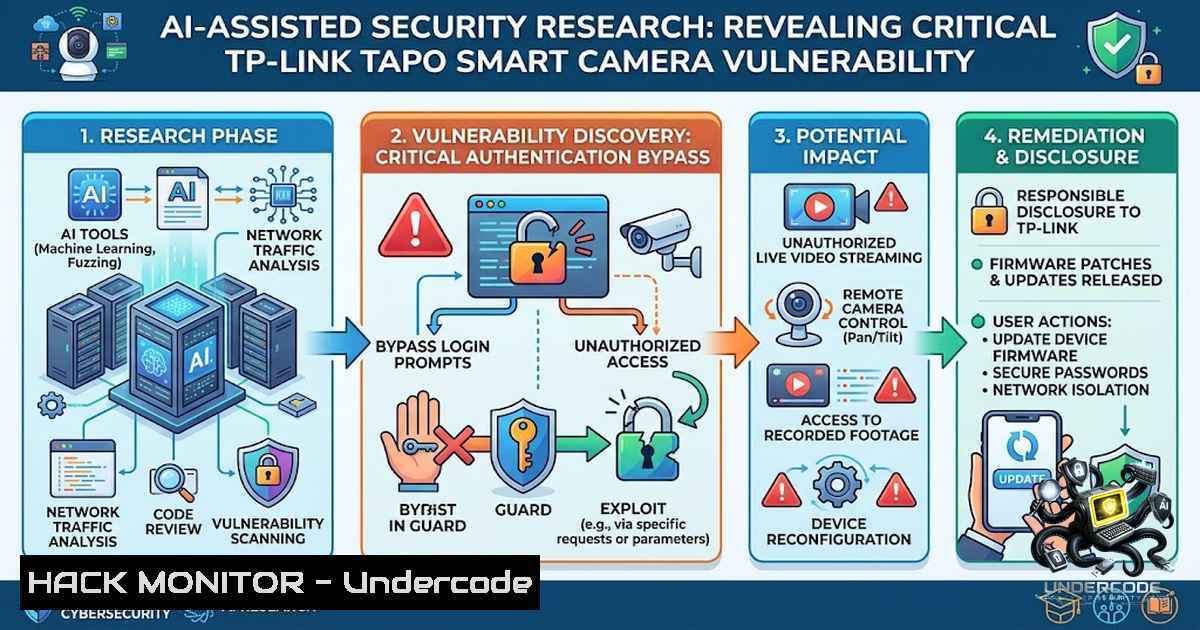
The Internet of Things (IoT) continues to expand the attack surface for organizations and consumers alike, with smart home devices often harboring overlooked vulnerabilities that can compromise entire networks. In a significant development for IoT security, security researchers have uncovered critical vulnerabilities in TP-Link Tapo C200 smart cameras, headlined by an unauthenticated administrative authentication bypass (CVE-2026-15315) that allows local network attackers to obtain administrative session tokens and execute privileged management actions. What makes this discovery particularly noteworthy is the methodology behind it: the research team leveraged AI-assisted security research—dubbed “Vibe Hacking”—combining deep firmware analysis with custom AI workflows to accelerate code auditing and reverse-engineering, pinpointing edge cases and logic flaws in record time.
Learning Objectives & Secrets
- Objective 1: Understand the Authentication Bypass Mechanism – Learn how improper validation of challenge parameters in the Tapo C200 login module enables attackers to replay `device_confirm` requests and obtain administrative session tokens without credentials.
-
Objective 2: Master AI-Assisted Firmware Reverse-Engineering – Discover how integrating Large Language Models (LLMs) with traditional reverse-engineering tools like Ghidra and EMBA can accelerate vulnerability discovery by automating decompiled code analysis and identifying logic flaws.
-
Objective 3: Implement Effective Mitigation Strategies – Learn the step-by-step process for identifying vulnerable devices, applying firmware updates, and implementing network segmentation to protect against local network attacks.
You Should Know
1. Understanding the Tapo C200 Authentication Bypass (CVE-2026-15315)
The first and most critical vulnerability identified affects Tapo C200 v5 firmware, specifically within the login authentication verification module. The flaw stems from improper validation of challenge parameters during the authentication handshake. An attacker on the same local network can exploit these weaknesses to bypass normal authentication controls and obtain administrative session tokens.
How the Exploit Works:
The attack leverages a replay technique targeting the `device_confirm` endpoint. When a legitimate user authenticates, the device generates a challenge parameter that should be unique per session. Due to improper validation, an attacker can capture and replay this challenge-response pair to obtain a valid administrative session token. Once authenticated, the attacker can:
- Execute privileged management actions
- Modify device configurations
- Disrupt device services, causing denial-of-service conditions
Step-by-Step Guide to Testing and Mitigation:
Step 1: Identify Vulnerable Devices
 Scan local network for Tapo C200 devices
nmap -p 80,443,554,8080 --open 192.168.1.0/24

Check firmware version via HTTP GET
curl -k https://<device-ip>/info
Step 2: Verify Firmware Version
Access the device web interface and navigate to Settings > Device Info. If firmware version is v5.x without the security patch, the device is vulnerable.
Step 3: Apply Firmware Update
- Visit TP-Link’s official support page: https://www.tp-link.com/us/support/download/tapo-c200/
- Download the latest firmware version (patched after August 2026)
3. Log in to the device web interface
4. Navigate to System > Firmware Update
- Upload the downloaded firmware file and follow the on-screen instructions
Step 4: Verify Patch Applied
 Re-check firmware version after update
curl -k https://<device-ip>/info | grep firmware
- The Second Vulnerability: Denial-of-Service via Oversized Ciphertext (CVE-2026-15316)
The second vulnerability identified is an improper input validation flaw in the configuration service responsible for processing encrypted credential data. An attacker can send oversized crypted ciphertext values that trigger exception handling failures due to insufficient validation. This causes the affected device to crash or restart, temporarily disrupting HTTPS management and monitoring functionality.
How the Exploit Works:
The configuration service fails to properly validate the size of incoming encrypted credential data. By sending a crafted request with an oversized ciphertext payload, an attacker can cause a buffer overflow or exception that crashes the service.
Step-by-Step Guide to Testing and Mitigation:
Step 1: Test for Vulnerability (Authorized Testing Only)
 Example: Sending oversized payload to configuration endpoint
curl -X POST https://<device-ip>/config \
-H "Content-Type: application/json" \
-d '{"credential": "'"$(python3 -c "print('A'10000)")"'"}'
Step 2: Implement Network Segmentation
Isolate IoT devices on a separate VLAN to prevent local network attackers from reaching the device:
 Example iptables rule to restrict access to IoT VLAN
iptables -A FORWARD -i eth0 -d 192.168.2.0/24 -j DROP
iptables -A FORWARD -i eth0 -d 192.168.2.0/24 -m state --state ESTABLISHED,RELATED -j ACCEPT
Step 3: Apply Firmware Update
Follow the same firmware update procedure as outlined in Section 1. TP-Link has released patches addressing both CVE-2026-15315 and CVE-2026-15316.
3. AI-Assisted Firmware Reverse-Engineering: The “Vibe Hacking” Approach
The research team’s secret weapon was an AI-assisted methodology they’ve dubbed “Vibe Hacking”—blending deep firmware analysis with custom AI workflows to accelerate code auditing and reverse-engineering. This approach represents a paradigm shift in vulnerability research, particularly for IoT devices where firmware is often obfuscated or lacks debugging symbols.
How AI Accelerates Firmware Analysis:
Traditional firmware reverse-engineering involves manually decompiling binaries, identifying functions, and tracing execution paths—a time-consuming process that can take weeks or months. AI-assisted workflows automate key stages:
- Automated Decompilation: Tools like Ghidra decompile firmware binaries into pseudo-code
- LLM-Powered Analysis: Large Language Models analyze the pseudo-code to identify suspicious patterns, potential buffer overflows, and logic flaws
- Function Identification: AI models can identify standard library functions even in stripped binaries, reducing false negatives from 11.96% to 8.70%
Step-by-Step Guide to AI-Assisted Firmware Analysis:
Step 1: Extract Firmware
 Dump firmware from device (requires physical access or UART)
binwalk -e firmware.bin
Step 2: Decompile with Ghidra
 Use Ghidra headless mode
./analyzeHeadless /path/to/project -import firmware.bin -scriptPath /path/to/scripts -postScript Decompile.java
Step 3: AI-Powered Code Analysis
 Example Python script using OpenAI API to analyze decompiled code
import openai

def analyze_function(decompiled_code):
response = openai.ChatCompletion.create(
model="gpt-4",
messages=[
{"role": "system", "content": "You are a security researcher. Analyze this decompiled C code for vulnerabilities."},
{"role": "user", "content": decompiled_code}
]
)
return response.choices[bash].message.content
Step 4: Validate Findings
Cross-reference AI-identified vulnerabilities with manual code review and dynamic analysis.
4. Responsible Disclosure and Patch Management
The research team coordinated directly with TP-Link to ensure patches were rolled out before going public. This responsible disclosure process is critical for protecting end-users and maintaining trust in the security research community.
Best Practices for Responsible Disclosure:
- Initial Contact: Notify the vendor through established security contact channels
- Technical Documentation: Provide detailed vulnerability reports with proof-of-concept code
- Coordinated Timeline: Agree on a disclosure timeline (typically 90 days)
- Patch Verification: Confirm that patches address all identified vulnerabilities
- Public Disclosure: Publish findings after patches are available
Verifying Patch Status:
 Check for available updates via API
curl -X GET https://<device-ip>/cgi-bin/luci/;stok=/admin/system?action=get_upgrade_status
5. IoT Security Hardening Guidelines
Beyond patching specific vulnerabilities, organizations and individuals should implement comprehensive IoT security measures:
Network Segmentation
- Place all IoT devices on isolated VLANs
- Restrict IoT devices from initiating connections to internal networks
- Use firewall rules to limit IoT device communication
Credential Management
- Change default passwords immediately upon setup
- Use strong, unique passwords for each device
- Disable unnecessary services (UPnP, Telnet, etc.)
Monitoring and Logging
 Monitor for suspicious traffic to IoT devices
tcpdump -i eth0 -1 'host 192.168.2.0/24 and (tcp port 80 or tcp port 443)'

Log failed authentication attempts
tail -f /var/log/auth.log | grep "Failed password"
Regular Updates
- Enable automatic firmware updates where available
- Regularly check vendor websites for security advisories
- Subscribe to CVE notifications for devices in use
What Undercode Say
- Key Takeaway 1: AI is Reshaping Vulnerability Research – The “Vibe Hacking” approach demonstrates that AI-assisted security research is not just a novelty but a practical force multiplier. By automating tedious aspects of firmware reverse-engineering, researchers can uncover vulnerabilities faster and more comprehensively than traditional methods alone. The reduction in false negative rates from 11.96% to 8.70% in firmware analysis validates the efficacy of this approach.
-
Key Takeaway 2: IoT Security Requires Proactive Defense – The discovery of these vulnerabilities in a widely deployed consumer device underscores the persistent risks in IoT ecosystems. The authentication bypass allows local network attackers to gain administrative control, while the DoS vulnerability can disrupt critical monitoring functions. Organizations must move beyond reactive patching to implement defense-in-depth strategies, including network segmentation, continuous monitoring, and regular security assessments.
-
Key Takeaway 3: Responsible Disclosure Works – The coordinated disclosure process between researchers and TP-Link ensured that patches were available before public announcement, protecting millions of users. This collaboration between the security research community and vendors is essential for maintaining the security of the broader IoT ecosystem. The fact that additional CVEs from this research sprint are still in the disclosure pipeline suggests that systematic, AI-assisted vulnerability research is uncovering systemic issues that require sustained attention.
Prediction
-
+1 AI-assisted security research will become standard practice in IoT vulnerability discovery within 12–18 months, with major vendors incorporating LLM-powered code auditing into their internal security testing pipelines.
-
-1 The commoditization of AI-assisted vulnerability research may lead to an increase in zero-day exploits as threat actors adopt similar techniques, potentially outpacing vendor patch cycles.
-
+1 The success of responsible disclosure in this case will encourage more researchers to follow coordinated disclosure practices, improving overall IoT security posture.
-
-1 Many consumers will fail to apply the firmware updates, leaving millions of Tapo C200 devices vulnerable to local network attacks for years to come.
-
+1 The “Vibe Hacking” methodology will inspire new open-source tools and frameworks that democratize advanced firmware analysis, enabling smaller security teams to conduct sophisticated IoT research.
-
-1 As IoT devices become smarter and more interconnected, the attack surface will continue to expand, with AI-assisted attacks potentially automating the discovery and exploitation of vulnerabilities at scale.
-
+1 Regulatory bodies may begin mandating AI-assisted security testing for IoT devices before market release, similar to existing compliance requirements for medical devices and automotive systems.
-
-1 The reliance on AI for vulnerability discovery may create a false sense of security, with organizations neglecting fundamental security practices like network segmentation and access control.
-
+1 The Tapo C200 disclosures will spur increased investment in IoT security research, with more resources allocated to firmware analysis and secure development practices.
-
+1 The collaboration between researchers and TP-Link sets a positive precedent for vendor-researcher relationships, potentially leading to more bug bounty programs and faster patch development cycles across the IoT industry.
▶️ Related Video (84% Match):
https://www.youtube.com/watch?v=_aFpty87ot8
🎯Let’s Practice For Free:
🎓 Live Courses & Certifications:
Join Undercode Academy for Verified Certifications
🚀 Request a Custom Project:
Secure, high-velocity infrastructure and disruptive technological engineering. Contact our engineering team for high-tier development and proprietary systems:
[email protected]
💎 Smart Architecture | 🛡️ Secure by Design | ⭐ Trusted by Thousands
IT/Security Reporter URL:
Reported By: https://lnkd.in/p/ehdxSGuf – Hackers Feeds
Extra Hub: Undercode MoN
Basic Verification: Pass ✅


