Listen to this Post
Introduction
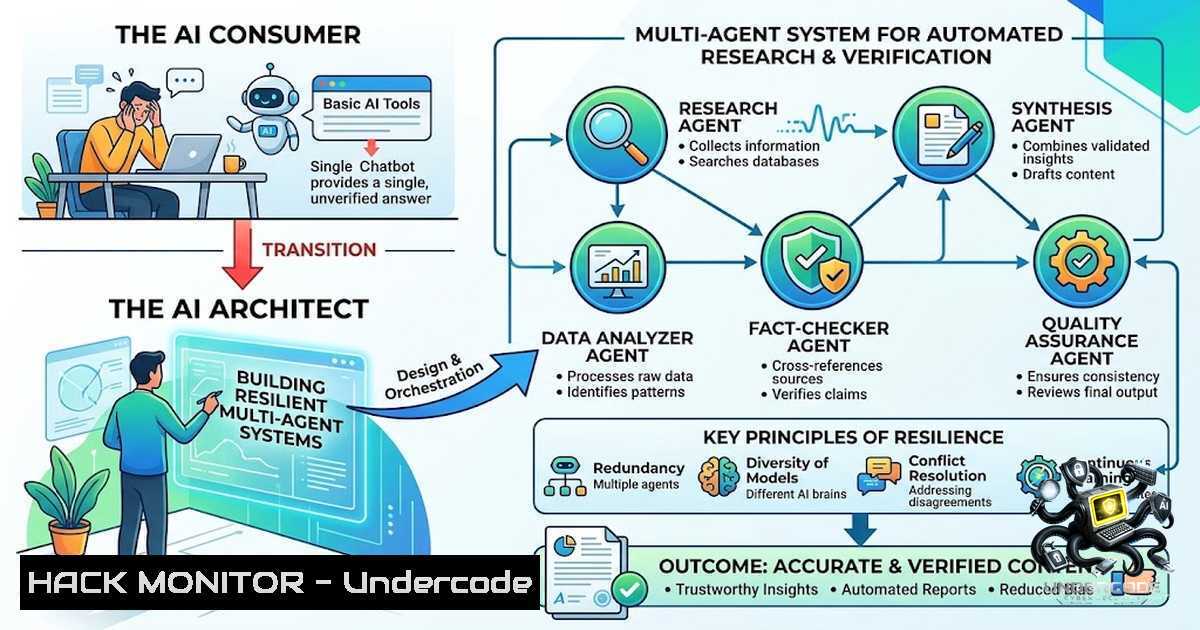
The proliferation of large language models has shifted focus from prompt engineering to agentic system design—the art of orchestrating specialized AI agents into cohesive workflows. As organizations rush to deploy autonomous agents for tasks ranging from threat intelligence gathering to compliance monitoring, understanding how to build robust, verifiable agent architectures becomes critical. This article explores the principles and practices of designing multi-agent systems that can research, validate, and synthesize information with accountability.
Learning Objectives
- Design and implement a multi-agent orchestration framework with clear separation of concerns
- Build verification loops that catch hallucinated content before it reaches end users
- Apply security hardening principles to agent tool access and data handling
You Should Know
1. Agent Architecture Design: Defining Responsibilities and Handoffs
Building agents is fundamentally different from building with them. When you build with an agent, you’re essentially using a black box. When you build the agent itself, you must define its job, its tools, its context, and the protocols for handing work off to other agents. This architecture-first approach is what separates proof-of-concept demos from production-ready systems.
Consider the newsroom agent architecture mentioned in the post. The workflow splits across research, writing, fact-checking, and editing agents. Each agent owns a specific responsibility. This modular design allows for targeted improvements and easier debugging. If fact-checking fails, you can improve that specific agent without disrupting the entire pipeline.
Step-by-step guide to designing agent responsibilities:
- Map the workflow: Document every step from user query to final output. For the newsroom agent, the flow is: Query → Research → Writing → Fact-checking → Editing → Output
2. Define tool access per agent:
- Research agent: Web search APIs, news RSS feeds, academic database access
- Writing agent: LLM with style guidelines, no external tool access
- Fact-checking agent: Cross-reference tools, credibility scoring APIs
- Editing agent: Grammar checkers, style validators
- Set handoff protocols: Determine what data structure passes between agents. For example:
{ "original_query": "What's happening with AI data centers and local power grids?", "sources": ["url1", "url2"], "draft_content": "...", "fact_check_results": {"verified": true, "issues": []} } -
Implement escalation logic: When an agent fails, define retry logic or human escalation paths. The fact-checker should be able to send a draft back for another pass with specific corrections needed.
2. Orchestration and State Management
Orchestration is the nervous system of your multi-agent system. It manages state transitions, handles failures, and ensures data flows correctly between agents. For production systems, this requires more than simple sequential chaining—you need state persistence, error recovery, and monitoring.
Step-by-step orchestration implementation:
- Choose your orchestration framework: Options include LangChain, AutoGen, or custom workflows. For critical systems, consider using a workflow engine with persistent state like Temporal or Prefect.
2. Implement state tracking:
 Pseudo-code for state management
workflow_state = {
"id": "session_123",
"current_agent": "research",
"status": "in_progress",
"data": {...},
"history": [...]
}
- Set up checkpointing: Save state at each agent handoff to enable rollback and debugging.
-
Implement timeouts and retries: Research agent should timeout after 30 seconds, with 2 retry attempts. Fact-checker should timeout after 15 seconds.
-
Build monitoring dashboards: Track agent performance metrics: latency per agent, failure rates, and handoff success rates. This allows you to identify bottlenecks in your pipeline.
Linux command for log monitoring:
tail -f /var/log/agent_orchestrator.log | grep -E "ERROR|WARN|HANDOFF"
3. Fact-Checking and Hallucination Mitigation
The fact-checking agent mentioned in the post is the most critical security component. In a world where AI hallucinations can spread misinformation, building a verifiable fact-checking layer is non-1egotiable.
Step-by-step verification loop implementation:
- Extract claims from the draft. Use a claims extraction model (or use LLM prompting) to identify factual statements.
2. Cross-reference claims against multiple sources:
- Use web search APIs to find corroborating sources
- Compare against known knowledge bases (Wikipedia API, Wikidata)
- Use credibility scoring APIs like NewsGuard
3. Implement confidence scoring:
- High confidence: Multiple reputable sources agree
- Medium confidence: Sources agree but may be biased
- Low confidence: No sources found or conflicting information
- Create a feedback loop: If the fact-checker flags issues, send the draft back to the writer with specific corrections. This iterative refinement is what the post describes: “the fact-checker can send a draft back for another pass.”
5. Log all verification attempts for auditability.
Windows command for API testing:
curl -X POST https://api.factchecktool.com/v1/verify -H "Content-Type: application/json" -d "{\"claim\": \"AI data centers consume 2% of global electricity\"}"
4. Tool Configuration and API Security
Agents need access to external tools (search APIs, databases, LLM endpoints). Each tool access point is a potential security vulnerability. Proper configuration and security hardening are essential.
Step-by-step tool configuration security:
- Use environment variables for all API keys and credentials:
export SEARCH_API_KEY="your-key-here"
export LLM_API_KEY="your-key-here"
-
Implement principle of least privilege: Each agent only gets access to the tools it needs. The writing agent doesn’t need search API access.
-
API rate limiting: Implement exponential backoff for failed API calls:
retry_count = 0
while retry_count < 3:
try:
response = call_api()
break
except RateLimitError:
wait_time = 2 retry_count
time.sleep(wait_time)
retry_count += 1
-
Validate all external inputs: Sanitize search queries before sending to APIs to prevent injection attacks.
-
Audit all API calls: Log which agent called which tool, with timestamps and response codes.
5. UI Simplification and User Experience
The post notes that “the interface can stay simple.” This is a crucial design principle—the complexity should be hidden behind a clean user interface. Users interact with a simple input field, while the agent orchestration handles everything else.
Step-by-step UI implementation:
- Simple input form: Accept plain language questions. No complex parameter configuration needed.
-
Progress indicators: Show which agent is currently working (e.g., “Researching…”, “Fact-checking…”).
-
Source transparency: Always show the sources used for any factual claim, even if the agent processed them behind the scenes.
-
Confidence annotations: Display fact-check confidence scores alongside the output.
-
Feedback mechanism: Allow users to flag incorrect information for continuous improvement.
HTML snippet for simple interface:
<form id="agent-query">
<input type="text" id="query" placeholder="What's happening with AI data centers?">
<button type="submit">Ask</button>
</form>

<div id="progress">Status: Idle</div>

<div id="result"></div>

<div id="sources"></div>
6. Linux System Hardening for AI Agent Deployments
When deploying agent systems, the underlying infrastructure must be hardened against attacks. This includes securing the Linux environment, monitoring for malicious activity, and implementing proper access controls.
Linux hardening commands for AI agent servers:
 Set up a dedicated service account for the agent
sudo useradd -m -s /bin/bash agentuser

Limit file system access
sudo chown -R agentuser:agentuser /opt/agent/
sudo chmod 750 /opt/agent/

Install and configure fail2ban for SSH protection
sudo apt install fail2ban
sudo systemctl enable fail2ban

Set up systemd service for agent with security hardening
sudo systemctl edit agent.service --full
 Add: PrivateTmp=true, NoNewPrivileges=true, ProtectSystem=strict
Container security checklist:
- Run containers as non-root users
- Use read-only root filesystems where possible
- Implement resource limits to prevent DoS
- Scan container images for vulnerabilities using Trivy or Clair
7. Continuous Learning and Skill Development
MLH Global Hack Week provides an excellent hands-on opportunity to practice agent building. But beyond events, sustained skill development requires structured learning paths.
Recommended learning resources:
- LangChain documentation and tutorials
- AutoGen from Microsoft Research
- Courses on AI engineering and MLOps
- Open-source projects that demonstrate multi-agent systems
Skill assessment checklist:
- [ ] Can I design a workflow with 3+ specialized agents?
- [ ] Have I implemented a fact-checking or verification layer?
- [ ] Can I secure tool access with least privilege?
- [ ] Have I deployed a simple agent UI?
- [ ] Can I monitor and debug agent failures effectively?
What Undercode Say
- Key Takeaway 1: Building agents is about architecture design, not just API calling. The real value comes from defining clear responsibilities, handoff protocols, and fallback mechanisms.
-
Key Takeaway 2: Fact-checking and verification loops transform agent systems from “interesting demos” to reliable tools. Every agent system should have built-in validation that can catch errors and trigger refinements.
-
Analysis: The approach described in this post—splitting work across specialized agents—is a classic separation of concerns pattern that makes complex AI workflows manageable. However, the critical insight is that each agent should be independently testable and replaceable. In practice, this means maintaining clear interfaces between agents (similar to API contracts) and logging every handoff for auditing. The fact-checking loop is particularly relevant for cybersecurity applications where agent-generated threat intelligence or incident reports must be accurate. Systems like this will eventually replace many human research and curation tasks, but only if they can demonstrate consistent reliability. The MLH Global Hack Week format provides low-stakes practice that translates directly to enterprise agent deployments.
Prediction
-
+1 Agent orchestration will become a standard skill for cybersecurity engineers, as automated threat intelligence gathering and incident summarization require multi-agent workflows with verification loops.
-
+1 The line between “building agents” and “building with agents” will blur, leading to new frameworks that make agent orchestration as accessible as function composition in modern programming languages.
-
-1 Without rigorous fact-checking and source verification, agent systems will amplify misinformation and generate plausible-but-false security alerts, wasting SOC analyst time and potentially causing critical incidents to be missed.
-
+1 Organizations that invest in agent architecture design today will gain a competitive advantage in automated research, compliance reporting, and threat analysis within 12-18 months.
-
-1 The security surface area of multi-agent systems (multiple LLM endpoints, tool APIs, and handoff protocols) will create new attack vectors that security teams are currently unprepared to defend against.
-
+1 Hackathons like MLH Global Hack Week are democratizing AI engineering skills, creating a talent pipeline of practitioners who understand agent systems from the ground up.
-
+1 The focus on “what happens when the output isn’t good enough” will drive innovation in agent error-handling and self-correction, making production deployments more reliable.
-
-1 Early adopters who treat agents as black boxes will face reliability and security issues that damage trust in AI automation, slowing enterprise adoption.
-
+1 Open-source agent frameworks will converge on common orchestration patterns, reducing vendor lock-in and enabling best practice sharing across the community.
-
+1 The skill of designing handoff protocols between agents will become as valued as API design, with formal interface specifications becoming standard practice for agent interoperability.
▶️ Related Video (76% Match):
https://www.youtube.com/watch?v=1n_sxODyeyM
🎯Let’s Practice For Free:
🎓 Live Courses & Certifications:
Join Undercode Academy for Verified Certifications
🚀 Request a Custom Project:
Secure, high-velocity infrastructure and disruptive technological engineering. Contact our engineering team for high-tier development and proprietary systems:
[email protected]
💎 Smart Architecture | 🛡️ Secure by Design | ⭐ Trusted by Thousands
IT/Security Reporter URL:
Reported By: https://lnkd.in/p/eDrRsWPC – Hackers Feeds
Extra Hub: Undercode MoN
Basic Verification: Pass ✅


