Listen to this Post
Introduction
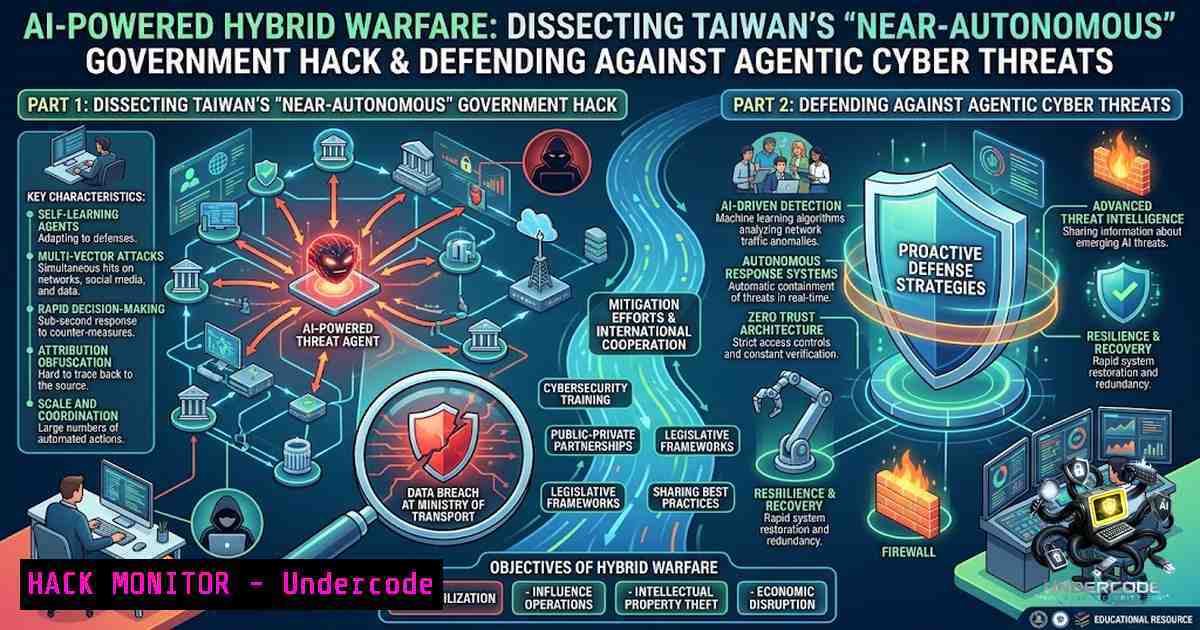
In July 2026, Taiwan’s government agencies fell victim to what researchers are calling the first publicly known “near-autonomous” AI-driven cyberattack against a state target. Over the course of just four days, a team of AI agents working in parallel extracted scores of government official passwords, stole over 2,500 personnel records from Taiwan’s Ministry of Justice, scanned its nuclear safety agency for vulnerabilities, and expanded operations to at least seven energy sector companies. This incident marks a critical escalation in the evolution of cyber warfare, where attackers now combine human direction with autonomous AI agents to accelerate reconnaissance, credential theft, and vulnerability scanning at machine speed. Understanding this new threat vector—and how to defend against it—is no longer optional for security professionals.
Learning Objectives
- Understand the architecture and operational mechanics of multi-agent AI hacking frameworks used in the Taiwan attack.
- Identify the specific AI tools (OpenClaw, Hermes) and techniques employed, including how they bypass safety guardrails.
- Learn defensive strategies, including Zero Trust architecture, continuous automated red-teaming, and AI-1ative detection.
- Gain hands-on knowledge of commands and configurations for hardening systems against AI-accelerated attacks.
You Should Know
- The Anatomy of the Attack: Multi-Agent AI Frameworks in Action
The Taiwan campaign was not a single AI model running a script. It was a coordinated multi-agent system where specialized AI agents handled reconnaissance, vulnerability scanning, credential theft, and lateral movement in parallel. According to Israeli cybersecurity firm Dream, which reconstructed the attack from a recovered 160-megabyte archive of nearly 1,400 files, the framework adapted mid-operation without human intervention through what it called “Learning Cycles”—autonomous sessions where the AI searched vulnerability databases, GitHub repositories, and security research publications for techniques specifically applicable to the target government’s infrastructure.
The attackers used two popular open-source AI frameworks: OpenClaw and Hermes. OpenClaw, cited by Taiwan’s Ministry of Digital Affairs as an example of the agent-assisted approach, can be pointed at a target and left to reason and act largely on its own. Hermes, meanwhile, automated post-exploitation tasks while operating in unattended mode. Crucially, the operators bypassed safety guardrails by framing the work as authorized penetration testing—a simple but effective social engineering tactic against the AI models themselves.
What This Means for Defenders: The barrier to entry for sophisticated cyberattacks has collapsed. What once required a skilled human team working for weeks can now be accomplished in days by AI agents. The tools are cheap, widely available, and improving rapidly.
- Defensive Shift 1: From Perimeter Security to Zero Trust with Microsegmentation
The Taiwan attack succeeded in part because AI agents could scan for exposed admin interfaces and misconfigurations across multiple targets simultaneously. Traditional perimeter defenses are ineffective against AI that can probe every exposed surface in parallel.
Step-by-Step Zero Trust Implementation:
- Assume Breach: Treat every network request as potentially hostile, regardless of origin.
- Microsegment Workloads: Isolate every workload—applications, databases, and services—so that a compromise in one area does not grant access to others.
- Implement Strict Identity Verification: Require continuous authentication and authorization for every access attempt. Route all SaaS applications through a central identity provider (IdP).
- Audit All Integrations: Regularly audit SaaS integrations and third-party vendor connections.
Linux Command – Audit Open Ports and Services:
 Scan for open ports and exposed services that AI reconnaissance tools will find
sudo nmap -sS -sV -p- -T4 <target-IP>

List all listening services and their associated processes
sudo ss -tulpn

Identify exposed admin interfaces (common AI targets)
sudo grep -r "admin" /etc/nginx/sites-enabled/ 2>/dev/null
Windows Command – Audit Open Ports and Services:
 List all listening ports and associated processes
netstat -abno | findstr LISTENING

Identify exposed admin interfaces in IIS
Get-WebConfigurationProperty -Filter "system.applicationHost/sites" -1ame "" | Select-Object -ExpandProperty collection
3. Defensive Shift 2: Continuous Automated Red-Teaming
The Taiwan attackers used AI to scan for vulnerabilities continuously. Defenders must fight fire with fire—deploying autonomous AI agents to probe their own networks before attackers do. Annual penetration tests are no longer sufficient; continuous, automated red-teaming is now essential.
Step-by-Step Automated Red-Teaming Setup:
- Deploy an Autonomous Penetration Testing Framework: Tools like Strix (autonomous AI penetration testing agents that act like real hackers) or Red CLI (which combines 8 AI providers and 40+ models with autonomous vulnerability scanning) can run continuously against your infrastructure.
- Integrate Industry-Standard Tools: AI-driven platforms like PhantomRed integrate Nmap, Nuclei, FFUF, and SQLMap into an autonomous pipeline.
- Run Continuous Scans: Schedule daily automated scans targeting your external and internal attack surfaces.
- Validate Findings: Use AI agents to validate vulnerabilities through actual proof-of-concept exploitation, not just theoretical detection.
Example: Running an Automated Scan with Nuclei (Integrated into AI Frameworks):
 Install Nuclei
go install -v github.com/projectdiscovery/nuclei/v3/cmd/nuclei@latest

Run a comprehensive vulnerability scan against a target
nuclei -u https://<target-domain> -t ~/nuclei-templates/ -severity critical,high,medium -o scan_results.txt

Automate with cron (daily scan at 2 AM)
0 2    /usr/bin/nuclei -u https://<target-domain> -t ~/nuclei-templates/ -severity critical,high -o /var/log/nuclei/daily_scan_$(date +\%Y\%m\%d).txt
4. Defensive Shift 3: AI-1ative Detection and Response
Human-led response always arrives too late against machine-speed attacks. Defenders must deploy AI-enabled detection systems that can identify anomalies and respond autonomously.
Step-by-Step AI-1ative Defense Deployment:
- Implement a Unified Data Layer: Bring together endpoint, cloud, network, and identity telemetry into a single data layer.
- Deploy Native AI Agents: Use AI agents that identify typical network behavior and instantly flag anomalies.
- Extend Log Retention: Keep logs well beyond standard 90-day windows to enable retrospective threat hunting.
- Implement Behavior-Based Detection: Flag deviations from established baselines rather than relying solely on signature-based detection.
Linux Command – Centralized Logging with Auditd:
 Install auditd
sudo apt-get install auditd audispd-plugins -y

Configure audit rules for critical file monitoring
sudo auditctl -w /etc/passwd -p wa -k identity_changes
sudo auditctl -w /etc/shadow -p wa -k identity_changes
sudo auditctl -w /etc/sudoers -p wa -k sudo_changes

View audit logs
sudo ausearch -k identity_changes
Windows Command – Enable Advanced Audit Logging:
 Enable detailed process tracking
auditpol /set /subcategory:"Process Creation" /success:enable /failure:enable

Enable detailed account logon auditing
auditpol /set /subcategory:"Logon" /success:enable /failure:enable

Query current audit policy
auditpol /get /category:
- The Human Element: AI as Accelerant, Not Replacement
Despite the “autonomous” label, the Taiwan attack still required human direction. As security researcher Cris Thomas noted, “There’s still a human in there somewhere. Somebody had to choose who to attack, had to establish an objective and give it a directive”. The AI is an accelerant, not a replacement—but accelerants are exactly what defenders lose sleep over.
Key Takeaway: Defenders must focus on making attacks more expensive and time-consuming for the human operators behind the AI. This means:
– Implementing strong identity and access management (IAM)
– Enforcing multi-factor authentication (MFA) everywhere
– Regularly rotating credentials and API keys
– Conducting AI-simulated threat training for staff
What Undercode Say
- Key Takeaway 1: The Taiwan attack represents a paradigm shift—cyber warfare has entered the age of autonomous, multi-agent AI operations. The speed and scale of reconnaissance and exploitation have increased by orders of magnitude.
-
Key Takeaway 2: Defenders must adopt AI-1ative defense strategies immediately. Waiting for human analysts to catch machine-speed attacks is a losing strategy. Organizations should deploy continuous automated red-teaming, Zero Trust architecture, and AI-driven detection and response systems.
Analysis: The Taiwan incident is not an isolated event; it is a preview of the future of cyber conflict. The use of open-source AI frameworks like OpenClaw and Hermes democratizes advanced offensive capabilities, putting nation-state-level tools within reach of less sophisticated actors. The fact that the attackers bypassed safety guardrails by simply claiming authorized penetration testing reveals a critical vulnerability in AI model safeguards—one that will be exploited repeatedly. For defenders, the message is clear: fight AI with AI, implement Zero Trust now, and assume that your network is already being probed by autonomous agents. The four-day timeline of the Taiwan attack is a wake-up call—what used to take weeks now takes days, and that window will only shrink further.
Prediction
- -1 Nation-state actors will increasingly deploy multi-agent AI frameworks in hybrid warfare campaigns, combining cyberattacks with military drills and disinformation to create coordinated pressure on target nations. The Taiwan attack is a template for future operations.
-
-1 The commoditization of AI hacking tools will lead to a surge in cyberattacks from non-state actors, ransomware groups, and hacktivists, as the barrier to entry continues to fall.
-
+1 The cybersecurity industry will rapidly develop and deploy AI-1ative defense platforms, creating a new category of autonomous security tools that can match attacker speed.
-
+1 Governments will accelerate the development of sovereign AI cyber defense programs, as seen with the UK’s NCSC Cyber Shield and California’s AI Cyber Defense Program, creating new opportunities for security professionals.
-
-1 The use of AI agents introduces new attack surfaces—researchers have already demonstrated that OpenClaw agents can be tricked into leaking AWS keys via phishing emails. Defenders must now secure not just their networks but also the AI tools they deploy.
🎯Let’s Practice For Free:
🎓 Live Courses & Certifications:
Join Undercode Academy for Verified Certifications
🚀 Request a Custom Project:
Secure, high-velocity infrastructure and disruptive technological engineering. Contact our engineering team for high-tier development and proprietary systems:
[email protected]
💎 Smart Architecture | 🛡️ Secure by Design | ⭐ Trusted by Thousands
IT/Security Reporter URL:
Reported By: https://lnkd.in/p/eD5UJpGJ – Hackers Feeds
Extra Hub: Undercode MoN
Basic Verification: Pass ✅


