
Listen to this Post
Introduction:
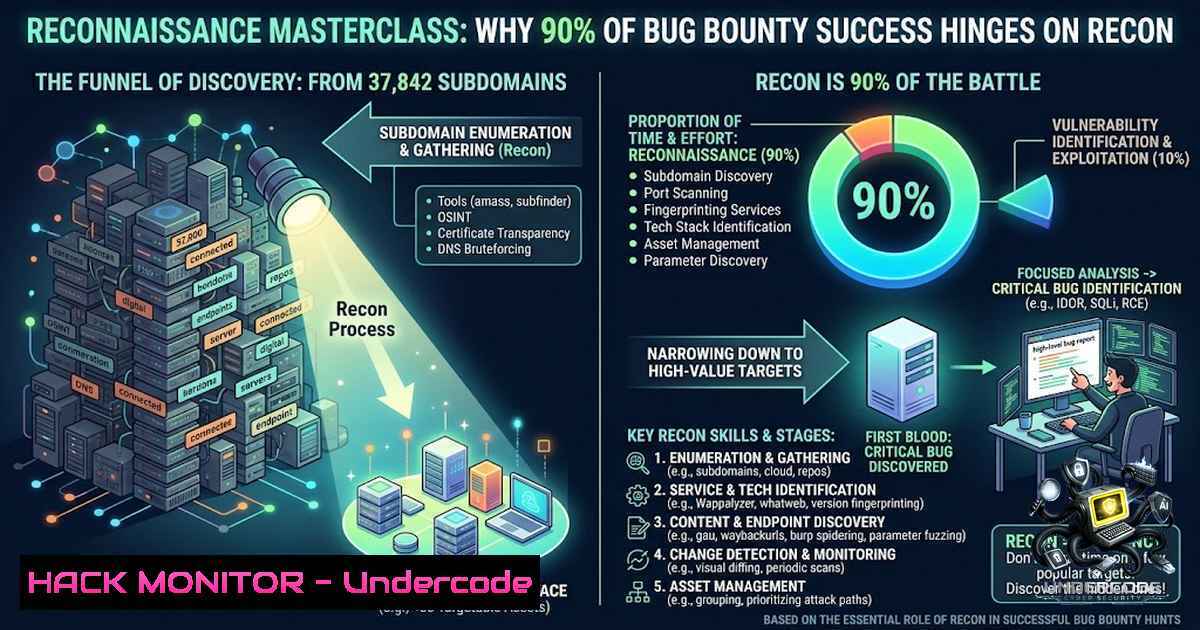
In the high-stakes arena of bug bounty hunting, the difference between a $50,000 payout and a year of fruitless scanning often comes down to one brutal truth: reconnaissance is not preparation—it is the battle itself. When a hunter announces they’ve discovered 37,842 subdomains yet remain “still searching for the first bug,” they’ve inadvertently revealed the single most common pitfall in modern security testing: the illusion that volume equals victory. This article dismantles that misconception, transforming raw data overload into a surgical, repeatable methodology that turns passive enumeration into active exploitation—because in 2025, the hunter who masters recon doesn’t just find bugs; they find the bugs everyone else missed.
Learning Objectives:
- Master the complete reconnaissance pipeline from passive subdomain discovery to live-host validation using industry-standard tooling
- Implement automated workflows that filter 37,000+ subdomains down to actionable attack surfaces in under 30 minutes
- Apply practical exploitation techniques—including HTTP fingerprinting, JavaScript analysis, and hidden parameter fuzzing—to convert recon data into verified vulnerabilities
- Subdomain Enumeration: The Art of Finding What Others Overlook
Subdomain enumeration is the cornerstone of any serious bug bounty operation. As one seasoned hunter puts it, “Before you attack anything, you need to know what exists. Companies often forget old infrastructure, old dev servers, or staging areas—and those forgotten doors lead to some of the best bugs you’ll ever find.” The goal is not merely to collect every possible subdomain but to intelligently aggregate data from multiple sources, deduplicate, and prepare for active probing.
Passive Discovery (No Direct Interaction)
Passive techniques leverage public datasets, certificate transparency logs, and search engines. These methods leave no footprint and are safe for any target.
Linux/macOS Commands:
 Install core passive tools
go install -v github.com/projectdiscovery/subfinder/v2/cmd/subfinder@latest
go install -v github.com/OWASP/Amass/v3/...@master
go install github.com/tomnomnom/assetfinder@latest

Create working directory
mkdir -p ~/recon/target && cd ~/recon/target

Subfinder - Fast and reliable
subfinder -d target.com -all -silent -o subfinder.txt

Amass - Deep OSINT enumeration
amass enum -passive -1orecursive -1oalts -d target.com -o amass.txt

Assetfinder - Quick discovery
assetfinder --subs-only target.com > assetfinder.txt

Certificate Transparency (crt.sh)
curl -s "https://crt.sh/?q=%25.target.com&output=json" | jq -r '.[].name_value' | sed 's/\.//g' | sort -u > crtsh.txt
Active Discovery (DNS Bruteforcing)
Active techniques involve sending DNS queries to discover subdomains via wordlist bruteforcing. This is resource-intensive but uncovers assets that don’t appear in public databases.
Commands:
 Install PureDNS for high-performance bruteforcing
go install github.com/d3mondev/puredns/v2@latest

Download quality wordlists
wget https://raw.githubusercontent.com/danielmiessler/SecLists/master/Discovery/DNS/dns-Jhaddix.txt
wget https://raw.githubusercontent.com/assetnote/commonspeak2-wordlists/master/subdomains/subdomains.txt

Bruteforce with PureDNS
puredns bruteforce dns-Jhaddix.txt target.com -r resolvers.txt -o bruteforce.txt
Windows Alternative (WSL or PowerShell)
For Windows users, the most practical approach is using Windows Subsystem for Linux (WSL) to run the same Go-based tools. Alternatively, use PowerShell with native cmdlets:
 PowerShell DNS resolution example
$domain = "target.com"
Get-Content .\subdomains.txt | ForEach-Object {
try {
$record = Resolve-DnsName "$<em>.$domain" -Type A -ErrorAction Stop
"$</em>.$domain" | Out-File -Append .\resolved.txt
} catch {}
}
Consolidation:
 Combine and deduplicate all sources
cat subfinder.txt amass.txt assetfinder.txt crtsh.txt bruteforce.txt | sort -u > all_subs.txt
wc -l all_subs.txt  Expect thousands—like 37,842
2. Live Host Detection: Separating Signal from Noise
Discovering 37,842 subdomains is meaningless if you cannot determine which are actually live and responding. This phase transforms a massive text file into a curated list of exploitable targets.
HTTP Probing with httpx
`httpx` is the industry standard for rapid, multi-threaded HTTP probing. It checks for live web servers, captures status codes, titles, and technology fingerprints.
Commands:
 Install httpx
go install -v github.com/projectdiscovery/httpx/cmd/httpx@latest

Probe all subdomains with intelligent filtering
httpx -l all_subs.txt -threads 100 -status-code -title -tech-detect -follow-redirects -o live_hosts.txt

Filter for specific status codes (e.g., 200 OK, 403 Forbidden)
httpx -l all_subs.txt -status-code -match-status 200,403,401 -o interesting.txt

Extract only live domains with web servers
httpx -l all_subs.txt -silent -o live.txt
Port Scanning Integration
Combine subdomain discovery with port scanning to identify services beyond HTTP/HTTPS:
 Pipe subfinder directly into naabu for port scanning
echo target.com | subfinder -silent -all | naabu -silent -o ports.txt
Windows Alternative:
For Windows without WSL, use `curl` or `Invoke-WebRequest` in a loop, though this is significantly slower. Consider using `httpx` via WSL for production workflows.
3. HTTP Fingerprinting: Profiling the Attack Surface
Once you have live hosts, the next step is to identify the technologies powering each application. HTTP fingerprinting reveals programming languages, frameworks, server versions, and third-party services—intelligence that enables targeted exploit crafting.
Automated Technology Detection
 Use httpx with tech detection
httpx -l live.txt -tech-detect -o tech_fingerprints.txt

Use Wappalyzer (via CLI or browser extension)
 For CLI: https://github.com/AliasIO/wappalyzer
Manual HTTP Header Analysis
Sometimes the most valuable intelligence comes from manual inspection:
 Grab headers for analysis
curl -I https://target.com

Check for misconfigured CORS, HSTS, or security headers
curl -I -X OPTIONS https://api.target.com
Key Indicators to Look For:
– `Server:` header reveals software versions (e.g., nginx/1.18.0)
– `X-Powered-By:` exposes underlying technology (e.g., PHP/7.4.33)
– `Set-Cookie:` reveals session management patterns
– Custom headers often indicate proprietary frameworks or API gateways
4. JavaScript Analysis and Endpoint Discovery
Modern web applications are JavaScript-heavy, and client-side code often leaks API endpoints, internal paths, and even hardcoded secrets. This is where many hunters miss critical vulnerabilities.
Extracting URLs from JavaScript
 Install waybackurls and gau
go install github.com/tomnomnom/waybackurls@latest
go install github.com/lc/gau/v2/cmd/gau@latest

Extract URLs from Wayback Machine
cat domains.txt | waybackurls | grep -E ".js$" | sort -u > js_files.txt

Download and analyze JavaScript files
cat js_files.txt | while read url; do
curl -s "$url" | grep -Eo "(http|https)://[a-zA-Z0-9./?=_-]" | sort -u >> endpoints.txt
done

Use gau for comprehensive URL discovery
cat domains.txt | gau --threads 10 | grep -E ".js$" | sort -u >> js_files.txt
Finding Secrets in JavaScript
 Use grep for common secret patterns
grep -E "api[_-]?key|secret|token|password|auth" js_files.txt

More comprehensive with truffleHog
trufflehog filesystem --directory ./js_downloads/
5. Hidden Parameter and Directory Fuzzing
Vulnerabilities often hide in undocumented parameters and directories that automated scanners miss. Fuzzing is the art of sending unexpected inputs to discover hidden functionality.
Directory Bruteforcing
 Install ffuf
go install github.com/ffuf/ffuf@latest

Directory fuzzing with common wordlist
ffuf -u https://target.com/FUZZ -w /usr/share/wordlists/dirb/common.txt -mc 200,301,302,403 -o dirs.json

Recursive directory discovery
ffuf -u https://target.com/FUZZ -w wordlist.txt -recursion -recursion-depth 2
Parameter Fuzzing (GET and POST)
 GET parameter fuzzing
ffuf -u https://target.com/page?FUZZ=test -w params.txt

POST parameter fuzzing with JSON
ffuf -u https://api.target.com/endpoint -X POST -H "Content-Type: application/json" -d '{"FUZZ":"value"}' -w params.txt
Wordlist Recommendations:
- SecLists: `https://github.com/danielmiessler/SecLists`
– Assetnote wordlists: `https://wordlists.assetnote.io/`
– Custom wordlists based on target technology (e.g., GraphQL, REST API patterns)
6. Vulnerability Scanning and Exploitation
With a refined list of live hosts, technology fingerprints, and discovered endpoints, you’re now positioned to scan for and exploit vulnerabilities.
Automated Vulnerability Scanning with Nuclei
 Install nuclei
go install -v github.com/projectdiscovery/nuclei/v3/cmd/nuclei@latest

Run nuclei against all live hosts
nuclei -l live.txt -t ~/nuclei-templates/ -severity low,medium,high,critical -o nuclei_results.txt

Focus on specific vulnerability types
nuclei -l live.txt -t ~/nuclei-templates/http/misconfiguration/ -o misconfigs.txt
nuclei -l live.txt -t ~/nuclei-templates/http/exposures/ -o exposures.txt
Manual Exploitation Techniques
- IDOR (Insecure Direct Object References): Look for numeric or UUID parameters in URLs (e.g.,
/user/1234). Increment the value and check for unauthorized access. - XSS (Cross-Site Scripting): Test input fields and URL parameters with payloads like
<script>alert(1)</script>. - SQL Injection: Use single quotes (
') and Boolean-based tests in search parameters. - SSRF (Server-Side Request Forgery): Test parameters that accept URLs (e.g.,
?url=...) by pointing them to an internal IP (e.g.,169.254.169.254).
API Security Testing
Modern bug bounties increasingly target APIs. Key areas to test:
– Authentication bypass: Test for missing or weak JWT validation
– GraphQL introspection: Query `__schema` to reveal the entire API structure
– Rate limiting bypass: Test for missing rate limits on sensitive endpoints
– CORS misconfiguration: Check for `Access-Control-Allow-Origin: `
What Undercode Say:
- “Recon isn’t about finding everything—it’s about finding the right things.” Discovering 37,842 subdomains is impressive, but without filtering and prioritization, it’s just noise. The true skill lies in transforming that raw data into a curated attack surface. Tools like `httpx` and `nuclei` are not optional; they are essential multipliers that turn reconnaissance into actionable intelligence.
-
“The best bugs are found in forgotten infrastructure.” Staging servers, development environments, and deprecated APIs are goldmines. These assets often lack proper security controls, use default credentials, or expose internal documentation. Certificate transparency logs and Wayback Machine archives are your best friends for uncovering these hidden gems.
-
Analysis: The hunter’s confession of finding 37,842 subdomains without a single bug exposes a systemic flaw in modern bug bounty methodology: the over-reliance on enumeration without contextual analysis. Successful hunting requires a shift from “collect everything” to “interrogate intelligently.” This means implementing automated filtering pipelines, mastering HTTP fingerprinting to prioritize high-value targets, and dedicating as much time to manual testing as to automated scanning. The hunters who consistently earn top bounties are not those with the largest wordlists but those who understand the architecture they’re attacking—and that understanding begins with rigorous, methodical reconnaissance that treats each subdomain not as a data point but as a potential entry point.
Prediction:
-
+1 The democratization of AI-powered reconnaissance tools will lower the barrier to entry for bug bounty hunting, enabling a new wave of hunters to compete alongside veterans. Tools like Pinakastra, which combine passive enumeration with AI-driven payload generation, will become standard in every hunter’s arsenal.
-
+1 Automated recon pipelines that integrate subdomain enumeration, live probing, fingerprinting, and vulnerability scanning into a single command will become the norm, reducing the average time from target assignment to first finding from weeks to hours.
-
-1 As reconnaissance becomes more automated and accessible, bug bounty programs will respond by hardening their attack surfaces, implementing better CDN configurations, and deploying Web Application Firewalls (WAFs) that detect and block automated scanning patterns. This arms race will make it harder for hunters relying solely on automated tools to find vulnerabilities.
-
-1 The increasing use of serverless architectures and API-first designs will render traditional subdomain enumeration less effective, as many attack surfaces will no longer be tied to DNS records. Hunters will need to adapt by mastering API discovery, GraphQL introspection, and cloud asset enumeration—skills that are currently underrepresented in the bug bounty community.
-
+1 The most successful hunters of 2026 will be those who combine automated recon with deep manual testing, focusing on business logic flaws and complex authentication bypasses that AI tools cannot yet detect. The “90% recon, 10% hunting” ratio will shift to “70% recon, 30% creative exploitation” as hunters realize that the real value lies not in finding more subdomains but in finding the one misconfigured endpoint that unlocks the entire application.
▶️ Related Video (68% Match):
https://www.youtube.com/watch?v=6TWufwZLh2w
🎯Let’s Practice For Free:
🎓 Live Courses & Certifications:
Join Undercode Academy for Verified Certifications
🚀 Request a Custom Project:
Secure, high-velocity infrastructure and disruptive technological engineering. Contact our engineering team for high-tier development and proprietary systems:
[email protected]
💎 Smart Architecture | 🛡️ Secure by Design | ⭐ Trusted by Thousands
IT/Security Reporter URL:
Reported By: Deepak Saini – Hackers Feeds
Extra Hub: Undercode MoN
Basic Verification: Pass ✅


