
Listen to this Post
Introduction:
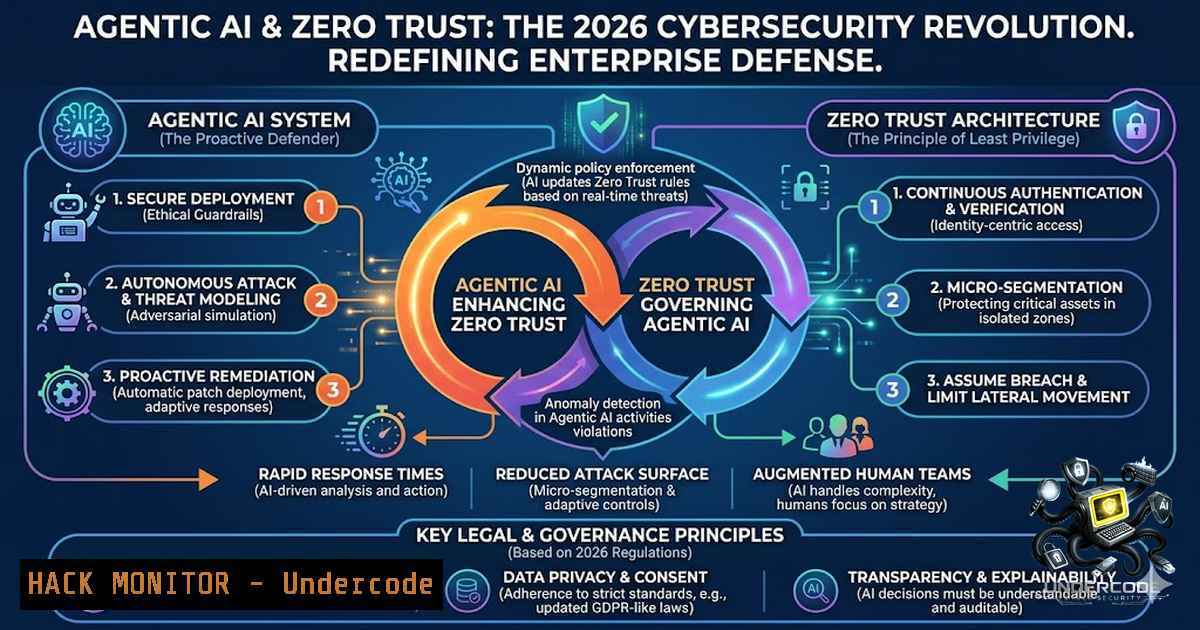
The convergence of Agentic Artificial Intelligence and Zero Trust architecture is fundamentally reshaping the enterprise security landscape in 2026. As autonomous AI agents gain the ability to execute complex tasks across multi-cloud environments, traditional perimeter-based security models have become obsolete, forcing organizations to adopt identity-centric, continuously verified security postures. Shahzad MS, a 34-year enterprise technology leader and Microsoft AI Winner, emphasizes that the integration of Agentic AI with Zero Trust frameworks and multi-cloud strategies represents the most significant paradigm shift in cybersecurity since the advent of cloud computing.
Learning Objectives:
- Understand the core principles of Agentic AI security and its unique risk landscape, including the OWASP Top 10 for Agentic Applications.
- Master Zero Trust architecture implementation using NIST SP 1800-35 guidelines and practical deployment strategies.
- Develop multi-cloud security strategies that unify protection across AWS, Azure, and Google Cloud platforms.
- Acquire hands-on skills with Linux and Windows commands for security hardening, identity management, and continuous monitoring.
- Prepare for Microsoft SC-100 Cybersecurity Architect certification with practical Zero Trust design patterns.
You Should Know:
- Agentic AI Security: The New Frontier of Cyber Defense
Agentic AI systems—autonomous agents that execute tasks across tools, APIs, and data stores—introduce unprecedented security challenges that traditional cybersecurity paradigms are ill-equipped to address. Unlike conventional AI models, agentic systems possess action-execution capabilities, making them vulnerable to control-flow hijacking, memory poisoning, and cascading failures.
The OWASP GenAI Security Project has released the Top 10 for Agentic Applications, identifying critical risks including memory poisoning, excessive agency, and insecure plugin design. To mitigate these threats, organizations must implement layered security frameworks such as the Asimov Safety Architecture (ASA), which combines deterministic pattern denylists with stateless verification gates.
Step‑by‑Step Guide: Securing Agentic AI Deployments
Step 1: Conduct a Risk Discovery Phase
Begin by mapping your agentic workflows and identifying potential attack vectors. Use frameworks like the Agentic AI Threats & Mitigations taxonomy to systematically evaluate risks across architectural layers.
Step 2: Implement Runtime Security Governance
Deploy runtime security toolkits that enforce deterministic, sub-millisecond policy enforcement. Microsoft’s Agent Governance Toolkit, released under the MIT license, addresses all 10 OWASP agentic AI risks.
 Linux: Monitor agentic AI process activity
sudo auditctl -w /opt/agentic_ai/bin/ -p rwx -k agentic_ai_monitor

Windows: Enable advanced audit policy for AI processes
auditpol /set /subcategory:"Process Creation" /success:enable /failure:enable
Step 3: Establish Agent Event Behavior Analysis (AEBA)
Implement behavioral monitoring equivalent to User and Entity Behavior Analytics (UEBA) for autonomous agents. Collect, sign, and analyze behavioral events to detect anomalies.
Step 4: Enforce Least Privilege Access
Restrict agent permissions to the minimum required for task execution. Use temporary tokens with strict scopes instead of permanent credentials.
 PowerShell: Restrict agent service permissions
Set-Acl -Path "C:\AgenticAI\Service" -AclObject (Get-Acl -Path "C:\AgenticAI\Service" |
ForEach-Object { $<em>.SetAccessRuleProtection($true, $false); $</em> })
2. Zero Trust Architecture: From Theory to Production
Zero Trust is a strategy, not a product—effective implementation requires a structured approach that moves beyond traditional perimeter-based security. The NIST National Cybersecurity Center of Excellence has released SP 1800-35, a final practice guide demonstrating end-to-end Zero Trust Architectures with 24 vendor partners.
Step‑by‑Step Guide: Implementing Zero Trust Architecture
Step 1: Define the Protect Surface
Identify your most critical data, applications, assets, and services (DAAS). Unlike traditional approaches that focus on the entire network perimeter, Zero Trust requires you to pinpoint specific protect surfaces.
Step 2: Map Transaction Flows
Understand how traffic moves across your environment. Document all data flows, including north-south (client-to-server) and east-west (server-to-server) traffic.
 Linux: Map network flows using netstat and ss
ss -tulpn | grep LISTEN
netstat -an | grep ESTABLISHED

Windows: View active connections
netstat -an | findstr ESTABLISHED
Step 3: Design Zero Trust Architecture
Build a micro-segmentation strategy that isolates workloads and prevents lateral movement. For Kubernetes environments, implement network policies to restrict pod-to-pod communication.
 Kubernetes NetworkPolicy for Zero Trust segmentation
apiVersion: networking.k8s.io/v1
kind: NetworkPolicy
metadata:
name: zero-trust-deny-all
spec:
podSelector: {}
policyTypes:
- Ingress
- Egress
Step 4: Build and Enforce Policy
Create granular access policies based on user identity, device posture, and contextual factors. Implement continuous verification for every access request.
 Azure CLI: Enforce Conditional Access policies
az rest --method patch --url "https://graph.microsoft.com/v1.0/identity/conditionalAccess/policies/{policy-id}" \
--body '{"state":"enabled"}'
Step 5: Monitor and Maintain Continuously
Deploy continuous monitoring solutions that validate trust in real-time. Use Security Information and Event Management (SIEM) tools to correlate events across your Zero Trust environment.
3. Multi-Cloud Security: Unifying Protection Across Diverse Environments
With 55% of organizations now multi-cloud by design, many managing deployments across five or more cloud providers, unified security strategies have become essential. The challenge lies in maintaining consistent policies, visibility, and compliance across AWS, Azure, Google Cloud, and on-premises environments.
Step‑by‑Step Guide: Multi-Cloud Security Hardening
Step 1: Centralize Identity and Access Management
Establish a single source of truth for identity across all cloud platforms. Enforce multi-factor authentication (MFA) and use role-based access control (RBAC) with temporary, scoped tokens.
 AWS CLI: Create IAM role with temporary credentials
aws iam create-role --role-1ame MultiCloudSecurityRole --assume-role-policy-document file://trust-policy.json
aws sts assume-role --role-arn arn:aws:iam::account-id:role/MultiCloudSecurityRole --role-session-1ame session1

Azure CLI: Assign RBAC role
az role assignment create --assignee [email protected] --role "Security Admin" --scope /subscriptions/subscription-id
Step 2: Implement Unified Policy Management
Deploy a comprehensive software firewall platform that automatically applies consistent security policies across all clouds. Use Infrastructure as Code (IaC) to enforce security baselines.
 Terraform: AWS Security Group with least privilege
resource "aws_security_group" "multi_cloud_sg" {
name = "multi-cloud-sg"
description = "Zero Trust security group"

ingress {
from_port = 443
to_port = 443
protocol = "tcp"
cidr_blocks = ["10.0.0.0/8"]
}

egress {
from_port = 0
to_port = 0
protocol = "-1"
cidr_blocks = ["0.0.0.0/0"]
}
}
Step 3: Encrypt Data at Rest and in Transit
Employ data encryption and protection measures across all cloud environments. Use customer-managed keys (CMK) for sensitive data and enforce TLS 1.3 for all communications.
 GCloud CLI: Enable encryption with customer-managed keys
gcloud kms keys create multi-cloud-key --location global --keyring multi-cloud-ring --purpose encryption
gcloud storage buckets update gs://multi-cloud-bucket --default-encryption-key projects/project-id/locations/global/keyRings/multi-cloud-ring/cryptoKeys/multi-cloud-key
Step 4: Automate Cloud Security Posture Management (CSPM)
Deploy automated tools that continuously scan for misconfigurations. Publicly accessible storage buckets remain a leading cause of breaches—automate detection and remediation.
 Python: Automated S3 bucket public access check
import boto3
s3 = boto3.client('s3')
buckets = s3.list_buckets()['Buckets']
for bucket in buckets:
acl = s3.get_bucket_acl(Bucket=bucket['Name'])
for grant in acl['Grants']:
if 'URI' in grant['Grantee'] and 'AllUsers' in grant['Grantee']['URI']:
print(f"ALERT: Bucket {bucket['Name']} is publicly accessible")
 Auto-remediate: block public access
s3.put_public_access_block(
Bucket=bucket['Name'],
PublicAccessBlockConfiguration={
'BlockPublicAcls': True,
'IgnorePublicAcls': True,
'BlockPublicPolicy': True,
'RestrictPublicBuckets': True
}
)
- Zero Trust Network Access (ZTNA): Replacing Traditional VPNs
ZTNA represents the evolution of remote access, restricting network access to specific applications based on user identity, device posture, and contextual factors rather than granting broad network access.
Step‑by‑Step Guide: Deploying ZTNA
Step 1: Assess Organizational Readiness
Before implementing ZTNA, evaluate your current identity management, device compliance, and application inventory capabilities.
Step 2: Define Application Groups
Log the location and access requirements of each application group. This inventory forms the foundation of your ZTNA policy.
Step 3: Configure ZTNA Gateways
Deploy ZTNA gateways that broker connections between users and applications. Configure trusted networks and enforce identity-based access.
 Cisco Secure Firewall: Configure trusted network
 Access Firewall Management Center > Objects > Network > Add Trusted Network
 Set network: 10.0.0.0/8, Description: "Corporate Trusted Network"

OpenVPN Access Server: Configure ZTNA policies
 /usr/local/openvpn_as/scripts/sacli --key "auth.ldap.0.server" --value "ldap.company.com" ConfigPut
 /usr/local/openvpn_as/scripts/sacli start
Step 4: Deploy Client Agents
Install ZTNA client agents on all remote user devices. Ensure version compatibility and enforce device posture checks before granting access.
 PowerShell: Deploy ZTNA agent silently
msiexec /i "ZTNA_Agent.msi" /quiet /norestart ZTNA_SERVER="ztna.company.com" ZTNA_TOKEN="secure-token-here"
Step 5: Implement Continuous Access Verification
Configure policies that continuously verify user identity and device posture throughout the session, not just at initial connection.
- Microsoft SC-100: Designing Zero Trust and Security Solutions
The SC-100 Microsoft Cybersecurity Architect certification validates expertise in designing Zero Trust strategies and security architectures using Microsoft’s cybersecurity reference architecture (MCRA).
Step‑by‑Step Guide: SC-100 Certification Preparation
Step 1: Master Zero Trust Design Principles
Understand how to build an overall security strategy that identifies integration points using MCRA. Evaluate security posture using Azure security benchmarks and ISO 27001 standards.
Step 2: Design Identity and Access Solutions
Develop expertise in identity and access management, privileged access, and regulatory compliance capabilities.
 Azure PowerShell: Configure Privileged Identity Management (PIM)
Enable-AzureRmPim -ResourceId "/subscriptions/subscription-id/providers/Microsoft.Authorization/roleAssignments/role-id"
New-AzureRmPimRoleAssignment -RoleDefinitionId "role-id" -PrincipalId "user-object-id" -Scope "/subscriptions/subscription-id"
Step 3: Design Security Operations (SecOps)
Learn to design solutions for security operations that integrate threat detection, incident response, and continuous monitoring.
// Azure Sentinel: KQL query for threat hunting
SecurityEvent
| where EventID in (4624, 4625)
| where TimeGenerated > ago(24h)
| summarize FailedAttempts = countif(EventID == 4625), SuccessfulAttempts = countif(EventID == 4624) by Account, Computer
| where FailedAttempts > 5
Step 4: Implement Data and Application Security
Design strategies for securing data and applications across hybrid and multi-cloud environments.
What Undercode Say:
- Key Takeaway 1: Agentic AI security requires a fundamental shift from reactive to proactive defense—organizations must implement runtime governance, behavioral monitoring, and layered security frameworks to mitigate the unique risks of autonomous agents.
-
Key Takeaway 2: Zero Trust is not a product but a strategic framework that demands continuous verification, micro-segmentation, and identity-centric access control across all environments, from on-premises to multi-cloud.
-
Key Takeaway 3: Multi-cloud security success hinges on centralized identity management, unified policy enforcement, and automated posture management—fragmented approaches lead to visibility gaps and misconfigurations.
-
Key Takeaway 4: The convergence of Agentic AI and Zero Trust represents the next evolution of cybersecurity, requiring professionals to master new frameworks like OWASP Top 10 for Agentic Applications and NIST SP 1800-35.
-
Key Takeaway 5: Certifications like Microsoft SC-100 are becoming essential for security architects, providing the structured knowledge needed to design Zero Trust solutions that leverage cloud-1ative security controls.
-
Key Takeaway 6: Organizations must treat security as a continuous process, not a one-time implementation—threat actors are increasingly targeting AI systems and cloud misconfigurations, demanding relentless vigilance.
-
Key Takeaway 7: The integration of agentic administration frameworks, such as Zscaler’s ZAgent, demonstrates how AI can enhance security operations while simultaneously introducing new attack surfaces that must be managed.
-
Key Takeaway 8: Supply chain security and B2B connectivity require Zero Trust extensions to unmanaged devices and partner ecosystems, as modern enterprises no longer operate within defined perimeters.
-
Key Takeaway 9: Kubernetes and container security are critical in multi-cloud environments—micro-segmentation capabilities that stop lateral movement are essential for protecting modern workloads.
-
Key Takeaway 10: The cybersecurity industry is witnessing a paradigm shift where AI-driven enterprises must adopt Zero Trust protections across everything from employee devices to cloud workloads, dramatically simplifying security management while enhancing protection.
Prediction:
-
+1 The Agentic AI security market will experience exponential growth through 2028, with Gartner projecting that organizations adopting formal agentic AI security frameworks will reduce AI-related breaches by 70% compared to those relying on traditional security controls.
-
+1 Zero Trust adoption will accelerate as NIST SP 1800-35 provides a standardized implementation roadmap, enabling organizations to move from pilot programs to full-scale production deployments within 18-24 months.
-
-1 Organizations that fail to implement unified multi-cloud security strategies will face increasing breach risks, with misconfigured cloud storage and identity mismanagement remaining the top attack vectors through 2027.
-
-1 The rapid adoption of autonomous AI agents without proper runtime governance will lead to a surge in AI-specific security incidents, including memory poisoning attacks and control-flow hijacking, potentially causing billions in damages.
-
+1 The convergence of Agentic AI and Zero Trust will create new career opportunities for cybersecurity professionals, with demand for AI security architects and Zero Trust engineers projected to outpace supply by 3:1 through 2028.
-
-1 Legacy VPN technologies will become obsolete as ZTNA adoption reaches critical mass, but organizations transitioning too slowly will experience increased exposure to lateral movement attacks and insider threats.
-
+1 Microsoft’s Agent Governance Toolkit and similar open-source frameworks will democratize AI security, enabling organizations of all sizes to implement enterprise-grade protection for autonomous agents without prohibitive costs.
▶️ Related Video (82% Match):
https://www.youtube.com/watch?v=-pqzyvRp3Tc
🎯Let’s Practice For Free:
🎓 Live Courses & Certifications:
Join Undercode Academy for Verified Certifications
🚀 Request a Custom Project:
Secure, high-velocity infrastructure and disruptive technological engineering. Contact our engineering team for high-tier development and proprietary systems:
[email protected]
💎 Smart Architecture | 🛡️ Secure by Design | ⭐ Trusted by Thousands
IT/Security Reporter URL:
Reported By: Shahzadms Share – Hackers Feeds
Extra Hub: Undercode MoN
Basic Verification: Pass ✅


