
Listen to this Post
Introduction:
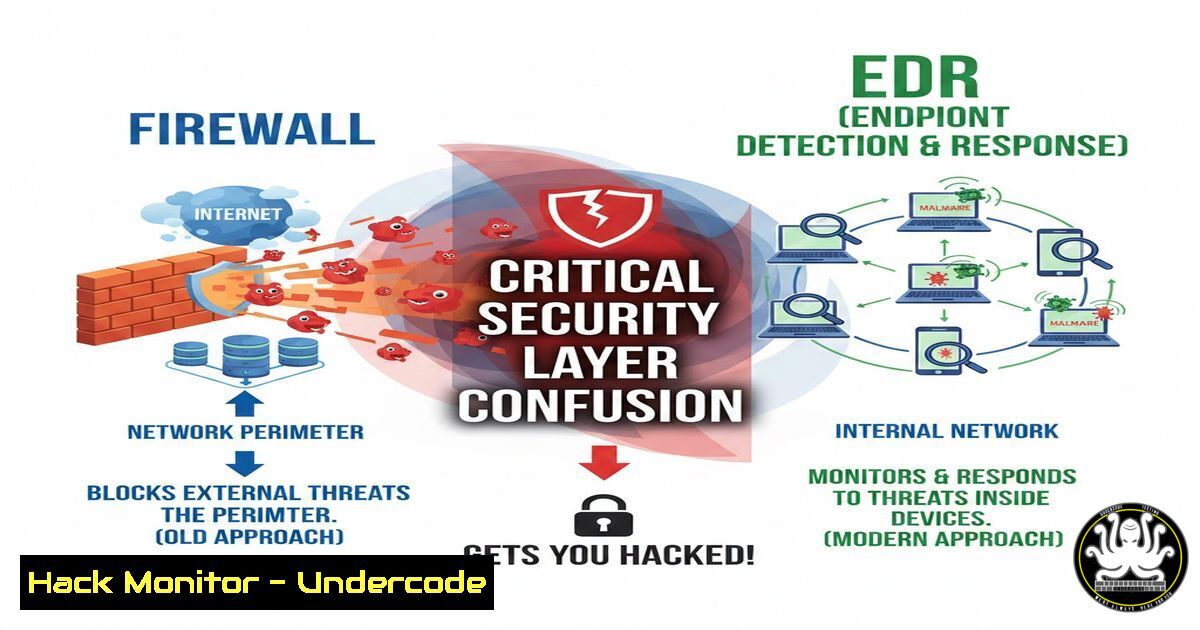
In cybersecurity, a pervasive and dangerous misconception conflates network firewalls with Endpoint Detection and Response (EDR) solutions. While both are essential pillars of a defense-in-depth strategy, they address fundamentally different questions in the attack chain. Understanding their distinct roles, operational layers, and limitations is not academic—it’s the difference between a resilient security posture and a breached network. This article deconstructs the firewall vs. EDR paradigm with technical precision, providing actionable guides for implementation and hardening.
Learning Objectives:
- Distinguish the core function, operational layer, and primary data source of firewalls versus EDR.
- Implement configuration checks and basic commands to validate the security posture of both layers.
- Architect a complementary strategy that correctly layers firewall and EDR controls to minimize exposure and detect post-breach activity.
You Should Know:
- The Foundational Divide: Network Filtering vs. Endpoint Telemetry
The core distinction lies in the security question each tool answers. A firewall operates at the network perimeter (and internally via segmentation), asking: “Is this network traffic authorized to reach this system or segment?” It controls flow based on rules (allow/deny) applied to IPs, ports, and protocols. An EDR operates on the endpoint (servers, workstations), asking: “Once execution is allowed on this machine, are these process, file, and network activities malicious?” It analyzes behavior, code injection, and live telemetry.
Step-by-step Guide:
Firewall Check (Linux iptables): List current filtering rules to understand allowed traffic.
sudo iptables -L -n -v
 -L: List rules, -n: numeric output (no DNS resolution), -v: verbose
EDR Check (Windows via PowerShell): Query for installed security products. EDRs should be listed.
Get-CimInstance -Namespace root/SecurityCenter2 -ClassName AntivirusProduct
Analysis: The firewall rule set shows your exposure surface (e.g., is RDP open to the internet?). The EDR query confirms endpoint monitoring is present. One does not replace the other.
- Firewall Deep Dive: Rule Configuration and Attack Surface Reduction
A firewall’s primary job is to minimize the attack surface. Misconfiguration here renders all other defenses ineffective. Modern Next-Generation Firewalls (NGFWs) add layer 7 inspection, but their core remains traffic control.
Step-by-step Guide:
Critical Rule Audit: The goal is “deny by default.” Audit rules for over-permissive allowances.
 Check the default policy chain on Linux. Should be DROP or REJECT.
sudo iptables -L | grep -E "(Chain INPUT|Chain FORWARD)" -A 1
Windows Firewall Advanced Check: Use `netsh` to examine specific rules.
netsh advfirewall firewall show rule name=all dir=in | findstr "RemoteDesktop"
 This checks for inbound RDP rules—a common attack vector.
Mitigation: Harden rules using the principle of least privilege. For example, if the above shows an RDP rule open to `ANY` IP, scope it to a management VLAN IP range only.
- EDR Core Function: Behavioral Analysis and Exploit Detection
EDR agents collect vast telemetry (process trees, registry changes, network connections). They use behavioral analytics and threat intelligence to detect malicious activity after an initial compromise, such as ransomware encryption or lateral movement.
Step-by-step Guide: Simulating a Test for EDR Alerting.
LOLBAS Test: Use a Living-Off-The-Land binary (like `certutil.exe` or msiexec.exe) for a common download pattern. A robust EDR should flag this.
rem On a Windows system with EDR, run in Command
certutil -urlcache -split -f http://example.com/file.txt C:\Users\Public\file.txt
PowerShell Execution Policy Bypass Test: A common attacker technique.
powershell -ExecutionPolicy Bypass -Command "Get-Process"
Analysis: These are benign commands but mimic TTPs (Tactics, Techniques, and Procedures). Monitor your EDR console for alerts. No alert may indicate a need to tune detection sensitivity or review agent health.
- The Gap Where Attacks Thrive: Encrypted Traffic and Zero-Days
This is where confusion is most dangerous. A firewall may allow encrypted (HTTPS) traffic to a web server. An exploit kit delivers a zero-day payload via that allowed channel. The firewall, without deep packet inspection (DPI) decryption, sees nothing malicious. The EDR is now the critical layer to detect the post-delivery exploit and shellcode execution.
Step-by-step Guide: Network Segment Hardening.
Implement Micro-Segmentation: Even if traffic is allowed north-south, restrict east-west movement. Use host-based firewalls.
 On a Linux web server, block unexpected outbound SMTP to hinder phishing campaigns.
sudo iptables -A OUTPUT -p tcp --dport 25 -j DROP
EDR Network Inspection: Configure EDR to monitor for anomalous outbound connections from non-browser processes, a key indicator of beaconing.
- Advanced Integration: Firewall Logs + EDR Telemetry for Threat Hunting
The true power is correlation. A firewall log showing an inbound connection from a Tor exit node, followed by EDR telemetry showing PowerShell spawning from a browser process, creates a high-fidelity incident.
Step-by-step Guide: Simple SIEM/SOC Correlation Rule Logic.
- Firewall Log Source: Generate a log entry for all allowed inbound connections to critical servers.
- EDR Log Source: Alert on `process_parent_name: msedge.exe` AND
process_name: powershell.exe. - Correlation Rule: If Firewall Log (source_ip is in ThreatIntel_Feed) occurs within 300 seconds of EDR Alert (Host_ID) → Generate Critical Incident.
- Action: Isolate the endpoint via EDR and block the source IP at the firewall.
6. Configuration Hardening Checklist
- Firewall: Enforce default-deny policies. Regularly review and prune rules. Implement Geo-blocking for non-essential services. Use Application Control (NGFW) where possible.
- EDR: Ensure agents are deployed to 100% of assets. Enable tamper protection. Configure exclusions carefully to avoid blind spots. Integrate with vulnerability management to prioritize alerts on unpatched systems.
7. The Modern Blur: XDR and Managed Services
The market is evolving towards Extended Detection and Response (XDR), which aims to unify data from firewalls, EDR, email, and cloud workloads. The principle remains: layers operating at different points in the kill chain must be integrated, not confused.
Step-by-step Guide: Evaluating an XDR Platform.
Ask: Does it normalize firewall network flow logs and endpoint process execution events into a single timeline?
Test: Can you see the initial exploit attempt (from network IDS) and the subsequent malicious process execution (from EDR) in one correlated alert?
Verify: Ensure it doesn’t create a single point of failure; layered controls should still operate independently.
What Undercode Say:
- Key Takeaway 1: A firewall is a preventive gatekeeper; an EDR is a detective/corrective camera system inside the building. You need both the locked gate and the internal cameras. One cannot do the other’s job.
- Key Takeaway 2: The most common security failure stems from assuming a strong firewall eliminates the need for robust endpoint visibility, leaving organizations blind to attacks that bypass perimeter controls through allowed channels like email or web browsing.
Analysis: The persistent confusion between these tools creates critical gaps in security postures. Organizations often overallocate budget to perimeter defense while neglecting endpoint visibility, directly enabling the success of prevalent attack models like phishing and drive-by downloads. The technical reality is that firewalls manage exposure, while EDR manages execution risk. A mature security program uses firewall logs to inform EDR hunting queries and uses EDR findings to create new, more restrictive firewall policies—creating a continuous feedback loop of hardening. Ignoring this symbiosis is an open invitation to breach.
Prediction:
The convergence of network and endpoint security will accelerate through AI-driven platforms, but the fundamental architectural separation of control points will remain. The future impact of this “layer confusion” will shift to cloud and identity boundaries. As perimeter dissolves, the failure to distinguish between Cloud Security Posture Management (CSPM – the “firewall” for cloud configs) and Cloud Workload Protection Platforms (CWPP – the “EDR” for cloud servers) will create the next wave of catastrophic breaches. Organizations that master the distinction between configuration governance and runtime protection—in any environment—will maintain a decisive defensive advantage.
▶️ Related Video (78% Match):
🎯Let’s Practice For Free:
IT/Security Reporter URL:
Reported By: Biren Bastien – Hackers Feeds
Extra Hub: Undercode MoN
Basic Verification: Pass ✅


