
Listen to this Post
Introduction:
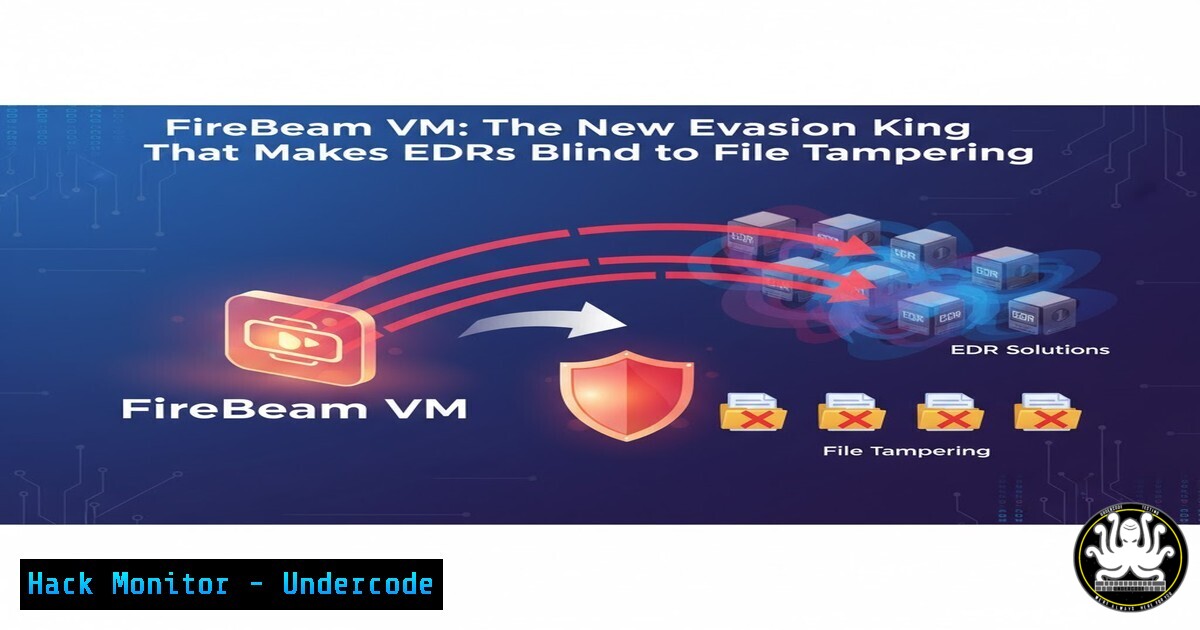
In an era where Endpoint Detection and Response (EDR) solutions have become adept at spotting malicious Beacon Object Files (BOFs) and traditional dynamic code injection, adversaries are shifting left into the processor itself. Researchers at InfinityCurveLabs have released a proof-of-concept named vm-filesystem, which utilizes a custom virtual machine (Firebeam) to interact with the host filesystem. By executing bytecode within this isolated VM and monkey-patching Python methods, this technique allows attackers to manipulate files while generating significantly less telemetry than standard API hooks or BOF execution, presenting a new frontier in stealthy post-exploitation.
Learning Objectives:
- Understand how Virtual Machine-based execution (Firebeam) can evade EDR hooks compared to traditional BOFs.
- Learn the mechanism of monkey-patching Python methods to redirect file browser interactions.
- Analyze the structure of a Firebeam project for custom agent capability development.
You Should Know:
1. Understanding the Firebeam Execution Paradigm
Traditional implant development often relies on executing position-independent code (like BOFs) directly in the process memory, which is heavily monitored by EDR user-land hooks. The `vm-filesystem` project introduces a different approach: a small, custom Virtual Machine (Firebeam) runs inside the agent. Instead of executing raw shellcode, the agent feeds the VM a specific set of bytecode instructions. Because the VM is a legitimate part of the agent process, and the bytecode is treated as data, EDRs struggle to differentiate malicious logic from benign processing.
To illustrate how logic is separated from execution, consider the structure of a Firebeam script (bytecode) vs. the agent loader:
Agent Side (C++ Concept):
// Pseudo-code for the agent loading Firebeam bytecode
unsigned char bytecode[] = { 0x01, 0x05, 0x00, 0x00, 0x00 }; // Example: READ_FILE command
FirebeamVM vm;
vm.LoadBytecode(bytecode);
vm.Execute(); // The VM handles the syscall, not the main agent thread directly
2. Step-by-Step: Setting Up the vm-filesystem Project
To understand how this works locally, you need to clone the repository and observe how the Firebeam VM interacts with the disk. This setup demonstrates how to compile the Firebeam loader and point it at a target filesystem.
Linux Setup:
 Clone the repository
git clone https://github.com/InfinityCurveLabs/vm-filesystem.git
cd vm-filesystem

Inspect the build structure
ls -la

Assuming a Makefile or build script is present (conceptual)
 make
 This compiles the Firebeam VM loader and links the filesystem interaction bytecode.
What this does: This downloads the research project. The `vm-filesystem` directory contains the VM interpreter source code and the specific bytecode scripts designed to list directories, read files, and write data without calling standard C library functions in a predictable pattern.
3. Monkey-Patching the File Browser
The critical innovation here is the “monkey patch.” In the context of this demonstration, the File Browser (a UI or management tool) has standard Python methods for listing files (e.g., os.listdir()). The Firebeam VM allows the operator to replace the memory address of that Python function at runtime, redirecting it to a custom function handled by the VM.
Python Concept (Target Machine):
Imagine the target is running a Python-based file browser. The attacker’s agent injects the following logic:
 Original function
 def list_directory(path):
 return os.listdir(path)

After Monkey Patch (via Firebeam)
def patched_list_directory(path):
 Instead of os.listdir, we call into the Firebeam VM
result = firebeam_vm.execute("LIST", path)
 The VM might return a spoofed directory listing to hide specific files
return result

Overwrite the function pointer
file_browser.list_directory = patched_list_directory
This allows the attacker to control what the user sees versus what actually exists on the disk, a powerful technique for hiding payloads or exfiltrating data without triggering file access audit logs from the main application thread.
4. Comparing Telemetry: BOFs vs. Firebeam VM
To understand why the researcher claims this triggers “much less telemetry,” we must look at the Operating System level. A Beacon Object File typically executes by allocating memory with VirtualAlloc, marking it as executable (PAGE_EXECUTE_READ), and creating a thread. These are high-visibility events (Event ID 8 for Sysmon, etc.).
Conversely, the Firebeam VM is likely already allocated as a persistent module within the agent. When it needs to read a file, the VM internally resolves the `NtReadFile` syscall. Because the syscall originates from a known (albeit malicious) module address range and follows a consistent pattern, behavior-based analytics often ignore it as “noise.”
Windows Command to check for loaded modules (Post-Exploitation):
 List loaded modules in a specific process to see if Firebeam stands out
tasklist /m /fi "PID eq 1234"
 Or use Process Explorer to view the DLL list. The VM might be packed into the main executable, not a separate DLL.
- The Architecture of Evasion: Syscall Direct vs. VM Wrapped
While direct syscalls are a known evasion technique, they still require the shellcode to invoke the syscall instruction. The Firebeam VM abstracts this further. The bytecode might contain a high-level instruction likeFILE_READ. The VM’s interpreter then decides how to execute that read—sometimes usingNtReadFile, sometimes using a different API, and sometimes alternating between them to avoid signature detection.
Conceptual Firebeam Bytecode Disassembly:
0x01: READ_FILE
0x05: Argument Length (5 bytes)
0x00: Path String Index in Memory
0xFF: HALT
This bytecode is not native machine code, so static analysis tools looking for `mov eax, syscall_number` instructions will miss it entirely.
6. Defensive Considerations and Hunting
For Blue Teams, detecting this type of activity requires a shift from API monitoring to behavioral deviation. Since the VM mimics legitimate filesystem access, defenders must look for the implant loading the VM, rather than the VM’s actions.
Detection Strategy (Sysmon Config Concept):
Focus on process creation anomalies and module loads.
<Sysmon>
<EventFiltering>
<!-- Monitor for processes loading custom VMs or bytecode interpreters -->
<RuleGroup>
<ImageLoad onmatch="include">
<!-- Look for suspicious DLL loads not in standard Windows paths -->
<Image condition="contains">firebeam</Image>
<Image condition="contains">vm_loader</Image>
</ImageLoad>
</RuleGroup>
</EventFiltering>
</Sysmon>
Additionally, monitor for Python (or other languages) creating unexpected child processes or making unusual filesystem requests that do not match the user’s typical workflow.
What Undercode Say:
- Key Takeaway 1: The shift toward custom Virtual Machines for post-exploitation represents a significant evolution in tradecraft. By moving malicious logic into bytecode executed by a benign-looking interpreter, attackers can bypass EDR hooks that target specific API calls or memory regions.
- Key Takeaway 2: Monkey-patching high-level language methods (like Python functions) combined with VM execution provides a powerful mechanism for manipulating user perception and process logic without triggering low-level kernel alerts.
Analysis:
The `vm-filesystem` project by InfinityCurveLabs is not just a tool; it is a harbinger of the next generation of malware architecture. By decoupling the malicious intent (bytecode) from the execution mechanism (VM), researchers have created a blueprint that drastically reduces the signal-to-noise ratio for defenders. This method thrives in environments where EDRs are tuned to catch “loud” behaviors like code injection or anomalous thread creation. Instead, the VM acts as a trusted insider within the process, performing filesystem operations that blend seamlessly with the application’s normal functions. For red teams, this offers a persistent, stealthy method to interact with the target. For blue teams, it highlights the critical need for behavior-based analytics that focus on the context of operations (e.g., “Why is a text editor reading the SAM hive?”) rather than the specific method of operation.
Prediction:
In the next 12-18 months, we will see a rise in “VM-dwelling” malware families. As EDR vendors begin to detect patterns in Firebeam-like execution (such as specific interpreter loops or memory access patterns), attackers will respond by forking these VM projects, obfuscating the interpreter code itself, and utilizing hardware-assisted virtualization (VT-x/AMD-V) to create truly invisible filesystem layers. This will force a paradigm shift in endpoint detection, moving away from signature and heuristic detection toward full-scale behavioral analysis and anomaly detection across logical execution layers.
▶️ Related Video (82% Match):
🎯Let’s Practice For Free:
IT/Security Reporter URL:
Reported By: C5pider Another – Hackers Feeds
Extra Hub: Undercode MoN
Basic Verification: Pass ✅


