Listen to this Post
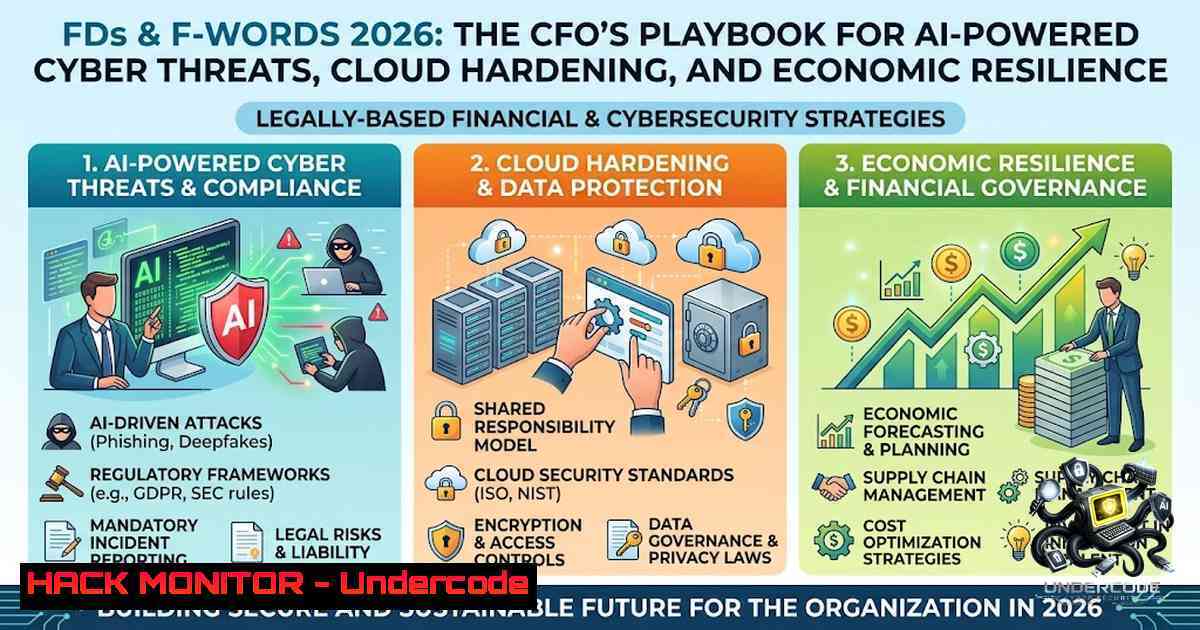
Introduction:
The modern finance leader’s mandate has expanded far beyond cash flow and P&L statements. As Cooper Parry’s upcoming FDs & F-Words event highlights, today’s CFOs and FDs are expected to understand AI, stay ahead of cyber threats, navigate economic uncertainty, and manage increasingly mobile workforces. The International Monetary Fund recently warned that artificial intelligence has fundamentally changed the cybersecurity risk environment, with AI-powered attacks now posing a systemic threat to the global financial system. This article translates the event’s core themes—AI, cyber security, economic outlook, and global mobility—into a technical playbook for finance leaders, complete with actionable commands, configuration guides, and hardening strategies across Linux, Windows, and cloud environments.
Learning Objectives:
- Understand how AI is compressing cyber attack lifecycles and what this means for financial risk management
- Implement cloud security hardening and Zero Trust architecture principles to protect financial data
- Master API security, ransomware defense, and identity access controls through verified technical commands
You Should Know:
1. AI-Powered Cyber Threats: The New Systemic Risk
The IMF has made it clear: AI is no longer a future concern but a present danger to financial stability. Attackers can now wield powerful AI tools to infiltrate financial systems, lowering the barrier to entry for cybercriminals while simultaneously accelerating the speed and scale of attacks. Frontier AI models compress the entire attack lifecycle—discovery, exploitation, and lateral movement—into a single, automated sequence with little or no human involvement. Vulnerabilities are now exploited within 24 hours of public disclosure, often before organizations even know they are exposed.
For finance leaders, this means traditional security operating models are obsolete. The Thales 2026 Data Threat Report for Financial Services reveals that the sector is being reshaped by AI and agentic technologies faster than its security operating model can keep pace. The response must be equally fast: invest in basic cybersecurity fundamentals—multi-factor authentication, access control, patching, logging, and incident management—because AI-driven threats can find and exploit weaknesses quickly and automatically.
Step-by-Step Guide: AI Threat Monitoring and Defense
To defend against AI-powered attacks, finance teams must adopt a proactive, data-driven approach. Below are verified commands and configurations for monitoring and hardening systems against AI-driven threats.
Linux – Real-time Threat Log Monitoring:
 Monitor authentication logs for brute-force patterns (AI-driven credential stuffing)
sudo tail -f /var/log/auth.log | grep -E "Failed password|Invalid user"

Set up fail2ban to block repeated AI-driven login attempts
sudo apt-get install fail2ban -y
sudo systemctl enable fail2ban
sudo systemctl start fail2ban

Check fail2ban status and banned IPs
sudo fail2ban-client status sshd
Windows PowerShell – Suspicious Process Detection:
 Detect AI agent-based process injection attempts
Get-WinEvent -LogName Security | Where-Object { $<em>.Id -eq 4688 -and $</em>.Message -match "cmd.exe|powershell.exe|wscript.exe" } | Select-Object TimeCreated, Message

Monitor for unusual outbound network connections (potential C2 traffic)
Get-1etTCPConnection | Where-Object { $<em>.State -eq "Established" -and $</em>.RemotePort -gt 1024 }
SIEM Integration for AI Threat Correlation:
Configure your SIEM to ingest logs from all critical systems and apply machine learning-based anomaly detection. The key is to shift from reactive security to predictive, adaptive defense—matching adversary velocity while preserving human oversight.
2. Cloud Security Hardening for Financial Data
The shift to cloud infrastructure has introduced new attack surfaces that finance leaders must secure. Misconfigured Infrastructure-as-Code (IaC) templates and hardcoded secrets are the upstream cause of most cloud exposures. Only 26% of organizations have architecture ready to enforce least-privilege access. This is unacceptable when handling sensitive financial data.
Step-by-Step Guide: Cloud Security Hardening
Google Cloud – Recommended Security Checklist:
Google Cloud’s recommended security checklist, inspired by Minimum Viable Secure Product (MVSP) principles, provides a clear path to security excellence. Key actions include:
 Enforce least-privilege access using IAM
gcloud projects add-iam-policy-binding PROJECT_ID \
--member="user:[email protected]" \
--role="roles/viewer" \
--condition="expression=resource.name.startsWith('projects/PROJECT_ID/datasets/FINANCE'),title=Finance Data Only"

Enable Cloud Audit Logs for all finance-related resources
gcloud services enable cloudaudit.googleapis.com
gcloud logging sinks create finance-audit-sink storage.googleapis.com/finance-audit-bucket \
--log-filter="resource.type=cloudaudit_audit_log AND protoPayload.methodName:('datasets' OR 'tables')"
AWS – CIS Hardened Images and Configuration:
Use CIS Hardened Images to start secure in the cloud, reducing the operational burden of manual hardening.
 Scan for misconfigured S3 buckets (potential data leaks)
aws s3api list-buckets --query 'Buckets[?contains(Name, <code>finance</code>)]' | \
jq '.[] | select(.ServerSideEncryptionConfiguration==null)'

Enable default encryption for all new S3 buckets
aws s3api put-bucket-encryption --bucket FINANCE-BUCKET \
--server-side-encryption-configuration '{"Rules": [{"ApplyServerSideEncryptionByDefault": {"SSEAlgorithm": "AES256"}}]}'
Azure – Zero Trust for Hybrid Cloud:
Zero Trust Architecture (ZTA) applied to hybrid cloud setups (combining Azure and private clouds) enhances hybrid cloud resiliency, improves visibility, and implements dynamic access control.
 Azure - Enforce MFA for all finance users
Connect-AzAccount
$policy = Get-AzADGroup -DisplayName "FinanceTeam" | Set-AzADGroup -EnableMFA $true

Azure - Enable just-in-time (JIT) VM access
Set-AzJitNetworkAccessPolicy -ResourceGroupName "Finance-RG" -Location "EastUS" \
-VirtualMachine "FinanceVM" -Port 3389 -MaxRequestAccessDuration "PT3H"
3. API Security: Protecting the Digital Backbone
APIs today don’t just exchange data; they control money, access, identity, and core business logic. One vulnerable API might let attackers steal customer data, manipulate transactions, or bring down entire services. The OWASP API Security Top 10 provides a practical defense framework, but implementation requires a vision that unites security and performance.
Step-by-Step Guide: API Security Hardening
API Gateway Configuration (NGINX Example):
 Rate limiting to prevent API abuse (AI-driven brute-force)
limit_req_zone $binary_remote_addr zone=api_limit:10m rate=10r/s;
limit_req zone=api_limit burst=20 nodelay;

JWT validation for all API endpoints
location /api/ {
auth_jwt "Finance API";
auth_jwt_key_request /jwks_uri;
proxy_pass http://finance_backend;
}

Input validation to block malicious payloads
if ($request_body ~ "(<script|javascript:|eval(|SELECT.FROM)") {
return 403;
}
API Key Rotation and Secrets Management:
API keys and tokens should expire in 90 days or less. If a key leaks, the exposure window is limited. Automate rotation with your secrets manager.
 HashiCorp Vault - Dynamic API key generation for finance services
vault secrets enable -path=finance-api aws
vault write finance-api/roles/finance-role \
credential_type=iam_user \
policy_document=-<<EOF
{
"Version": "2012-10-17",
"Statement": [
{
"Effect": "Allow",
"Action": "s3:GetObject",
"Resource": "arn:aws:s3:::finance-bucket/"
}
]
}
EOF
API Discovery and Attack Blocking:
Implement API discovery to identify all endpoints, real-time blocking of attacks, and API security testing to ensure APIs are protected.
4. Ransomware Defense: Resilience Over Prevention
The modern ransomware landscape demands resilience, not just prevention. Detection, containment, identity security, immutable backups, and rapid recovery have become the new pillars of cyber strategy. Prevention alone is no longer enough; the modern mandate is the ability to keep operating, even while under attack.
Step-by-Step Guide: Ransomware Defense Implementation
Immutable Backups (Linux):
 Create immutable backup directory with append-only permissions
sudo mkdir -p /mnt/backups/finance
sudo chattr +a /mnt/backups/finance

Schedule automated, verified backups using rsync with versioning
rsync -av --backup --backup-dir=/mnt/backups/finance/$(date +%Y%m%d) /data/finance/ /mnt/backups/finance/current/
Windows – Enable Controlled Folder Access:
 Enable Windows Defender Controlled Folder Access to block ransomware encryption
Set-MpPreference -EnableControlledFolderAccess Enabled
Add-MpPreference -ControlledFolderAccessProtectedFolders "C:\FinanceData"
Add-MpPreference -ControlledFolderAccessAllowedApplications "C:\Program Files\FinanceApp\finance.exe"
Zero Trust Network Access (ZTNA) Implementation:
Zero Trust has become the default security architecture for modern systems. In 2026, regulators, insurers, and customers all expect it. The principle is simple: never trust, always verify, assume breach, and apply least privilege.
- Economic Uncertainty and Global Mobility: The Human Factor
Beyond technology, finance leaders must navigate economic uncertainty and manage increasingly mobile teams. The CFO-CISO tension is one of the most consequential misalignments in modern enterprise risk management. Organizations routinely acquire impressive security tool portfolios while neglecting resilience, recovery, and business continuity.
Step-by-Step Guide: Bridging the CFO-CISO Gap
Quantify Cyber Risk in Financial Terms:
Four in 10 surveyed finance leaders said quantified risk reduction would make it easier to justify a cybersecurity spending hike. Use the following framework to translate technical risk into financial impact:
 Simplified cyber risk quantification script
def calculate_cyber_risk(asset_value, breach_probability, impact_ratio):
"""
Calculate expected financial loss from a cyber breach.
asset_value: Total value of assets at risk (USD)
breach_probability: Probability of breach (0-1)
impact_ratio: Percentage of asset value lost in a breach (0-1)
"""
return asset_value  breach_probability  impact_ratio

Example: Finance database valued at $50M, 5% annual breach probability, 30% impact
risk = calculate_cyber_risk(50000000, 0.05, 0.30)
print(f"Expected annual loss: ${risk:,.2f}")
Secure Global Mobility and Remote Access:
VPNs are increasingly targeted by ransomware groups. Replace traditional VPNs with Zero Trust Network Access (ZTNA) solutions that provide granular, identity-based access to applications.
 Linux - Set up WireGuard for secure, audited remote access
sudo apt-get install wireguard -y
wg genkey | tee privatekey | wg pubkey > publickey
sudo ip link add dev wg0 type wireguard
sudo ip address add 10.0.0.1/24 dev wg0
sudo wg set wg0 private-key ./privatekey listen-port 51820
sudo ip link set wg0 up
What Undercode Say:
- Key Takeaway 1: AI has transformed cyber risk from an IT issue into a systemic financial stability threat. Finance leaders must treat cybersecurity as a core financial risk, not a technical afterthought. The IMF’s warning is clear: AI-driven cyber attacks can now destabilize the entire financial system.
-
Key Takeaway 2: Resilience trumps prevention in the modern threat landscape. Organizations must invest in immutable backups, rapid recovery capabilities, and Zero Trust architectures—not just prevention tools. The CFO-CISO rift over security spend must be bridged through quantified risk reduction and shared accountability.
Analysis: The convergence of AI, cloud, and economic uncertainty creates a perfect storm for finance leaders. AI lowers the barrier for attackers while accelerating attack speed, cloud introduces new misconfiguration risks, and economic pressure forces difficult spending decisions. The solution is not more tools but better integration: connect cybersecurity with enterprise risk management to gain a more complete view of risk. Finance leaders must lead the response by evaluating security spending based on its impact on underlying financial and enterprise risk. The FDs & F-Words event provides a crucial forum for these conversations, but the real work begins in the boardroom and the server room alike.
Prediction:
- -1 AI-powered cyber attacks will become the primary driver of financial instability by 2027, with systemic breaches causing market-wide disruptions comparable to the 2008 financial crisis. Organizations that fail to adopt Zero Trust architectures will face existential threats.
-
+1 The convergence of AI defense tools (like Microsoft’s RAMPART and OpenAI’s Daybreak) will enable organizations to detect and patch vulnerabilities before attackers can exploit them, shifting the balance of power back toward defenders.
-
-1 The skills gap in AI security and cloud hardening will widen, leaving many organizations exposed. Finance leaders must prioritize cybersecurity training and upskilling as a critical business investment.
-
+1 Regulatory frameworks (like IEEE 3409-2026 for Zero Trust) will provide clear standards for implementation, reducing confusion and enabling faster adoption of effective security architectures.
-
-1 Economic uncertainty will pressure organizations to cut cybersecurity spending, creating a dangerous feedback loop where reduced investment leads to more breaches, which in turn cause greater financial losses.
-
+1 The integration of AI-driven threat modeling and predictive attack-path risk assessment into cloud architectures will enable proactive defense, making security an inherent part of infrastructure design rather than an afterthought.
▶️ Related Video (76% Match):
https://www.youtube.com/watch?v=6_Sf21g8Mds
🎯Let’s Practice For Free:
🎓 Live Courses & Certifications:
Join Undercode Academy for Verified Certifications
🚀 Request a Custom Project:
Secure, high-velocity infrastructure and disruptive technological engineering. Contact our engineering team for high-tier development and proprietary systems:
[email protected]
💎 Smart Architecture | 🛡️ Secure by Design | ⭐ Trusted by Thousands
IT/Security Reporter URL:
Reported By: Devon Oliver – Hackers Feeds
Extra Hub: Undercode MoN
Basic Verification: Pass ✅


