Listen to this Post
Introduction:
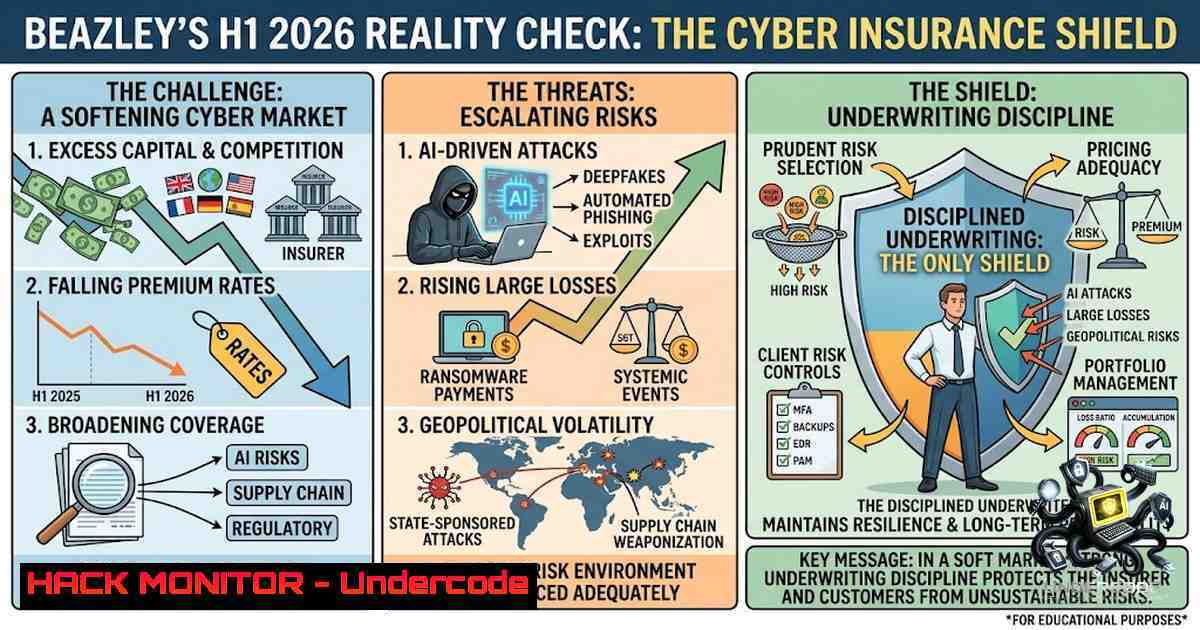
The global cyber insurance market is caught in a perfect storm—premiums are falling even as ransomware severity and AI-driven attack sophistication reach new highs. Beazley’s first-half 2026 results, with pre-tax profits plunging 53% to $237.7 million and cyber premiums contracting 15.4%, serve as a stark warning: market softening does not equate to reduced risk. In a climate where the undiscounted combined ratio has jumped to 93.3% from 84.9% a year earlier, the insurer’s unwavering commitment to technical underwriting discipline offers a masterclass in risk selection—and a blueprint for cybersecurity practitioners who must translate insurance requirements into actionable technical controls.
Learning Objectives:
- Understand the technical drivers behind the cyber insurance market softening and their implications for enterprise security posture
- Master the seven core security controls that underwriters verify in 2026, including MFA, EDR, immutable backups, and patch management
- Implement a data-driven underwriting framework using open-source intelligence (OSINT) and vulnerability assessment tools to quantify cyber risk
- Deploy Linux and Windows commands to harden infrastructure against the specific loss drivers observed in Beazley’s active large-loss environment
- Apply API security, cloud hardening, and incident response playbook techniques to align with insurer expectations and reduce premiums
You Should Know:
- The Technical Anatomy of Market Softening: Why Falling Premiums Mask Escalating Risk
Beazley’s H1 2026 results reveal a market in transition. Cyber risks saw premiums drop 15.4% with a combined ratio of 91.7%, while property risks contracted 5.9% yet maintained a healthy 79.6% combined ratio. Specialty risks barely broke even at 98.5%, and marine, accident, and political risks posted a concerning 103% combined ratio due to war and political violence losses. This divergence underscores a critical technical reality: the pricing floor for cyber insurance has not yet stabilized, with global cyber rates down 4% in Q2 2026 alone—the twelfth consecutive quarterly decline.
The technical implications are profound. S&P Global Ratings projects 15–20% annual premium increases through 2026 as severity catches up with pricing, driven by rising incident response costs and legal expenses. For security teams, this means the window to implement controls that satisfy underwriting criteria is narrowing rapidly.
Step‑by‑Step Guide to Assessing Your Cyber Risk Posture:
- Map your attack surface using open-source reconnaissance tools. On Linux:
Perform a comprehensive subdomain enumeration
amass enum -d yourdomain.com -o subdomains.txt
Scan for open ports and services
nmap -sV -sC -oA scan_results yourdomain.com/24
Identify exposed cloud assets
cloudlist -provider aws -config config.json -output cloud_assets.txt
On Windows (PowerShell):
 Test network segmentation and firewall rules
Test-1etConnection -ComputerName target-server -Port 443
 Enumerate Active Directory attack paths
Import-Module ActiveDirectory; Get-ADComputer -Filter  | Select-Object Name, OperatingSystem
- Quantify your vulnerability backlog using automated scanners. Integrate results into a risk register:
Run a Nessus scan and export to CSV
nessuscli scan launch --scan-id=1234 --export=csv
Prioritize using CVSS scores and exploit availability
grep -E "CVSS:([bash].[0-9])" nessus_report.csv | sort -t, -k5 -1r > critical_vulns.txt
-
Benchmark against Beazley’s underwriting framework. The insurer’s evolving subscription framework evaluates portfolio selectivity, pricing discipline, and exposure management. Translate this into technical metrics:
– Mean Time to Patch (MTTP) : Target < 48 hours for critical vulnerabilities
– MFA覆盖率: 100% for all administrative and remote access
– Backup immutability: Verify with:
 Check backup immutability on AWS S3
aws s3api get-bucket-versioning --bucket your-backup-bucket
 Verify retention policies
aws s3api get-bucket-lifecycle-configuration --bucket your-backup-bucket
- The Seven Controls Underwriters Verify in 2026: A Technical Deep Dive
According to industry analysis, underwriters are now control-gated, with seven non-1egotiable requirements. Beazley’s own data-driven approach for SME cyber cover emphasizes that declarative information is no longer sufficient—controls must be demonstrable.
Step‑by‑Step Guide to Implementing and Verifying Each Control:
- Multi-Factor Authentication (MFA) : Enforce MFA for all users, including service accounts. On Microsoft Entra ID (Azure AD):
Enable MFA for all users via Conditional Access policy
New-AzureADMSConditionalAccessPolicy -DisplayName "Require MFA for All Users" -State "enabled" -Conditions $conditions -GrantControls $grantControls
On Linux with Duo:
 Configure Duo MFA for SSH
echo "ForceCommand /usr/sbin/duo_login" >> /etc/ssh/sshd_config
systemctl restart sshd
- Endpoint Detection & Response (EDR) : Deploy and validate EDR coverage across all endpoints. Verify with:
Check CrowdStrike Falcon sensor status on Linux
falconctl -g --aid --cid
On Windows (PowerShell)
Get-Service -1ame "CSFalconService" | Select-Object Status, StartType
-
Immutable Backups: Implement write-once-read-many (WORM) storage. On AWS:
Enable Object Lock on S3 bucket
aws s3api put-bucket-object-lock-configuration --bucket your-bucket --object-lock-configuration '{"ObjectLockEnabled":"Enabled"}'
Set retention period
aws s3api put-object-retention --bucket your-bucket --key backup.tar.gz --retention '{"Mode":"GOVERNANCE","RetainUntilDate":"2026-12-31T23:59:59Z"}'
On Windows Server with Azure Backup:
 Configure immutable vault
Set-AzRecoveryServicesVault -1ame "YourVault" -ResourceGroupName "RG" -ImmutabilityState "Locked"
- Patch Management: Automate patching with a defined SLA. On Linux:
Automated patching with unattended-upgrades (Ubuntu/Debian)
sudo apt-get install unattended-upgrades
sudo dpkg-reconfigure --priority=low unattended-upgrades
On RHEL/CentOS
sudo yum install dnf-automatic
sudo systemctl enable --1ow dnf-automatic.timer
On Windows:
 Configure Windows Update for automatic installation
New-Item -Path "HKLM:\SOFTWARE\Policies\Microsoft\Windows\WindowsUpdate\AU" -Force
Set-ItemProperty -Path "HKLM:\SOFTWARE\Policies\Microsoft\Windows\WindowsUpdate\AU" -1ame "AUOptions" -Value 4
Set-ItemProperty -Path "HKLM:\SOFTWARE\Policies\Microsoft\Windows\WindowsUpdate\AU" -1ame "ScheduledInstallDay" -Value 0
Set-ItemProperty -Path "HKLM:\SOFTWARE\Policies\Microsoft\Windows\WindowsUpdate\AU" -1ame "ScheduledInstallTime" -Value 3
- Security Awareness Training: Implement phishing simulations and track click rates. Use GoPhish on Linux:
Deploy GoPhish
wget https://github.com/gophish/gophish/releases/latest/download/gophish-vX.X.X-linux-64bit.zip
unzip gophish-.zip && cd gophish-
./gophish
Configure campaign and export results
curl -X GET http://localhost:3333/api/campaigns/ -H "Authorization: Bearer YOUR_API_KEY"
-
Privileged Access Management (PAM) : Implement just-in-time (JIT) access. On Linux with Teleport:
Install Teleport
curl https://get.gravitational.com/teleport-v13.0.0-linux-amd64-bin.tar.gz | tar -xz
sudo ./teleport install --role=node --cluster=your-cluster
sudo systemctl start teleport
On Windows with CyberArk:
 Configure CyberArk PSMP for privileged session recording
Set-PSMConfiguration -EnableRecording $true -RecordingPath "\server\recordings"
- Incident Response (IR) Plan: Develop and exercise an IR playbook. Document with:
Create a templated IR plan using Markdown
cat > ir_playbook.md << EOF
Incident Response Playbook
Preparation</li>
</ol>

- IR team roster
- Communication channels
- Forensic toolkits
Detection
- SIEM alerts
- EDR notifications
Containment
- Network segmentation commands
- Host isolation scripts
Eradication
- Malware removal procedures
Recovery
- Backup restoration steps
Lessons Learned
- Post-incident review template
EOF
- API Security and Cloud Hardening: Addressing the AI-Driven Threat Landscape
Beazley’s CEO Adrian Cox noted that “the first half of 2026 saw rapidly softening conditions in the specialty insurance market” amid “growing global turbulence”. CyberCube’s 2026 report emphasizes that underwriting must adapt by focusing on identity security, patch latency, and governance of AI agents—including permissions, API scope control, logging, and segregation of duties.
Step‑by‑Step Guide to Hardening APIs and Cloud Environments:
1. API security scanning:
 Scan REST APIs for vulnerabilities using OWASP ZAP
zap-cli quick-scan --self-contained --start-options "-config api.disablekey=true" https://api.yourservice.com/v1
 Test for broken object-level authorization (BOLA)
ffuf -u https://api.yourservice.com/v1/users/FUZZ -w user_ids.txt -fc 404
2. Cloud infrastructure hardening (AWS):
 Enforce S3 bucket policies to prevent public access
aws s3api put-bucket-policy --bucket your-bucket --policy file://bucket-policy.json
 Enable AWS Config for compliance monitoring
aws configservice put-configuration-recorder --configuration-recorder name=default,roleARN=arn:aws:iam::account:role/config-role
aws configservice start-configuration-recorder --configuration-recorder-1ame=default
3. Zero-trust network segmentation:
 On Linux with iptables: restrict lateral movement
iptables -A INPUT -s 10.0.0.0/8 -j DROP
iptables -A FORWARD -s 10.0.0.0/8 -d 192.168.0.0/16 -j DROP
 On Windows with Windows Firewall
New-1etFirewallRule -DisplayName "Block Internal Lateral Movement" -Direction Inbound -RemoteAddress 10.0.0.0/8 -Action Block
- Vulnerability Exploitation and Mitigation: Learning from Beazley’s Active Large-Loss Environment
Beazley’s results reflect an “active large-loss environment” across cyber, political violence, and marine war exposures. For cybersecurity professionals, this translates into a need to prioritize vulnerabilities that are actively exploited in the wild.
Step‑by‑Step Guide to Prioritizing and Mitigating Exploitable Vulnerabilities:
1. Leverage CISA’s Known Exploited Vulnerabilities (KEV) catalog:
 Download and parse the KEV catalog
curl -s https://www.cisa.gov/sites/default/files/feeds/known_exploited_vulnerabilities.json | jq '.vulnerabilities[] | select(.knownRansomwareCampaignUse == "Known") | .cveID'
 Cross-reference with your asset inventory
grep -f kev_cves.txt vulnerability_scan.csv
- Automated exploitation simulation (with SafeBreach or Metasploit in controlled environments):
Launch a Metasploit auxiliary scan for SMB vulnerabilities
msfconsole -q -x "use auxiliary/scanner/smb/smb_ms17_010; set RHOSTS 192.168.1.0/24; run; exit"
Apply Microsoft patch for EternalBlue (MS17-010) on Windows
wusa.exe windows6.1-kb4012212-x64.msu /quiet /norestart
3. Continuous threat hunting using SIEM queries:
Elasticsearch query for suspicious lateral movement (Linux) curl -X GET "localhost:9200/_search" -H 'Content-Type: application/json' -d' { "query": { "bool": { "must": [ {"match": {"event.type": "Network Connection"}}, {"range": {"@timestamp": {"gte": "now-1h"}}}, {"term": {"destination.port": 445}} ] } } }'- Cyber ILS and Data-Driven Underwriting: The Future of Risk Transfer
Beazley’s development of Cyber Insurance-Linked Securities (ILS) capabilities and its acquisition of kWh Analytics signal a shift toward data-driven, parametric risk transfer. For CISOs, this means underwriting will increasingly rely on objective, machine-readable security data.
Step‑by‑Step Guide to Generating Underwriter-Ready Security Metrics:
1. Automate security control attestation using OpenSCAP:
 Run a compliance scan against CIS benchmarks
oscap xccdf eval --profile xccdf_org.cisecurity.benchmarks_profile_Level_1_Server --results scan-results.xml /usr/share/xml/scap/ssg/ssg-rhel9-xccdf.xml
 Generate a human-readable report
oscap xccdf generate report scan-results.xml > compliance_report.html
- Produce a cyber risk score using open-source tools like OWASP Risk Rating:
Calculate risk score based on CVSS and business impact
echo "CVSS_Score,Impact,Exploitability,Risk_Score" > risk_scores.csv
awk -F, '{impact=($2+$3)/2; risk=impact$1; print $1","$2","$3","risk}' vulnerability_data.csv >> risk_scores.csv
3. Continuous control monitoring with Prometheus and Grafana:
 prometheus.yml - scrape EDR and patch metrics
scrape_configs:
- job_name: 'edr_metrics'
static_configs:
- targets: ['edr-exporter:9090']
- job_name: 'patch_metrics'
static_configs:
- targets: ['patch-exporter:9091']
What Undercode Say:
- Key Takeaway 1: Beazley’s 53% profit drop is not a failure of underwriting—it is a testament to disciplined risk selection in a market where premiums no longer reflect underlying exposure. The 15.4% contraction in cyber premiums, coupled with a 91.7% combined ratio, signals that the market has not yet priced in the escalating severity of ransomware and AI-driven attacks.
-
Key Takeaway 2: The seven controls—MFA, EDR, immutable backups, patch management, security awareness training, PAM, and an exercised IR plan—are no longer optional. Underwriters are verifying these controls through technical assessments, not self-attestation. Organizations that fail to implement and document these controls face higher premiums, sub-limits, or outright denial of coverage.
Analysis: The convergence of a softening insurance market and an escalating threat landscape creates a dangerous asymmetry. While Beazley’s disciplined approach preserves long-term profitability, it also exposes the gap between market pricing and actual risk. For cybersecurity practitioners, this is a call to action: align security investments with underwriting criteria, automate control verification, and treat cyber insurance not as a safety net but as a validation of your security posture. The acquisition of kWh Analytics and the expansion of Cyber ILS capabilities indicate that the future of cyber insurance lies in data-driven, parametric models—making real-time security telemetry a competitive advantage. As AI reshapes attack vectors, underwriting will pivot to identity security, API governance, and patch latency as primary loss drivers. Organizations that proactively adopt these frameworks will not only secure better coverage but also build resilience against the next generation of threats.
Prediction:
- -1: Continued market softening will drive at least two major cyber insurers to exit the SME segment by 2027, as combined ratios above 100% become unsustainable without significant rate increases.
- -1: AI-generated social engineering attacks will cause a 40% spike in cyber insurance claims severity by Q4 2026, forcing underwriters to impose AI-specific exclusions or sub-limits.
- +1: The adoption of Cyber ILS and parametric insurance products will grow by 300% over the next 18 months, creating new risk transfer mechanisms that reward organizations with verifiable, real-time security controls.
- +1: Beazley’s integration into Zurich will accelerate the development of a unified cyber underwriting framework across Europe and North America, standardizing control requirements and reducing market fragmentation.
- -1: Ransomware gangs will increasingly target policyholders with inadequate backups, exploiting the 15–20% of organizations that fail to implement immutable storage, leading to a surge in denied claims and litigation.
- -1: The 12th consecutive quarter of cyber rate declines will trigger a “Minsky moment” in the insurance market, where a single systemic event (e.g., a cloud provider outage or zero-day vulnerability) causes catastrophic losses that expose the underpricing of risk.
- +1: Regulatory pressure, particularly from the EU’s DORA and NIS2 directives, will mandate cyber insurance as a compliance requirement, creating a floor for demand and stabilizing premium erosion.
- -1: The widening gap between SME and enterprise cyber insurance pricing will force 60% of small businesses to self-insure, increasing their exposure to bankruptcy from a single ransomware event.
▶️ Related Video (72% Match):
🎯Let’s Practice For Free:
🎓 Live Courses & Certifications:
Join Undercode Academy for Verified Certifications
🚀 Request a Custom Project:
Secure, high-velocity infrastructure and disruptive technological engineering. Contact our engineering team for high-tier development and proprietary systems:
[email protected]
💎 Smart Architecture | 🛡️ Secure by Design | ⭐ Trusted by ThousandsIT/Security Reporter URL:
Reported By: Beazley Chiude – Hackers Feeds
Extra Hub: Undercode MoN
Basic Verification: Pass ✅🔐JOIN OUR CYBER WORLD [ CVE News • HackMonitor • UndercodeNews ]
📢 Follow UndercodeTesting & Stay Tuned:


