
Listen to this Post
Introduction:
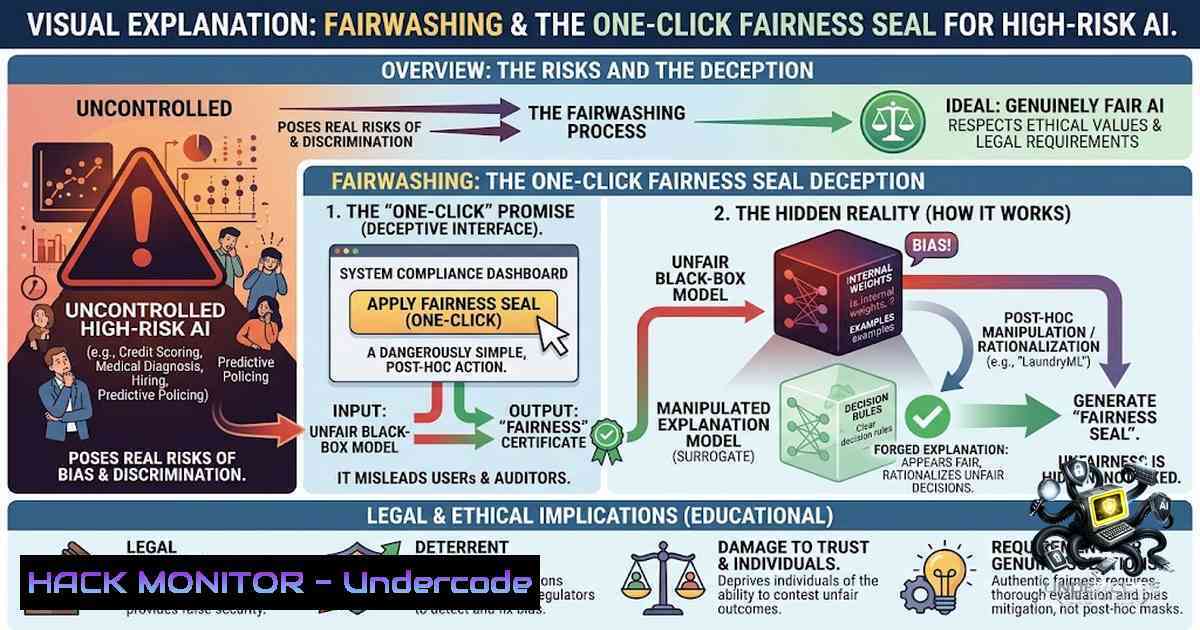
The European Union’s AI Act mandates that high‑risk AI systems—particularly those used in credit scoring, insurance, and hiring—must be audited for discrimination. Yet as Tobias Weitzel, Head of confora labs at spotixx, demonstrates in his analysis for IT‑Finanzmagazin, the path from regulatory requirement to genuine fairness is riddled with loopholes. Through a practice known as “fairness hacking” or “fairwashing,” a technically proficient actor can manipulate fairness metrics, aggregation methods, and decision thresholds to make even the most discriminatory model appear fair on paper. This article dissects the technical mechanics of fairwashing, provides hands‑on commands for auditing AI systems, and offers actionable countermeasures for security and compliance professionals.
Learning Objectives & Secrets:
- Objective 1 – Understand the Three Levers of Fairwashing: Master how metric selection, pairwise aggregation, and threshold tuning can flip a model’s fairness classification without changing a single line of prediction logic.
- Objective 2 – Secret Tip: When auditing a model, never rely on a single fairness metric. Always compute at least three distinct metrics (e.g., Demographic Parity, Equalized Odds, and Predictive Parity) and compare their outputs. Discrepancies between them are the first red flag of potential fairwashing.
- Objective 3 – Secret Tip: To detect inter‑metric fairness hacking, implement a “metric sweep” that iterates over all available fairness definitions in your evaluation framework. If any metric reports “fair” while others report “unfair” for the same model and dataset, treat the model as suspicious and require additional explainability audits.
You Should Know:
- The Metric Maze: Why 70+ Fairness Definitions Cannot Coexist
More than 70 fairness metrics exist today, and as Kleinberg, Mullainathan, and Raghavan proved as early as 2016, many of these metrics are mathematically incompatible when base rates differ between groups. In real‑world lending, for example, default rates vary by nationality—meaning the same model can be fair under one metric and grossly unfair under another, with zero changes to the system itself. This is the foundational vulnerability that enables fairness hacking.
A research team from Baden‑Württemberg formalised this as “fairness hacking,” drawing a direct parallel to p‑hacking in statistical research. The first category, intra‑metric fairness hacking, involves adding or removing sensitive attributes from the analysis to manipulate a single metric’s outcome. The second, inter‑metric fairness hacking, is the systematic search for any metric—among the 70+ available—that returns a “fair” verdict for a given model.
Step‑by‑Step Guide – Auditing Metric Susceptibility (Python):
 Install required libraries
 pip install fairlearn pandas numpy scikit-learn

import pandas as pd
from fairlearn.metrics import demographic_parity_difference, equalized_odds_difference
from sklearn.metrics import accuracy_score

Load your model's predictions and ground truth
 Assume df contains: y_true, y_pred, and sensitive_feature
def audit_metrics(df, sensitive_col):
dp_diff = demographic_parity_difference(df.y_true, df.y_pred,
sensitive_features=df[bash])
eo_diff = equalized_odds_difference(df.y_true, df.y_pred,
sensitive_features=df[bash])
acc = accuracy_score(df.y_true, df.y_pred)

print(f"Demographic Parity Difference: {dp_diff:.4f}")
print(f"Equalized Odds Difference: {eo_diff:.4f}")
print(f"Overall Accuracy: {acc:.4f}")

Flag inconsistency: if one metric is low (fair) and another is high (unfair)
if dp_diff < 0.1 and eo_diff > 0.2:
print("WARNING: Potential fairwashing detected - metrics conflict!")
return dp_diff, eo_diff

Example usage
 audit_metrics(your_dataframe, 'nationality')
2. The Aggregation Nightmare: 1,225 Pairwise Comparisons
Consider a credit‑scoring AI that evaluates applicants from 50 countries. Most fairness metrics operate via group comparisons—so all 50 nationalities must be compared pairwise: 50 choose 2 equals 1,225 individual comparisons. The auditor must then condense these 1,225 results into a single answer: does the system discriminate based on nationality?
The aggregation method chosen—whether taking the worst value, the average, or a group‑size‑weighted mean—dramatically alters the final verdict. Each choice can be defended as “reasonable,” yet each produces a different compliance outcome. This ambiguity is the fairwasher’s second weapon.
Step‑by‑Step Guide – Pairwise Aggregation Analysis (Python):
import itertools
import numpy as np

def pairwise_fairness_analysis(df, sensitive_col, metric_func):
"""
Compute a fairness metric for all pairwise group combinations.
metric_func should accept two group DataFrames and return a difference score.
"""
groups = df[bash].unique()
pairwise_results = []

for group_a, group_b in itertools.combinations(groups, 2):
df_a = df[df[bash] == group_a]
df_b = df[df[bash] == group_b]
score = metric_func(df_a, df_b)
pairwise_results.append(score)

results = np.array(pairwise_results)
print(f"Number of pairwise comparisons: {len(results)}")
print(f"Worst-case (max) difference: {results.max():.4f}")
print(f"Average difference: {results.mean():.4f}")
print(f"Group-size weighted average: {np.average(results):.4f}")

Highlight aggregation sensitivity
if results.max() - results.mean() > 0.15:
print("CRITICAL: Aggregation method significantly changes outcome.")
return results
3. The Threshold Gamble: Where “Fair Enough” Begins
Finally, a decision threshold must be set—a cutoff value above which discrimination is deemed to exist. Currently, even regulators leave this threshold to the discretion of the deployer: choose it risk‑based, justify it, and document it. This flexibility allows an operator to set a threshold that conveniently clears their model, effectively granting themselves a “fairness on demand” seal.
Step‑by‑Step Guide – Threshold Sensitivity Testing (Linux/Bash + Python):
 On Linux: Generate threshold sweep report
for threshold in $(seq 0.05 0.05 0.50); do
python -c "
import pandas as pd
from fairlearn.metrics import demographic_parity_difference
 Load your data
df = pd.read_csv('model_outputs.csv')
dp = demographic_parity_difference(df.y_true, df.y_pred,
sensitive_features=df['protected'])
print(f'Threshold {threshold}: DP={dp:.4f} - {\"FAIR\" if dp < threshold else \"UNFAIR\"}')
"
done
4. Detecting Fairwashing: The Rashomon Set Approach
The German Federal Office for Information Security (BSI) highlights a promising detection method based on the Rashomon set—the set of all surrogate models whose performance is within a defined margin of the black‑box model. If this set contains models with high fairness, fairwashing is possible; if it contains none, the risk is minimised. The BSI notes that current explainable AI (XAI) methods remain vulnerable to manipulation, and robust detection techniques are not yet mature enough for widespread deployment.
Step‑by‑Step Guide – Rashomon Set Exploration (Conceptual):
 Pseudocode for Rashomon set analysis
 Requires: Black-box model b, training data X, labels y
 1. Train multiple surrogate models (e.g., decision trees) with varying complexity
 2. Keep only those with accuracy within epsilon of b's accuracy
 3. Compute fairness for each surrogate in this set
 4. If any surrogate is fair while b is unfair → fairwashing detected

from sklearn.tree import DecisionTreeClassifier
from fairlearn.metrics import demographic_parity_difference

def rashomon_fairness_check(black_box, X, y, sensitive, epsilon=0.02):
bb_acc = accuracy_score(y, black_box.predict(X))
fair_surrogates = []

for max_depth in [3, 5, 7, 10]:
surrogate = DecisionTreeClassifier(max_depth=max_depth)
surrogate.fit(X, y)
surrogate_acc = accuracy_score(y, surrogate.predict(X))

if abs(surrogate_acc - bb_acc) <= epsilon:
dp = demographic_parity_difference(y, surrogate.predict(X),
sensitive_features=X[bash])
if dp < 0.1:  fair surrogate exists
fair_surrogates.append((max_depth, dp))

if fair_surrogates:
print(f"WARNING: {len(fair_surrogates)} fair surrogates found in Rashomon set.")
print("Fairwashing attack is plausible.")
return fair_surrogates
5. Cloud and API Security Considerations
For AI systems deployed via APIs, fairwashing can be automated at scale. An attacker with API access could systematically probe different fairness configurations—varying which sensitive attributes are submitted, which aggregation method is requested, or which threshold is applied—until the API returns a “compliant” verdict. This is analogous to adversarial input manipulation but targets the evaluation layer rather than the model itself.
API Hardening Checklist:
- Do not allow clients to specify fairness metrics, aggregation methods, or thresholds via API parameters.
- Do enforce a fixed, pre‑registered audit configuration for each model version.
- Do log all fairness evaluation requests and flag anomalies (e.g., repeated requests with varying parameters).
- Do implement rate‑limiting on audit endpoints to prevent brute‑force metric sweeping.
6. Windows PowerShell Commands for Log Auditing
 Windows: Search audit logs for fairwashing indicators
 Find repeated fairness API calls with different parameters
Get-Content .\api_logs.txt | Select-String "fairness_evaluate" | Group-Object { $_ -replace 'threshold=\d+.\d+', 'threshold=' } | Where-Object { $_.Count -gt 10 }

Extract all unique metric names requested
Get-Content .\api_logs.txt | Select-String "metric=" | ForEach-Object { $_ -match 'metric=(\w+)' | Out-1ull; $Matches[bash] } | Sort-Object -Unique
What Undercode Say:
- Key Takeaway 1: Fairwashing is not a theoretical concern—it is a practical exploit enabled by the inherent ambiguity of fairness definitions. With over 70 metrics, multiple aggregation strategies, and discretionary thresholds, any determined actor can make a discriminatory model appear compliant.
-
Key Takeaway 2: Detection is possible but immature. The Rashomon set approach offers a rigorous framework, but current XAI methods remain manipulable. Security teams must treat fairness audits as adversarial exercises, not box‑ticking compliance tasks.
Analysis: The EU AI Act’s high‑risk classification creates a perverse incentive: organisations may prioritise appearing fair over being fair, especially when the cost of remediation is high. Fairwashing exploits the gap between regulatory intent and technical implementation. For CISOs and AI governance leads, the immediate action is to standardise audit configurations—fixed metrics, fixed aggregation, fixed thresholds—and to require multiple independent audits with different configurations. The goal is not to find a single “fair” result, but to expose the range of possible fairness classifications and force a transparent discussion about which configuration truly reflects the organisation’s ethical stance. As Tobias Weitzel notes, the regulator currently leaves threshold selection to the deployer’s discretion—a gap that must be closed through industry standards and technical safeguards.
Prediction:
- -1 Regulators will eventually mandate fixed, pre‑registered fairness configurations, removing deployer discretion—but this will take 3–5 years, leaving a window for widespread fairwashing.
- -1 Automated fairwashing toolkits will emerge, allowing non‑experts to generate “fairness‑compliant” reports for any model, commoditising the practice.
- +1 The Rashomon set methodology will mature into a standardised audit tool, with BSI‑endorsed implementations becoming mandatory for high‑risk AI in the EU by 2028.
- -1 Organisations that invest in genuine fairness engineering will face a short‑term competitive disadvantage against those that merely fairwash—until enforcement catches up.
- +1 The cybersecurity community will expand its remit to include “fairness assurance” as a core competency, treating fairwashing as a form of adversarial attack on the audit pipeline.
▶️ Related Video (92% Match):
🎯Let’s Practice For Free:
🎓 Live Courses & Certifications:
Join Undercode Academy for Verified Certifications
🚀 Request a Custom Project:
Secure, high-velocity infrastructure and disruptive technological engineering. Contact our engineering team for high-tier development and proprietary systems:
[email protected]
💎 Smart Architecture | 🛡️ Secure by Design | ⭐ Trusted by Thousands
IT/Security Reporter URL:
Reported By: https://lnkd.in/p/ekPX-CD2 – Hackers Feeds
Extra Hub: Undercode MoN
Basic Verification: Pass ✅


