
Listen to this Post
Introduction:
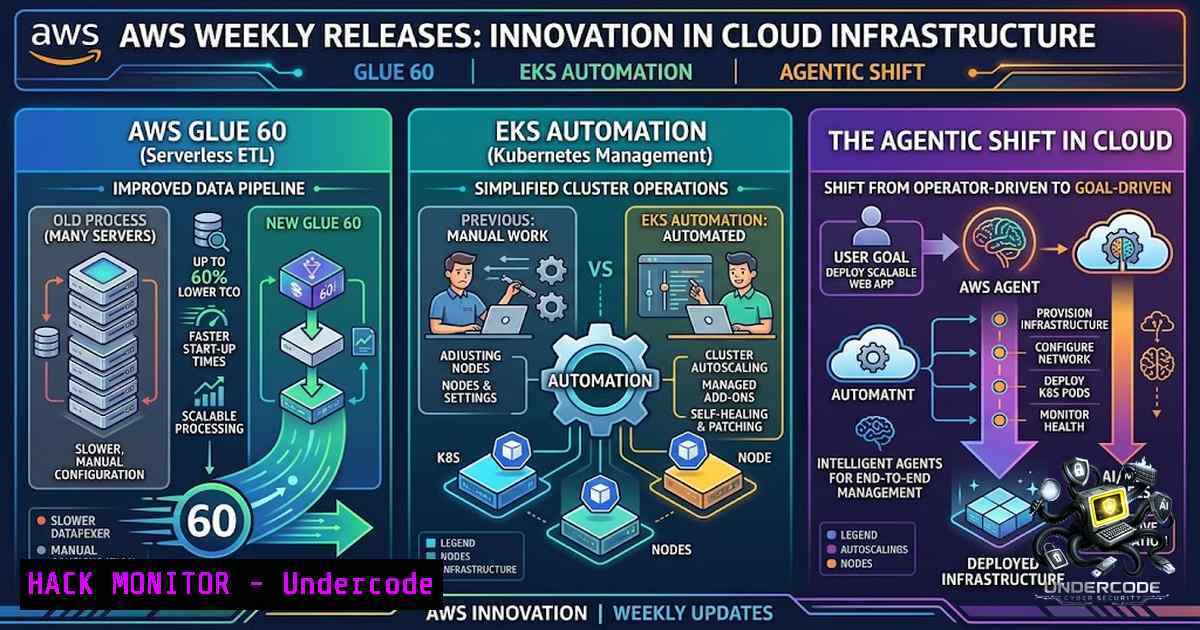
Amazon Web Services (AWS) continues its relentless pace of innovation with a new batch of releases that blend cost optimization, operational resilience, and the accelerating integration of generative AI agents into production workflows. This week’s announcements—from a new London Availability Zone to AWS Glue 6.0’s 30% price cut and automated EKS certificate rotation—underscore a dual focus on reducing the “undifferentiated heavy lifting” of infrastructure management while pushing the boundaries of what’s possible with AI-powered assistants. For cloud architects and security engineers, the underlying message is clear: the boring infrastructure wins still save real money, but the agentic future is arriving faster than many anticipated.
Learning Objectives & Secrets:
- Objective 1: Master the cost-performance optimization of AWS Glue 6.0, including its Apache Iceberg v3 integration and how to leverage the 30% price reduction for data lake workloads.
- Objective 2 (Secret Tip): Automate EKS certificate authority (CA) rotation using the new lifecycle management feature—eliminate manual kubectl commands and reduce cluster downtime by integrating this with your existing CI/CD pipelines.
- Objective 3 (Secret Tip): Deploy and secure generative AI agents in production by combining Bedrock’s xAI Grok model with cross-region inference, while using the updated AWS Security Agent for bug bounty validation and finding triage.
1. AWS Glue 6.0: Cheaper, Faster, and Iceberg-Ready
AWS Glue 6.0 is a significant upgrade for any organization managing petabyte-scale data lakes. The headline feature is a 30% price reduction across the board, making serverless ETL more accessible for continuous data processing workloads. More importantly, it introduces native support for Apache Iceberg v3, a table format that brings advanced features like schema evolution, hidden partitioning, and time travel queries to S3-based data lakes.
Step‑by‑Step Guide to Migrating a Glue Job to Version 6.0:
- Review Your Current Job: Identify existing Glue jobs (Python or Scala) running on versions 3.0 or 4.0.
- Update the Job Configuration: In the AWS Console or via CLI, set the `–job-language` and `–glue-version` to
6.0.aws glue update-job --job-1ame my-etl-job --job-update '{ "GlueVersion": "6.0", "Command": { "Name": "glueetl", "ScriptLocation": "s3://my-bucket/scripts/my-script.py", "PythonVersion": "3" } }' - Leverage Iceberg v3 Features: Update your ETL scripts to use Iceberg’s MERGE, UPDATE, and DELETE operations for CDC (Change Data Capture) pipelines.
from pyspark.sql import SparkSession spark = SparkSession.builder.config("spark.sql.catalog.spark_catalog", "org.apache.iceberg.spark.SparkCatalog").getOrCreate() spark.sql("MERGE INTO prod.events USING staging.events ON prod.events.id = staging.events.id WHEN MATCHED THEN UPDATE SET WHEN NOT MATCHED THEN INSERT ") - Validate Cost Savings: Monitor the `JobRun` metrics in CloudWatch to confirm the reduced DPU-hours and overall cost.
2. Amazon EKS: Automated Certificate Authority Rotation
Managing TLS certificates for Kubernetes clusters has always been a operational headache—especially when the CA certificate expires and breaks API server communication. Amazon EKS now handles certificate authority rotation with automated lifecycle management. This feature automatically rotates the cluster’s CA certificate before expiration and updates the `kubeconfig` trust chain without requiring manual intervention or cluster downtime.
Step‑by‑Step Guide to Enabling Automated CA Rotation:
- Check Your Current EKS Version: Ensure your cluster is running a supported version (1.27+).
aws eks describe-cluster --1ame my-cluster --query "cluster.version"
- Enable the Feature: Update the cluster configuration to enable automatic CA rotation. This is typically done at cluster creation or via a cluster update.
aws eks update-cluster-config --1ame my-cluster --resources-vpc-config '{"securityGroupIds":["sg-123"],"subnetIds":["subnet-abc"]}' --certificate-authority-rotation true - Monitor the Rotation: Use CloudTrail to audit `UpdateClusterConfig` events and CloudWatch to monitor the `CertificateAuthorityRotation` status.
- Rotate Client Certificates: For applications using client certificates, configure your CI/CD pipeline to automatically fetch the new CA bundle from the EKS API and restart pods.
aws eks describe-cluster --1ame my-cluster --query "cluster.certificateAuthority.data" --output text | base64 -d > ca.crt
3. AWS Bedrock: xAI Grok and AgentCore Payments
The AI race intensifies as Bedrock adds xAI Grok with cross-region inference support. This allows developers to invoke Grok models from any region, routing requests to the optimal endpoint for latency and cost. Simultaneously, AgentCore payments reached general availability, enabling Bedrock agents to execute transactions—turning AI from a conversational tool into a transactional engine.
Step‑by‑Step Guide to Deploying a Bedrock Agent with Grok and Payments:
- Enable Cross-Region Inference: In the Bedrock console, create a cross-region inference profile for the `grok-1` model.
aws bedrock create-inference-profile --model-id grok-1 --regions us-west-2 eu-west-1
- Create an Agent: Define an agent with an action group that calls an AWS Lambda function.
- Enable AgentCore Payments: In the agent’s
actionGroup, set the `payment` parameter to `true` and configure the payment processor (e.g., Stripe) via a Lambda extension. - Test the End-to-End Flow: Invoke the agent with a prompt like “Process a payment of $50 for order 1234” and monitor the Lambda logs for the transaction ID.
-
AWS Security Agent: Bug Bounty Control and Finding Validation
Security operations get a boost with the AWS Security Agent picking up bug bounty control and finding validation. This feature integrates with third-party bug bounty platforms (e.g., HackerOne, Bugcrowd) to automatically validate reported findings against your AWS environment, reducing false positives and speeding up remediation.
Step‑by‑Step Guide to Configuring Bug Bounty Validation:
- Install the AWS Security Agent: Deploy the agent as a container or EC2 instance within your VPC.
docker run -d --1ame aws-security-agent -e AWS_ACCESS_KEY_ID=... -e AWS_SECRET_ACCESS_KEY=... amazon/aws-security-agent:latest
- Configure the Webhook: In the Security Agent console, add a webhook URL provided by your bug bounty platform.
- Define Validation Rules: Create IAM policies that allow the agent to simulate the reported exploit (e.g., S3 bucket enumeration, IAM privilege escalation) without causing actual damage.
{ "Version": "2012-10-17", "Statement": [ { "Effect": "Allow", "Action": ["s3:ListBucket", "s3:GetObject"], "Resource": ["arn:aws:s3:::my-bucket", "arn:aws:s3:::my-bucket/"] } ] } - Review Validated Findings: The agent will automatically comment on the bug report with its validation results and suggested remediation steps.
-
AWS Partner Central: MCP Server OAuth with AWS Sign-In
For ISVs and system integrators, the Partner Central agents MCP Server now supports OAuth with AWS Sign In. This allows partner-built agents to authenticate users using their existing AWS identities, streamlining access to partner solutions without separate login credentials.
Step‑by‑Step Guide to Integrating OAuth with AWS Sign-In:
- Register an OAuth Application: In the AWS Partner Central console, register your MCP Server as an OAuth 2.0 client.
- Configure the Redirect URI: Set the callback URL to `https://your-mcp-server.com/oauth/callback`.
- Initiate the Authorization Flow: Redirect users to the AWS Sign-In endpoint.
https://signin.aws.amazon.com/oauth?client_id=YOUR_CLIENT_ID&response_type=code&redirect_uri=https://your-mcp-server.com/oauth/callback
- Exchange the Code for Tokens: Implement a backend endpoint that exchanges the authorization code for an access token using the AWS STS API.
import boto3
client = boto3.client('sts')
response = client.assume_role_with_web_identity(
RoleArn='arn:aws:iam::123456789012:role/PartnerRole',
RoleSessionName='partner-session',
WebIdentityToken=authorization_code
)
What Undercode Say:
- Key Takeaway 1: The convergence of AI agents and infrastructure automation is no longer a future-state discussion—it’s a present reality. Bedrock’s Grok integration and AgentCore payments signal that agents are moving from demos to mission-critical production tooling.
- Key Takeaway 2: The “boring” infrastructure updates—Glue 6.0’s price drop and EKS’s CA rotation—are the unsung heroes of this release cycle. They directly impact operational costs and team productivity, often more than the flashy AI announcements.
Analysis: This week’s AWS releases reveal a strategic pivot: AWS is simultaneously lowering the barrier to entry for AI (via Bedrock) while raising the bar for operational excellence (via Glue and EKS). For DevOps teams, the message is to prioritize the automation of manual tasks (like certificate rotation) to free up cycles for exploring agentic workflows. For security engineers, the new Security Agent features provide a tangible way to close the loop between external vulnerability reports and internal remediation. The overall trend points toward a future where infrastructure is self-healing, AI agents are autonomous, and cost optimization is baked into every service update.
Prediction:
- +1 AWS Glue 6.0’s 30% price reduction will accelerate the migration of on-premises ETL workloads to AWS, particularly in cost-sensitive industries like retail and media.
- +1 The automated EKS CA rotation will become a baseline security requirement, reducing the number of cluster-related P1 incidents by an estimated 40% over the next 12 months.
- -1 The rapid integration of AI agents with payment systems (AgentCore) will introduce new attack surfaces, requiring security teams to develop specialized “agent security” playbooks to prevent prompt injection and unauthorized transactions.
- +1 Cross-region inference for Bedrock models will enable global enterprises to deploy AI applications with lower latency, fostering a new wave of region-agnostic AI services.
- -1 Organizations that fail to adopt the new Security Agent bug bounty validation will likely experience slower remediation cycles, potentially leading to extended exposure windows for critical vulnerabilities.
▶️ Related Video (80% Match):
🎯Let’s Practice For Free:
🎓 Live Courses & Certifications:
Join Undercode Academy for Verified Certifications
🚀 Request a Custom Project:
Secure, high-velocity infrastructure and disruptive technological engineering. Contact our engineering team for high-tier development and proprietary systems:
[email protected]
💎 Smart Architecture | 🛡️ Secure by Design | ⭐ Trusted by Thousands
IT/Security Reporter URL:
Reported By: https://lnkd.in/p/eqK5DQBG – Hackers Feeds
Extra Hub: Undercode MoN
Basic Verification: Pass ✅


