Listen to this Post
Introduction:
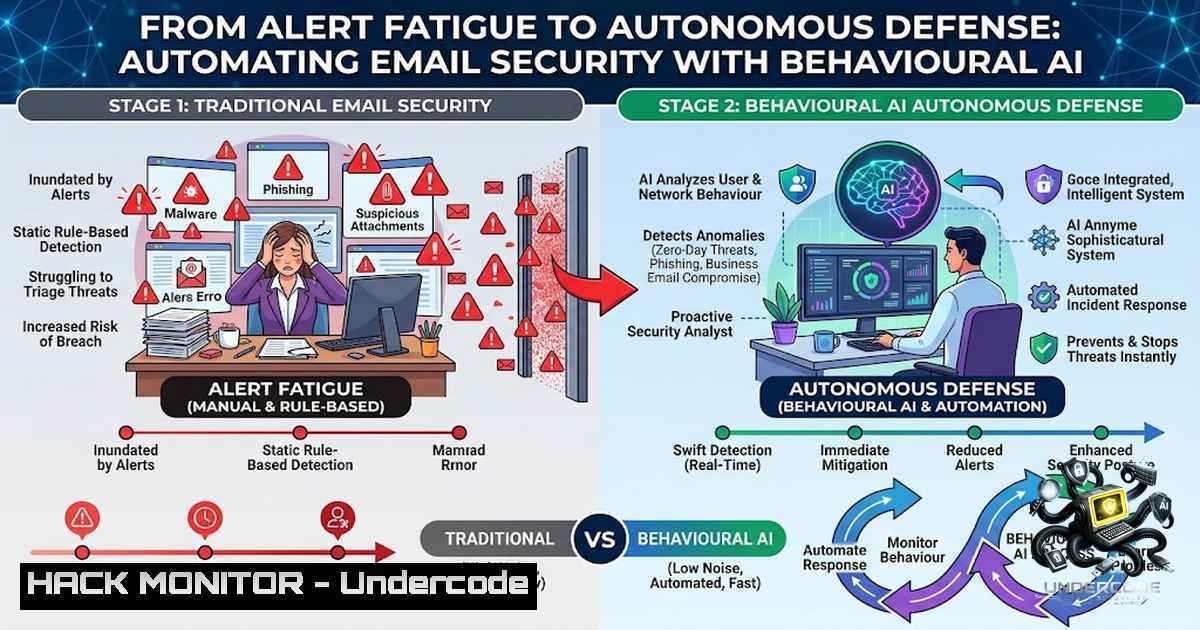
Traditional email security tools operate on a fundamentally reactive premise: they wait for known threat signatures to appear and then raise an alert for human investigation. This model is collapsing under the weight of AI-generated phishing, business email compromise (BEC), and vendor fraud that bypass SPF, DKIM, and DMARC checks entirely. Behavioural AI represents a paradigm shift—moving from chasing alerts to proactively detecting attacker intent by learning what normal looks like for every user, vendor, and application in your environment. This article explores how security engineers can implement behavioural AI-driven automation to stop chasing alerts and start preventing breaches at machine speed.
Learning Objectives:
- Understand how behavioural AI establishes individual baselines to detect anomalies that signature-based and rule-based systems miss.
- Learn to configure and interact with behavioural AI email security platforms via REST APIs for automation and SOAR integration.
- Master practical Linux, Windows, and API commands to operationalize automated email threat detection, triage, and remediation.
You Should Know:
1. Understanding Behavioural AI: Moving Beyond Static Rules
Rule-based secure email gateways (SEGs) function like tripwires: if an attacker avoids a rule’s conditions, that rule does not detect the threat. Modern attackers no longer rely on obvious malicious domains or attachments—they operate from legitimate, compromised accounts and inject malicious content into active email threads. These messages pass authentication checks because they come from trusted senders, leaving traditional tools blind.
Behavioural AI solves this by evaluating tens of thousands of behavioural, identity, recipient, and content signals simultaneously instead of rigid if-then logic. The platform builds comprehensive profiles of legitimate communication patterns: login telemetry (geography, device fingerprint), message cadence, tone, recipient patterns, vendor relationships, historical invoice amounts, and banking details. When a trusted supplier sends an invoice significantly higher than historical averages, the system flags the deviation against that supplier’s established baseline.
Step-by-Step: How Behavioural AI Detects a Compromised Account
- Baseline Establishment: The AI ingests 7–14 days of historical email and login data via API integration, building individual behavioural profiles for every identity.
- Real-Time Anomaly Scoring: Every incoming message, login, and application action is evaluated against millions of learned parameters. A single deviation receives a risk score.
- Intent Detection: The system distinguishes between legitimate anomalies (e.g., a user travelling abroad) and malicious intent by analysing behavioural context—not just content.
- Automated Remediation: When a threat is confirmed, the platform automatically purges malicious emails from all inboxes, revokes compromised sessions, and resets credentials without manual runbooks.
- Continuous Retraining: Models retrain automatically from SOC feedback and misclassification reports, reducing the need for manual tuning.
Linux Command – Email Header Analysis: To manually inspect email headers for manipulation patterns on a Linux mail server:
> “`bash
curl -s https://api.hybrid-analysis.com/v2/search/hash | jq ‘. | {threat_level: .threat_level, verdict: .verdict}’
sudo grep -r “phishing” /var/log/mail.log | awk ‘{print $1, $5, $NF}’ | column -t
> “`
These commands help security analysts quickly identify suspicious patterns in mail logs and correlate with threat intelligence feeds.
2. API-First Integration: Deploying Behavioural AI Without Disruption
Unlike traditional SEGs that require MX-record changes and mail-flow rewiring, behavioural AI platforms deploy via API integration with Microsoft 365 or Google Workspace in approximately 60 seconds. This API-1ative architecture enables real-time data streaming, automated remediation, and seamless SOAR integration.
Step-by-Step: Generating and Using an API Token
- Generate API Token: Log in to the Abnormal portal (
portal.abnormalsecurity.com), navigate to Settings > Integrations > Abnormal REST API, and copy your authentication token.
2. Set Environment Variable:
export ABNORMAL_API_TOKEN="your-api-token-here"
This static Bearer token has no expiry rotation, simplifying automation.
3. Restrict API Access: Enable IP allowlisting in the Abnormal portal by entering specific IPv4/IPv6 addresses or CIDR blocks.
4. Test API Connectivity:
curl -X GET "https://api.abnormalplatform.com/v1/threats" \
-H "Authorization: Bearer $ABNORMAL_API_TOKEN" \
-H "Accept: application/json"
This returns the top threats from your Threat Log in JSON format.
5. Configure Webhooks for Real-Time Event Streaming: Add Webhook as a new SIEM integration type in the Portal, configure your HTTPS endpoint, and choose authentication (API Key, Basic Authentication, Bearer Token, or Custom Header). Webhooks deliver near-real-time events including Threats, Vendor Cases, Audit Logs, and Account Takeover events directly to your security tools.
> Windows PowerShell – Automated Threat Fetching:
> “`bash
> $headers = @{
> “Authorization” = “Bearer $env:ABNORMAL_API_TOKEN”
> “Accept” = “application/json”
> }
$response = Invoke-RestMethod -Uri “https://api.abnormalplatform.com/v1/threats” -Headers $headers -Method Get
$response | ConvertTo-Json -Depth 10 | Out-File “C:\Security\threats_$(Get-Date -Format ‘yyyyMMdd’).json”
> “`
This PowerShell script fetches threat data and saves it with a timestamp, enabling automated threat intelligence ingestion into SIEM or ticketing systems.
3. Building Automated Incident Response with SOAR Integration
Behavioural AI platforms integrate natively with SOAR solutions to automate the entire incident response lifecycle—from detection to containment to remediation—eliminating manual triage and reducing mean time to respond (MTTR).
Step-by-Step: SOAR Playbook Automation for Email Threats
- Ingest High-Fidelity Alerts: Automatically push data from Inbound Email Security, Account Takeover Protection, and Security Posture Management into your SOAR platform via SIEM integration.
- Install Native Connector: Install the Abnormal AI connector from your SOAR marketplace (e.g., Google SecOps Marketplace, CrowdStrike Falcon Fusion) to investigate and respond to threats directly from SOAR playbooks.
- Create YARA-L Detection Rules: Use YARA-L rules to automatically convert SIEM events into SOAR cases, eliminating manual triage.
4. Define Automated Response Workflows:
- Isolate compromised accounts and quarantine suspicious messages.
- Automate safelisting of IPs based on threat intelligence.
- Trigger session revocation and credential resets for confirmed account takeovers.
- Continuous Optimisation: AI-driven SOAR solutions dynamically adjust response workflows based on real-time threat intelligence and evolving attack patterns.
Linux Command – Monitoring for Account Takeover Indicators:
> “`bash
sudo auditctl -w /etc/passwd -p wa -k sensitive_file_access
sudo ausearch -k sensitive_file_access –format raw | aureport -f -i
> “`
These auditd commands monitor sensitive file access on Linux systems, complementing behavioural AI by detecting insider threats and privilege escalation attempts that may precede email-based attacks.
4. Hardening Email Authentication Infrastructure
Behavioural AI is most effective when layered over properly configured email authentication. Attackers increasingly hijack trusted vendor accounts to bypass SPF, DKIM, and DMARC entirely. Proper authentication configuration ensures that behavioural AI focuses on detecting behavioural anomalies rather than being overwhelmed by basic authentication failures.
Step-by-Step: Configuring DMARC, DKIM, and SPF
- Configure SPF: Publish an SPF TXT record listing all authorised sending IPs and services.
v=spf1 include:spf.protection.outlook.com include:_spf.google.com -all
- Set Up DKIM: On Linux, install and configure OpenDKIM:
sudo apt-get install opendkim opendkim-tools
sudo opendkim-genkey -D /etc/opendkim/keys/ -d yourdomain.com -s default
Publish the resulting DNS TXT record and configure your MTA to sign outgoing messages.
- Implement DMARC: Publish a DMARC policy starting with monitoring mode (
p=none) before moving to quarantine or reject:v=DMARC1; p=quarantine; rua=mailto:[email protected]; pct=100
4. Validate Configuration:
dig TXT _dmarc.yourdomain.com
dig TXT default._domainkey.yourdomain.com
dig TXT yourdomain.com | grep "v=spf1"
5. Monitor Reports: AI can analyse DMARC aggregate (RUA) and forensic (RUF) reports to identify spoofing, impersonation, and misconfigured senders in real time.
5. Practical Threat Hunting with Behavioural AI APIs
Beyond automated detection, security engineers can proactively hunt for threats using behavioural AI APIs. The API provides programmatic access to detected threats, attack cases, abuse mailbox submissions, and account takeover events.
Step-by-Step: Threat Hunting with API Queries
1. Search for Specific Threat Patterns:
curl -X GET "https://api.abnormalplatform.com/v1/threats?filter=sender eq '[email protected]'&pageSize=50" \
-H "Authorization: Bearer $ABNORMAL_API_TOKEN"
This searches for threats by sender, recipient, attack type, or keywords.
2. Fetch Account Takeover Cases:
curl -X GET "https://api.abnormalplatform.com/v1/account-takeover/cases?filter=status eq 'OPEN'" \
-H "Authorization: Bearer $ABNORMAL_API_TOKEN"
Returns all open account takeover cases with full telemetry.
3. Retrieve Detailed Threat Information:
curl -X GET "https://api.abnormalplatform.com/v1/threats/{threat_id}" \
-H "Authorization: Bearer $ABNORMAL_API_TOKEN"
Provides complete details including behavioural signals behind each verdict.
4. Automate Threat Intelligence Forwarding: Use the API to forward attack data into SIEMs, drive SOAR playbooks, and integrate into ticketing and incident workflows.
> Python Script – Automated Threat Triage:
> “`bash
> import os
> import requests
> import json
> API_TOKEN = os.getenv(“ABNORMAL_API_TOKEN”)
> HEADERS = {“Authorization”: f”Bearer {API_TOKEN}”, “Accept”: “application/json”}
response = requests.get(“https://api.abnormalplatform.com/v1/threats”, headers=HEADERS)
> threats = response.json()
> for threat in threats.get(“threats”, [])[:10]:
print(f”Threat ID: {threat[‘threatId’]} | Severity: {threat[‘severity’]} | Status: {threat[‘status’]}”)
> Auto-escalate critical threats
> if threat[‘severity’] == ‘CRITICAL’:
Trigger SOAR playbook or send to SIEM
> print(f”Escalating critical threat: {threat[‘threatId’]}”)
> “`
This lightweight Python script demonstrates automated threat triage, enabling SOC teams to prioritise critical threats without manual review.
What Undercode Say:
- Key Takeaway 1: Behavioural AI eliminates the detection gap that traditional SEGs cannot address. By learning normal communication patterns for every user and vendor, it catches payload-less BEC, vendor fraud, and account takeovers that pass all authentication checks. The results speak for themselves: organisations replacing legacy SEGs with behavioural AI saw potential threats requiring attention drop from approximately 1 in 100 messages to approximately 1 in a million.
-
Key Takeaway 2: Automation is the force multiplier that transforms detection into prevention. Behavioural AI platforms deploy via API in minutes, integrate natively with SOAR workflows, and automatically remediate threats without manual intervention. This reduces SOC workload by 15+ hours per week and cuts breach costs by 33% for organisations using AI and automation.
Analysis:
The shift from chasing alerts to autonomous defence represents a fundamental rethinking of email security architecture. Traditional tools assume that threats can be predefined—an assumption that collapses when attackers use generative AI to craft hyper-personalised messages that defeat template-based detection. Behavioural AI flips this model: instead of asking “Is this message malicious?”, it asks “Does this message deviate from normal behaviour?” This subtle but profound shift enables detection of never-before-seen threats without rule writing or constant tuning.
For security engineers, the practical implications are clear. The API-first architecture of behavioural AI platforms enables seamless integration into existing security stacks—SIEM, SOAR, ticketing systems, and custom automation scripts. The commands and scripts provided in this article offer a starting point for operationalising behavioural AI detection: from fetching threats via curl and PowerShell to building automated triage pipelines in Python.
However, behavioural AI is not a silver bullet. It must be layered over properly configured email authentication (SPF, DKIM, DMARC) and integrated with broader security controls including identity protection, endpoint detection, and network segmentation. The most effective defence combines behavioural AI’s anomaly detection with traditional controls—creating a defence-in-depth architecture that catches attackers at every stage of the kill chain.
Prediction:
- +1 Behavioural AI will become the default standard for email security within 3–5 years, rendering traditional rule-based SEGs obsolete as organisations recognise that static rules cannot keep pace with AI-generated attacks.
-
+1 The convergence of behavioural AI with SOAR and autonomous agentic detection will enable fully automated incident response—from detection to containment to remediation—without human intervention for 80%+ of common email threats.
-
-1 Attackers will increasingly target the behavioural AI models themselves through adversarial AI techniques, poisoning training data and exploiting model blind spots to evade detection.
-
-1 Organisations that fail to adopt behavioural AI will face exponentially rising breach costs as AI-generated phishing becomes indistinguishable from legitimate communication, with email already accounting for 27% of all breaches.
-
+1 The API-1ative architecture of behavioural AI platforms will enable unprecedented security automation, with security teams shifting from reactive triage to proactive threat hunting and strategic security engineering.
▶️ Related Video (84% Match):
https://www.youtube.com/watch?v=2rFyj1N5WGg
🎯Let’s Practice For Free:
🎓 Live Courses & Certifications:
Join Undercode Academy for Verified Certifications
🚀 Request a Custom Project:
Secure, high-velocity infrastructure and disruptive technological engineering. Contact our engineering team for high-tier development and proprietary systems:
[email protected]
💎 Smart Architecture | 🛡️ Secure by Design | ⭐ Trusted by Thousands
IT/Security Reporter URL:
Reported By: Mohit Biradar – Hackers Feeds
Extra Hub: Undercode MoN
Basic Verification: Pass ✅


