
Listen to this Post
Introduction:
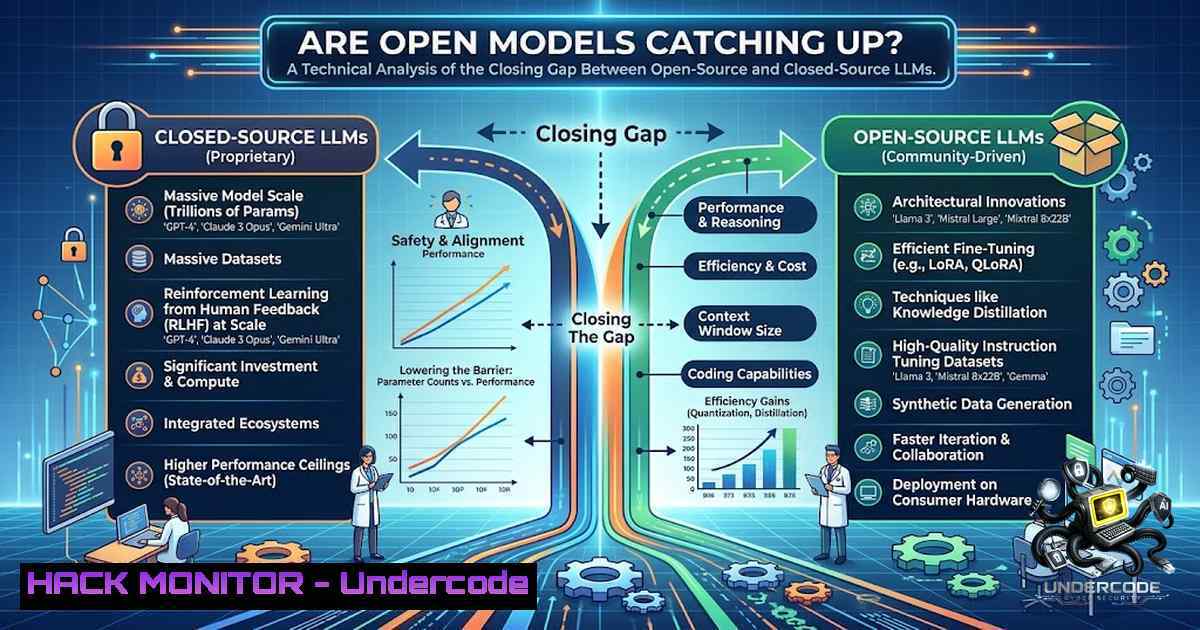
The perennial debate over open versus closed-source large language models (LLMs) has entered a critical new phase, driven by empirical data rather than speculative claims. Recent research analyzing model capability across all three major developmental eras—early scaling, reasoning, and agentic—reveals a remarkably consistent pattern: open-source models now take roughly half as long to close the capability gap with each successive generation. This compression follows a predictable curve, with the reasoning era gap of 12.1 points closing in approximately 8.5 months, while the current agentic era has seen comparable gaps closed in under 5 to 6 months by models like Kimi K2.6 and GLM-5.2. However, as SemiAnalysis notes in their comprehensive study, benchmarks alone do not tell the full story—production-grade tooling, harness quality, and real-world performance remain critical factors that enterprise AI buyers must weigh alongside raw capability scores.
Learning Objectives & Secrets:
- Objective 1: Understand the Three Eras of LLM Development — Grasp the distinct characteristics of the early scaling era (2022–2024), the reasoning era (2024–2025), and the current agentic era (2025–present), including the benchmark shifts that define each period.
-
Objective 2 Secret Tip: Leverage the Halving Trend for Strategic Planning — The gap-closing time has consistently halved with each era (35.8 points in ~16 months → 12.1 points in ~8.5 months → ~10 points in ~5 months). Enterprise architects should use this trend to time build-vs-buy decisions, anticipating that open models will match closed frontier capabilities within 3–5 months of a major closed release by late 2026.
-
Objective 3 Secret Tip: Prioritize Harness Quality Over Raw Model Scores — Even when open models like Kimi K3 outperform closed models like Fable 5 on curated benchmarks, practitioners at SemiAnalysis still prefer using the closed frontier model for daily work due to superior productization via tools like Claude Code and Claude Tag. The model + harness combination is now what truly matters in production.
You Should Know:
1. Benchmark Selection and Evaluation Methodology
The research team at SemiAnalysis adopted a sophisticated approach to measuring model capabilities across eras, avoiding the common pitfall of using a single, static benchmark set. Their methodology recognizes that every benchmark is a product of its era—when a new benchmark is created to discern differences in model capabilities, model makers inevitably climb it until saturation occurs, at which point the cycle repeats.
For each era, a curated set of benchmarks was selected:
- Early Scaling Era (2022–2024): GSM8K, HumanEval, TriviaQA, and MMLU-Pro—representative of frontier capabilities at the time, focusing on multiple-choice questions, word problems, and single-function programming tasks.
-
Reasoning Era (2024–2025): AIME (advanced math), Humanity’s Last Exam (PhD-level multiple-choice questions), and test-time-compute benchmarks that replaced the elementary evals of Era 1.
-
Agentic Era (2025–Present): Terminal-Bench 2.1, BrowseComp-Plus, ³-banking, and DeepSWE—covering software engineering, deep research, and long-horizon knowledge work that agents are used for today.
All scores were normalized per era, with the best result set to 100 and every other model scored relative to that benchmark. Open models were served with era-appropriate configurations: vLLM versions, hardware in use at the time, and sampling settings from the model card, while closed models were run against their pinned API versions.
Practical Evaluation Setup:
To replicate similar evaluations, you can use the Prime Intellect evaluation stack:
 Clone the Prime-RL evaluation harness
git clone https://github.com/PrimeIntellect-ai/prime-rl.git
cd prime-rl

Install dependencies
pip install -e .

Run a benchmark evaluation (example with DeepSWE)
python -m prime_rl.evals --benchmark deepswe --model llama-3.1-405b --1um_samples 100

For custom benchmark suites, configure the evals harness
python -m prime_rl.evals --config configs/agentic_benchmarks.yaml --output results.json
Windows Alternative (PowerShell):
 Using WSL2 for Linux compatibility
wsl --install -d Ubuntu
wsl bash -c "git clone https://github.com/PrimeIntellect-ai/prime-rl.git && cd prime-rl && pip install -e ."
2. Model Release Velocity and Its Implications
The research reveals a dramatic acceleration in model release cycles across eras. In Era 1 (early scaling), frontier labs released models every 213 days on average. Era 2 (reasoning) saw this compress to 120 days. In the current Era 3 (agentic), OpenAI and Anthropic have been releasing models every 51 days on average. This 4x speedup in release cadence has profound implications for enterprise AI infrastructure:
- Continuous Integration Required: Organizations can no longer treat model selection as an annual exercise. With models dropping every 7–8 weeks, evaluation pipelines must be automated and continuous.
-
API Version Pinning is Critical: Closed models were evaluated against pinned API versions. Enterprises should implement strict version pinning in production to prevent unexpected capability shifts.
-
Cost Optimization Windows: With usage resets being doled out and competition heating up beyond the OpenAI-Anthropic duopoly—Fireworks alone now processes over 40 trillion tokens per day, 2x the OpenAI API volume at the end of March—organizations should build flexible routing layers that can switch between providers based on cost-performance metrics.
Implementation Guide for Model Routing:
 Python example: Dynamic model router with fallback
import requests
import json
from datetime import datetime

class ModelRouter:
def <strong>init</strong>(self, config_path='model_config.json'):
with open(config_path) as f:
self.config = json.load(f)
self.provider_metrics = {}

def evaluate_and_route(self, prompt, max_tokens=1000):
 Check cache for recent model performance
 Route based on cost-performance heuristics
for provider in self.config['providers']:
if self._is_available(provider):
try:
response = self._call_api(provider, prompt, max_tokens)
self._log_metric(provider, 'success')
return response
except Exception as e:
self._log_metric(provider, 'failure')
continue
raise Exception("All providers failed")

def _call_api(self, provider, prompt, max_tokens):
 Implementation varies by provider (OpenAI, Anthropic, Fireworks, etc.)
pass
3. The Distillation Factor and Knowledge Transfer
The research emphasizes that “nothing stays secret forever—especially when you factor in distillation”. Model distillation—the process of training smaller models to mimic larger ones—has become a primary mechanism for open models to rapidly close capability gaps. This has significant security and operational implications:
- API Security: Distillation attacks can extract proprietary model capabilities through API access. Organizations should implement rate limiting, output monitoring, and anomaly detection on API endpoints.
-
Model Watermarking: To detect unauthorized distillation, consider implementing statistical watermarking in model outputs.
-
Access Control: Limit API access to verified users and monitor for suspicious query patterns that might indicate distillation attempts.
API Security Hardening (NGINX + Rate Limiting):
 /etc/nginx/nginx.conf - Rate limiting for LLM API endpoints
http {
limit_req_zone $binary_remote_addr zone=llm_api:10m rate=10r/m;

server {
location /api/v1/chat {
limit_req zone=llm_api burst=5 nodelay;
limit_req_status 429;

Additional security headers
add_header X-Content-Type-Options "nosniff" always;
add_header X-Frame-Options "DENY" always;

proxy_pass http://llm_backend;
proxy_set_header Host $host;
proxy_set_header X-Real-IP $remote_addr;
}
}
}
Linux Command for Monitoring API Access Patterns:
 Monitor API logs for suspicious patterns (high-frequency requests from single IP)
tail -f /var/log/nginx/access.log | awk '{print $1}' | sort | uniq -c | sort -1r | head -20

Detect potential distillation attempts (unusually long sessions)
grep "POST /api/v1/chat" /var/log/nginx/access.log | awk '{print $1, $4, $10}' | sort | uniq -c
4. The Model + Harness Paradigm Shift
Perhaps the most critical finding from the SemiAnalysis research is that the “full agentic product (model + harness) was now what mattered”. Anthropic’s success in adding north of $65 billion in ARR since the general release of Claude Code in May 2025 demonstrates that superior harness quality can outweigh raw model capability. Interestingly, GPT-5.2 performed better on the benchmark suite but didn’t correspond to a better user experience, highlighting the gap between benchmark performance and real-world utility.
Key Harness Components to Evaluate:
- Tool Calling Reliability: How consistently does the model use available tools?
- Context Management: How well does the harness handle long-running agentic tasks?
- Error Recovery: Can the agent recover from failed operations?
- Cost Controls: Does the harness implement token usage limits and cost guards?
Building a Basic Agent Harness (Python):
 Simple agent harness with tool calling and error recovery
import asyncio
from typing import List, Dict, Any

class AgentHarness:
def <strong>init</strong>(self, model_client, max_steps=10, cost_limit=0.50):
self.model = model_client
self.max_steps = max_steps
self.cost_limit = cost_limit
self.tools = {}
self.history = []
self.total_cost = 0.0

def register_tool(self, name: str, func: callable, description: str):
self.tools[bash] = {'func': func, 'description': description}

async def run(self, task: str) -> Dict[str, Any]:
for step in range(self.max_steps):
 Check cost limits
if self.total_cost > self.cost_limit:
return {'status': 'cost_limit_reached', 'history': self.history}

Get model response with tool availability
response = await self.model.chat(
messages=self.history + [{'role': 'user', 'content': task}],
tools=self.tools,
temperature=0.3
)

self.total_cost += response.usage.cost
self.history.append(response.message)

Execute tool calls if any
if response.tool_calls:
for tool_call in response.tool_calls:
try:
result = await self._execute_tool(tool_call)
self.history.append({'role': 'tool', 'content': result})
except Exception as e:
 Error recovery
self.history.append({
'role': 'tool',
'content': f"Error: {str(e)}. Retry with different approach."
})
else:
 No tool calls, task complete
return {'status': 'completed', 'result': response.content, 'history': self.history}

return {'status': 'max_steps_reached', 'history': self.history}
5. Enterprise Implications and Vendor Lock-In Risk
The accelerating open-source catch-up curve has direct implications for enterprise AI procurement and infrastructure strategy:
- Pricing Pressure: If open models keep closing gaps faster with each cycle, the pressure on closed-model pricing and differentiation only intensifies—a dynamic every enterprise AI buyer should be tracking.
-
Build-vs-Buy Recalibration: With the gap-closing time halving each era, the build option becomes increasingly viable. Organizations should consider:
- Fine-tuning open models on proprietary data
- Deploying open models on internal infrastructure for sensitive workloads
-
Using closed models for tasks requiring the absolute frontier capability (which now has a shorter shelf life)
-
Vendor Lock-In Mitigation: Implement abstraction layers that allow swapping between providers. The research notes that “Fireworks alone is processing over 40T tokens per day—2x the OpenAI API’s volume”, indicating a thriving ecosystem of alternatives.
Cloud Hardening for Open Model Deployment:
 Deploy vLLM with security best practices on Linux
 Install vLLM
pip install vllm

Start vLLM server with authentication and rate limiting
python -m vllm.entrypoints.openai.api_server \
--model meta-llama/Llama-3.1-405B \
--tensor-parallel-size 8 \
--max-model-len 8192 \
--api-key YOUR_SECURE_API_KEY \
--rate-limit 100 \
--rate-limit-window 60

Configure firewall (UFW)
sudo ufw allow from 10.0.0.0/8 to any port 8000  Allow only internal network
sudo ufw enable

Set up TLS termination with Let's Encrypt
sudo apt install certbot python3-certbot-1ginx
sudo certbot --1ginx -d llm.yourdomain.com
Windows Server Deployment (PowerShell):
 Using Windows Subsystem for Linux (WSL) for vLLM
wsl --install -d Ubuntu
wsl bash -c "pip install vllm && python -m vllm.entrypoints.openapi.api_server --model meta-llama/Llama-3.1-405B --tensor-parallel-size 8"

Windows Firewall rule to restrict access
New-1etFirewallRule -DisplayName "Allow LLM API only from internal subnet" -Direction Inbound -LocalPort 8000 -Protocol TCP -RemoteAddress 192.168.0.0/16 -Action Allow
What Undercode Say:
- Key Takeaway 1: The halving trend is empirically validated and predictable. Across three distinct eras of LLM development—early scaling, reasoning, and agentic—the time required for open models to close the capability gap has consistently halved. The reasoning era saw a 12.1-point gap closed in 8.5 months; the agentic era has seen comparable gaps closed in under 5–6 months. This isn’t random—it’s a pattern that enterprise strategists can bank on for capacity planning.
-
Key Takeaway 2: Benchmarks are necessary but insufficient. Even the researchers who conducted this analysis—SemiAnalysis—still prefer using closed frontier models for their daily work. The reason isn’t raw capability but production-grade tooling: Anthropic’s Claude Code and Claude Tag represent a model + harness combination that open ecosystems have yet to fully replicate. Procurement decisions must weigh both model capability and the quality of the surrounding tooling.
-
Key Takeaway 3: The economics of frontier labs are under pressure. If open models keep closing gaps faster with each cycle, closed-model pricing and differentiation face intensifying pressure. With release cycles compressing from 213 days to 51 days, the window for closed models to monetize their frontier advantage is shrinking. Enterprise AI buyers should build flexible infrastructure that can pivot between open and closed providers as the economics shift.
Prediction:
-
-1 Frontier lab margins will face sustained compression. As open models close gaps in under 5 months, the pricing power of closed providers will erode. The “duopoly” OpenAI-Anthropic model release every 51 days suggests a frantic race to maintain differentiation, but each cycle delivers diminishing returns as open models rapidly replicate advances.
-
-1 Benchmark gaming will intensify. The research notes that “model makers can easily hill climb by simply creating a bunch of RL environments that closely mimic the benchmark tasks”. As more providers optimize for benchmark scores, the gap between benchmark performance and real-world utility may widen, creating evaluation fatigue for enterprise buyers.
-
+1 The agentic era will reward harness innovation over model size. Anthropic’s $65B+ ARR from Claude Code proves that superior productization can dominate even when benchmarks favor competitors. Startups and enterprises that focus on building exceptional harnesses—not just fine-tuning models—will capture disproportionate value.
-
+1 Open-source infrastructure will mature rapidly. With Fireworks processing 40T tokens daily—2x OpenAI’s API volume—the open ecosystem is achieving economies of scale that will further accelerate capability catch-up. This creates a virtuous cycle: more usage → more feedback → faster improvement → more usage.
-
-1 Vendor lock-in risks remain significant for the unwary. Despite the open-source momentum, enterprises that build deeply on closed APIs without abstraction layers will find themselves trapped when pricing shifts or models change. The research’s emphasis on pinned API versions underscores the importance of version control and provider-agnostic architectures.
▶️ Related Video (74% Match):
https://www.youtube.com/watch?v=-RYR0_L3OV0
🎯Let’s Practice For Free:
🎓 Live Courses & Certifications:
Join Undercode Academy for Verified Certifications
🚀 Request a Custom Project:
Secure, high-velocity infrastructure and disruptive technological engineering. Contact our engineering team for high-tier development and proprietary systems:
[email protected]
💎 Smart Architecture | 🛡️ Secure by Design | ⭐ Trusted by Thousands
IT/Security Reporter URL:
Reported By: https://lnkd.in/p/eUMdQpim – Hackers Feeds
Extra Hub: Undercode MoN
Basic Verification: Pass ✅


