
Listen to this Post
Introduction:
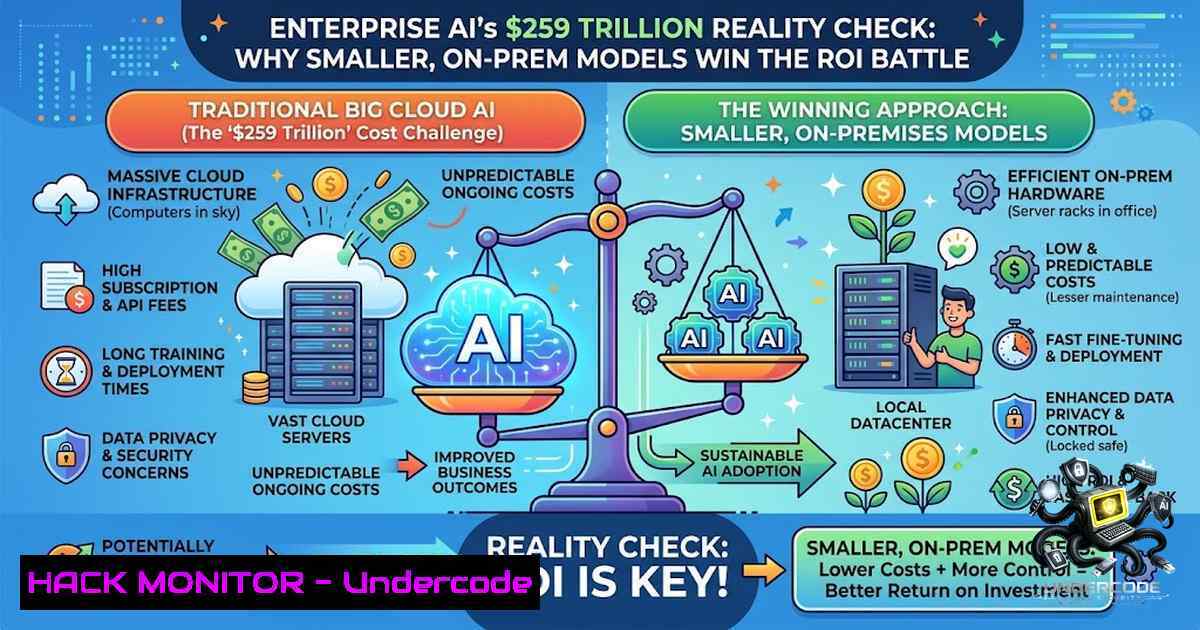
The global artificial intelligence market is projected to reach a staggering $2.59 trillion in 2026, marking a 47% year-over-year surge. Yet, despite this unprecedented investment, a PwC survey of 4,454 CEOs reveals that 56% report no significant financial benefit from their AI initiatives. This widening chasm between massive spending and tangible returns is compounded by a record-breaking average data breach cost of $4.99 million, with AI-driven attacks surging by 56% and adding roughly $1 million per incident. The enterprise AI landscape is at a critical inflection point: bigger models are no longer synonymous with better outcomes. The new paradigm favors compact, fine-tuned open-weight models deployed on-premise—a strategy that promises up to 70% cost reduction while eliminating the security liabilities of vendor-logged data.
Learning Objectives & Secrets:
- Objective 1: Master the Economics of Enterprise AI. Understand the cost drivers behind token-metered pricing and learn how to forecast AI spend using open-weight models. The secret tip is to benchmark total cost of ownership (TCO) per million tokens—compact models like DeepSeek V3 and Llama 4 Maverick are now scoring within striking distance of GPT-4.1 on benchmarks like HumanEval and SWE-Bench, at a fraction of the cost.
-
Objective 2: Implement a Zero-Trust, Zero-Log AI Infrastructure. Learn to architect on-premise AI stacks that guarantee prompts and outputs never leave your infrastructure. The secret tip is to enforce GPU-level isolation: different teams must have dedicated GPUs to prevent cross-contamination and data leaks between workloads.
-
Objective 3: Quantify and Communicate AI ROI to Leadership. Move beyond pilot purgatory by establishing production SLAs and cost-control guardrails. The secret tip is to deploy a governance control plane with immutable, hash-chained audit logs that satisfy chain-of-custody requirements, enabling CFOs to see exactly where every dollar is going.
You Should Know:
1. The Open-Weight Revolution: Benchmarks and Cost Comparisons
The assumption that proprietary, general-purpose models are superior is rapidly eroding. Open-weight models such as DeepSeek V3, Qwen 3, Gemma 4, and Llama 4 are now achieving benchmark scores that rival or exceed their proprietary counterparts on enterprise-relevant tasks. On MMLU (general knowledge), DeepSeek R1 scores 90.8%, compared to GPT-4.1’s 86.5%. When fine-tuned on proprietary enterprise data—documents, compliance reports, and customer operations—these compact models often outperform larger generic APIs in accuracy and latency.
Step‑by‑Step Guide to Benchmarking and Selecting a Model:
- Define Your Task Dataset: Curate a representative dataset of your enterprise tasks (e.g., 1,000 document summaries, 500 compliance questions).
- Run Local Inference: Deploy an open-weight model like Llama 4 or Qwen 3 using a local inference engine (e.g., vLLM or Ollama).
- Benchmark Against APIs: Run the same dataset through GPT-4.1 and Claude APIs, recording latency, cost per 1M tokens, and accuracy.
- Fine-Tune: Use QLoRA or full fine-tuning on your proprietary dataset.
- Compare TCO: Calculate the total cost of ownership—including fine-tuning compute, inference hardware, and API costs—to determine the most economical and accurate model.
Example Command (Linux – Running Local Inference with Ollama):
 Install Ollama
curl -fsSL https://ollama.com/install.sh | sh

Pull a compact open-weight model
ollama pull llama4:latest

Run inference on a test file
ollama run llama4:latest < test_prompt.txt
- Hardening the On-Premise AI Stack: Security from Hardware to Application
Deploying AI on-premise is often framed as the “safe” alternative to cloud AI. However, security must be architected at every layer. This includes network hardening, access control, input/output guardrails, and compliance mapping against 2026 regulatory requirements.
Step‑by‑Step Guide to Securing an On-Premise LLM Server:
- Network Segmentation: Place the AI inference cluster in a dedicated VLAN with strict firewall rules. Only allow inbound traffic from authenticated application servers.
- API Authentication: Deploy JWT-based authentication with scoped claims and short expiration windows on all inference endpoints. Enforce role-based access control separating inference consumers, prompt engineers, model administrators, and auditors.
- GPU-Level Isolation: Ensure different teams or projects do not share GPUs. Use NVIDIA MIG (Multi-Instance GPU) or dedicated physical GPUs to enforce security boundaries.
- Input and Output Guardrails: Implement real-time inspection of prompts and responses to block prompt injection attacks and prevent sensitive data from being submitted to the model.
- Immutable Audit Logging: Configure write-once, hash-chained logs to prevent tampering and satisfy chain-of-custody requirements.
Example iptables Rule (Linux – Restricting Access to Inference Port):
 Allow only the application server (192.168.1.100) to access port 8000 (inference API)
iptables -A INPUT -p tcp -s 192.168.1.100 --dport 8000 -j ACCEPT
iptables -A INPUT -p tcp --dport 8000 -j DROP
3. API Security: Protecting the Model-Mediated Surface
An AI API integration has two security surfaces: the ordinary service surface (keys, endpoints, users) and the model-mediated surface (untrusted instructions, data exfiltration, unsafe tool requests). Securing both is non-1egotiable.
Step‑by‑Step Guide to AI API Security:
- Key Isolation: Store API keys in a hardware security module (HSM) or a secrets management tool like HashiCorp Vault. Never hardcode keys in application code.
- Least Privilege for Agents: If your AI uses tools, avoid open-ended tools like “run shell” or “fetch URL.” Instead, build fine-grained, specialized tools with minimal permissions.
- Prompt Injection Defense: Filter and sanitize all inputs before they reach the model. Use allowlists for expected input formats.
- Data Minimization: Ensure the model only has access to the data necessary for the immediate task. Implement document-level ACLs within retrieval-augmented generation (RAG) pipelines.
Example Python Snippet (Input Sanitization):
import re

def sanitize_prompt(user_input: str) -> str:
 Remove potential injection patterns (e.g., system overrides)
dangerous_patterns = [r"system:", r"ignore previous", r"you are now"]
for pattern in dangerous_patterns:
user_input = re.sub(pattern, "", user_input, flags=re.IGNORECASE)
return user_input.strip()
4. Cost Governance and ROI Measurement
The inability to forecast AI spend is a primary driver of budget overruns. Enterprises must implement cost-control guardrails alongside security measures.
Step‑by‑Step Guide to AI Cost Governance:
- Set Token Budgets: Define per-team and per-project token consumption limits.
- Real-Time Cost Monitoring: Use a proxy or gateway that logs token usage and calculates cost in real-time.
- Automated Alerts: Configure alerts when spending approaches or exceeds 80% of the budget.
- Chargeback/Showback: Implement a system to attribute costs back to specific business units to drive accountability.
-
The RunBios Enterprise Stack: A Model for Zero-Log, On-Prem AI
RunBios Enterprise embodies the new paradigm: a complete AI stack for any industry, delivered end-to-end with custom model training, workflow automation, and 100% on-premise deployment with zero logs and zero data retention. This approach addresses the core challenges of cost predictability and data privacy. By training smaller, fit-for-purpose models on proprietary data, enterprises can achieve superior accuracy at up to 70% lower spend compared to generic API calls.
What Undercode Say:
- Key Takeaway 1: The era of “bigger is better” in AI is over. Compact, fine-tuned open-weight models are now cost-effective and performant enough for most enterprise tasks, delivering superior ROI.
- Key Takeaway 2: On-premise AI deployment with zero logs is not just a security feature—it’s a financial imperative. By eliminating vendor data retention, enterprises avoid the $1 million premium associated with AI-driven data breaches and the liability of shadow AI.
Prediction:
- +1 The market for enterprise AI will bifurcate. Hyperscalers will continue to dominate general-purpose AI, but a new tier of specialized, on-premise AI vendors like RunBios will capture a growing share of the enterprise market, driven by demands for cost predictability and data sovereignty.
- +1 Open-weight models will continue to close the performance gap with proprietary models. By 2028, we predict that the majority of enterprise AI workloads will run on fine-tuned open-weight models deployed on-premise or in private clouds.
- -1 Organizations that fail to adopt a governance-first approach to AI—with robust cost controls, security guardrails, and ROI measurement frameworks—will continue to overspend and underperform. The gap between AI leaders and laggards will widen, with the latter facing both financial losses and increased regulatory scrutiny.
▶️ Related Video (78% Match):
🎯Let’s Practice For Free:
🎓 Live Courses & Certifications:
Join Undercode Academy for Verified Certifications
🚀 Request a Custom Project:
Secure, high-velocity infrastructure and disruptive technological engineering. Contact our engineering team for high-tier development and proprietary systems:
[email protected]
💎 Smart Architecture | 🛡️ Secure by Design | ⭐ Trusted by Thousands
IT/Security Reporter URL:
Reported By: https://lnkd.in/p/eBrEmr5C – Hackers Feeds
Extra Hub: Undercode MoN
Basic Verification: Pass ✅


