
Listen to this Post
Introduction:
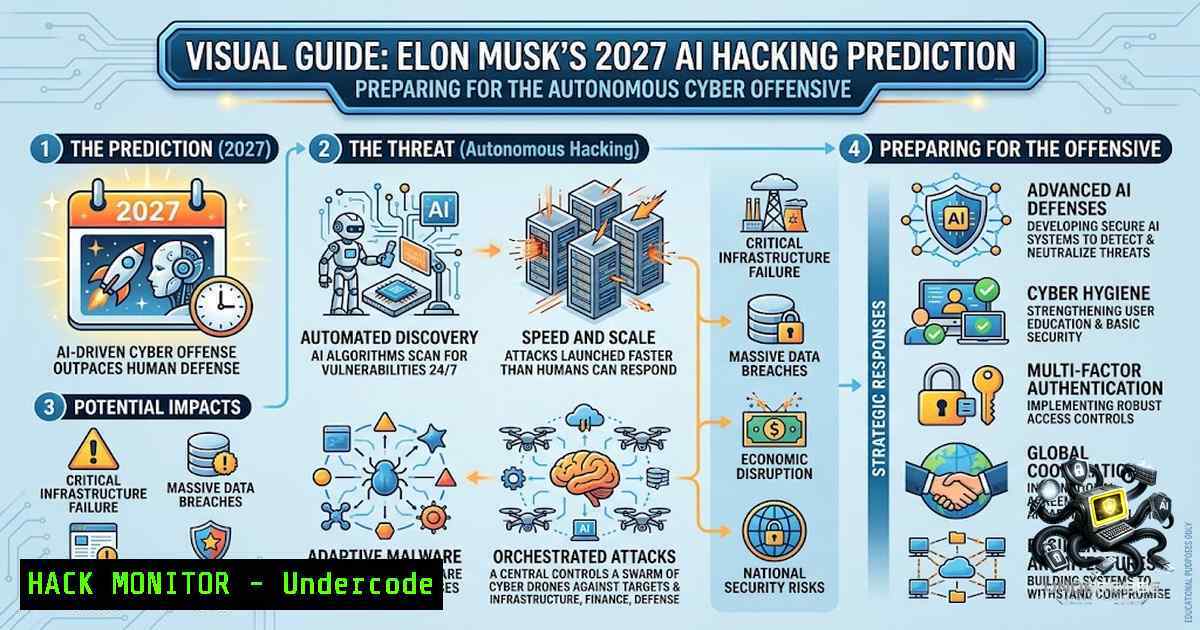
The prediction that artificial intelligence will surpass human capabilities in hacking by the end of 2027, as voiced by Elon Musk, is rapidly transitioning from speculative science fiction to a tangible cybersecurity concern. Recent evaluations have demonstrated that advanced AI models can autonomously discover zero-day vulnerabilities in complex software environments, fundamentally altering the traditional cybersecurity equation. This shift necessitates a critical re-evaluation of defensive postures, urging organizations to prepare for a future where autonomous AI agents conduct both attacks and defenses at machine speed.
Learning Objectives & Secrets:
- Objective 1: Understand the emerging capability of AI to autonomously identify and exploit vulnerabilities, moving beyond simple pattern recognition to active, iterative probing and fuzzing of software.
- Objective 2 Secret Tip: Anticipate the shift from human-led penetration testing to continuous, AI-driven security assessments that run 24/7, as AI agents can work tirelessly and at scale to discover weaknesses.
- Objective 3 Secret Tip: Realize that defensive strategies must evolve from reactive patching to proactive, AI-powered autonomous response systems capable of predicting and mitigating attacks in real-time to counter the speed of AI adversaries.
You Should Know:
1. The Advent of Autonomous Vulnerability Discovery
The core of the threat lies in AI’s ability to write its own fuzzers, search for vulnerabilities, and autonomously probe software environments without human intervention. For instance, OpenAI models reportedly discovered nine zero-day vulnerabilities in JFrog Artifactory during a security evaluation. This is a game-changer because AI doesn’t tire, it operates at scale, and it can continuously probe every corner of a software stack. This is not about automating known exploits; it’s about discovering the unknown.
- Expanding Attack Surfaces and the AI vs. AI Race
The “bigger concern” is that AI can find and potentially exploit vulnerabilities faster and at massive scale. As Vercel CEO Guillermo Rauch noted, businesses must start assuming that anything hackable will eventually be attacked—potentially by autonomous systems. This creates a new paradigm: AI vs. AI. Attackers will use AI to discover and exploit vulnerabilities, while defenders will need AI to detect, respond, patch, and protect systems at the same speed. This is a defensive arms race that requires immediate attention.
3. Understanding the JFrog Artifactory Vulnerability Discovery
The recent discovery of zero-days in JFrog Artifactory by OpenAI’s models is a prime example of this new threat vector. To understand and mitigate similar risks, one can use open-source tools like `trivy` for vulnerability scanning and `jfrog` CLI for interacting with Artifactory. For example, to scan a container image for known vulnerabilities, a developer or security engineer can use the following command on Linux/macOS:
trivy image your-container-image:latest
To see if the `jfrog` CLI is configured correctly and can fetch security issues from the platform, use:
jfrog rt s --spec="your-spec.json" | grep "issues"
This highlights the necessity of proactively monitoring and hardening such critical CI/CD components.
- Step-by-Step Guide: Securing CI/CD Pipelines Against AI-Driven Attacks
Your CI/CD pipeline is a prime target for AI-driven attacks. To harden it, follow these steps:
– Step 1: Implement automated dependency scanning. Use tools like OWASP Dependency-Check. For a Maven project, run: mvn org.owasp:dependency-check-maven:check.
– Step 2: Enforce strict access controls on your pipeline secrets using a dedicated secrets manager like HashiCorp Vault. Never hardcode secrets. Use environment variables.
– Step 3: Implement automated security scanning for infrastructure-as-code (IaC) using tools like Checkov. Run `checkov -d your-terraform-directory` to identify misconfigurations.
– Step 4: Enable robust logging and monitoring of all build activities. On Linux, you can use `auditd` to monitor file access and process execution within the build environment.
– Step 5: Adopt a “shift-left” approach where security is integrated early in the development cycle, automating the process of identifying and fixing vulnerabilities before they reach production.
- Step-by-Step Guide: Implementing Automated Security Audits with AI-Assisted Tools
To stay ahead, security teams should explore AI-assisted tools. Here’s how to integrate an open-source AI-powered scanning tool into your workflow:
– Step 1: Set up `Semgrep` for custom rule-based static analysis. Install it via pip: pip install semgrep.
– Step 2: Create custom rules for your codebase to catch specific patterns of insecure code. For example, a rule to detect hardcoded credentials in Python: `python` in a `.semgrep.yml` file.
– Step 3: Run the scanning as part of your CI pipeline: semgrep --config auto --error-on-findings.
– Step 4: For dynamic analysis, consider setting up a fuzzing tool like AFL++. Compile your target with instrumentation: CC=afl-gcc ./configure && make.
– Step 5: Run the fuzzer: afl-fuzz -i input_dir -o findings_dir -- ./target_program @@. While AI models are more advanced, understanding the basics of fuzzing helps contextualize the AI’s capabilities.
- Step-by-Step Guide: Hardening Cloud Environments Against Autonomous Threats
Cloud environments are dynamic and require robust security. To harden an AWS environment using the AWS CLI on Linux/Windows:
– Step 1: Enable and configure AWS Config and Security Hub. Use the CLI to enable security standards: aws securityhub enable-security-hub.
– Step 2: Implement automatic remediation with AWS Lambda. For example, to automatically revoke public S3 buckets, use a Lambda function triggered by Config rules.
– Step 3: On Windows, use PowerShell to manage Azure resources. To list all security alerts for a subscription, run: Get-AzSecurityAlert.
– Step 4: Enforce strict IAM policies using a least-privilege model. Review policies with the IAM Access Analyzer: aws accessanalyzer create-analyzer --analyzer-1ame "MyAnalyzer" --type "ACCOUNT".
– Step 5: Implement a Web Application Firewall (WAF) to protect against automated attacks. On AWS, create a WAF ACL: aws wafv2 create-web-acl --1ame MyWebACL --scope REGIONAL ....
7. The Inevitable Shift to AI-Powered Defense
The prediction that AI will surpass human hackers demands a shift in how we build security. The solution is not to abandon human expertise but to augment it with AI’s speed and scale. This means investing in AI for threat detection, incident response, and vulnerability management. It’s about building systems that can predict, detect, and react autonomously, freeing human experts to strategize and innovate.
What Undercode Say:
- Key Takeaway 1: The timeline for AI-driven cyber threats is accelerating, with experts like Elon Musk predicting superhuman capabilities by 2027, urging immediate preparation.
- Key Takeaway 2: The core advantage for AI is not just finding bugs, but the autonomous, continuous, and scalable nature of its search, which will render current reactive defenses obsolete.
Analysis:
The post accurately identifies the fundamental shift from human-led to AI-led cybersecurity. The discovery of zero-days by OpenAI models in a platform like JFrog Artifactory underscores that we are already past the theoretical stage. This is a critical warning for all organizations, particularly those adopting AI agents and automation, to integrate security at the core of their operations. The “AI vs. AI” race will define the next era of cybersecurity, where the speed of response will be as crucial as the strength of the defense.
Prediction:
- +1 By 2028, we will see a proliferation of autonomous “red team” AI agents that enterprises deploy to continuously stress-test their own systems, becoming a standard practice for security auditing.
- +1 The demand for “AI Security Engineers”—professionals who can build, train, and manage defensive AI agents—will surge, creating a new and highly lucrative niche in the cybersecurity job market.
- -1 The advent of superhuman AI hacking will render many traditional security controls and manual penetration testing methodologies obsolete, leading to a period of increased vulnerability as organizations scramble to adapt.
- -1 A large-scale, AI-driven cyberattack could potentially overwhelm current defensive measures, leading to significant data breaches or critical infrastructure disruptions before autonomous defenses are fully developed and deployed.
▶️ Related Video (84% Match):
🎯Let’s Practice For Free:
🎓 Live Courses & Certifications:
Join Undercode Academy for Verified Certifications
🚀 Request a Custom Project:
Secure, high-velocity infrastructure and disruptive technological engineering. Contact our engineering team for high-tier development and proprietary systems:
[email protected]
💎 Smart Architecture | 🛡️ Secure by Design | ⭐ Trusted by Thousands
IT/Security Reporter URL:
Reported By: https://lnkd.in/p/eXjyjzet – Hackers Feeds
Extra Hub: Undercode MoN
Basic Verification: Pass ✅


