
Listen to this Post
Introduction
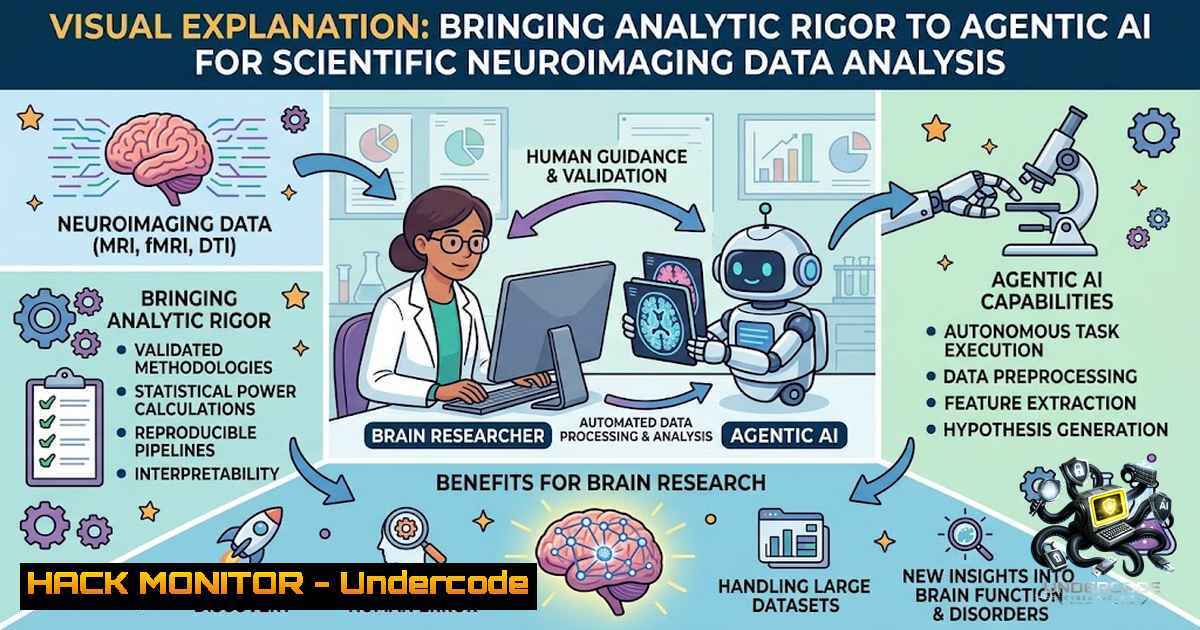
The proliferation of autonomous AI agents in scientific research promises accelerated discovery, yet it simultaneously introduces profound risks: unchecked agents can perpetuate selective analysis, prematurely declare success, and optimize for imperfect criteria without ever questioning the validity of their own outputs. The fundamental challenge lies in the fact that an analytic output becomes a defensible scientific claim only after alternatives are weighed and the claim is rigorously limited to what the evidence genuinely supports. Brain Researcher, an agentic research harness developed by Chen, Poldrack, and colleagues, directly confronts this vulnerability by embedding methodological judgment directly within the computational workflow—not as an afterthought, but as a governing framework that enforces rules for admissible analyses, required checks, and claim scope.
Learning Objectives & Secrets
- Objective 1: Understand the core vulnerability of agentic AI in scientific workflows. Learn how autonomous agents can inadvertently introduce biases through selective analysis, premature declarations of success, and optimization of flawed criteria—and why traditional validation methods fail to catch these failures in real-time.
-
Objective 2 Secret Tip: Implement rule-based governance for AI agents. Discover how to define and enforce “admissible analyses” and “required checks” within your own computational environment. The secret lies not in restricting the agent’s capabilities, but in constraining its decision-making process through a pre-execution rule engine that validates every proposed analytic step against a predefined set of methodological standards.
-
Objective 3 Secret Tip: Leverage multiverse analysis for claim validation. Instead of accepting a single analytic output, learn how to systematically expose analytic-choice sensitivity by running parallel analyses across multiple valid pipelines. The secret is to treat every analytical decision point—from preprocessing steps to statistical models—as a variable in a “multiverse” that collectively defines the robustness (or fragility) of your final claim.
You Should Know
- Enforcing Admissible Analyses: A Pre-Execution Rule Engine for AI Agents
At the heart of Brain Researcher is a governance layer that operates before any agentic action is executed. This is not a post-hoc validation tool; it is a gatekeeper that evaluates proposed analyses against a set of configurable rules. For neuroimaging, these rules might include: “Must apply motion correction before any first-level GLM,” or “Must report multiple comparison correction method.” But the architecture is generalizable to any domain where analytical rigor is paramount.
Step‑by‑step guide to implementing a rule-based pre-execution engine:
- Define your rule set. Create a YAML or JSON configuration file that enumerates all mandatory preprocessing steps, required statistical tests, and prohibited analytical shortcuts for your domain. Example (
brain_rules.yaml):rules:</li> </ol> - id: "preproc_motion_correction" description: "Motion correction must be applied before GLM" check: "pipeline.steps contains 'motion_correct'" action: "block" or 'warn' - id: "stats_multi_comp_correction" description: "Multiple comparison correction must be reported" check: "report.contains('FDR') or report.contains('Bonferroni')" action: "block" - id: "data_grounding" description: "All claims must be grounded in raw data provenance" check: "provenance.raw_data_hash is not null" action: "block"- Instrument your agent’s decision loop. Before the agent submits a tool call or a pipeline definition, intercept the request and pass it through a rule validator. In Python:
import yaml from typing import Dict, List</li> </ol> class RuleEngine: def <strong>init</strong>(self, rules_file: str): with open(rules_file, 'r') as f: self.rules = yaml.safe_load(f)['rules'] def validate(self, proposed_action: Dict) -> List[bash]: violations = [] for rule in self.rules: Evaluate the rule.check expression against proposed_action if not eval(rule['check'], {}, {'pipeline': proposed_action}): violations.append(f"Rule violated: {rule['description']}") return violations- Integrate with your agent framework. For OpenAI Assistants, LangChain, or AutoGPT, wrap the tool-calling function with the rule engine. If violations are found, either block the action and request revision, or log the violation and force the agent to justify the deviation.
-
Log every decision. Maintain a provenance trail that records which rules were evaluated, which actions were blocked or allowed, and the agent’s justification for any overrides. This log becomes the foundation for verifiable grounding—Brain Researcher improved verifiable grounding from 4.6% to 22.0% precisely through such provenance tracking.
2. Multiverse Analysis: Exposing Analytic-Choice Sensitivity
A single analytic pipeline can produce a statistically significant result purely by chance or due to arbitrary preprocessing choices. Brain Researcher’s multiverse analysis systematically varies each analytic decision point—different motion correction parameters, different smoothing kernels, different statistical models—and runs the entire analysis across all valid combinations. The result is a distribution of outcomes that reveals whether the core finding is robust or an artifact of a specific analytic choice.
Step‑by‑step guide to implementing multiverse analysis:
- Identify decision points. List every tunable parameter in your analysis pipeline. For neuroimaging: smoothing FWHM (4mm, 6mm, 8mm), high-pass filter cutoff (100s, 128s), GLM model type (canonical HRF, finite impulse response), multiple comparison correction (FDR, Bonferroni, cluster-wise).
-
Generate the multiverse grid. Use a Cartesian product of all parameter combinations. In Python:
import itertools</p></li> </ol> <p>params = { 'smoothing': [4, 6, 8], 'hp_filter': [100, 128], 'glm_model': ['canonical', 'fir'], 'correction': ['fdr', 'bonferroni', 'cluster'] } combinations = list(itertools.product(params.values()))- Parallelize execution. Each combination is an independent analysis job. Use a task queue (Celery, Dask) or cloud batch processing to run all combinations concurrently. For large multiverses (e.g., 3×2×2×3 = 36 combinations), this is computationally intensive but feasible with modern cloud infrastructure.
-
Aggregate and visualize results. For each combination, extract the key effect size and p-value. Plot the distribution of effect sizes across all combinations. A narrow distribution centered on a significant effect indicates robustness; a wide distribution that crosses zero indicates fragility.
-
Classify the claim. Based on the multiverse results, classify the claim using Brain Researcher’s taxonomy: accepted, qualified, revised, blocked, rejected, or deferred. A claim is “accepted” only if it survives across a predefined majority of analytic specifications.
-
Verifiable Grounding: Linking Every Claim to Data Provenance
One of the most striking improvements reported by Brain Researcher is the increase in verifiable grounding from 4.6% to 22.0%. Verifiable grounding means that every output claim can be traced back to the exact raw data, preprocessing steps, and analytic parameters that produced it. Without this, a claim is essentially an orphan—unverifiable and thus unscientific.
Step‑by‑step guide to implementing verifiable grounding:
- Hash your raw data. At the start of every analysis, compute a cryptographic hash (SHA-256) of the raw data files. Store this hash in a provenance manifest.
Linux / macOS
sha256sum raw_data.nii.gz > provenance_manifest.txt

Windows (PowerShell)
Get-FileHash raw_data.nii.gz -Algorithm SHA256 >> provenance_manifest.txt
-
Log every transformation. For each preprocessing or analysis step, log the exact command, parameters, and the hash of the input and output files. Use a structured format like JSON Lines:
{"step": "motion_correction", "input_hash": "abc123...", "output_hash": "def456...", "params": {"ref_vol": 0, "cost": "normcorr"}} -
Embed provenance in the output. When the agent generates a final report or figure, include a machine-readable provenance section that lists all hashes and transformation logs. This allows any reviewer to independently reproduce the exact analysis.
-
Automate provenance capture. Use tools like DVC (Data Version Control) or MLflow to automatically track data, code, and parameters. Configure your agent to call these tools at each step:
dvc add raw_data.nii.gz
dvc run -1 motion_correction -d raw_data.nii.gz -o mc_data.nii.gz -- python motion_correct.py raw_data.nii.gz mc_data.nii.gz
4. Agentic Self-Evolution: Continuous Improvement Through Review Feedback
Brain Researcher is not a static system; it supports self-evolving studies where the agent learns from scientific review classifications. When a claim is classified as “revised” or “blocked,” the agent can adjust its future behavior to avoid similar methodological pitfalls.
Step‑by‑step guide to implementing self-evolution:
- Collect review feedback. After each analysis run, capture the review classification (accepted, qualified, revised, blocked, rejected, deferred) along with free-text comments from human reviewers.
-
Extract actionable patterns. Use NLP to extract recurring critiques. For example, if reviewers frequently comment “missing multiple comparison correction,” the system should flag that as a high-priority rule addition.
-
Update the rule engine dynamically. Automatically append new rules to the `brain_rules.yaml` file based on aggregated feedback. However, require human approval for any new rule that would block a significant number of analyses.
-
Fine-tune the agent’s tool selection. Brain Researcher increased first-choice tool-selection accuracy from 23.3% to 93.6% across seven models. This was achieved by training the agent on a corpus of past analyses and their outcomes. Implement a similar feedback loop: log which tool the agent selected, whether the analysis succeeded, and whether the claim was ultimately accepted. Use this data to fine-tune a small classifier that predicts tool success probability.
-
Cloud and API Security Considerations for Agentic Research Platforms
Deploying an agentic platform like Brain Researcher in a shared or cloud environment introduces significant security and API hardening requirements. The agent has the ability to execute arbitrary code, access raw data, and make API calls to external services. Without proper isolation, a compromised agent could exfiltrate sensitive neuroimaging data or execute malicious pipelines.
Step‑by‑step guide to securing an agentic research platform:
- Containerize the agent. Run each agentic analysis in an isolated Docker container with minimal privileges. Use read-only mounts for raw data and restrict network access to only approved endpoints.
FROM python:3.10-slim
RUN useradd -m -s /bin/bash researcher
USER researcher
WORKDIR /home/researcher
COPY --chown=researcher:researcher requirements.txt .
RUN pip install --1o-cache-dir -r requirements.txt
-
Implement API key rotation and secret management. Never hard-code API keys. Use a secrets manager (HashiCorp Vault, AWS Secrets Manager) and inject keys as environment variables at runtime. Rotate keys every 24 hours.
Linux
export OPENAI_API_KEY=$(vault kv get -field=key secret/openai)
python run_agent.py
-
Enforce rate limiting and cost controls. Agentic systems can rapidly accumulate API costs. Implement a token budget that, once exhausted, terminates the agent session. Use Redis-based rate limiting for all external API calls:
import redis r = redis.Redis() def check_rate_limit(user_id): key = f"rate:{user_id}" current = r.incr(key) if current == 1: r.expire(key, 3600) 1 hour window return current <= 1000 1000 requests per hour -
Audit all agent actions. Log every tool call, every API request, and every file access to an immutable audit log (e.g., AWS CloudTrail, or a blockchain-based ledger for maximum integrity). This audit trail is essential for both security incident response and scientific reproducibility.
-
Sanitize all outputs. Before the agent’s output is displayed or stored, strip any potentially executable content. Use a strict allowlist for output formatting (e.g., only Markdown with no HTML or JavaScript).
What Undercode Say
-
Key Takeaway 1: Agentic AI in science is not inherently flawed, but it is dangerously naive. Without a governance layer that enforces methodological rigor before execution, agents will faithfully execute flawed analyses and present them as definitive conclusions. Brain Researcher demonstrates that embedding judgment into the workflow—not after it—is the only viable path forward.
-
Key Takeaway 2: The numbers are staggering: a 70.2 percentage point improvement in tool-selection accuracy and a near-fivefold increase in verifiable grounding. These are not incremental gains; they represent a fundamental shift in what is possible when AI is constrained by scientific principles rather than left to optimize for statistical significance at any cost.
The broader implication is that the AI community has been approaching agentic systems backwards. We have focused on making agents more capable, more autonomous, and more creative, while neglecting the equally important problem of making them accountable. Brain Researcher is a blueprint for a new class of AI systems—not autonomous in the sense of unfettered freedom, but autonomous within a rigorously defined scientific framework. The platform’s ability to classify claims across a six-tier taxonomy (accepted, qualified, revised, blocked, rejected, deferred) introduces a level of epistemological discipline that has been conspicuously absent from most AI research. For neuroimaging, this is a game-changer; for the broader scientific community, it is a wake-up call that we must build guardrails into our AI systems from the ground up, not as an afterthought.
Prediction
- +1 The adoption of governance-layer architectures like Brain Researcher will become a regulatory requirement for AI-assisted scientific research within the next 3–5 years, particularly in fields with high stakes such as clinical trials and drug discovery.
-
+1 The multiverse analysis paradigm will expand beyond neuroimaging to become a standard practice in all data-intensive sciences, fundamentally changing how statistical significance is evaluated and reported.
-
-1 The computational cost of running exhaustive multiverse analyses will create a bifurcation between well-funded institutions that can afford the infrastructure and under-resourced labs that cannot, potentially exacerbating existing inequalities in scientific research.
-
+1 Agentic platforms with built-in governance will accelerate the adoption of AI in regulated industries (healthcare, finance, aerospace) by providing the auditability and traceability that regulators demand.
-
-1 Malicious actors could exploit self-evolving features to subtly corrupt the rule engine over time, gradually weakening methodological standards through a “boiling frog” effect—a risk that will require continuous monitoring and cryptographic attestation of rule sets.
▶️ Related Video (82% Match):
https://www.youtube.com/watch?v=0RLma5nBbso
🎯Let’s Practice For Free:
🎓 Live Courses & Certifications:
Join Undercode Academy for Verified Certifications
🚀 Request a Custom Project:
Secure, high-velocity infrastructure and disruptive technological engineering. Contact our engineering team for high-tier development and proprietary systems:
[email protected]
💎 Smart Architecture | 🛡️ Secure by Design | ⭐ Trusted by ThousandsIT/Security Reporter URL:
Reported By: https://lnkd.in/p/eRWX9vWf – Hackers Feeds
Extra Hub: Undercode MoN
Basic Verification: Pass ✅🔐JOIN OUR CYBER WORLD [ CVE News • HackMonitor • UndercodeNews ]
📢 Follow UndercodeTesting & Stay Tuned:
- Instrument your agent’s decision loop. Before the agent submits a tool call or a pipeline definition, intercept the request and pass it through a rule validator. In Python:


