
Listen to this Post
Introduction:
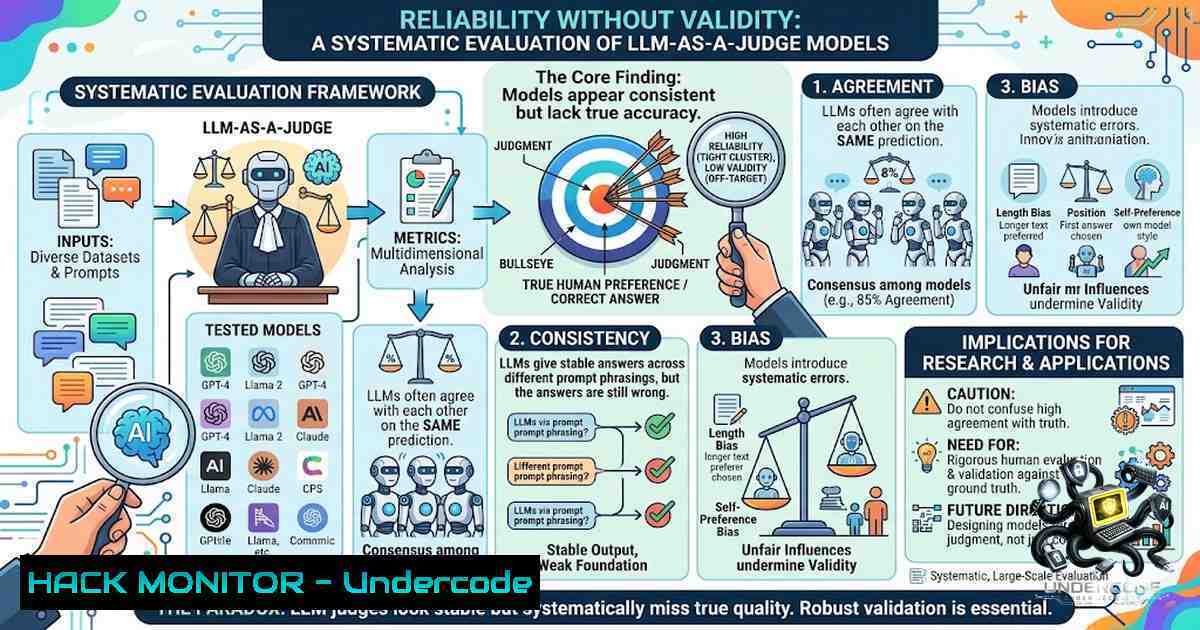
The widespread adoption of LLM-as-a-Judge has transformed how AI systems are evaluated, yet the validation practices behind these judges remain dangerously shallow. A landmark study by Norman, Rivera, and Hughes audited 21 LLM judges across 9 providers, 3 benchmarks, and 3 protocols—generating approximately 541,000 individual judgments. Their central finding cuts through the noise: reliability is not validity. A judge that produces consistent outputs can still be systematically biased, and raw exact-match agreement—the industry’s default metric—systematically overstates a judge’s true discriminative ability. This article unpacks the study’s methodology, exposes the consistency-bias paradox, and provides a practical validation protocol for production-grade LLM judge deployment.
Learning Objectives & Secrets:
- Objective 1: Understand why exact-match agreement is a misleading headline metric for LLM judge validation and how chance-corrected metrics like Cohen’s kappa reveal the true agreement signal.
-
Objective 2 (Secret Tip): A judge with near-perfect test-retest reliability (e.g., Qwen 3 8B at 0.992) can simultaneously exhibit severe position bias (0.192)—the consistency-bias paradox means stability alone is a false safety signal.
-
Objective 3 (Secret Tip): Judge rankings shift by up to 14 positions across different benchmarks—never select a production judge based on a single public benchmark score without target-domain validation.
You Should Know:
- The Kappa Deflation: Why 85% Agreement Is Not What It Seems
The study’s most striking finding is the universal kappa deflation across all 21 judges. On MT-Bench, the gap between exact-match agreement and Cohen’s kappa ranged from 33.8 to 41.2 percentage points for every single judge evaluated. A judge reporting 85% raw agreement may have a chance-corrected κ of approximately 0.48—meaning its actual discriminative ability is barely moderate.
Why This Happens: Exact match does not correct for chance agreement. When benchmark label distributions are skewed (e.g., one answer choice appears 80% of the time), a judge that simply predicts the majority class can achieve high raw agreement without meaningful discrimination. The deflation varies by benchmark: cohort-mean deflation reaches 38.6 percentage points on MT-Bench, 23.7 on JudgeBench, and 10.2 on RewardBench.
Step‑by‑Step Guide – Computing Cohen’s Kappa for Your Judge:
- Collect paired judgments: Run your LLM judge on N benchmark items with known human labels. Record each verdict (ŷᵢ) alongside the ground truth (yᵢ).
-
Build the confusion matrix: Count observed agreements (both say “A,” both say “B”) and disagreements.
-
Calculate observed agreement (Pₒ): Pₒ = (agreements) / N.
-
Calculate expected agreement (Pₑ): For each class, multiply the proportion of human labels by the proportion of judge verdicts, then sum across classes. Pₑ = Σ (P_human
× P_judge[bash]).</p></li> <li><p>Compute Cohen's kappa: κ = (Pₒ − Pₑ) / (1 − Pₑ).</p></li> <li><p>Report both metrics: Present exact match for readability but use κ as your headline reliability number.</p></li> </ol> <h2 style="color: yellow;">Python Implementation:</h2> <p>[bash] from sklearn.metrics import cohen_kappa_score import numpy as np y_true: human labels, y_pred: judge verdicts kappa = cohen_kappa_score(y_true, y_pred) print(f"Cohen's kappa: {kappa:.3f}") Exact match exact_match = np.mean(np.array(y_true) == np.array(y_pred)) print(f"Exact match: {exact_match:.3f}") print(f"Kappa deflation: {exact_match - kappa:.3f}")- The Consistency-Bias Paradox: When Stability Masks Systematic Error
Perhaps the most counterintuitive discovery is that high test-retest reliability and severe position bias can coexist. Qwen 3 8B achieved a test-retest reliability of 0.992—nearly perfect stability—yet its position bias measured 0.192, meaning it favored the first-position response nearly 20% more often than chance. Gemini 2.5 Flash showed similar behavior: 0.988 test-retest with 0.125 position bias.
Why This Matters: In production, a “consistent but biased” judge is more dangerous than a noisy one. Stable outputs inspire trust, making systematic biases harder to detect. The judge isn’t randomly wrong—it’s deterministically wrong in a predictable direction, silently skewing every evaluation.
Step‑by‑Step Guide – Auditing Position Bias:
- Create paired items: For each evaluation item, generate two versions: one with response A first and B second (AB), another with B first and A second (BA).
-
Run both versions: Pass both AB and BA through your judge independently.
-
Compute position bias: PB = |P(A wins in AB) − 0.5|. A PB of 0 means no position preference; PB = 0.5 means complete first-position bias.
-
Calculate flip rate: The proportion of items where the judge changes its verdict when positions are swapped.
-
Report both metrics: Position bias reveals systematic preference; flip rate reveals instability under perturbation.
Example Command for Batch Evaluation (Pseudocode):
 Generate swapped pairs
for item in benchmark:
generate_ab(item)  Response A first
generate_ba(item)  Response B first

Run judge on both
python run_judge.py --input ab_items.jsonl --output ab_results.jsonl
python run_judge.py --input ba_items.jsonl --output ba_results.jsonl

Compute bias
python audit_position_bias.py --ab ab_results.jsonl --ba ba_results.jsonl
- Cross-Benchmark Rank Instability: Your Leaderboard Is a Trap
Judge rankings are not portable. The study found that a judge’s rank can shift by up to 14 positions depending on which benchmark is used for evaluation. A model that tops MT-Bench may underperform on JudgeBench or RewardBench. This instability stems from differences in label distribution, task difficulty, and rubric structure across benchmarks.
The Deployment Lesson: Do not select a production judge based on a single public leaderboard. If your evaluation uses a custom rubric, you must validate the judge directly on that rubric with target-domain examples.
Step‑by‑Step Guide – Cross-Benchmark Validation:
- Select candidate judges: Include both frontier models (large, expensive) and cost-conscious alternatives.
-
Run all candidates across multiple benchmarks: At minimum, test on MT-Bench, JudgeBench, and RewardBench.
-
Compute rank per benchmark: Rank judges by Cohen’s kappa (not exact match) within each benchmark.
-
Measure rank instability: Calculate the standard deviation or range of each judge’s rank across benchmarks.
-
Validate on your target rubric: Create a small held-out set of 50–100 examples with human labels from your actual use case. Compute κ on this set and use it as your primary selection criterion.
4. The Minimum Viable Validation Protocol (MVVP)
The authors propose a lightweight yet rigorous validation framework that every team using LLM-as-a-Judge should adopt. MVVP consists of three core checks:
| Check | Implementation | Why It Matters |
|-|-|-|
| Chance Correction | Report Cohen’s κ or Krippendorff’s α alongside exact match | Prevents overestimation of judge quality |
| Position Invariance | Run AB/BA swapped pairs; report PB and flip rate | Detects order-based systematic bias |
| Repeated Runs | Disable caching; run 3+ independent evaluations at temperature 0 | Measures test-retest reliability |Step‑by‑Step Guide – Implementing MVVP in Your Pipeline:
- Log raw verdicts, not just aggregates: Store every individual judgment with item ID, model version, temperature, and position order.
-
Use paired AB/BA item IDs: Ensure every evaluation item has a corresponding swapped version for bias auditing.
-
Disable caching for retest: API caching or local response caching will artificially inflate reliability—force fresh inference for each run.
-
Set κ as your primary metric: Present exact match in footnotes or appendices, but make chance-corrected agreement the headline number.
-
Report uncertainty: Include bootstrap confidence intervals for κ and position bias.
-
Production Deployment: When to Trust an LLM Judge (and When Not To)
The study does not argue for abandoning LLM-as-a-Judge. Instead, it calls for treating judges as measurement instruments that require systematic validation. Low-stakes applications—triage, regression signal detection, human review prioritization, data cleaning, and qualitative feedback generation—can safely use LLM judges even with imperfect validation.
For high-stakes decisions—model training data filtering, RL reward modeling, production eval dashboards, or any decision that affects downstream systems—the bar must be higher. In these contexts:
- Use multi-judge ensembles with diverse model families
- Perform repeated runs (3+ per item)
- Always include position-swapped pairs
- Conduct human spot-checking on a regular cadence
What Undercode Say:
- Key Takeaway 1: Exact-match agreement is a dangerously misleading metric for LLM judge validation. The 33–41 percentage point kappa deflation on MT-Bench demonstrates that raw agreement systematically overstates discriminative ability. Teams reporting only exact match are unknowingly inflating their judge’s perceived quality.
-
Key Takeaway 2: The consistency-bias paradox—where highly reliable judges exhibit severe position bias—reveals that stability is not a proxy for validity. A judge that never changes its mind can still be systematically wrong. Production pipelines must audit for bias separately from reliability.
The paper’s core contribution is reframing LLM judge validation as measurement system validation rather than benchmark chasing. The MVVP—chance correction, position swap, and repeated runs—is remarkably lightweight yet catches the most critical failure modes. For teams already running evaluation pipelines, adding AB/BA swaps and κ calculations is low-cost and high-impact. The uncomfortable truth is that many current LLM judge deployments are operating on unvalidated instruments, silently biasing the very decisions they’re meant to inform. This study provides the diagnostic tools to fix that—but only if teams choose to use them.
Prediction:
- +1 The MVVP framework will become the industry standard for LLM judge validation within 12–18 months, driven by both academic pressure and production failures from unvalidated judges.
-
+1 Benchmark providers will begin reporting Cohen’s kappa alongside exact match by default, and leaderboards will incorporate chance-corrected metrics to prevent misleading comparisons.
-
-1 Many production systems currently relying on single-judge, single-run evaluations with exact-match reporting will discover hidden biases only after they’ve already corrupted downstream training data or product decisions.
-
-1 The consistency-bias paradox will cause well-intentioned teams to overtrust highly stable judges, leading to systematic but invisible evaluation drift that compounds over time.
-
+1 Open-source tooling for judge validation—including automated κ computation, position bias auditing, and MVVP checklists—will proliferate, lowering the barrier to proper validation.
-
-1 Teams that continue using exact match as their primary validation metric will face increasing scrutiny from reviewers, auditors, and regulators as awareness of kappa deflation spreads.
-
+1 The distinction between reliability and validity will enter the mainstream AI engineering lexicon, fundamentally changing how teams think about evaluation infrastructure.
-
-1 Frontier model providers will face pressure to disclose position bias and other failure modes for their judge-optimized models, potentially complicating marketing narratives around “best” evaluators.
-
+1 Multi-judge ensembles with explicit bias auditing will become the default for high-stakes evaluation, replacing the prevailing single-judge paradigm.
-
+1 The study’s emphasis on target-domain validation will accelerate the shift from generic leaderboard chasing to task-specific judge selection, improving real-world evaluation quality.
▶️ Related Video (78% Match):
https://www.youtube.com/watch?v=3gRqNdC0XjY
🎯Let’s Practice For Free:
🎓 Live Courses & Certifications:
Join Undercode Academy for Verified Certifications
🚀 Request a Custom Project:
Secure, high-velocity infrastructure and disruptive technological engineering. Contact our engineering team for high-tier development and proprietary systems:
[email protected]
💎 Smart Architecture | 🛡️ Secure by Design | ⭐ Trusted by ThousandsIT/Security Reporter URL:
Reported By: https://lnkd.in/p/e9bzxsu8 – Hackers Feeds
Extra Hub: Undercode MoN
Basic Verification: Pass ✅🔐JOIN OUR CYBER WORLD [ CVE News • HackMonitor • UndercodeNews ]
📢 Follow UndercodeTesting & Stay Tuned:


