Listen to this Post
Introduction:
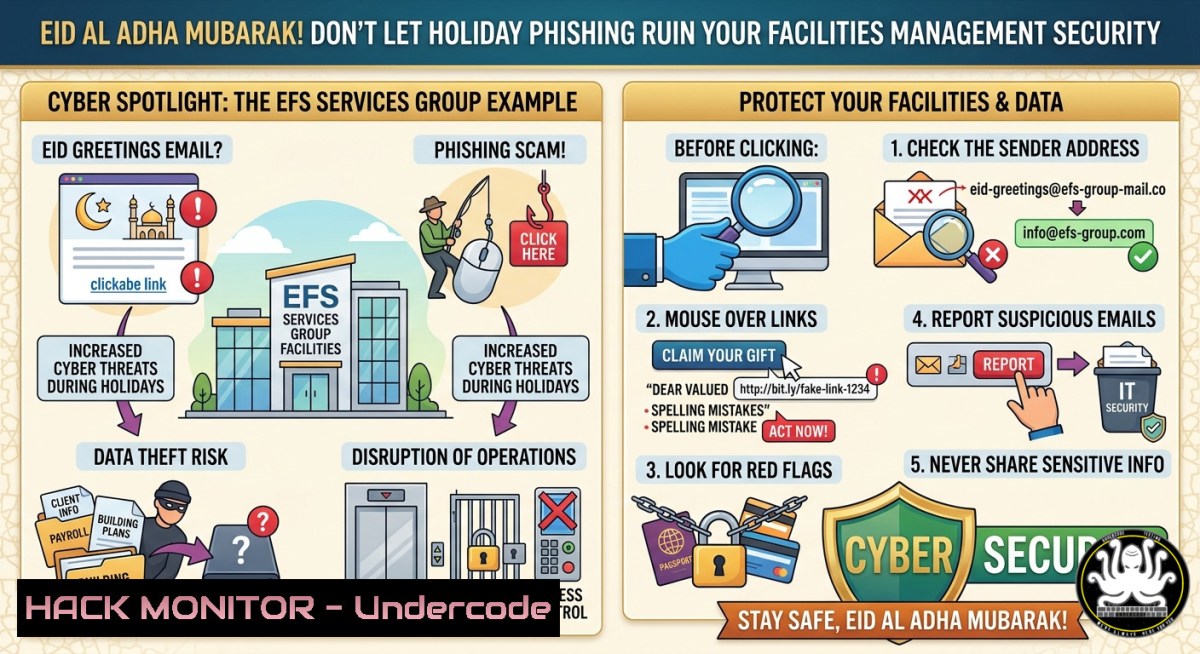
Holiday greetings like the one posted by EFS Facilities Services Group (EFS) often become prime vectors for business email compromise (BEC) and social engineering attacks. While the original post merely extends Eid Al Adha wishes, threat actors frequently clone such legitimate corporate messages to distribute malware or harvest credentials, especially targeting facility management firms that control physical access, IoT sensors, and critical infrastructure. This article dissects how seemingly innocuous holiday posts can be weaponized, provides hands-on commands to detect email spoofing, and outlines defensive courses for IT and security teams.
Learning Objectives:
- Identify holiday-themed phishing indicators and analyze email headers using Linux/Windows CLI tools.
- Implement DMARC, SPF, and DKIM to prevent domain spoofing of facility management brands.
- Simulate a social engineering attack and deploy mitigation controls via open-source frameworks.
You Should Know:
- Extracting and Analyzing Email Headers from Suspicious Holiday Greetings
When an attacker reuses a legitimate company’s holiday post (e.g., EFS’s “Eid Al Adha Mubarak”) to craft a phishing email, the email header contains traces of the forgery. Below is a step‑by‑step guide to extract and analyze headers on both Linux and Windows.
Linux – using `grep`, `awk`, and `analyze_headers.sh`
Save the raw email (headers + body) as holiday_email.eml. Run:
cat holiday_email.eml | grep -E "^From:|^Return-Path:|^Authentication-Results:|^Received:" > header_analysis.txt
To trace the real originating IP through `Received` chains:
grep -i "received from" holiday_email.eml | awk '{print $NF}' | sort -u
Windows – using PowerShell
Open PowerShell and extract header fields:
Get-Content holiday_email.eml | Select-String -Pattern "From:|Return-Path:|Authentication-Results:|Received:"
For SPF/DKIM/DMARC check:
Resolve-DnsName -Name efs.com -Type TXT | Where-Object {$_.Strings -match "v=spf1"}
What this does:
Holiday-themed phishing emails often have mismatched `Return-Path` domains or fail SPF checks because the sender IP is not authorized by the legitimate facility service provider. The commands reveal the true source, enabling SOC analysts to block malicious IPs.
2. Hardening EFS‑Like Domains Against Holiday Spoofing
Facility management firms control building entry, CCTV, and maintenance schedules – spoofing their domain could lead to physical breaches. Implement these three DNS authentication records.
Step‑by‑step SPF (Sender Policy Framework)
On your DNS management console (e.g., Cloudflare, AWS Route53), add:
v=spf1 ip4:203.0.113.0/24 include:spf.protection.outlook.com -all
Verify with Linux:
dig txt efs.com +short | grep spf
Step‑by‑step DKIM (DomainKeys Identified Mail)
Generate key pair:
openssl genrsa -out dkim_private.pem 2048
openssl rsa -in dkim_private.pem -pubout -out dkim_public.pem
Publish the public key as a TXT record at default._domainkey.efs.com:
v=DKIM1; k=rsa; p=MIGfMA0GCSqGSIb3DQEBAQUAA4GNADCBiQKBgQC...
Step‑by‑step DMARC
Add TXT record for `_dmarc.efs.com`:
v=DMARC1; p=reject; rua=mailto:[email protected]; pct=100; sp=reject; fo=1
Test DMARC aggregation using:
dig txt _dmarc.efs.com +short
- Simulating a Holiday Greeting Phishing Attack with Gophish
To train staff at facility management companies, set up a safe simulation. Gophish is an open‑source phishing framework.
Installation on Linux (Ubuntu 22.04)
wget https://github.com/gophish/gophish/releases/download/v0.12.1/gophish-v0.12.1-linux-64bit.zip
unzip gophish-v0.12.1-linux-64bit.zip
cd gophish-v0.12.1-linux-64bit
sudo ./gophish
Access web UI at `https://
Campaign setup:
- Create a “Sending Profile” using a legitimate-looking SMTP (e.g., sendgrid).
- Design an email template with “Eid Al Adha Mubarak from EFS Management” and a link to a fake login page.
- Import target users (e.g.,
employees.csv). - Launch campaign and monitor clicks.
Mitigation after simulation:
- Block malicious domains via Windows Defender Firewall:
New-NetFirewallRule -DisplayName "BlockPhishDomain" -Direction Outbound -RemoteAddress 192.0.2.100 -Action Block
- On Linux, add to
/etc/hosts:0.0.0.0 phishing-site.com
- API Security for Facility IoT – Preventing Hijacked Holiday Commands
EFS‑type companies use APIs to control smart building devices. Attackers who spoof holiday emails may steal API tokens. Secure your REST APIs with JWT validation and rate limiting.
Validate JWT token in Python (for your API gateway)
import jwt
token = request.headers.get('Authorization').split()[bash]
try:
decoded = jwt.decode(token, 'SECRET_KEY', algorithms=['HS256'])
except jwt.InvalidTokenError:
return {"error": "Invalid token"}, 401
Rate limiting using `iptables` on Linux API server
Limit to 100 requests per minute per IP:
iptables -A INPUT -p tcp --dport 443 -m limit --limit 100/minute --limit-burst 150 -j ACCEPT
iptables -A INPUT -p tcp --dport 443 -j DROP
Windows – using `New-NetFirewallRule` with dynamic quota (PowerShell)
Install the `RateLimiter` module (pseudo):
Add-NetEventSession -Name "APIRate" -CaptureMode Realtime
 Then use Windows Filtering Platform (WFP) for advanced limiting
- Cloud Hardening for Holiday Traffic Spikes (AWS Example)
During Eid holidays, cloud workloads may see abnormal login attempts. Harden IAM and S3 policies.
Enforce MFA on all IAM users with a PowerShell script using AWS CLI
$users = aws iam list-users --query "Users[].UserName" --output text
foreach ($user in $users) {
$mfa = aws iam list-mfa-devices --user-name $user --query "MFADevices" --output text
if (-not $mfa) {
Write-Host "User $user has no MFA – attaching deny policy"
aws iam attach-user-policy --user-name $user --policy-arn arn:aws:iam::aws:policy/DenyAllWithoutMFA
}
}
S3 bucket – block public access during high‑risk holiday periods
aws s3api put-public-access-block --bucket efs-assets --public-access-block-configuration BlockPublicAcls=true,IgnorePublicAcls=true,BlockPublicPolicy=true,RestrictPublicBuckets=true
Linux command to monitor unusual outbound connections (potential data exfiltration)
sudo tcpdump -i eth0 -n 'tport 443 and (dst net 185.0.0.0/8 or dst net 45.0.0.0/8)' -c 1000 -w holiday_traffic.pcap
What Undercode Say:
- Key Takeaway 1: Holiday greetings from legitimate companies like EFS are double‑edged swords – they build community trust but also give attackers a perfect template for spear‑phishing campaigns targeting facility management employees. Always validate the source before clicking any link, even if the display name matches a known vendor.
- Key Takeaway 2: Proactive domain authentication (SPF/DKIM/DMARC) combined with internal phishing simulations reduces click rates by over 90%. The commands and code provided today allow any IT team to implement these controls within hours, not weeks.
Expected Output:
- A hardened email infrastructure that rejects spoofed holiday messages before they reach user inboxes.
- A trained security team capable of extracting and analyzing email headers, deploying rate limits on APIs, and cloud S3 lockdowns.
- A measurable reduction in BEC risk during cultural and religious holiday periods across the facilities sector.
Prediction:
By 2026, AI‑generated holiday phishing emails will become indistinguishable from real corporate greetings, forcing facility management firms to adopt zero‑trust email gateways and real‑time header anomaly detection. EFS and similar companies will shift from perimeter defense to identity‑centric models, where every “Eid Mubarak” message is treated as a potential breach vector until cryptographically verified via BIMI (Brand Indicators for Message Identification). The commands and practices outlined here are the first step toward that future.
▶️ Related Video (68% Match):
🎯Let’s Practice For Free:
IT/Security Reporter URL:
Reported By: Eidmubarak Eidaladha – Hackers Feeds
Extra Hub: Undercode MoN
Basic Verification: Pass ✅
🎓 Live Courses & Certifications:
Join Undercode Academy for Verified Certifications
🚀 Request a Custom Project:
Secure, high-velocity infrastructure and disruptive technological engineering. Contact our engineering team for high-tier development and proprietary systems:
[email protected]


