Listen to this Post
Introduction:
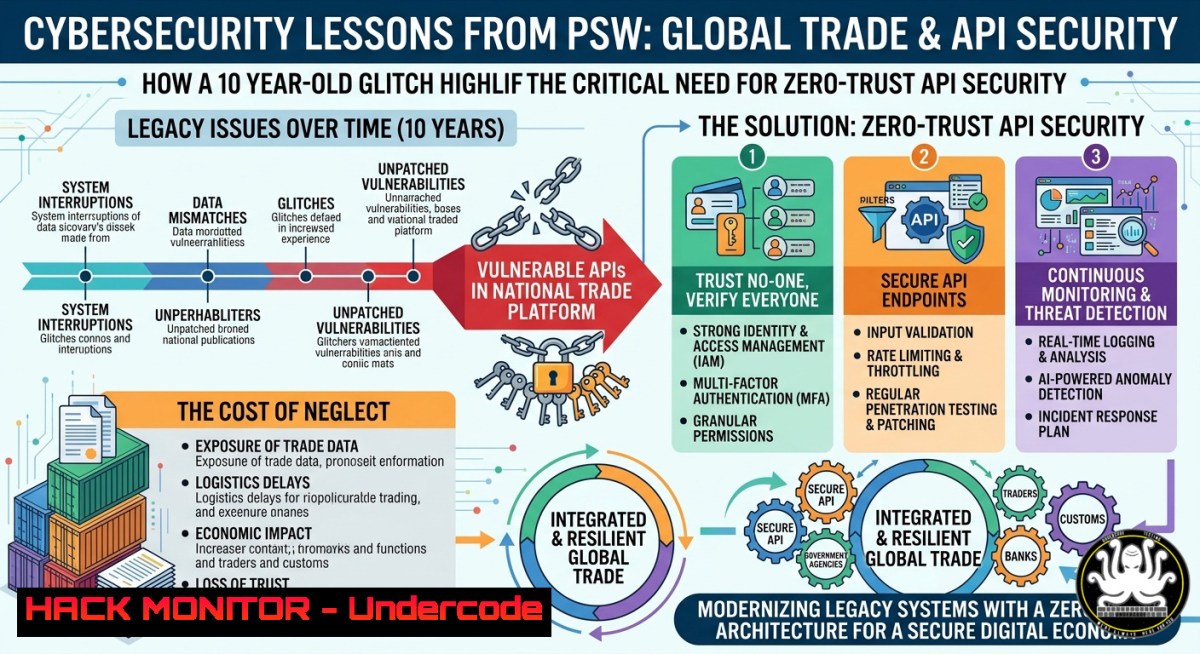
Pakistan Single Window (PSW) centralizes over 15 government agencies and thousands of traders onto one digital cross-border trade platform. However, the platform’s cybersecurity has come under intense scrutiny after a technical flaw allowed the tampering of over 10,000 import declarations for nearly a decade. Consequently, this case underscores the urgent need for Zero-Trust API security to protect national trade infrastructure and illustrates the devastating impact of hidden back-end flaws.
Learning Objectives:
- Analyze the technical architecture of National Single Window systems and their inherent API vulnerabilities.
- Identify critical attack vectors, including browser‑side data manipulation and insecure authentication tokens.
- Implement practical system hardening commands and security controls for Linux and Windows environments.
You Should Know:
- The Anatomy of the WeBOC Vulnerability: Browser‑Based Data Manipulation
Step‑by‑step guide explaining what this does and how to use it.
The PSW vulnerability was not a complex hack but a flaw in application‑layer validation. The Web-Based One Customs (WeBOC) system failed to revalidate edited data on the server side. This allowed malicious users to alter declared quantities and product descriptions through simple browser‑side scripts, bypassing all back‑end checks. Understanding how this works is key to mitigating similar API weaknesses.
This flaw mimics the OWASP API Top 10 category “Mass Assignment” (API3:2019) and “Improper Input Validation” (API5:2023). Attackers can use browser developer tools to intercept, modify, and replay legitimate requests. For example, changing a request’s payload for “quantity=10” to “quantity=1” before it reaches the backend database. When building secure applications, developers can emulate this manipulation using a simple cURL command to identify weak points:
 Simulate a request with manipulated data to test if an API endpoint validates input
curl -X POST https://api.target-system.com/v1/import-declaration \
-H "Content-Type: application/json" \
-H "Authorization: Bearer [valid-token]" \
-d '{"gd_id": "12345", "declared_quantity": "999999", "hs_code": "unchanged"}' \
-v
If the system accepts the payload without checking it against the original declaration or business rules, it is vulnerable. To mitigate this, implement strong server‑side validation and use parameterized queries for database operations. Following the Zero‑Trust principle of “never trust, always verify” at every layer stops this simple yet dangerous exploit.
- API Gateway Security and Authentication for Critical Platforms
Step‑by‑step guide explaining what this does and how to use it.
The PSW’s new Port Community System (PCS) centralizes maritime trade operations via an API‑driven platform. This convergence creates a critical vulnerability: a single weak API gateway could cripple national trade. Attackers often target API authentication to steal tokens, escalate privileges, or replay credentials. The recent advice for PSW emphasizes mitigating token theft through robust security practices. You can implement similar controls to fortify your organization’s API infrastructure.
Security professionals should follow a multi‑phase strategy to secure API gateways. First, enforce mutual authentication such as OAuth 2.0 or client certificates. Second, deploy an API gateway to enforce rate limiting, input validation, and access control for all API traffic. The commands below demonstrate how to set up a basic rate limit and input validation policy for an API gateway. This example assumes a gateway configuration file (e.g., for NGINX or an Envoy proxy) and can be applied after installation.
 Sample NGINX configuration for rate limiting and input validation
 Add these directives to your nginx.conf inside the HTTP block

Define a zone for rate limiting
limit_req_zone $binary_remote_addr zone=api_limit:10m rate=100r/s;

Apply input validation and rate limit to the API location
location /v1/ {
 Check for specific request headers (example: HMAC signature)
if ($http_authorization !~ "^Bearer [a-zA-Z0-9]+$") {
return 401;
}

Apply rate limiting
limit_req zone=api_limit burst=200 nodelay;

Forward to upstream API
proxy_pass http://backend_api;
}
After modifying the configuration, always test it with `nginx -t` and reload with systemctl reload nginx. This strategy ensures a “defense in depth” posture, securing the API entry point against brute‑force, DoS, and request manipulation.
3. Linux Privilege Management to Prevent Internal Lapses
Step‑by‑step guide explaining what this does and how to use it.
The recent scams at PSW were not just external attacks; they also involved the misuse of internal user codes. This highlights that even a secure API cannot protect against compromised credentials. Therefore, enforcing least privilege on Linux systems is a vital mitigation. Attackers who gain initial access through stolen credentials (or malicious insiders) will immediately attempt to escalate privileges to gain more control. The following commands, when used as part of a regular audit, can detect and prevent such threats.
The principle of least privilege is a core tenet of Zero‑Trust Architecture (ZTA). System administrators can implement it on Linux by creating dedicated service accounts with locked shells and then granting them only the specific commands they require.
 Step 1: Create a service account with a locked password and no home directory
sudo useradd -M -s /sbin/nologin web_service_user

Step 2: Edit the sudoers file to grant specific command access
sudo visudo -f /etc/sudoers.d/99-web_service_user
 Add the following line to allow the web_service_user to restart nginx only:
web_service_user ALL=(ALL) NOPASSWD: /usr/bin/systemctl restart nginx

Step 3: List and audit sudo privileges for the current user to check for anomalies
sudo -l

Step 4: Find all world-writable files, which are a common privilege escalation vector
find / -type f -perm /o=w -ls 2>/dev/null > /tmp/world_writable_files.txt
By implementing these commands, you drastically reduce the attack surface. The `find` command identifies files that any user can write to, which an attacker could use to plant malicious code. Using `visudo` to manage specific permissions ensures a service account cannot execute arbitrary commands. Regularly review the `/tmp/world_writable_files.txt` output and adjust file permissions, as shown in the Zero‑Trust hardening guides.
4. Hardening Windows Authentication Against Pass‑the‑Hash
Step‑by‑step guide explaining what this does and how to use it.
Windows servers and workstations are often present in complex environments like customs agencies. Attackers frequently target outdated Windows authentication protocols, such as NTLM, to move laterally across a network without ever cracking a password. This technique, known as pass‑the‑hash, is a direct threat to the kind of sensitive data handled by PSW and similar organizations. You can use the following PowerShell commands (as Administrator) to apply security hardening, directly derived from Zero‑Trust hardening principles.
These commands modify the Windows Registry and audit policies to significantly reduce the risk of lateral movement and credential theft. Run them as part of a standard security baseline.
 Step 1: Restrict NTLM usage to mitigate pass‑the‑hash attacks
Set-ItemProperty -Path "HKLM:\SYSTEM\CurrentControlSet\Control\Lsa" -Name "RestrictNTLMInDomain" -Value 1

Step 2: Disable LM hash storage to prevent weak password hash storage
Set-ItemProperty -Path "HKLM:\SYSTEM\CurrentControlSet\Control\Lsa" -Name "NoLMHash" -Value 1

Step 3: Enable detailed auditing for all logon attempts
auditpol /set /subcategory:"Logon" /success:enable /failure:enable

Step 4: Enumerate all active firewall rules for review
Get-NetFirewallRule | Where-Object {$_.Enabled -eq "True"} | Select-Object Name,DisplayName,Direction,Action
After applying these settings, a reboot is not usually required, but the changes take effect immediately for new logons. It is also essential to monitor Security Event ID 4625 (failed logons) and 4672 (special privilege use) to detect ongoing attacks, as highlighted in hardening checklists. This proactive configuration directly addresses the insider threats and credential misuse observed in recent incidents.
What Undercode Say:
- Key Takeaway 1: The PSW data manipulation demonstrates that a single missing back‑end validation can undermine the integrity of an entire national trade system for a decade.
- Key Takeaway 2: Centralizing critical operations onto API‑driven platforms without implementing Zero‑Trust security for authentication and gateway controls creates a concentrated, high‑value target for adversaries.
The case of PSW is not an isolated incident; it is a clear warning to all organizations undertaking digital transformation. The vulnerability exploited was not a zero-day but a fundamental application logic flaw that passed through governance processes for years. Moreover, the transition to a new Port Community System (PCS) risks replicating these mistakes if security, particularly around API gateways and token management, is not treated as a primary architectural requirement from day one. The involvement of multiple government agencies and private partners also introduces a complex supply chain risk, where a compromise at any one point could cascade through the entire trade ecosystem. Organizations must internalize that after an incident, the focus is not on assigning blame but on building resilient, testable, and continuously monitored systems, as highlighted by the PSW CEO’s admission that WeBOC had not undergone a technical audit for several years.
Prediction:
Within the next five years, the increasing integration of IoT sensors, AI‑driven predictive analytics, and blockchain technologies into National Single Window platforms will expand the attack surface beyond traditional APIs to include edge devices and smart contracts. Consequently, nation‑state actors and sophisticated cybercriminal groups will shift focus from simple data tampering to disrupting physical trade flows by targeting these newly integrated systems, such as port scanners or automated gate systems. The most successful security teams will shift from compliance‑based audits to continuous adversarial emulation, actively attempting to “break” their own systems using the same flawed validation logic and token theft techniques discovered at PSW.
▶️ Related Video (66% Match):
🎯Let’s Practice For Free:
IT/Security Reporter URL:
Reported By: Eidmubarak Eiduladha2026 – Hackers Feeds
Extra Hub: Undercode MoN
Basic Verification: Pass ✅
🎓 Live Courses & Certifications:
Join Undercode Academy for Verified Certifications
🚀 Request a Custom Project:
Secure, high-velocity infrastructure and disruptive technological engineering. Contact our engineering team for high-tier development and proprietary systems:
[email protected]


