Listen to this Post
Introduction
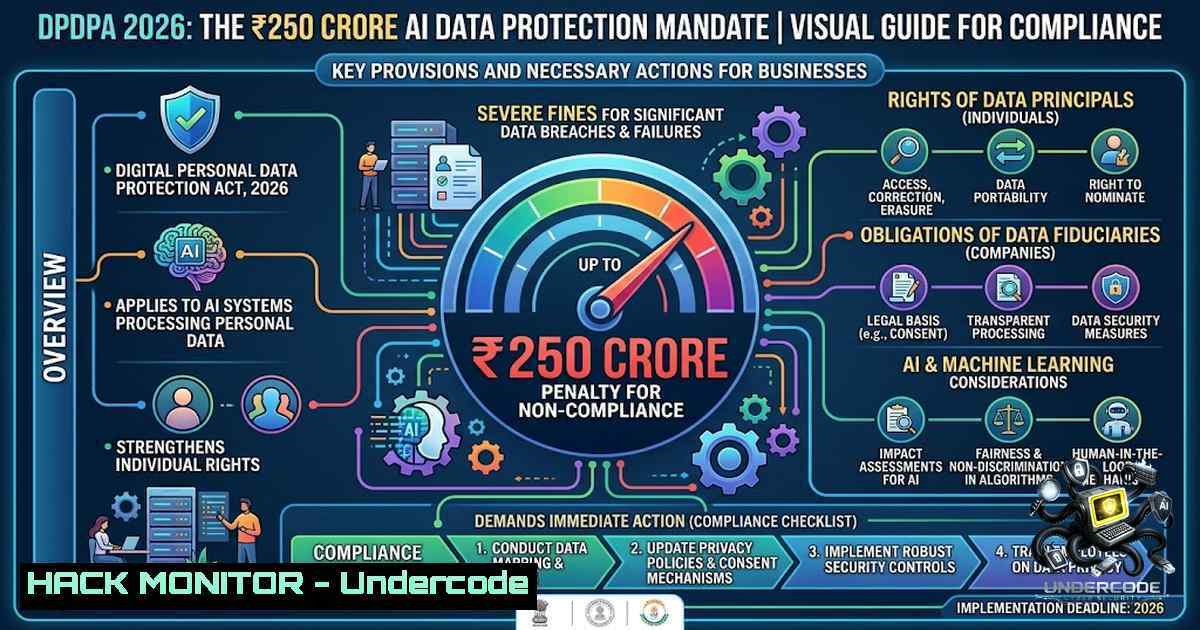
India’s Digital Personal Data Protection Act (DPDPA) 2023, operationalized through the Digital Personal Data Protection Rules 2025, establishes the nation’s first comprehensive data protection framework—and it carries unprecedented penalties of up to ₹250 crore per contravention. For organizations deploying artificial intelligence systems that process personal data of Indian residents, DPDPA compliance is not optional; it is the legal baseline for AI operations. With full enforcement beginning May 13, 2027, and consent manager provisions effective November 13, 2026, the compliance clock is ticking.
Learning Objectives
- Understand the extraterritorial scope and core obligations of the DPDPA framework
- Master technical implementation of consent management, breach notification, and security safeguards
- Identify AI-specific data protection risks and deploy mitigation strategies across Linux and Windows environments
- Understanding the DPDPA: Scope, Obligations, and the AI Connection
The DPDPA applies to any Data Fiduciary—an entity that determines the purpose and means of processing digital personal data—operating within India or offering goods/services to individuals in India. This extraterritorial reach means foreign companies with Indian customers, employees, or users fall squarely within its scope, regardless of server location.
Core obligations include:
- Consent as Primary Legal Basis: Data Fiduciaries must obtain explicit, informed consent before processing personal data, with limited exceptions for “certain legitimate uses”
- Privacy Notices: Must be published in English and all languages listed in the Eighth Schedule of the Indian Constitution
- Data Breach Notification: Mandatory reporting to the Data Protection Board and affected Data Principals within 72 hours
- Reasonable Security Safeguards: Technical and organizational measures to protect personal data
- Data Protection Officer: Appointment required for Significant Data Fiduciaries (SDFs)
What This Means for AI Systems
Any AI system processing personal data of Indian residents triggers DPDPA obligations. The Act does not create a standalone AI law but deliberately positions data protection as the governing framework for AI. Organizations deploying generative AI, machine learning models, or automated decision-making systems must ensure:
- Training data is collected with proper consent or falls within legitimate use exceptions
- Model outputs do not violate Data Principal rights
- AI-specific notifications are provided when personal data is used for training or fine-tuning
- The Penalty Landscape: What ₹250 Crore Really Means
The Data Protection Board of India, established November 2025, has authority to impose penalties structured by violation severity:
| Violation | Maximum Penalty |
|–|–|
| Failure to implement “Reasonable Security Safeguards” | ₹250 crore |
| Failure to notify breach to Board/users | ₹200 crore |
| Breach of SDF additional obligations | ₹150 crore |
| Non-compliance with Data Principal rights | ₹10–100 crore |
Context matters: The average cost of a data breach in India reached ₹24.23 crore in 2025. DPDPA penalties can exceed breach costs by an order of magnitude, fundamentally altering the risk calculus for AI-driven enterprises.
- Technical Implementation: Consent Management and Privacy Notice Systems
Linux Implementation: Consent Management API
 Install consent management dependencies
sudo apt-get update
sudo apt-get install -y python3-pip nginx postgresql

Create consent database
sudo -u postgres psql -c "CREATE DATABASE consent_manager;"
sudo -u postgres psql -c "CREATE USER consent_user WITH PASSWORD 'SecurePassword2026';"
sudo -u postgres psql -c "GRANT ALL PRIVILEGES ON DATABASE consent_manager TO consent_user;"

Deploy consent API (Flask example)
cat > /opt/consent_api/app.py << 'EOF'
from flask import Flask, request, jsonify
import hashlib
import datetime
import json

app = Flask(<strong>name</strong>)

Consent record structure per DPDPA Section 6
def record_consent(user_id, purpose, data_elements, consent_given):
consent_id = hashlib.sha256(f"{user_id}{datetime.datetime.now().isoformat()}".encode()).hexdigest()
record = {
"consent_id": consent_id,
"user_id": user_id,
"purpose": purpose,
"data_elements": data_elements,
"consent_given": consent_given,
"timestamp": datetime.datetime.now().isoformat(),
"withdrawal_status": "active"
}
 Store in PostgreSQL
return record

@app.route('/consent/record', methods=['POST'])
def record():
data = request.json
 Validate required fields per DPDPA Rules
required = ['user_id', 'purpose', 'data_elements', 'consent_given']
if not all(k in data for k in required):
return jsonify({"error": "Missing required fields"}), 400
record = record_consent(data)
return jsonify(record), 201

if <strong>name</strong> == '<strong>main</strong>':
app.run(host='0.0.0.0', port=5000)
EOF

Start the service
cd /opt/consent_api && python3 app.py &
Windows Implementation: PowerShell Consent Audit Script
 Consent audit logging per DPDPA Section 5 privacy notice requirements
$LogPath = "C:\DPDPA_Logs\consent_audit.csv"
$ConsentRecord = @{
"Timestamp" = (Get-Date -Format "yyyy-MM-dd HH:mm:ss")
"UserID" = $env:USERNAME
"ConsentPurpose" = "AI_Model_Training"
"DataCategories" = "Email,UsagePatterns,Preferences"
"ConsentStatus" = "Granted"
"PrivacyNoticeVersion" = "v2.1_2026"
"WithdrawalAvailable" = $true
}

Append to audit log
$ConsentRecord | Export-Csv -Path $LogPath -1oTypeInformation -Append

Generate privacy notice (required in English + Eighth Schedule languages)
$PrivacyNotice = @"
PRIVACY NOTICE - Digital Personal Data Protection Act 2023
[bash] Your personal data is collected for AI model training purposes.
[bash] आपका व्यक्तिगत डेटा AI मॉडल प्रशिक्षण के लिए एकत्र किया जाता है।
[bash] உங்கள் தனிப்பட்ட தரவு AI மாதிரி பயிற்சிக்காக சேகரிக்கப்படுகிறது.
"@
$PrivacyNotice | Out-File -FilePath "C:\DPDPA_Logs\privacy_notice_$(Get-Date -Format 'yyyyMMdd').txt"
4. 72-Hour Breach Notification: Implementation and Automation
Under DPDPA Section 8(6), Data Fiduciaries must intimate breaches to the Data Protection Board and affected Data Principals within 72 hours of becoming aware.
Linux: Automated Breach Detection and Notification
!/bin/bash
 /opt/dpdpa/breach_detector.sh
 Monitors system logs for potential breaches and triggers notification

LOG_FILE="/var/log/dpdpa_breach.log"
ALERT_THRESHOLD=5  Number of failed access attempts before alert

Monitor failed authentication attempts
FAILED_ATTEMPTS=$(grep "Failed password" /var/log/auth.log | wc -l)

if [ $FAILED_ATTEMPTS -gt $ALERT_THRESHOLD ]; then
TIMESTAMP=$(date -Iseconds)
BREACH_ID=$(uuidgen)

Create breach report per DPDPA requirements
cat > /tmp/breach_report_${BREACH_ID}.json << EOF
{
"breach_id": "$BREACH_ID",
"timestamp": "$TIMESTAMP",
"type": "Unauthorized_Access_Attempt",
"affected_systems": ["$(hostname)"],
"data_categories": ["User_Authentication_Records"],
"affected_principals_estimate": $(grep -c "Failed password" /var/log/auth.log),
"mitigation_status": "In_Progress",
"notification_status": "Pending"
}
EOF

Send notification to Data Protection Board (API endpoint simulation)
curl -X POST https://api.dataprotectionboard.gov.in/breach/notify \
-H "Content-Type: application/json" \
-d @/tmp/breach_report_${BREACH_ID}.json \
--connect-timeout 10 || echo "Notification failed - manual escalation required" >> $LOG_FILE

Log breach for audit trail
echo "$TIMESTAMP - BREACH DETECTED: $BREACH_ID" >> $LOG_FILE
fi
Windows: SIEM Integration for Breach Detection
 Windows Event Log monitoring for breach detection
$EventLog = Get-WinEvent -LogName Security -MaxEvents 100 | Where-Object { $_.Id -in 4625, 4648 }
$BreachEvents = @()

foreach ($Event in $EventLog) {
$BreachEvents += [bash]@{
"Timestamp" = $Event.TimeCreated
"EventID" = $Event.Id
"Source" = $Event.ProviderName
"User" = ($Event.Properties | Where-Object { $_.Index -eq 5 }).Value
"Description" = $Event.Message
}
}

if ($BreachEvents.Count -gt 0) {
$ReportPath = "C:\DPDPA_Logs\breach_report_$(Get-Date -Format 'yyyyMMdd_HHmmss').json"
$BreachEvents | ConvertTo-Json -Depth 3 | Out-File -FilePath $ReportPath

Automated notification via SMTP
$SmtpServer = "smtp.enterprise.com"
$SmtpFrom = "[email protected]"
$SmtpTo = "[email protected]"
$Subject = "DPDPA Breach Notification - $(Get-Date -Format 'yyyy-MM-dd')"
$Body = "Breach detected. Report attached. Notification required within 72 hours per DPDPA Section 8(6)."

Send-MailMessage -SmtpServer $SmtpServer -From $SmtpFrom -To $SmtpTo -Subject $Subject -Body $Body -Attachments $ReportPath
}
- AI Data Leak Prevention: Guardrails for Generative AI
Generative AI tools present a significant DPDPA risk. Employees inadvertently leaking sensitive intellectual property or personal data into public AI tools now constitutes a breach of “reasonable security safeguards” under DPDPA Section 8(5).
Linux: DLP for AI Tool Access
 /opt/dpdpa/ai_dlp.sh
 Monitor and block sensitive data exfiltration to public AI APIs

Define sensitive patterns (PII, financial data, credentials)
PATTERNS=(
"[0-9]{10}"  Phone numbers
"[A-Z]{5}[0-9]{4}[A-Z]{1}"  PAN India
"[0-9]{12}"  Aadhaar
"sk-[a-zA-Z0-9]{32}"  API keys
"--BEGIN.PRIVATE KEY--"  Private keys
)

Monitor outbound traffic to known AI endpoints
AI_ENDPOINTS=(
"api.openai.com"
"api.anthropic.com"
"generativelanguage.googleapis.com"
)

for endpoint in "${AI_ENDPOINTS[@]}"; do
 Check for sensitive data in outbound requests
tcpdump -i eth0 -1 -A "host $endpoint and port 443" -c 100 2>/dev/null | \
while read line; do
for pattern in "${PATTERNS[@]}"; do
if echo "$line" | grep -qE "$pattern"; then
echo "$(date -Iseconds) - ALERT: Sensitive data detected in AI API request to $endpoint" >> /var/log/dpdpa_ai_dlp.log
 Block further requests
iptables -A OUTPUT -d $endpoint -j DROP
 Trigger breach notification
/opt/dpdpa/breach_detector.sh
fi
done
done
done
Windows: DLP Policy for AI Tools
 Windows DLP policy for AI tools via PowerShell
$DLPPath = "C:\Program Files\DLP\AI_Guard"
New-Item -ItemType Directory -Force -Path $DLPPath

Create sensitive data patterns
$SensitivePatterns = @(
@{Name="Aadhaar"; Pattern="\b[0-9]{12}\b"},
@{Name="PAN"; Pattern="\b[A-Z]{5}[0-9]{4}[A-Z]{1}\b"},
@{Name="Email"; Pattern="\b[A-Za-z0-9._%+-]+@[A-Za-z0-9.-]+.[A-Z|a-z]{2,}\b"},
@{Name="APIKey"; Pattern="sk-[a-zA-Z0-9]{32}"}
)

Monitor clipboard for AI tool paste events
Add-Type -AssemblyName System.Windows.Forms
Register-ObjectEvent -InputObject (Get-WinEvent -LogName "Microsoft-Windows-Kernel-EventTracing/Admin") -EventName "EventRecorded" -Action {
$Event = $EventArgs.NewEvent
if ($Event.ProviderName -eq "Microsoft-Windows-Kernel-EventTracing" -and $Event.Id -eq 2) {
$ClipboardText = Get-Clipboard
foreach ($Pattern in $SensitivePatterns) {
if ($ClipboardText -match $Pattern.Pattern) {
$Alert = @{
"Timestamp" = (Get-Date -Format "yyyy-MM-dd HH:mm:ss")
"Pattern" = $Pattern.Name
"Action" = "AI_Tool_Paste_Blocked"
"User" = $env:USERNAME
}
$Alert | Export-Csv -Path "$DLPPath\dlp_alerts.csv" -1oTypeInformation -Append
Clear-Clipboard  Prevent paste to AI tool
}
}
}
}
6. Cross-Border Data Transfers: Technical Controls
DPDPA regulates cross-border data transfers, requiring Data Fiduciaries to maintain records of data destinations.
Linux: Data Flow Mapping and Transfer Logging
!/bin/bash
 /opt/dpdpa/data_flow_monitor.sh
 Track cross-border data transfers per DPDPA requirements

Define geographic zones based on data destination
declare -A ZONES=(
["IN"]="India_Allowed"
["US"]="US_Restricted"
["EU"]="EU_Adequate"
["SG"]="SG_Approved"
)

Monitor outbound data flows
tcpdump -i eth0 -1 -e -tttt 'port 443 or port 80' | \
while read line; do
 Extract destination IP and resolve country
DST_IP=$(echo "$line" | awk '{print $5}' | cut -d. -f1-4)
COUNTRY=$(geoiplookup $DST_IP | awk -F: '{print $2}' | cut -d, -f1 | xargs)

Log transfer
echo "$(date -Iseconds),$DST_IP,$COUNTRY,$(echo "$line" | grep -o 'Host:.' | cut -d' ' -f2)" >> /var/log/dpdpa_cross_border.log

Alert if restricted zone
if [[ "${ZONES[$COUNTRY]}" == "Restricted" ]]; then
echo "WARNING: Cross-border transfer to restricted zone $COUNTRY" >> /var/log/dpdpa_restricted_transfers.log
fi
done
Windows: Data Flow Compliance Audit
 PowerShell script for data flow mapping
$LogPath = "C:\DPDPA_Logs\data_flow_audit.csv"
$NetworkAdapters = Get-1etAdapter | Where-Object { $_.Status -eq "Up" }

foreach ($Adapter in $NetworkAdapters) {
$Connections = Get-1etTCPConnection -State Established | Where-Object { $_.LocalAddress -1e "127.0.0.1" }
foreach ($Conn in $Connections) {
$RemoteIP = $Conn.RemoteAddress
$RemotePort = $Conn.RemotePort

Resolve country (requires MaxMind GeoIP database)
$Country = (Invoke-RestMethod -Uri "http://ip-api.com/json/$RemoteIP" -ErrorAction SilentlyContinue).countryCode

$Record = [bash]@{
"Timestamp" = Get-Date -Format "yyyy-MM-dd HH:mm:ss"
"LocalAddress" = $Conn.LocalAddress
"LocalPort" = $Conn.LocalPort
"RemoteAddress" = $RemoteIP
"RemotePort" = $RemotePort
"Country" = $Country
"Process" = (Get-Process -Id $Conn.OwningProcess -ErrorAction SilentlyContinue).ProcessName
}
$Record | Export-Csv -Path $LogPath -1oTypeInformation -Append
}
}
- Data Protection Impact Assessment (DPIA) for AI Systems
Significant Data Fiduciaries must conduct periodic Data Protection Impact Assessments.
Linux: DPIA Automation Script
!/bin/bash
 /opt/dpdpa/dpia_runner.sh
 Automated Data Protection Impact Assessment for AI systems

DPIA_DIR="/opt/dpdpa/dpia_reports"
mkdir -p $DPIA_DIR

Generate DPIA report template
cat > $DPIA_DIR/dpia_template.json << 'EOF'
{
"dpia_id": "DPIA-$(date +%Y%m%d)-$(uuidgen | cut -c1-8)",
"system_name": "",
"data_processing_description": "",
"personal_data_categories": [],
"data_subjects_affected": 0,
"processing_purposes": [],
"risk_assessment": {
"confidentiality_risk": "Low/Medium/High",
"integrity_risk": "Low/Medium/High",
"availability_risk": "Low/Medium/High",
"privacy_risk": "Low/Medium/High"
},
"mitigation_measures": [],
"dpia_date": "$(date -Iseconds)",
"reviewer": "",
"status": "Draft"
}
EOF

Function to assess AI model data processing
assess_ai_model() {
local model_path=$1
local model_name=$(basename $model_path)
local report_path="$DPIA_DIR/dpia_${model_name}_$(date +%Y%m%d).json"

Check for personal data in training logs
if [ -f "${model_path}/training_logs.txt" ]; then
PII_COUNT=$(grep -cE '[0-9]{10}|[A-Z]{5}[0-9]{4}[A-Z]{1}|[0-9]{12}' ${model_path}/training_logs.txt)
echo "Found $PII_COUNT potential PII entries in training data" >> $report_path
fi

cp $DPIA_DIR/dpia_template.json $report_path
sed -i "s/\"system_name\": \"\"/\"system_name\": \"$model_name\"/g" $report_path
sed -i "s/\"data_subjects_affected\": 0/\"data_subjects_affected\": $PII_COUNT/g" $report_path
}

Run assessment for each AI model in /opt/models
for model in /opt/models/; do
if [ -d "$model" ]; then
assess_ai_model "$model"
fi
done

echo "DPIA reports generated in $DPIA_DIR"
What Undercode Say
- DPDPA is not GDPR-lite—it is a distinct framework with consent as the primary lawful basis, a narrower scope (digital data only), and penalties that can exceed ₹250 crore per contravention. Organizations assuming GDPR compliance equals DPDPA compliance face significant exposure.
-
2026 is the critical build year. With full enforcement beginning May 2027 and consent manager provisions effective November 2026, organizations that have not begun data mapping, policy development, and technical implementation are already behind.
The convergence of AI adoption and DPDPA enforcement creates a perfect storm. AI systems that process personal data—whether through training, inference, or output generation—must embed privacy by design. The era of “move fast and break things” is over; the era of “move fast with compliance” has arrived.
Prediction
-1 Organizations that treat DPDPA as a checkbox exercise rather than a fundamental operational shift will face enforcement actions beginning May 2027. The Data Protection Board’s first rulings—particularly against AI-driven systems—will serve as precedent-setting cases that define the interpretation of “reasonable security safeguards”.
-1 Generative AI adoption without adequate DLP controls will become the primary vector for DPDPA violations. Employee use of public AI tools will expose organizations to breaches that trigger both regulatory penalties and reputational damage.
+1 Organizations that proactively implement DPDPA-compliant AI governance will gain competitive advantage. Compliance will become a market differentiator, particularly for B2B enterprises serving Indian customers and global organizations with Indian operations.
+1 The DPDPA framework will accelerate the development of privacy-enhancing technologies (PETs) including federated learning, differential privacy, and homomorphic encryption—creating new markets for compliance-focused AI infrastructure.
-1 The 72-hour breach notification window will prove insufficient for organizations without automated detection and response capabilities, leading to penalty exposure for delayed reporting.
▶️ Related Video (82% Match):
🎯Let’s Practice For Free:
🎓 Live Courses & Certifications:
Join Undercode Academy for Verified Certifications
🚀 Request a Custom Project:
Secure, high-velocity infrastructure and disruptive technological engineering. Contact our engineering team for high-tier development and proprietary systems:
[email protected]
💎 Smart Architecture | 🛡️ Secure by Design | ⭐ Trusted by Thousands
IT/Security Reporter URL:
Reported By: Mohd Ahmad – Hackers Feeds
Extra Hub: Undercode MoN
Basic Verification: Pass ✅


