Listen to this Post
Introduction:
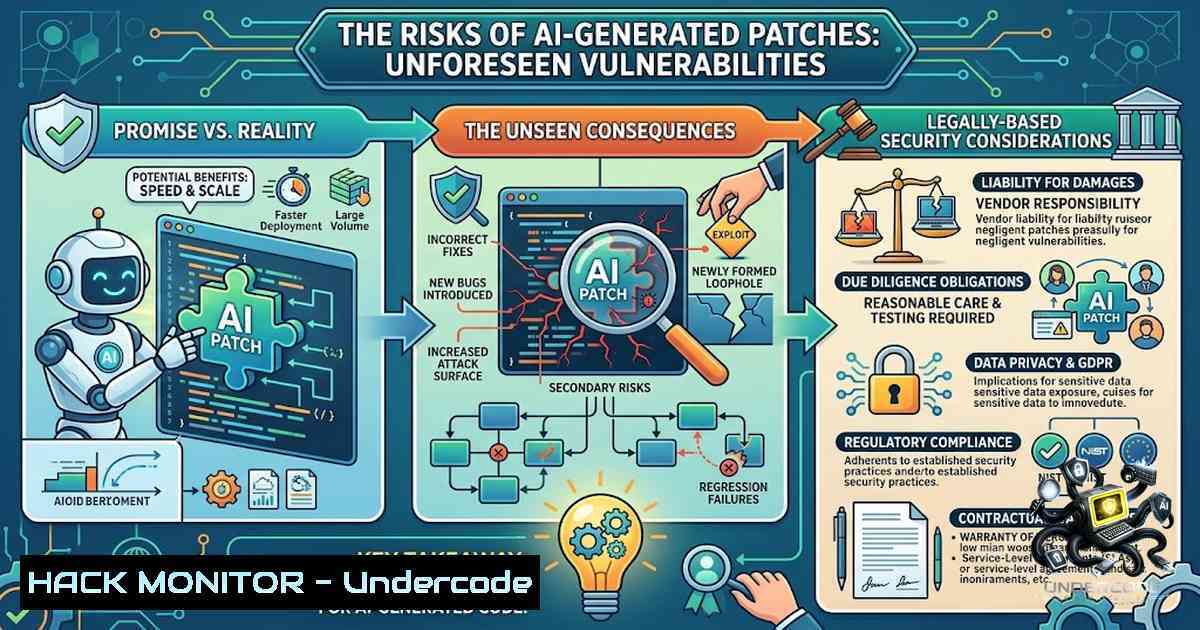
The software industry is rapidly embracing AI agents to find and fix security vulnerabilities at machine speed. However, new research from 1Password’s Off-by-1 Labs and Veracode reveals a troubling reality: when asked to patch serious security flaws, AI systems succeed only about a quarter to half of the time—and frequently introduce brand-1ew security holes in the process. As organizations increasingly let AI write and patch code with minimal human oversight, the security of critical infrastructure in banking, healthcare, and enterprise software hangs in the balance, with some “fixes” leaving systems worse off than before.
Learning Objectives:
- Understand the empirical failure rates of AI-generated security patches across frontier models
- Identify common failure modes including incomplete remediation, behavioral changes, and new vulnerability introduction
- Learn practical validation techniques, including static analysis, dynamic testing, and human review workflows
- Master command-line tools and scripts to evaluate patch quality before deployment
- Develop a risk-based strategy for safely integrating AI into your vulnerability management pipeline
You Should Know:
- The F.L.A.W.E.D. Reality: Only 26% of AI Patches Are Clean
1Password’s Off-by-1 Labs generated 6,080 patches using two frontier models—OpenAI’s ChatGPT 5.5 and Anthropic’s Claude Opus 4.8—against six recently disclosed, high-complexity CVEs. The results were sobering: only 26.0% of patches fully resolved the vulnerability without materially changing application behavior. An additional 20.1% fixed the bug but altered application behavior—for example, changing “allow list” logic to “deny list” logic or rewriting parsers. Critically, 53.9% of patches either failed to remediate the vulnerability, introduced a new vulnerability, or both. Veracode’s parallel research found similar patterns, with an average security “pass rate” of around 56% across frontier models, and 44% of automated fixes introducing detectable OWASP Top 10 vulnerabilities.
Step-by-Step Guide: Validating AI-Generated Patches
Before deploying any AI-generated patch, implement this validation workflow:
- Isolate the patch in a staging environment that mirrors production.
- Run static analysis using tools like Semgrep or SonarQube to catch common vulnerabilities:
Linux/macOS: Run Semgrep on the patched code
semgrep --config=p/owasp-top-ten --config=p/cwe-top-25 /path/to/patched/code
- Execute the original proof-of-concept (PoC) exploit to confirm the patch actually blocks the attack:
Example: Reproduce a PoC for a Linux privilege escalation
./poc_exploit.sh && echo "Vulnerability still present!" || echo "Patch appears effective"
- Run regression tests to ensure no behavioral changes broke existing functionality:
Run your test suite against the patched build
pytest tests/ || npm test || dotnet test
- Perform fuzz testing on the patched code path to catch new memory corruption issues:
Using AFL++ for C/C++ code
afl-fuzz -i input_corpus -o findings ./target_binary @@
- Conduct a mandatory human code review focused on the patch’s logic, not just its syntax. The 1Password team emphasizes that “the expected value of a fully LLM-generated, non-human-reviewed patch is a net-1egative by a considerable margin”.
-
Why AI Patches Fail: Surface-Level Fixes and Root-Cause Blindness
The fundamental problem is that LLMs patch the example, not the bug. When given a reproducer that demonstrates one malicious input, the model fixes that specific code path while leaving identical vulnerabilities in adjacent functions untouched. The 1Password researchers observed that “the models often addressed only a subset of vulnerable code paths, added fragile guard code that satisfied tests while failing to address the vulnerability’s root cause, and sometimes introduced subtle changes in the application’s behavior”. In one case study involving a use-after-free vulnerability in Freenginx, ChatGPT 5.5 generated 270 patch attempts; the reviewer judged 114 to have closed the original hole, but found a new problem in every single one of those 114 attempts.
Step-by-Step Guide: Root-Cause Analysis for Patch Validation
To avoid surface-level fixes, apply this root-cause analysis methodology:
- Map all vulnerable code paths using a call graph analyzer:
Linux: Generate a call graph with cflow
cflow --format=posix /path/to/source.c > call_graph.txt
- Identify the root cause (e.g., missing bounds check, improper input sanitization, race condition) rather than just the symptom.
- Verify the patch addresses all instances of the vulnerability pattern, not just the one in the PoC:
Search for similar patterns across the codebase grep -rn "unsafe_function(" /path/to/source/ --include=".c" - Use dynamic analysis to confirm all exploit paths are closed:
Run Valgrind to detect memory errors after patching
valgrind --leak-check=full ./patched_application
- Compare pre- and post-patch application behavior using a behavioral diffing tool:
Capture API responses before and after
diff before_patch_responses.json after_patch_responses.json
-
The Guidance Paradox: Wrong Advice Hurts More Than No Advice
The research uncovered a critical insight: the quality of initial patching guidance dramatically affects AI success rates. When given correct guidance, the fix-success rate reached 65.0%; with no guidance, it dropped to 50.4%; but with incorrect guidance, it plummeted to just 15.2%. Unlike human developers who can catch misleading information through reasoning, LLMs blindly follow bad advice, producing patches that are functionally incorrect or insecure. This means that organizations using AI for patching must invest in crafting precise, accurate prompts—or risk making vulnerabilities worse.
Step-by-Step Guide: Crafting Effective Patching Prompts
To maximize AI patch quality:
- Provide complete context: Include the vulnerable code snippet, the CVE description, and a clear explanation of the root cause.
- Specify constraints: Explicitly state “Do not change application behavior” and “Fix all instances of this vulnerability pattern.”
- Include test cases: Provide both positive (should pass) and negative (should fail) test cases.
- Request explanation: Ask the model to explain its patch logic before generating code.
- Iterate with feedback: Run the patch through your validation workflow and feed results back to the model for refinement.
4. The Cost Argument: Cheap Patches, Expensive Breaches
AI-generated patches are undeniably cheap—the average successful, clean patch cost just $6.74, including failed attempts. However, this cost-benefit analysis is dangerously incomplete. The 1Password team warns that “the cognitive load imposed by reviewing AI-generated patches may be higher than writing the fix from scratch” in many cases. A patch that looks correct but leaves an exploit path open—or introduces a new one—can lead to a breach costing millions. Organizations must account for the cost of expert supervision, validation tooling, and the risk of false confidence in automated fixes.
Step-by-Step Guide: Cost-Benefit Analysis for AI Patch Adoption
- Calculate your current patching cost: (engineer hours × hourly rate) + (testing infrastructure costs).
- Estimate AI-assisted cost: (API costs) + (validation engineer hours × hourly rate) + (tooling costs).
- Factor in risk: Multiply the probability of a failed patch by the estimated cost of a breach in your environment.
- Run a pilot program: Deploy AI-generated patches in a non-critical environment and measure the validation overhead.
- Establish a kill switch: Define criteria for rejecting AI patches (e.g., “Any patch that introduces a new OWASP Top 10 vulnerability is automatically rejected”).
-
Tooling and Automation: The FLAWED Harness and Beyond
1Password has open-sourced its patch evaluation harness, FLAWED (Fix-Like Artifacts With Embedded Defects), available on GitHub. This tool allows organizations to evaluate the effectiveness of AI-generated security fixes against their own codebases. The harness includes datasets of patch attempts and can be integrated into CI/CD pipelines to automatically reject patches that fail validation criteria.
Step-by-Step Guide: Deploying the FLAWED Harness
1. Clone the repository:
git clone https://github.com/Off-by-1-Labs/FLAWED.git
cd FLAWED
2. Install dependencies:
pip install -r requirements.txt
3. Configure your target vulnerabilities:
 Edit the configuration file to point to your CVEs
vim config/vulnerabilities.yaml
4. Run the harness:
python flawed.py --model gpt-5.5 --cve CVE-2026-31431 --output ./results
5. Review the output: The harness generates a detailed report showing which patches passed, failed, or introduced new issues.
6. Integrate into CI/CD:
 Example GitHub Actions workflow snippet
- name: Validate AI-generated patch
run: python flawed.py --model ${{ inputs.model }} --cve ${{ inputs.cve }} --fail-on-1ew-vuln
For Windows environments, use PowerShell to invoke the harness:
 Windows PowerShell
python flawed.py --model gpt-5.5 --cve CVE-2026-31431 --output .\results
- Cloud and API Security: Hardening AI Patch Pipelines
Organizations deploying AI patching agents in cloud environments must secure the pipeline itself. The AI agent often requires elevated permissions to read source code, run tests, and deploy patches—making it a prime target for attackers. Implement these hardening measures:
Step-by-Step Guide: Securing Your AI Patching Pipeline
1. Use dedicated service accounts with least-privilege permissions:
 AWS: Create a restricted IAM role
aws iam create-role --role-1ame AI-Patcher-Role --assume-role-policy-document file://trust-policy.json
2. Enable detailed audit logging:
 Azure: Enable diagnostic settings for the patching agent
az monitor diagnostic-settings create --1ame AI-Patcher-Logs --resource /subscriptions/... --logs '[{"category": "AuditEvent","enabled": true}]'
3. Isolate the patching environment in a separate VPC or subnet with no outbound internet access except to approved registries.
4. Implement API rate limiting to prevent abuse:
 Using a reverse proxy like NGINX
limit_req_zone $binary_remote_addr zone=mylimit:10m rate=10r/s;
5. Rotate API keys for the AI model provider regularly:
 Example: Rotate OpenAI API key via script
export OPENAI_API_KEY=$(openssl rand -base64 32)
7. The Human-in-the-Loop Imperative
Despite the allure of fully automated patching, the research is unequivocal: AI-generated patches still require expert human review. The 1Password team notes that “manual review makes the point about why that review is expensive”—but also why it is non-1egotiable. Organizations must establish clear review protocols, including:
– Mandatory peer review for all AI-generated patches
– Automated rejection of patches that introduce new vulnerabilities
– Regular training for engineers on AI patch evaluation techniques
– A feedback loop where human reviewers’ corrections are fed back into the model’s training or prompt engineering
Step-by-Step Guide: Building a Human Review Workflow
- Define clear acceptance criteria: The patch must pass all static analysis, dynamic tests, and regression tests.
- Assign a primary reviewer with domain expertise in the affected codebase.
- Use a code review tool (e.g., GitHub Pull Requests, Gerrit) to track changes.
- Document all rejected patches and the reasons for rejection to build an institutional knowledge base.
- Conduct periodic audits of the review process to ensure consistency and quality.
What Undercode Say:
- Key Takeaway 1: AI is currently better at finding vulnerabilities than fixing them. The same models that can discover a zero-day with impressive accuracy often produce patches that are incomplete, behavior-altering, or actively harmful. Organizations should leverage AI for discovery but treat its patches as drafts requiring rigorous validation.
-
Key Takeaway 2: The 26% clean success rate across 6,080 patches is not an indictment of AI’s potential—it’s a call for better tooling, better prompts, and mandatory human oversight. The open-sourcing of the FLAWED harness is a critical step toward building a rigorous patch-validation ecosystem.
Analysis: The 1Password and Veracode studies collectively paint a picture of an AI patching ecosystem that is immature but rapidly evolving. The failure modes are consistent across models and vulnerability types, suggesting fundamental limitations in how LLMs reason about code security. However, the dramatic improvement with correct guidance (65% success) indicates that prompt engineering and context provision are currently the highest-leverage interventions. The release of the FLAWED tooling is a positive development, enabling organizations to systematically evaluate and improve patch quality. The most dangerous outcome, however, is false confidence—believing that an AI patch is correct simply because it passes a few tests. The research demonstrates that patches can pass functional tests while leaving exploit paths open or introducing subtle behavioral changes that break security assumptions. The path forward requires a hybrid approach: AI for speed and scale, humans for judgment and root-cause analysis, and robust tooling to validate every step of the pipeline.
Prediction:
- -1: Organizations that deploy AI-generated patches without rigorous human validation will experience a surge in security incidents over the next 12–18 months. The false confidence in automated fixes will lead to unpatched vulnerabilities and newly introduced flaws being deployed to production, creating an expanded attack surface.
-
-1: The gap between AI vulnerability discovery and remediation will widen, as attackers leverage AI to find flaws faster than defenders can safely patch them. This asymmetry will favor offensive security until patch-validation tooling matures.
-
+1: The open-sourcing of evaluation harnesses like FLAWED will accelerate the development of robust patch-validation pipelines, enabling organizations to systematically measure and improve AI patch quality.
-
+1: Frontier models like Anthropic’s Mythos and OpenAI’s GPT-5.6-Sol, which are already being distributed through Project Glasswing and Project Daybreak, may demonstrate significantly higher cybersecurity capabilities, potentially shifting the success rate above 70%.
-
-1: Regulators will increasingly scrutinize the use of AI in critical infrastructure patching, potentially mandating human review and audit trails for all security fixes in banking, healthcare, and government systems—increasing compliance costs.
-
+1: The integration of AI patching agents with CI/CD pipelines, combined with automated validation tools, will eventually create a virtuous cycle where failed patches are rapidly iterated and improved, leading to higher success rates over time.
▶️ Related Video (84% Match):
https://www.youtube.com/watch?v=1tcir8BPP3M
🎯Let’s Practice For Free:
🎓 Live Courses & Certifications:
Join Undercode Academy for Verified Certifications
🚀 Request a Custom Project:
Secure, high-velocity infrastructure and disruptive technological engineering. Contact our engineering team for high-tier development and proprietary systems:
[email protected]
💎 Smart Architecture | 🛡️ Secure by Design | ⭐ Trusted by Thousands
IT/Security Reporter URL:
Reported By: Ai Generated – Hackers Feeds
Extra Hub: Undercode MoN
Basic Verification: Pass ✅


