Listen to this Post
Introduction:
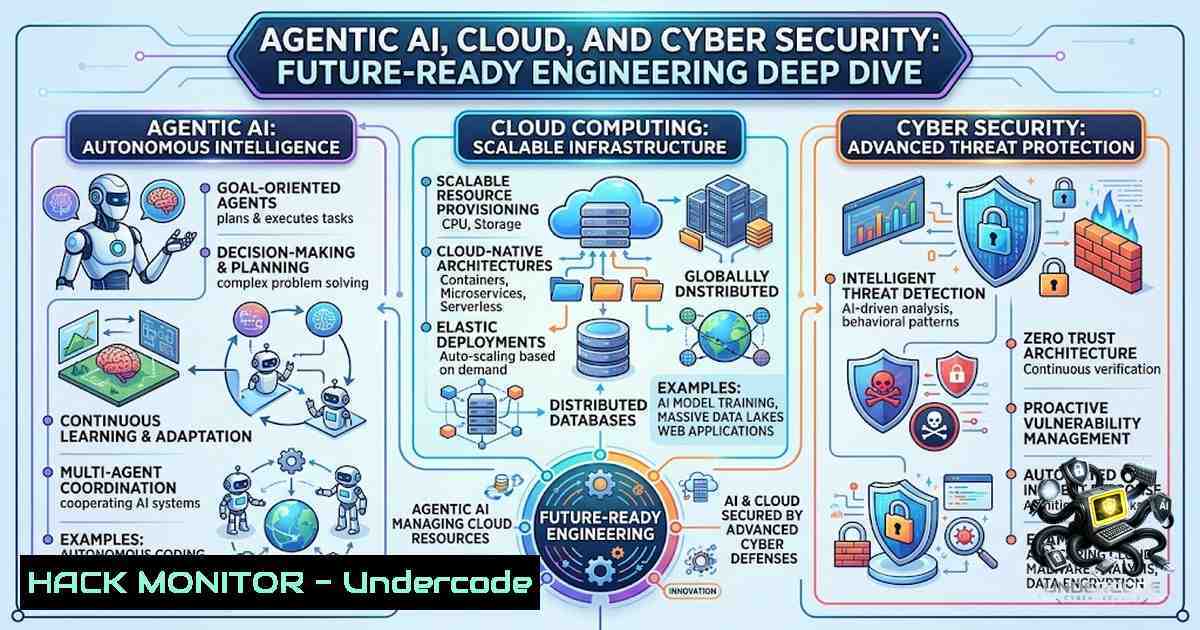
The intersection of Agentic AI, cloud-1ative infrastructure, and zero-trust security models is redefining enterprise technology. As organizations transition from generative AI’s content-creation capabilities to autonomous agentic systems that plan, execute, and adapt, the demand for professionals who can deploy, secure, and manage these workloads at scale has surged. This article examines the core technical pillars of modern AI and cloud engineering—Agentic AI, Generative AI, Cloud Computing, Cyber Security, and AI Forward Deployment—providing actionable commands, configurations, and hardening techniques for engineers preparing for this shift.
Learning Objectives:
- Understand the architectural and operational differences between generative and agentic AI systems, including memory management and tool-calling frameworks.
- Master cloud infrastructure provisioning, identity and access management (IAM), and network segmentation using AWS, Azure, and Linux-based tools.
- Implement cybersecurity controls, including vulnerability scanning, SIEM configuration, and incident response playbooks.
- Apply forward deployment engineering practices to ship AI models securely into production environments.
- Execute hands-on labs covering LLM evaluation, RAG pipeline hardening, and multi-agent orchestration.
You Should Know:
- Agentic AI vs. Generative AI: Architectural Divergence and Tooling
Generative AI produces text, images, or code in response to prompts; it is stateless or session-based and operates in single-turn or few-turn interactions. Agentic AI, by contrast, is an autonomous system that maintains its own memory, tracks intermediate steps, plans multi-step workflows, calls external tools and APIs, and iterates until a goal is achieved. This architectural shift demands new frameworks: LangGraph, CrewAI, and AutoGen are commonly used to build agentic systems.
Step‑by‑step: Building a Simple Agentic Loop with LangGraph (Python)
1. Install LangGraph and dependencies:
pip install langgraph langchain-openai
2. Define a state schema that persists across agent steps:
from typing import TypedDict, Annotated
import operator

class AgentState(TypedDict):
messages: Annotated[list, operator.add]
next_step: str
3. Create a tool‑calling node (e.g., a web search or calculator):
from langchain_community.tools import DuckDuckGoSearchRun
search = DuckDuckGoSearchRun()
4. Build the graph with conditional edges that route based on the agent’s decision:
from langgraph.graph import StateGraph, END

workflow = StateGraph(AgentState)
workflow.add_node("agent", call_model)
workflow.add_node("tool", call_tool)
workflow.add_conditional_edges("agent", should_continue, {"tool": "tool", "end": END})
workflow.set_entry_point("agent")
app = workflow.compile()
5. Invoke the agent with a user query and observe multi‑step reasoning.
For production, secure tool calls by validating arguments, limiting write permissions, and logging every external action—key FDE best practices.
- Cloud Computing: Infrastructure as Code and IAM Hardening
Cloud computing courses (60 hours) typically cover deployment models (IaaS, PaaS, SaaS), virtualization, and hands‑on AWS services like S3 and EC2. However, security misconfigurations remain the leading cause of cloud breaches. Engineers must master Infrastructure as Code (IaC) and least‑privilege IAM.
Step‑by‑step: Securing an AWS S3 Bucket with Terraform and Linux CLI
- Write a Terraform configuration that enforces private ACLs and blocks public access:
resource "aws_s3_bucket" "secure_bucket" {
bucket = "my-secure-bucket-${var.environment}"
acl = "private"
}</li>
</ol>

resource "aws_s3_bucket_public_access_block" "block_public" {
bucket = aws_s3_bucket.secure_bucket.id
block_public_acls = true
block_public_policy = true
ignore_public_acls = true
restrict_public_buckets = true
}
2. Apply the policy using the AWS CLI:
aws s3api put-bucket-policy --bucket my-secure-bucket --policy file://policy.json
3. Enable server‑side encryption (SSE‑S3 or KMS) and versioning:
aws s3api put-bucket-encryption --bucket my-secure-bucket --server-side-encryption-configuration '{"Rules":[{"ApplyServerSideEncryptionByDefault":{"SSEAlgorithm":"AES256"}}]}'
aws s3api put-bucket-versioning --bucket my-secure-bucket --versioning-configuration Status=Enabled
4. Enforce IAM roles with least privilege; never use root credentials. Example IAM policy restricting access to a specific bucket:
{
"Version": "2012-10-17",
"Statement": [
{
"Effect": "Allow",
"Action": ["s3:GetObject", "s3:PutObject"],
"Resource": "arn:aws:s3:::my-secure-bucket/"
}
]
}
5. Audit access using AWS CloudTrail and S3 server access logging. On Linux, monitor with:
aws cloudtrail lookup-events --lookup-attributes AttributeKey=ResourceName,AttributeValue=my-secure-bucket
- Cyber Security: Vulnerability Assessment, SIEM, and Incident Response
A 60‑hour cyber security curriculum should include threat identification, vulnerability assessment, penetration testing, and digital forensics. In practice, security engineers must operationalize continuous monitoring and rapid containment.
Step‑by‑step: Setting Up a Basic SIEM Pipeline with Elastic Stack (Linux)
- Install Elasticsearch, Logstash, and Kibana (ELK Stack) on an Ubuntu server:
wget -qO - https://artifacts.elastic.co/GPG-KEY-elasticsearch | sudo apt-key add -
sudo apt-get install apt-transport-https
echo "deb https://artifacts.elastic.co/packages/7.x/apt stable main" | sudo tee /etc/apt/sources.list.d/elastic-7.x.list
sudo apt-get update && sudo apt-get install elasticsearch logstash kibana
- Configure Logstash to ingest Windows Event Logs (via Winlogbeat) and Linux syslogs:
input { beats { port => 5044 } } filter { if [bash][module] == "system" { grok { match => { "message" => "%{SYSLOGTIMESTAMP:timestamp} %{SYSLOGHOST:hostname} %{DATA:program}: %{GREEDYDATA:msg}" } } } } output { elasticsearch { hosts => ["localhost:9200"] } } - Deploy Winlogbeat on Windows to forward security logs:
.\winlogbeat.exe setup -e
.\winlogbeat.exe -e -c winlogbeat.yml
- Create detection rules in Kibana for suspicious activities (e.g., multiple failed logins, privilege escalation).
5. Establish an incident response playbook:
- Contain: Isolate affected instances using cloud provider security groups or `iptables` on Linux:
iptables -A INPUT -s <malicious_IP> -j DROP
- Eradicate: Remove persistence mechanisms (cron jobs, scheduled tasks) and patch vulnerabilities.
- Recover: Restore from clean backups and validate integrity.
- Generative AI: Model Fine‑Tuning, RAG, and Prompt Hardening
Generative AI courses cover transformers, diffusion models, VAEs, and GANs, along with fine‑tuning and RAG. From a security perspective, prompt injection and data leakage are critical risks. Engineers must implement input validation, output filtering, and retrieval sanitization.
Step‑by‑step: Building a Secure RAG Pipeline with LlamaIndex
1. Install LlamaIndex and an embedding model:
pip install llama-index chromadb
2. Load and chunk documents, then create a vector index:
from llama_index import SimpleDirectoryReader, VectorStoreIndex
documents = SimpleDirectoryReader("./data").load_data()
index = VectorStoreIndex.from_documents(documents)
3. Harden the retriever by sanitizing retrieved chunks—strip any executable content or control characters:
import re
def sanitize(text):
return re.sub(r'[^\w\s.,!?-]', '', text)
4. Implement a guardrail that rejects prompts containing system‑level instructions (e.g., “ignore previous instructions”):
def prompt_guardrail(query):
forbidden = ["ignore", "override", "system prompt"]
if any(word in query.lower() for word in forbidden):
raise ValueError("Prompt rejected: potential injection attempt")
5. Fine‑tune a model using Hugging Face’s PEFT library for domain adaptation, and evaluate using metrics like BLEU and ROUGE. On Windows, use WSL2 for GPU acceleration:
wsl --install -d Ubuntu
5. AI Forward Deployment Engineering: Productionizing AI Systems
Forward Deployed Engineering (FDE) bridges AI engineering, customer collaboration, and production implementation. FDEs deploy AI agents in customer environments, handle schema drift, API rate limits, and partial data failures. Core practices include least‑privilege access, scoped credentials, tool allowlists, secrets isolation, and data loss prevention.
Step‑by‑step: Deploying an AI Agent as a Microservice with Docker and Kubernetes
1. Containerize the agent using a Dockerfile:
FROM python:3.10-slim
WORKDIR /app
COPY requirements.txt .
RUN pip install --1o-cache-dir -r requirements.txt
COPY . .
CMD ["uvicorn", "main:app", "--host", "0.0.0.0", "--port", "8000"]
2. Build and push the image to a private registry (e.g., Amazon ECR):
docker build -t my-agent:latest .
aws ecr get-login-password --region us-east-1 | docker login --username AWS --password-stdin <account-id>.dkr.ecr.us-east-1.amazonaws.com
docker tag my-agent:latest <account-id>.dkr.ecr.us-east-1.amazonaws.com/my-agent:latest
docker push <account-id>.dkr.ecr.us-east-1.amazonaws.com/my-agent:latest
3. Write a Kubernetes deployment with resource limits, liveness probes, and secret management:
apiVersion: apps/v1
kind: Deployment
metadata:
name: agent-deployment
spec:
replicas: 3
selector:
matchLabels:
app: agent
template:
metadata:
labels:
app: agent
spec:
containers:
- name: agent
image: <account-id>.dkr.ecr.us-east-1.amazonaws.com/my-agent:latest
ports:
- containerPort: 8000
env:
- name: OPENAI_API_KEY
valueFrom:
secretKeyRef:
name: api-secrets
key: openai-key
resources:
limits:
memory: "512Mi"
cpu: "500m"
4. Implement observability with Prometheus and Grafana to monitor latency, error rates, and token usage.
5. Establish a CI/CD pipeline (GitHub Actions or Jenkins) that runs security scans (Trivy, Snyk) before deployment.- Cloud and API Security: Hardening Endpoints and Secrets Management
APIs are the primary attack surface for AI and cloud services. Implement OAuth2/OIDC, rate limiting, and input validation. Use HashiCorp Vault or AWS Secrets Manager to store credentials.
Step‑by‑step: Securing a REST API with OAuth2 and Rate Limiting (Python/FastAPI)
1. Install FastAPI and dependencies:
pip install fastapi uvicorn python-multipart httpx
2. Implement OAuth2 password flow with JWT tokens:
from fastapi import FastAPI, Depends, HTTPException
from fastapi.security import OAuth2PasswordBearer
oauth2_scheme = OAuth2PasswordBearer(tokenUrl="token")
3. Add rate limiting using `slowapi`:
from slowapi import Limiter, _rate_limit_exceeded_handler
from slowapi.util import get_remote_address
limiter = Limiter(key_func=get_remote_address)
app.state.limiter = limiter
app.add_exception_handler(RateLimitExceeded, _rate_limit_exceeded_handler)
@app.get("/secure")
@limiter.limit("5/minute")
async def secure_endpoint(token: str = Depends(oauth2_scheme)):
return {"status": "authenticated"}
4. Validate all inputs using Pydantic models to prevent injection attacks.
5. Enable HTTPS with Let’s Encrypt on Linux:
sudo certbot --1ginx -d yourdomain.com
7. Linux and Windows Commands for Security Auditing
- Linux: Check open ports (
ss -tulpn), list running services (systemctl list-units), audit file permissions (find / -perm -4000 -type f 2>/dev/null), and monitor logs (journalctl -xe). - Windows: Use
Get-Service,Get-Process,Get-WinEvent -LogName Security, and `Test-1etConnection` for network diagnostics. - Cross‑platform: Use `nmap` for network scanning, `curl` for API testing, and `openssl` for certificate validation.
What Undercode Say:
- Key Takeaway 1: Agentic AI is not just an evolution of generative AI—it is a paradigm shift that requires new architectures (memory, planning, tool‑calling) and new security models (least‑privilege tool access, audit trails). Engineers must master frameworks like LangGraph and AutoGen to build autonomous systems that are both capable and containable.
- Key Takeaway 2: Cloud security and cyber defense are inseparable from AI deployment. Misconfigured S3 buckets, overly permissive IAM roles, and unpatched vulnerabilities remain the top entry points for breaches. Integrating IaC, SIEM, and incident response into the development lifecycle is non‑negotiable.
Analysis: The convergence of AI, cloud, and security is creating a new breed of engineer—the Forward Deployed Engineer—who must be equally comfortable with Python, Terraform, Kubernetes, and threat modeling. The 40‑ to 60‑hour course structures offered by Sankhyana reflect this reality, but true mastery requires hands‑on labs, real‑world case studies, and continuous upskilling. Organizations that invest in cross‑functional training will outpace competitors in both innovation and resilience.
Prediction:
- +1: The demand for Forward Deployed Engineers will grow exponentially over the next three years, with salaries outpacing traditional software engineering roles as enterprises race to productionize AI.
- +1: Agentic AI will automate up to 40% of routine security operations (alert triage, log analysis, patch verification), freeing human analysts for strategic threat hunting.
- -1: The complexity of securing multi‑agent systems will introduce new attack vectors—prompt injection, tool misuse, and data poisoning—that current security frameworks are ill‑equipped to handle.
- -1: Without standardized governance and auditing for agentic systems, organizations risk regulatory non‑compliance and reputational damage from autonomous actions taken outside human oversight.
- +1: Cloud providers will embed agentic AI capabilities directly into their security and operations consoles, reducing the barrier to entry for small and medium businesses.
- -1: The skill gap in AI security and deployment will widen, leading to a talent war that favors large tech firms and leaves traditional enterprises struggling to recruit and retain qualified engineers.
▶️ Related Video (82% Match):
🎯Let’s Practice For Free:
🎓 Live Courses & Certifications:
Join Undercode Academy for Verified Certifications
🚀 Request a Custom Project:
Secure, high-velocity infrastructure and disruptive technological engineering. Contact our engineering team for high-tier development and proprietary systems:
[email protected]
💎 Smart Architecture | 🛡️ Secure by Design | ⭐ Trusted by ThousandsIT/Security Reporter URL:
Reported By: Sankhyana Freedemosession – Hackers Feeds
Extra Hub: Undercode MoN
Basic Verification: Pass ✅🔐JOIN OUR CYBER WORLD [ CVE News • HackMonitor • UndercodeNews ]
📢 Follow UndercodeTesting & Stay Tuned:


